
Cleopatra facts for kids
Quick facts for kids Cleopatra VII Philopator |
|||||
|---|---|---|---|---|---|

Bust believed to be of Cleopatra VII, Altes Museum, Berlin
|
|||||
| Queen of Ptolemaic Kingdom | |||||
| Reign | 51 – 12 August 30 BC (21 years) | ||||
| Predecessor | Ptolemy XII Auletes | ||||
| Successor | Ptolemy XV Caesarion | ||||
| Co-rulers | Ptolemy XII Auletes Ptolemy XIII Theos Philopator Ptolemy XIV Ptolemy XV Caesarion |
||||
| Born | 69 BC Alexandria, Ptolemaic Kingdom |
||||
| Died | 12 August 30 BC (aged 39) Alexandria, Egypt |
||||
| Burial | Unknown (probably in Egypt) | ||||
| Spouse | Ptolemy XIII Theos Philopator Ptolemy XIV Mark Antony |
||||
| Issue | Caesarion, Ptolemy XV Philopator Philometor Caesar Alexander Helios Cleopatra Selene, Queen of Mauretania Ptolemy XVI Philadelphus |
||||
|
|||||
| Dynasty | Ptolemaic | ||||
| Father | Ptolemy XII Auletes | ||||
| Mother | Cleopatra V of Egypt (presumably) | ||||
Cleopatra, whose full name was Cleopatra VII Thea Philopator, was a famous queen of Egypt. She lived from 69 BC to 12 August 30 BC. Cleopatra was the very last ruler from the Ptolemaic family, who were originally from Macedonia. This family had ruled Egypt for a long time after Alexander the Great conquered it. After Cleopatra's death, Egypt became a part of the Roman Empire.
Contents
Early life
.jpg)
Cleopatra was born in 69 BC in Alexandria, which was the capital city of Egypt back then. She was the daughter of King Ptolemy XII Auletes. When her father passed away in 51 BC, she became queen, ruling alongside her younger brother, Ptolemy XIII. He was only 12, so Cleopatra was the main leader.
Being a queen wasn't easy! Cleopatra faced many challenges, including a famine caused by low Nile floods and disagreements with her brother and his advisors. These disagreements eventually led to a civil war, and Cleopatra had to flee Alexandria to gather her own army.
Powerful Alliances

At this time, the Roman Republic was a huge and powerful force in the world, and its leaders often got involved in the affairs of other kingdoms, including Egypt. Cleopatra knew that to protect her kingdom, she needed strong allies.
Julius Caesar: The First Alliance
When: Around 48 BC.
How they met: A famous story says Cleopatra had herself secretly brought to Julius Caesar, the powerful Roman dictator, rolled up in a carpet or a bed sack! She wanted to meet him personally to convince him to support her.
Their Connection: Caesar was impressed by Cleopatra's intelligence and charm. Egypt was very important to Rome because it produced a lot of bread and food. Caesar helped Cleopatra settle the dispute with her brother, and she became the sole ruler of Egypt, with her younger brother Ptolemy XIV as a co-ruler.
Their Son: Cleopatra and Caesar had a son named Caesarion, which means "little Caesar."
Cleopatra even visited Rome with her brother and son, where she was treated like an important guest. She helped Caesar with his new calendar, which we still use parts of today! After Caesar was sadly assassinated in 44 BC, Cleopatra returned to Egypt. Her brother Ptolemy XIV died, and she made Caesarion her co-ruler, hoping he would one day follow in his famous father's footsteps.
Mark Antony: The Second Alliance
When: Around 41 BC.
Who was he? Mark Antony was another powerful Roman general and one of the leaders who took charge after Caesar's death.
Their Meeting: Cleopatra met Antony in Tarsos (modern-day Turkey). She arrived in a magnificent ship with purple sails, dressed as the goddess Aphrodite, making a grand entrance!
Their Alliance: Cleopatra and Antony formed a strong alliance. She provided him with money and military help for his campaigns, and in return, he helped her expand Egypt's territories, bringing back lands that once belonged to her ancestors.
Their Children: They had three children together: twins named Alexander Helios (meaning "Sun") and Cleopatra Selene II (meaning "Moon"), and another son named Ptolemy Philadelphus. These names showed their big hopes for a new, bright future!
Cleopatra's Rule and Kingdom

Following the traditions of Macedonian rulers, Cleopatra ruled Egypt and other lands like Cyprus as an absolute monarch. This meant she was the only person who made laws for her kingdom. She was also the most important religious leader, overseeing ceremonies for both Egyptian and Greek gods.
Cleopatra made sure new temples were built for Egyptian and Greek gods. She also built a place of worship for the Jews in Egypt and even a temple dedicated to Julius Caesar. Cleopatra was very involved in running her kingdom. For example, during a drought early in her rule, she ordered royal food storage places to give food to people who were starving.
Her government tried to control prices, taxes on goods, and even had state-owned businesses for certain products. They also set fixed exchange rates for foreign money. Farmers were even required to stay in their villages during planting and harvesting times. Because of money problems, Cleopatra made her coins less valuable by using less precious metal in them.
Growing Tensions


Antony and Cleopatra made some big announcements in 34 BC, known as the "Donations of Alexandria." They declared their children as rulers over various territories, including parts of Armenia, Media, Parthia, Syria, and Cyrene. Cleopatra was even called the "Queen of Kings," and Caesarion the "King of Kings."
Why was this a problem?
This made another Roman leader, Octavian (Julius Caesar's adopted son and Antony's rival), very angry. He saw it as Antony giving away Roman lands to a foreign queen and trying to create a new empire with Cleopatra, which was against Roman traditions. Octavian used this to turn the Roman people against Antony and Cleopatra.
The Battle of Actium: A Turning Point
The rivalry between Octavian and Antony eventually led to a huge war.
When: 31 BC.
Where: Off the coast of Actium, Greece.
What happened: It was a massive naval battle. Cleopatra commanded 60 of her own ships. During the battle, Cleopatra and Antony made a strategic decision to break through Octavian's blockade and sail back to Egypt, hoping to regroup and defend their homeland.
The Outcome: Octavian won the Battle of Actium. This victory greatly weakened Antony and Cleopatra's forces and their position.
Cleopatra's Death
Octavian pursued Antony and Cleopatra to Egypt. As Octavian's forces closed in on Alexandria in 30 BC, Antony, believing Cleopatra had ended her life, chose to end his own.
Cleopatra, determined not to be captured and paraded as a prisoner in a Roman victory celebration (which was a common, humiliating practice for defeated enemies), chose to end her own life. The exact way she did this is a bit of a mystery, but a popular story says she used a venomous snake, like an asp or cobra, to bite her. In 2010, a German historian named Christoph Schaefer suggested a different idea. After studying old texts and talking to experts on poisons, he believed Cleopatra might have died from drinking a mix of poisons. He argued that an asp's venom would cause a slow and painful death, starting with paralysis. Cleopatra, being very knowledgeable, would likely have known this. So, he thought it was unlikely she would choose such a painful way to die.
Cleopatra was 39 years old when she died.
Octavian had Caesarion killed. Cleopatra's other children were taken to Rome as prisoners. Two of them died from illness. However, her daughter, Cleopatra Selene II, later married an African king named Juba II of Numidia. Octavian sent them to rule in Mauritania, where they lived a full life and had their own children.
With Cleopatra's death, the Ptolemaic Kingdom of Egypt came to an end, and Egypt became a province of the Roman Empire. This marked the end of the Hellenistic period, a time when Greek culture was very influential across the Mediterranean.
Interesting facts about Cleopatra
- Many stories are told about how rich Cleopatra was. For example, some say she bathed in milk to make her skin soft.
- Another story claims she made a bet with Antony that she could create the most expensive meal ever. To win, she supposedly dissolved a pearl earring in vinegar and drank it!
- Cleopatra was the only Ptolemaic ruler known to have learned the ancient Egyptian language! This was a huge deal because it showed she respected and connected with the people she ruled.
- She could also speak many other languages, including Ethiopian, Hebrew, Arabic, and possibly Latin.
- She was the only Ptolemaic queen to issue coins with her own image on them, showing her unique power.
- Cleopatra's unique hairstyle, where her hair was braided back into a bun, became very fashionable among Roman women after she visited Rome!
- Julius Caesar was so impressed by Cleopatra that he had a golden statue of her placed in a Roman temple dedicated to the goddess Venus. This was a huge honor, as it was the first time a living person had their statue next to a god in a Roman temple!
- Cleopatra has appeared in countless books, plays, movies, and even songs! From Shakespeare's famous play "Antony and Cleopatra" to Hollywood films starring actresses like Elizabeth Taylor, her image as a powerful, intelligent, and captivating queen continues to inspire stories and art around the world.
Related pages
See also
 In Spanish: Cleopatra para niños
Images for kids
-
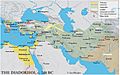
Hellenistic Kingdoms that emerged after the death of Alexander the Great
-
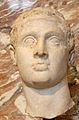
Hellenistic portrait of Ptolemy XII Auletes, the father of Cleopatra, located in the Louvre, Paris
-
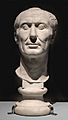
The Tusculum portrait, a contemporary Roman sculpture of Julius Caesar located in the Archaeological Museum of Turin, Italy
-
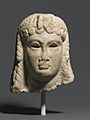
Egyptian portrait of a Ptolemaic queen, possibly Cleopatra, c. 51–30 BC, located in the Brooklyn Museum
-
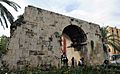
Cleopatra's Gate in Tarsos (now Tarsus, Mersin, Turkey), the site where she met Mark Antony in 41 BC
-
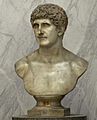
A Roman marble bust of the consul and triumvir Mark Antony, late 1st century AD, Vatican Museums
-
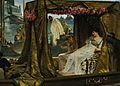
The Meeting of Antony and Cleopatra (1885), by Lawrence Alma-Tadema
-
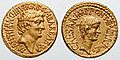
Roman aureus bearing the portraits of Mark Antony (left) and Octavian (right), issued in 41 BC to celebrate the establishment of the Second Triumvirate by Octavian, Antony and Marcus Aemilius Lepidus in 43 BC
-
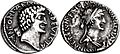
A denarius minted by Antony in 34 BC with his portrait on the obverse, which bears the inscription reading "ANTONIVS ARMENIA DEVICTA", alluding to his Armenian campaign. The reverse features Cleopatra, with the inscription "CLEOPATR[AE] REGINAE REGVM FILIORVM REGVM". The mention of her children on the reverse refers to the Donations of Alexandria.
-
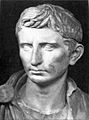
A reconstructed statue of Augustus as a younger Octavian, dated c. 30 BC
-
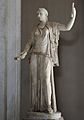
A restructured marble Roman statue of Cleopatra wearing a diadem and 'melon' hairstyle similar to coinage portraits, found along the Via Cassia near the Tomba di Nerone, Rome, and now located in the Museo Pio-Clementino
-
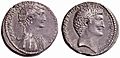
Cleopatra and Mark Antony on the obverse and reverse, respectively, of a silver tetradrachm struck at the Antioch mint in 36 BC, with Greek legends: BACIΛΙCCA KΛΕΟΠΑΤΡΑ ΘΕΑ ΝΕΩΤΕΡΑ, ANTΩNIOC AYTOKPATΩP TPITON TPIΩN ANΔPΩN.
-
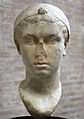
Cleopatra, mid-1st century BC, with a "melon" hairstyle and Hellenistic royal diadem worn over her head, now in the Vatican Museums
-
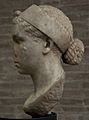
Profile view of the Vatican Cleopatra
-
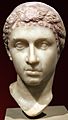
Cleopatra, mid-1st century BC, showing Cleopatra with a "melon" hairstyle and Hellenistic royal diadem worn over the head, now in the Altes Museum
-
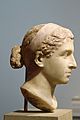
Profile view of the Berlin Cleopatra
-
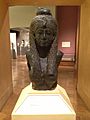
A granite Egyptian bust of Cleopatra from the Royal Ontario Museum, mid-1st century BC
-
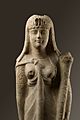
A marble statue of Cleopatra with her cartouche inscribed on the upper right arm and wearing a diadem with a triple uraeus, from the Metropolitan Museum of Art
-
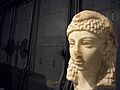
Possible sculpted head of Cleopatra VII wearing an Egyptian-style vulture headdress, discovered in Rome, either Roman or Hellenistic Egyptian art, Parian marble, 1st century BC, from the Capitoline Museums


.jpg)
.jpg)
,_50-30_B.C.E.,_71.12.jpg)


.jpg)


