
Ice age facts for kids

An ice age is a long period when Earth gets much colder. During an ice age, huge sheets of ice, called glaciers, grow and cover large parts of the continents and poles. This happens because the temperature of Earth's surface and air drops significantly.
Our planet's climate changes between "icehouse" times (when there's a lot of ice) and "greenhouse" times (when there's little to no ice). For most of Earth's history, it was a "greenhouse" world.
Right now, Earth is in a very long "icehouse" period called the Late Cenozoic Ice Age. This started about 34 million years ago. Within this long ice age, there are colder times called glacial periods and warmer times called interglacial periods. We are currently in a warm interglacial period called the Holocene, which began about 11,700 years ago. The last very cold time, the Last Glacial Period, ended around then.
Contents
Discovering Past Ice Ages
For a long time, people wondered about strange rocks found far from their original mountains. In the 1700s, people living in the Alps mountains noticed that glaciers could move huge boulders. They thought that glaciers must have been much bigger in the past.
Later, in the early 1800s, scientists like James Hutton and Jens Esmark started to think about this more deeply. Esmark even suggested that Earth had gone through several worldwide ice ages. He believed changes in Earth's orbit caused these cold periods.
A German botanist, Karl Friedrich Schimper, and a Swiss scientist, Louis Agassiz, worked together. In 1837, Schimper actually created the term "ice age" ("Eiszeit") to describe these times of widespread ice. Agassiz then shared this new theory with other scientists. At first, many scientists were doubtful. But after more research and fieldwork, the idea of past ice ages became widely accepted by the late 1800s.
How Do We Know About Ice Ages?
Scientists use several clues to learn about past ice ages. These clues come from geology, chemistry, and fossils.
Looking at Rocks and Landforms
The most direct clues are found in the land itself. When huge glaciers move, they scrape and carve the land. They leave behind unique features like:
- Scratches on rocks
- Piles of rock and dirt called glacial moraines
- Oval-shaped hills called drumlins
- Deep valleys
- Huge boulders, called glacial erratics, dropped far from their origin.
These landforms show us where glaciers once were. However, new glaciers can erase the evidence of older ones, making it tricky to study very ancient ice ages.
Clues from Chemistry
Scientists also study tiny chemical clues found in sedimentary rocks and ocean sediment cores. They look at different types of isotopes (versions of atoms) in ancient fossils. These isotopes can tell us about past temperatures.
For more recent ice ages, scientists drill deep into ice sheets to get ice cores. These cores contain layers of ice and tiny bubbles of ancient air. By studying these, we can learn about past temperatures and even the amount of carbon dioxide in the air long ago.
Fossils Tell a Story
Fossils also provide important evidence. During cold periods, animals and plants that like cold weather spread to new areas. Those that prefer warmth either move to warmer places or die out. By looking at where different fossils are found, scientists can figure out how cold or warm it was in the past.
Combining all these clues helps scientists create a clear picture of Earth's climate history.
Earth's Big Ice Ages Through Time
Earth has experienced at least five major ice ages throughout its long history. Between these cold periods, the planet was much warmer, with little to no permanent ice.

The Huronian Ice Age: Early Earth's Chill
The earliest known ice age, the Huronian, happened about 2.4 to 2.1 billion years ago. Evidence for it is found in rocks near Lake Huron in Canada and Michigan. This ice age likely occurred because a lot of atmospheric methane, a powerful greenhouse gas, disappeared from the air during the Great Oxygenation Event.
Snowball Earth: A Frozen Planet
The Cryogenian period, from 720 to 630 million years ago, saw perhaps the most extreme ice age. It's called "Snowball Earth" because glaciers might have covered the entire planet, even reaching the equator! Scientists think volcanoes eventually released enough CO2 to warm Earth and melt the ice.
The Andean-Saharan Ice Age
This ice age took place about 460 to 420 million years ago, during the Late Ordovician and Silurian periods.
The Late Paleozoic Ice Age
From about 360 to 260 million years ago, Earth experienced another major cold spell. This was partly due to the rise of land plants, which helped reduce CO2 levels in the atmosphere. Large ice caps formed in what is now South Africa and Argentina, which were then part of the supercontinent Gondwanaland.
The Quaternary Ice Age: Our Current Chill
The Quaternary Ice Age began about 2.58 million years ago. This is the ice age we are still in today! Since then, Earth has gone through many cycles of glaciers growing (glacial periods) and shrinking (interglacial periods). The last glacial period ended about 11,700 years ago. Today, only the Greenland and Antarctic ice sheets remain of the huge continental ice sheets.

Warm and Cold Cycles: Glacials and Interglacials
Within a major ice age, Earth's climate doesn't stay the same. It cycles between colder times, called glacial periods, and warmer times, called interglacial periods. We are currently in an interglacial period called the Holocene.

During glacial periods, the climate is cooler and drier. Huge ice sheets expand from the poles, and mountain glaciers grow larger. Sea levels drop because so much water is locked up in ice. These cycles are linked to small, regular changes in Earth's orbit and tilt, known as Milankovitch cycles.
Why Do Ice Ages Happen?
Scientists believe several factors work together to cause ice ages and their cycles.
Earth's Atmosphere and Greenhouse Gases
The amount of greenhouse gases like carbon dioxide (CO2) and methane in the atmosphere plays a big role. When these gases decrease, Earth cools. When they increase, Earth warms. For example, the "Snowball Earth" period might have ended when volcanoes released a lot of CO2.
Continents on the Move
The slow movement of tectonic plates also affects climate. Ice ages often start when continents move into positions that block warm ocean currents from reaching the poles. This allows ice sheets to form and grow. For instance, Antarctica sits over the South Pole today, and the Arctic Ocean is almost surrounded by land.
Ocean Currents Change
Ocean currents act like giant conveyor belts, moving heat around the planet. Changes in the position of continents or sea levels can alter these currents. For example, the closing of the Isthmus of Panama about 3 million years ago might have helped start the current ice age in North America.
Mountains and Climate
Some scientists think that the rise of huge mountain ranges, like the Himalayas, contributed to the current ice age. These mountains can increase rainfall, which helps remove CO2 from the atmosphere, leading to a cooler climate.
Earth's Wobble and Tilt: Milankovitch Cycles

Milankovitch cycles describe how Earth's orbit around the Sun changes over thousands of years. These changes include:
- The shape of Earth's orbit (how elliptical it is).
- The tilt of Earth's axis (how much it leans).
- The wobble of Earth's axis (like a spinning top).
These cycles affect how much sunlight Earth receives, especially at the poles. When summers become too cool to melt all the winter snow, ice sheets can start to grow.
The Sun's Energy
The Sun's energy output can also vary. Over billions of years, the Sun slowly gets brighter. There are also shorter-term changes, like sunspot cycles, which can cause slight variations in Earth's temperature.
Volcanoes and Climate
Volcanic eruptions can impact climate. Large eruptions can release ash and gases that block sunlight, causing cooling. However, volcanoes also release CO2, which can lead to warming over longer periods.
Ice Ages in North America
The most recent major glaciation in North America was the Wisconsin glaciation. It happened during the latter part of the Last Glacial Maximum, between 26,000 and 13,300 years ago. During this time, ice sheets up to 3 to 4 kilometers (about 2 miles) thick covered much of Canada and extended down to about the 45th parallel in the United States.

These massive glaciers dramatically changed the North American landscape. They carved out the Great Lakes and the Finger Lakes in New York. Many lakes in Minnesota and Wisconsin were also formed by glaciers. The ice sheets also diverted rivers and created features like Niagara Falls. Areas like Long Island and Nantucket, Massachusetts were formed from glacial debris.
How Glaciers Shaped Our World
Even though the last glacial period ended thousands of years ago, its effects are still visible today.
- Landforms: Glaciers left behind many unique landforms, including fjords (deep, narrow inlets of the sea), kettle lakes (lakes formed in depressions left by melting ice blocks), and erratic boulders.
- Sea Level Changes: During glacial periods, so much water was frozen in ice sheets that global sea levels dropped by about 110 meters (360 feet). This exposed continental shelfs and created land bridges, allowing animals and early humans to migrate. When the ice melted, sea levels rose again.
- Earth's Crust: The immense weight of the ice sheets pressed down on Earth's crust. After the ice melted, the land slowly started to rise back up, a process called Post-glacial rebound. This rebound is still happening today in places like Scandinavia and the Great Lakes region.
- Earthquakes: The removal of the ice's weight can also trigger earthquakes as the land adjusts.
- Baltic Sea: In Europe, the Baltic Sea was formed by glacial erosion and the sinking of land under the ice's weight. Before the ice age, this area was dry land with a large river.
What About Future Ice Ages?
Based on past patterns, some scientists in the 1970s thought another ice age might be coming soon. However, current research suggests that human activities, especially the release of carbon dioxide into the atmosphere, are likely to delay the next glacial period significantly.
Scientists now predict that a new glaciation is unlikely to happen for at least another 50,000 years. This is because the amount of CO2 humans have added to the atmosphere is so high that it will likely outweigh the natural orbital changes that would normally trigger the next ice age.
Images for kids
-
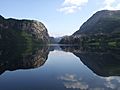
Haukalivatnet lake (50 meters — 164 feet — above sea level) where Jens Esmark in 1823 discovered similarities to moraines near existing glaciers in the high mountains
-
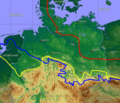
Ice age map of northern Germany and its northern neighbours. Red: maximum limit of Weichselian glacial; yellow: Saale glacial at maximum (Drenthe stage); blue: Elster glacial maximum glaciation.
-
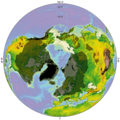
Minimum (interglacial, black) and maximum (glacial, grey) glaciation of the northern hemisphere
-
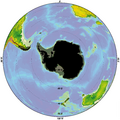
Minimum (interglacial, black) and maximum (glacial, grey) glaciation of the southern hemisphere
-

Diagram of key climate-carbon cycle feedbacks linking Quaternary climates and temperatures, Generalized Milankovitch Theory (GMT), to atmospheric CO2 and ice sheets. Positive feedbacks amplify and negative feedbacks dampen environmental change, with slow-acting responses shown as dashed arrows.
-
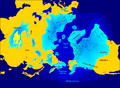
Northern hemisphere glaciation during the last ice ages. The setup of 3 to 4 kilometer thick ice sheets caused a sea level lowering of about 120 m.
-
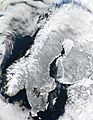
Scandinavia exhibits some of the typical effects of ice age glaciation such as fjords and lakes.


See also
 In Spanish: Glaciación para niños
- Geologic temperature record
- Global cooling
- International Union for Quaternary Research
- Irish Sea Glacier
- Last Glacial Maximum
- List of Ice Age species preserved as permafrost mummies
- Little Ice Age
- Post-glacial rebound
- Timeline of glaciation
