
Roller coaster facts for kids

A roller coaster is an exciting amusement ride that uses a special elevated track. Passengers ride in connected cars, called a train, through twists, steep drops, and other fun elements. Most roller coasters are designed to give riders a thrilling experience. The tracks are usually a complete loop, meaning the train starts and ends at the same station. You can find these rides in amusement parks, shopping malls, and even zoos around the world. As of October 2025, there are about 6,000 roller coasters in operation globally.
The very first ideas for roller coasters came from "Russian Mountains" in the 1600s. These were large ice slides. Later, in 1885, LaMarcus Adna Thompson received one of the first patents for a track-based roller coaster. This was based on his Switchback Railway at Coney Island. Today, most roller coasters are made of steel. Steel tracks allow for faster speeds, more intense forces, and even going upside down!
Contents
The Exciting History of Roller Coasters
From Ice Slides to Wheeled Wonders
The earliest roller coasters began as "Russian Mountains" in the 1600s. These were huge ice slides built in what is now Saint Petersburg, Russia. They were often 70 to 80 feet tall and had steep 50-degree drops. People would slide down them on sleds! Later, in 1784, Catherine the Great even had a sledding hill built at her palace.
.png)
In the 1750s, a grand "Riding Mountain" called Katalnaya gora was built at Tsarskoye Selo. It was a large building with a track that had five hills. In winter, it was covered with ice. In summer, people rode in trolleys with wheels on wooden tracks. This ride used inertia to carry riders over all five hills.

The first wheeled roller coasters appeared in France in 1817. Les Montagnes de Belleville in Paris had carriages with wheels locked onto tracks. Another ride, the Promenades Aériennes, opened in Paris with cars securely locked to the track. These early rides had guide rails and offered higher speeds.
The Rise of Scenic Railways

In 1827, a mining company in Pennsylvania built the Mauch Chunk Switchback Railway. This was a downhill gravity railroad used to transport coal. By the 1850s, people started paying to ride it for fun!
Inspired by this, LaMarcus Adna Thompson created a gravity Switchback Railway at Coney Island in New York in 1884. Passengers would climb a platform, ride down a 600-foot track, and then be switched to a return track. Soon, this design was improved with an oval, complete circuit track. In 1885, Phillip Hinkle introduced the first full-circuit coaster with a lift hill. Thompson later patented his own design that included dark tunnels with painted scenes. These "Scenic railways" quickly became popular in amusement parks.
Roller Coasters: A Golden Age and a Comeback
By 1919, John Miller developed the first roller coaster with wheels that gripped the track from underneath. This led to the "Golden Age" of roller coasters in the 1920s. Famous rides like the Cyclone opened in 1927. However, the Great Depression in the 1930s slowed down the growth of amusement parks.
A big change happened in 1959 when Disneyland introduced the Matterhorn Bobsleds. This was the first permanent roller coaster to use a tubular steel track. This new track design allowed for sharper turns, loops, and going upside down! The success of The Racer in 1972 sparked a new wave of excitement for roller coasters. This led to many new and exciting rides being built in the following decades.
Where Did the Name "Roller Coaster" Come From?
There are a few ideas about how roller coasters got their name. One story says it came from an early American design where sleds would "coast" over rollers on a ramp. Even though wheels were later added to the sleds, the name stuck.
Another idea comes from a ride in Massachusetts in 1887. This "Roller Toboggan" used a sled that was pulled up a track with hundreds of rollers. The sled then rolled down gentle hills. The inventors of this ride claimed they were the first to use the term "roller coaster."
In Japan, roller coasters are often called jet coasters. In many other languages, especially those from Europe, they are called "Russian mountains." Interestingly, in Russian, they are called "American hills"!
How Roller Coasters Work

Most roller coaster trains don't have their own engines. Instead, they are usually pulled up a tall lift hill by a chain or cable. As the train goes up, it stores potential energy. When it's released downhill, this potential energy changes into kinetic energy, which is the energy of motion. This kinetic energy then helps the train go up the next hill, turning back into potential energy.
Some roller coasters use a special launch system instead of a lift hill. These systems can use things like powerful magnets or hydraulics to shoot the train forward at high speeds. This allows them to reach amazing speeds very quickly!
At the end of the ride, a brake run slows the train down before it returns to the station. There are also "powered roller coasters" that use motors to move the trains along the track, rather than relying on gravity alone.
Keeping Riders Safe on Roller Coasters
Roller coasters are actually very safe compared to many other activities. The International Association of Amusement Parks and Attractions (IAAPA) reports that the chance of being injured on a ride is very low. Safety is a top priority for amusement parks and ride designers.
Smart Safety Systems and Technology
Many clever safety features protect riders on roller coasters.
The Block System
Many large roller coasters can run several trains at once. To prevent them from crashing, a "block system" is used. The track is divided into sections called blocks.
- Only one train is allowed in each block at a time.
- At the end of each block, there's a spot where a train can be stopped if needed. This could be a brake section or the top of a lift hill.
- Sensors detect where each train is. If a train tries to enter a block that's already taken, the system will stop all trains.
Secure Seat Restraints
Seat restraints are super important to keep riders safely in their seats during the ride.
- Over-the-shoulder restraints: These are harnesses that come down over your shoulders and chest. They make many riders feel very secure.
- Lap bars: These bars secure your lap and lower body. They often allow for a more open feeling and can enhance the sensation of weightlessness.
- Vest restraints: Similar to over-the-shoulder restraints, but they fit more like a vest, often feeling less bulky.
- Seatbelts: These are belts across your waist. They are sometimes used on their own for gentler rides or as an extra safety measure with other restraints.
Restraints have special locking systems. Some use hydraulics, which means liquid keeps them locked until the ride operator releases them. Others use a ratcheting system, where a pawl clicks into teeth to keep the restraint closed. If any restraint isn't fully locked, the train won't be able to leave the station.
Braking and Anti-Rollback Systems
On the lift hill, you hear a loud "clicking" sound. This is from the anti-rollback system. As the train goes up, a pawl (a small arm) clicks over bumps on the track. If the train ever disconnects from the chain, this system stops it from rolling backward down the hill.
Computer Control with PLCs
A programmable logic controller (PLC) is like the brain of the roller coaster's computer system. Multiple PLCs work together to detect any problems and automatically control parts of the ride, like the lift and brakes. Regular checks by engineers are also vital to make sure everything is working perfectly.
Designing for Comfort and Safety
Roller coaster designers use physics to make rides fun and safe. They carefully study how the ride moves passengers to avoid any harmful strain. For example, they make sure the forces (called g-force) are within safe limits.
- Positive g-force pushes you into your seat, making you feel heavier. Designers usually keep this between 4 and 6 Gs. Too much positive g-force can make you feel dizzy.
- Negative g-force makes you feel weightless, like you're floating! This is often kept between 1.5 and 2 Gs.
- Lateral g-force is the side-to-side force. Designers keep this under 2 Gs by banking curves, which means tilting the track.
Wheels are also a key part of safety. Most roller coaster wheels are made from a strong material called polyurethane. There are three main types:
- Road wheels ride on top of the track.
- Side friction wheels press against the sides of the track to keep the train centered, especially on turns.
- Up-stop wheels ride underneath the track, preventing the train from lifting off.
Designers always focus on making sure the ride is thrilling but also comfortable and safe for everyone.
Different Kinds of Roller Coasters

Roller coasters generally fall into two main groups: steel roller coasters and wooden roller coasters.
- Steel coasters have smooth, tubular steel tracks. They are known for their smooth rides and can often turn riders upside down with loops and twists. Most roller coasters built today are made of steel.
- Wooden coasters have flat steel tracks supported by a large wooden structure. They often offer a classic, bumpy, and thrilling ride experience.
A newer type is the hybrid roller coaster. These rides mix wood and steel. For example, they might have a steel track on a wooden support structure. Companies like Rocky Mountain Construction (RMC) often rebuild old wooden coasters with new steel tracks. This makes the ride smoother, adds new elements like inversions, and reduces maintenance.
One of the oldest examples of a hybrid coaster is the Coney Island Cyclone, which opened in 1927 with a wood track and steel structure. The term "hybrid" became more common after the New Texas Giant opened in 2011.
Modern roller coasters are always changing to offer new experiences. Some coasters position riders differently:
- Stand-up coasters let you ride standing up.
- Flying coasters have you lying down, facing forward, making you feel like you're flying!
- Floorless coasters remove the floor, so your feet dangle above the track.
- Shuttle roller coasters go forward and then reverse back along the same track.
- Some parks even use virtual reality headsets to add a whole new dimension to the ride!
Roller Coasters by Height
Roller coasters are often grouped by how tall they are.

- Kiddie coasters or family coasters are designed for younger riders. They usually have lift hills shorter than 25 feet.
- Junior coasters are a bit bigger, with lift hills up to 45 feet. The Sea Dragon is a famous junior coaster that opened in 1956.
Hypercoasters

A hypercoaster is a roller coaster that is at least 200 feet tall or has a drop of at least 200 feet. The first coaster to break this height was Moonsault Scramble in 1984. However, the term "hypercoaster" became popular with the opening of Magnum XL-200 in 1989. Today, companies like Bolliger & Mabillard and Intamin build many popular hypercoasters.
Giga Coasters
_06.JPG)
A giga coaster is an even taller type of roller coaster, reaching a height or drop of at least 300 feet. The term was first used during the building of Millennium Force at Cedar Point amusement park.
| Name | Park | Manufacturer | Status | Opened | Height | Drop | |
|---|---|---|---|---|---|---|---|
| Millennium Force | Cedar Point | Intamin | Operating | May 13, 2000 | 310 ft | 300 ft | |
| Steel Dragon 2000 | Nagashima Spa Land | Morgan | Operating | August 1, 2000 | 318.2 ft | 306.8 ft | |
| Pantherian | Kings Dominion | Intamin | Operating | April 2, 2010 | 305 ft | 300 ft | |
| Leviathan | Canada's Wonderland | Bolliger & Mabillard | Operating | May 6, 2012 | 306 ft | 306 ft | |
| Fury 325 | Carowinds | Bolliger & Mabillard | Operating | March 25, 2015 | 325 ft | 320 ft | |
| Red Force | Ferrari Land | Intamin | Operating | April 7, 2017 | 367 ft | N/A | |
| Orion | Kings Island | Bolliger & Mabillard | Operating | July 2, 2020 | 287 ft | 300 ft | |
| Tormenta Rampaging Run | Six Flags Over Texas | Bolliger & Mabillard | Under construction | 2026 | 309 ft | 285 ft |
Strata Coasters

A strata coaster is a roller coaster that is at least 400 feet tall or has a drop of at least 400 feet. The term "strata" was first used for Top Thrill 2 (originally Top Thrill Dragster) at Cedar Point, which opened in 2003 and is 420 feet tall. Kingda Ka at Six Flags Great Adventure opened in 2005 as the world's tallest roller coaster at 456 feet. Kingda Ka closed on November 10, 2024. Top Thrill Dragster closed in 2021, was refurbished, and reopened as Top Thrill 2 in 2024.
| Name | Park | Manufacturer | Status | Opened | Modified | Height | |
|---|---|---|---|---|---|---|---|
| Top Thrill 2 | Cedar Point | Intamin and Zamperla | Operating | May 4, 2003 | May 4, 2024 | 420 ft | |
| Kingda Ka | Six Flags Great Adventure | Intamin | Removed | May 21, 2005 | N/A | 456 ft |
Exa Coasters
An exa coaster is a roller coaster that is at least 600 feet tall or has a drop of at least 600 feet. The term "exa" was introduced for Falcons Flight, a 640-foot-tall coaster. It is currently under construction at Six Flags Qiddiya and is expected to open in 2025. When it opens, it will be the tallest roller coaster in the world.
| Name | Park | Manufacturer | Status | Opening | Height | |
|---|---|---|---|---|---|---|
| Falcons Flight | Six Flags Qiddiya | Intamin | Under Construction | 2025 | 640 ft |
Who Builds These Amazing Rides? (Major Roller Coaster Manufacturers)
- Allan Herschell Company
- Arrow Development
- Arrow Dynamics
- ART Engineering
- Arrow-Huss
- B.A. Schiff & Associates
- Bolliger & Mabillard
- Bradley and Kaye (defunct)
- Chance Morgan
- Chance Rides
- Custom Coasters International
- D. H. Morgan Manufacturing
- Dinn Corporation
- Dynamic Structures
- E&F Miler Industries
- Fabbri Group
- Gerstlauer
- Giovanola
- The Gravity Group
- Great Coasters International
- Hopkins Rides
- Intamin
- Mack Rides
- Maurer AG
- Martin & Vleminckx
- Philadelphia Toboggan Coasters
- Pinfari
- Premier Rides
- Preston & Barbieri
- Reverchon SAMC
- Rocky Mountain Construction
- Roller Coaster Corporation of America
- Sansei Technologies
- S&S - Sansei Technologies
- SBF Visa Group
- Schwarzkopf
- TOGO
- Vekoma
- Zamperla
- Zierer
Gallery
- Roller Coasters
-
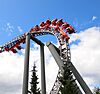
Tornado, located at Särkänniemi in Tampere, Pirkanmaa, Finland
-

Hypersonic XLC, the world's first production Thrust Air 2000. (now defunct)
-

Top Thrill 2 (previously known as Top Thrill Dragster) at Cedar Point was the first strata coaster ever built.
-

Riding Expedition GeForce at Holiday Park, Germany
-

Raptor, a steel inverted coaster, is located at Cedar Point in Sandusky, Ohio, United States.
-

Texas Giant at Six Flags Over Texas before being refurbished into a hybrid steel-wood coaster New Texas Giant.
-

Lightning Racer at Hersheypark is a racing, dueling roller coaster made by GCI.
-

This all-wooden roller coaster, built in 1951, dominates the Linnanmäki amusement park in Helsinki, Finland.
-

Coney Island Cyclone in Brooklyn, New York was built in 1927 and refurbished in 1975.
-

Son of Beast in Kings Island was the only wooden coaster to have a vertical loop.
-

Jack Rabbit at Kennywood Park outside of Pittsburgh, Pennsylvania, United States was built in 1920.
-

Phoenix, built in 1947, at Knoebels Amusement Resort in Elysburg, Pennsylvania, United States.
-
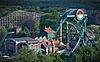
Baron 1898 at Efteling in Kaatsheuvel, The Netherlands
-
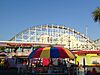
Swamp Fox at Family Kingdom in Mrytle Beach, South Carolina.
-
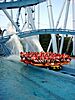
Griffon splashing down into a pool at Busch Gardens Williamsburg, US.
-

Great Bear is the first steel inverted coaster in Pennsylvania, located at Hersheypark.
-

Behemoth, at Canada's Wonderland, at one point the highest and fastest coaster in Canada
-

"Montu", a popular inverted roller coaster at Busch Gardens Tampa Bay, US
-

Black Mamba at Phantasialand, Germany
-

Euro-Mir, a spinning roller coaster at Europa-Park in Rust, Germany
-

Dragon Khan at PortAventura Park in Salou (Tarragona), Spain
-

Thunderbolt at Kennywood outside of Pittsburgh, Pennsylvania, US was built in 1968.
-

Leviathan at Canada's Wonderland, the tallest coaster in Canada (306 ft, 148 km/h)
-
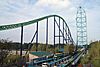
Kingda Ka at Six Flags Great Adventure was the world's tallest roller coaster and was the second strata coaster in the world after Top Thrill Dragster.
-

Expedition Everest, a roller coaster at Disney's Animal Kingdom in Walt Disney World
-
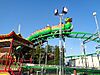
A small roller coaster at a local festival in Čakovec, Croatia
-

Hyperion at Energylandia in Zator, Lesser Poland Voivodeship, Poland
-

Fury 325 at Carowinds is the tallest roller coaster to use a traditional chain lift.
-
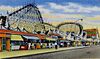
The Cyclone, Revere Beach, Massachusetts, USA


_02.JPG)

_06.jpg)


.jpg)

See also
 In Spanish: Montaña rusa para niños
- Amusement park (Lists of amusement parks)
- Amusement rides on the National Register of Historic Places
- Fear of roller coasters
- List of roller coaster elements
- List of roller coaster rankings
- List of theme park management video games
- Roller coaster train
- Ron Toomer
