
Dry Tortugas National Park facts for kids
Quick facts for kids Dry Tortugas National Park |
|
|---|---|
|
IUCN Category II (National Park)
|
|
| Location | Monroe County, Florida, United States |
| Nearest city | Key West |
| Area | 64,701 acres (261.84 km2) |
| Established | January 4, 1935 |
| Visitors | 89,355 (in 2025) |
| Governing body | National Park Service |

National Park Service map of the Dry Tortugas
|
|
| Geography | |
|---|---|
| Location | end of the Florida Keys, United States |
| Coordinates | 24°38′00″N 82°55′12″W / 24.63333°N 82.92000°W |
| Archipelago | Florida Keys |
| Adjacent bodies of water | Gulf of Mexico |
| Total islands | 7 |
| Major islands | Garden Key |
| Area | 10,000,000 acres (4,000,000 ha) |
| Highest elevation | 10 ft (3 m) |
Dry Tortugas National Park is a special national park in the United States. It is located about 68 miles (109 km) west of Key West, Florida, in the Gulf of Mexico. The park protects Fort Jefferson and the beautiful Dry Tortugas islands. These islands are the most western and isolated part of the Florida Keys. Their coral reefs are among the healthiest in the Florida Keys.
The park is famous for its rich sea life, tropical birds, colorful coral reefs, and historic shipwrecks. The main attraction is Fort Jefferson, a huge but unfinished coastal fortress. Fort Jefferson is the largest brick building in the Western Hemisphere, made from over 16 million bricks. Dry Tortugas is unique because it combines a mostly untouched tropical ecosystem with important historical sites.
You can only reach the park by seaplane or boat. Each year, many visitors come to enjoy activities like snorkeling, picnicking, birdwatching, camping, scuba diving, saltwater fishing, and kayaking. Camping is available at Garden Key, near Fort Jefferson, but spaces are limited. The park is also part of the Everglades & Dry Tortugas Biosphere Reserve, recognized by UNESCO since 1976.
Contents
Exploring the Dry Tortugas Islands
The Dry Tortugas are a small group of coral islands about 70 miles (113 km) west of Key West, Florida. They are the very end of the Florida Keys. Most of the park area, over 99 percent, is water. A large part of the park is a special research area where marine life is protected, and boats must use specific mooring spots. About half of the park is still open for fishing.
The islands are low and change shape often. Some have mangroves and other plants, while smaller ones might only have grass or no plants at all. There are usually seven main islands, but the number can change with water levels and storms like hurricanes. The major islands are Loggerhead Key, Garden Key, Bush Key, Long Key, Hospital Key, Middle Key, and East Key. The total land area of the park is about 144 acres (58 hectares).
| Island | Acres | % of total |
|---|---|---|
| Total | 144.39 | 100 |
| Loggerhead Key | 64.25 | 44.49 |
| Garden Key | 42 | 29.09 |
| Bush Key | 29.65 | 20.54 |
| Long Key | 2 | 1.39 |
| Hospital Key | 0.99 | 0.69 |
| Middle Key | 1.5 | 1.04 |
| East Key | 4 | 2.77 |
- Loggerhead Key is the largest island, about 250 by 1200 meters (820 by 3,937 feet). It has the highest point in the Dry Tortugas, about 10 feet (3 meters) above sea level. The tall Dry Tortugas lighthouse, 46 meters (151 feet) high, stands on this island.
- Garden Key is home to Fort Jefferson and an old lighthouse. It is the second-largest island, about 400 by 500 meters (1,312 by 1,640 feet).
- Bush Key is very close to Garden Key. It is the third-largest island. Bush Key is a very important place for many terns to build their nests. Because of this, it is closed to visitors from February to September to protect the nesting sooty terns and brown noddies.
- Long Key is a smaller island, sometimes connected to Bush Key by sand.
- Hospital Key got its name because a hospital for the fort's workers was built there long ago.
- Middle Key is another small island that sometimes disappears under the water due to tides and storms, only to reappear later.
- East Key is one of the easternmost islands.
How the Islands Formed: Geology
The Dry Tortugas islands are part of a long chain of islands called the Florida Keys. These islands are made from ancient coral reefs and a type of rock called limestone. Over millions of years, layers of sediment built up, forming the base of these islands. You can see two main types of limestone here: Key Largo Limestone, which comes from old reefs, and Miami Limestone, which formed from sand and shell fragments. The Dry Tortugas also have interesting sand deposits made from tiny pieces of marine plants.
Weather and Climate
The Dry Tortugas has a tropical savanna climate. This means it has a rainy season from May to October, which is also when hurricanes can happen. The dry season lasts from November to April. Even though it's in a tropical area, Dry Tortugas is one of the driest places in Florida, getting about 38 inches (965 mm) of rain each year. The islands don't have large forests, and the sandy soil drains water quickly, making them feel very dry.
Temperatures don't change much throughout the year. Summers are warm, with highs around 91°F (33°C), and winters are mild, with lows around 65°F (18°C). It has never been cold enough for frost or freezing temperatures here.
| Climate data for Dry Tortugas, Florida (1991–2020 normals, extremes 1950–present) | |||||||||||||
|---|---|---|---|---|---|---|---|---|---|---|---|---|---|
| Month | Jan | Feb | Mar | Apr | May | Jun | Jul | Aug | Sep | Oct | Nov | Dec | Year |
| Record high °F (°C) | 89 (32) |
92 (33) |
93 (34) |
94 (34) |
96 (36) |
99 (37) |
98 (37) |
101 (38) |
98 (37) |
95 (35) |
90 (32) |
88 (31) |
101 (38) |
| Mean daily maximum °F (°C) | 73.9 (23.3) |
75.5 (24.2) |
78.7 (25.9) |
82.7 (28.2) |
86.0 (30.0) |
89.2 (31.8) |
91.0 (32.8) |
91.4 (33.0) |
88.9 (31.6) |
85.0 (29.4) |
79.4 (26.3) |
75.7 (24.3) |
83.1 (28.4) |
| Daily mean °F (°C) | 69.3 (20.7) |
70.5 (21.4) |
73.1 (22.8) |
76.9 (24.9) |
80.3 (26.8) |
83.3 (28.5) |
84.4 (29.1) |
85.2 (29.6) |
83.4 (28.6) |
80.4 (26.9) |
74.9 (23.8) |
71.2 (21.8) |
77.7 (25.4) |
| Mean daily minimum °F (°C) | 64.7 (18.2) |
65.5 (18.6) |
67.5 (19.7) |
71.1 (21.7) |
74.5 (23.6) |
77.4 (25.2) |
77.9 (25.5) |
79.0 (26.1) |
77.9 (25.5) |
75.8 (24.3) |
70.5 (21.4) |
66.6 (19.2) |
72.4 (22.4) |
| Record low °F (°C) | 46 (8) |
40 (4) |
47 (8) |
56 (13) |
55 (13) |
64 (18) |
64 (18) |
65 (18) |
66 (19) |
59 (15) |
51 (11) |
48 (9) |
40 (4) |
| Average precipitation inches (mm) | 2.35 (60) |
1.69 (43) |
2.07 (53) |
2.60 (66) |
2.02 (51) |
4.26 (108) |
2.19 (56) |
4.31 (109) |
7.18 (182) |
4.72 (120) |
1.88 (48) |
2.36 (60) |
37.63 (956) |
| Average precipitation days (≥ 0.01 in) | 6.9 | 5.7 | 4.1 | 4.2 | 4.5 | 7.4 | 8.7 | 10.4 | 11.9 | 9.8 | 4.3 | 6.1 | 84.0 |
| Source: NOAA | |||||||||||||
A Look Back in Time: History of Dry Tortugas
The first European to see the Dry Tortugas was Juan Ponce de León on June 21, 1513. He caught many sea turtles there, so he named the islands "Tortugas," which means turtles in Spanish. They are called Dry because there is no fresh water on the islands. This name is one of the oldest European place-names in the United States.
The islands have a rich maritime history, with many important shipwrecks from the 17th century to today. In 1742, a British ship called HMS Tyger wrecked here. Later, in 1622, the Spanish ship Nuestra Señora de Atocha sank near the Dry Tortugas during a hurricane. Many years later, in 1985, explorers found this famous shipwreck. It contained a huge amount of historical treasures, including gold, silver, and emeralds, giving us a glimpse into the past.
Fort Jefferson: A Giant Fortress

After the United States acquired Florida in 1819, the Dry Tortugas became a very important strategic point. It helped control the shipping lanes in the Straits of Florida and the Gulf of Mexico. Work on Fort Jefferson began in 1847. It is a massive, unfinished coastal fortress and the largest brick building in the Western Hemisphere.
Many people worked to build this huge fort. Some were skilled workers, and others were laborers, including African Americans who were forced to work there. Later, during the American Civil War, African American soldiers were stationed at the fort. The fort remained under Union control throughout the war.
After the Civil War, Fort Jefferson was used as a prison until 1874. One famous prisoner was Dr. Samuel Mudd, who was held there for conspiracy. He became known for helping to stop a viral outbreak at the fort, and was later pardoned.
In the 1880s, the United States Navy set up a base here, including a refueling station and a radio station. A marine biology laboratory also operated on Loggerhead Key from 1903 to 1939, where many scientists studied sea life. President Franklin D. Roosevelt even visited the fort once.
The Park's Journey
Dry Tortugas National Park was first established as Fort Jefferson National Monument on January 4, 1935, by President Franklin D. Roosevelt. It was expanded and renamed Dry Tortugas National Park on October 26, 1992. The park's main goals are to protect the islands, the marine ecosystems, Fort Jefferson, and underwater historical sites like shipwrecks. It also allows people to visit and enjoy this special place.
In the mid-1990s, when many national parks were temporarily closed, the people of Key West worked together to raise money to keep Dry Tortugas open. This showed how much the community valued the park.
Because the park is so remote, sometimes people arrive by boat from other countries. This creates special challenges for the park staff, who work to help these arrivals and coordinate with other agencies.
The number of visitors to the park grew steadily for many years. In August 2004, Hurricane Charley directly hit the Dry Tortugas. In September 2022, Hurricane Ian also directly struck the islands.
Amazing Nature: Ecology
.jpg)
The Dry Tortugas islands have a unique ecosystem that is a mix of subtropical and tropical environments. This means you can find species here that are not usually seen anywhere else in the continental United States. The park's coral reefs are very important, even though some were damaged by cold weather in the past.
Birds and Their Reproduction
.jpg)
Dry Tortugas National Park is a paradise for birds, with 299 different species recorded. Eight species regularly build their nests and raise their young here, including the sooty tern, brown noddy, brown pelican, magnificent frigatebird, and masked booby. The park has the only nesting colonies of sooty terns, brown noddies, magnificent frigatebirds, and masked boobies in the mainland United States.
Birdwatching is especially exciting in spring, usually April, when many migratory birds pass through the park. You can often see dozens of different species in a single day, sometimes even inside Fort Jefferson!
Protecting the Ecosystem: Invasive Species
The park actively works to remove plants that are not native to the islands, such as Casuarina trees and agave. These plants can harm the natural environment. Also, Pterois, commonly known as lionfish, an invasive species, have been found in the park's waters. The National Park Service is working on plans to manage their spread and protect the native marine life.
Visiting Dry Tortugas National Park
.jpg)
Most visitors travel to Dry Tortugas National Park by ferry or seaplane from Key West. The official ferry, the Yankee Freedom III catamaran, offers transportation. You can also charter private boats or seaplanes. There are no roads to the Dry Tortugas, so cars cannot reach the islands.
Once you are at Dry Tortugas National Park, there are limited services. Visitors need to bring their own food, water, and any other supplies they might need for their trip. The closest restaurants and hotels are in Key West. However, you can enjoy primitive camping at Garden Key.
Images for kids
-
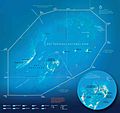
National Park Service map of the Dry Tortugas
See also
 In Spanish: Parque nacional Tortugas Secas para niños
- Florida Keys National Marine Sanctuary
- List of national parks of the United States
