
Airbus A350 facts for kids
Quick facts for kids Airbus A350 |
|
|---|---|
 |
|

An Airbus A350-900 at the 2014 Farnborough Airshow, with the branding of its launch operator Qatar Airways
|
|
| General information | |
| Other name(s) | Airbus A350 XWB |
| Role | Wide-body airliner |
| National origin | Multi-national |
| Manufacturer | Airbus |
| Status | In service |
| Primary users | Singapore Airlines |
| Number built | 734 |
| History | |
| Manufactured | 2010–present |
| Introduction date | 15 January 2015 with Qatar Airways |
| First flight | 14 June 2013 |
The Airbus A350 is a huge, modern passenger airplane. It travels on long-haul flights across large oceans and between different continents.
The company Airbus builds this popular wide-body aircraft. It has two giant jet engines beneath its wings.
A wide-body plane has two separate aisles for walking. Passengers can easily move through the spacious cabin.
The plane is known as the A350 XWB. XWB stands for "Extra Wide Body."
Airbus built the airplane using advanced composite materials like carbon fiber. These materials make the jet light and strong.
Because it is so light, it burns much less jet fuel. This saves money and protects our Earth's atmosphere.
The jet can carry hundreds of travelers in quiet comfort. It flies safely to distant destinations worldwide every single day.
Contents
How the Airbus A350 Was Born
The Challenge from Boeing
In the early 2000s, airlines wanted brand-new planes. They needed planes that consumed much less fuel.
The American company Boeing announced a cool new plane. That new plane was the Boeing 787 Dreamliner.
Airbus first thought its older Airbus A330 was fine. However, customer airlines wanted something newer and better.
At first, Airbus suggested small changes to the A330. They called this early concept the "A330-200 Lite."
Airlines told Airbus that this plan was not enough. They wanted a completely fresh, high-tech jetliner.
Starting with a Fresh Design

Airbus listened closely to the advice of large airlines. Airline leaders asked for a brand-new body.
In 2006, Airbus decided to start totally from scratch. Engineers call this clean-sheet design work.
They named the exciting new project the A350 XWB. They promised to make the cabin much wider.
This wider cabin gave passengers extra space for shoulders. It also allowed airlines to install wider, comfy seats.
Designing a brand-new jet costs billions of euros. Airbus gathered engineers from France, Germany, the United Kingdom, and Spain.
Building the First Test Planes

Building a modern jet requires smart planning. Airbus made parts in factories across different countries.
Workers built the giant wings inside a factory in Broughton, Wales. They used super-strong carbon-fiber-reinforced polymers.
Other teams built body sections in Nantes and Hamburg. They sent these huge parts to Toulouse, France.
In Toulouse, workers joined all the pieces together. They hooked up miles of wires and pipes.
Engineers built special test planes to check everything carefully. Safety is always the top priority in aviation.
Taking to the Skies for the First Time

The very first A350 test flight took place in 2013. On 14 June, the plane lifted into the blue sky.
Thousands of excited workers watched from the airfield in Toulouse. The pilots flew the plane for four wonderful hours.
The test pilots tested the landing gear, flaps, and engines. The pilots smiled because the plane flew smoothly.
Over the next year, five test planes flew constantly. They flew through freezing cold air and burning desert heat.
One plane visited the McKinley Climatic Laboratory in Florida. Inside, technicians froze the plane to test extreme winter weather.
Official Safety Approval
A passenger jet must earn a safety certificate. Experts check every part to ensure it is completely safe.
The European Union Aviation Safety Agency tested the jet. The American Federal Aviation Administration tested it as well.
Both agencies gave the A350 their safety stamp in 2014. This meant airlines could carry real passengers.
The jet was also approved for special long-distance rules. These rules are known by the letters ETOPS.
Under these rules, it can fly across oceans. It can fly safely even if one engine stops working.
Inside the High-Tech Aircraft Design
Advanced Space-Age Materials

Traditional airplanes were made mostly of metals like aluminium. Metal is strong, but it can be quite heavy.
The A350 is built differently than older jets. More than half of its structure uses composite materials.
These composites mix tiny strands of carbon fiber with plastic resin. The result is stronger than metal yet wonderfully lightweight.
Composites do not rust or corrode like metal parts. They also do not wear out easily from frequent flights.
Airbus used strong titanium for the heavy-duty landing gear. They also used special aluminium–lithium alloys in select spots.
Wings Inspired by Birds
.jpg)
The wings of the A350 are engineering marvels. They measure nearly 65 meters from tip to tip.
Engineers studied how large birds, like eagles, glide smoothly. They designed the wings to bend slightly during flight.
At the very end of each wing sits a curved tip. Pilots and engineers call these stylish tips sharklets.
Sharklets reduce unwanted air swirls called wingtip vortices. This reduces aerodynamic drag and saves lots of expensive fuel.
Computers move small wing panels called flaps automatically. This keeps the airplane flying smoothly through bumpy turbulence.
The Pilot Cockpit and Flight Controls

Two pilots fly the A350 from the front cockpit. Instead of old mechanical dials, they look at large screens.
This setup is called a glass cockpit. Six big color displays show speed, height, and route maps.
The pilots use a small joystick called a side-stick. It sits neatly on the side rather than between their knees.
The side-stick sends electronic signals to the control surfaces. This smart computer control system is called fly-by-wire.
Computers help prevent the pilots from making dangerous turns. The computers ensure the airplane stays within safe flight limits.
Pilots also look through clear glass panels called a head-up display. Crucial flight numbers shine right in front of their eyes.
Powerful Rolls-Royce Jet Engines

The A350 is powered by two massive engines. A famous United Kingdom company named Rolls-Royce makes them.
The engine model is called the Rolls-Royce Trent XWB. It is a modern type of turbofan engine.
The giant spinning fan at the front pulls in air. Most of that air flows around the core engine.
This design is known as a high-bypass engine. It makes the engine run much quieter and cleaner.
Special noise-reducing covers surround each engine. Passengers hear less noise inside the cabin during flight.
People living near airports also enjoy much quieter takeoffs. This helps reduce unwanted noise in cities.
Passenger Comfort and Cabin Air

Flying on an airplane can sometimes make people feel tired. The A350 cabin is designed to help travelers feel fresh.
Because the composite walls do not rust, air stays moist. The air conditioning system adds extra humidity into the cabin.
Air inside the cabin is refreshed every few minutes. Advanced HEPA filters remove tiny dust and bacteria.
Air pressure inside the cabin feels like a low mountain. Passengers breathe easily, which prevents headaches during long trips.
Bright LED lights mimic natural sunlight throughout the journey. They gently change color to help passengers sleep and wake up.
Large panoramic windows let in plenty of daylight. Some models feature modern windows that darken with the push of a button.
Main Models of the A350
The Baseline A350-900
.jpg)
The most common version is the A350-900. It measures almost 67 meters in length.
This model usually holds around 300 to 350 passengers. Seats are arranged in comfy sections, including economy and business class.
It can fly non-stop for up to 15,000 kilometers. That is far enough to travel from London to Singapore.
Four-wheel bogies make up its main landing gear. The landing gear legs tuck into the fuselage after takeoff.
Airlines all around the globe fly this popular version. It has proven to be reliable and economical.
The Extra-Long Range A350-900ULR

Some airlines want to fly across half the planet non-stop. Airbus created the A350-900ULR for these super-long routes.
The letters ULR stand for Ultra Long Range. It does not need extra fuel tanks inside the plane.
Instead, engineers use the full space of existing wing tanks. The plane carries extra fuel and slightly fewer passengers.
Singapore Airlines uses this plane for record-breaking journeys. It flies directly from Singapore Changi Airport to New York City.
This flight takes almost 19 continuous hours. Passengers can watch movies, eat meals, and sleep in comfortable beds.
The Stretched A350-1000
.jpg)
Airbus also designed a longer version called the A350-1000. It is roughly seven meters longer than the -900 model.
It can seat between 350 and 410 passengers. Because it is heavier, it has six wheels on each main gear.
The wing features a slightly larger area for extra lift. The engines are upgraded to produce even more pushing power.
This big plane can fly far across wide oceans. Airlines use it on busy routes connecting giant world cities.
It replaced older four-engine planes like the Airbus A340. Having only two engines saves airlines huge amounts of money.
The Project Sunrise Ultra-Long Range Jet
An Australian airline named Qantas has big travel dreams. They want to connect Sydney and Melbourne directly to London.
They call this ambitious plan Project Sunrise. It requires planes to stay aloft for twenty hours straight.
Qantas selected a specialized long-range version of the A350-1000. Airbus added an extra center fuel tank for the journey.
Test flights proved the plane can cover these huge distances safely. It allows travelers to skip annoying layover stops entirely.
The A350F Cargo Jet

Not all airplanes carry human passengers. Some planes fly boxes, packages, fruit, and factory machinery.
Airbus designed a special freight version called the A350F. It features a huge loading door on its side.
Inside, there are no passenger seats or windows. Workers slide large metal containers, called unit load devices, into the cabin.
The floor is reinforced with sturdy metal beams. This allows the jet to carry heavy cargo loads across continents.
It burns much less fuel than older cargo planes. Shipping companies use it to move goods quickly around the world.
Flying Passengers Worldwide
First Commercial Flights
.jpg)
The first airline to receive an A350 was Qatar Airways. They picked up their shiny new jet in late 2014.
Its first official flight with passengers took place in January 2015. The plane flew happily from Doha to Frankfurt Airport.
Passengers loved how quiet the plane was during the flight. Flight attendants enjoyed serving meals in the wide, bright cabin.
Soon, other world airlines began receiving their ordered airplanes. Airlines like Vietnam Airlines and Finnair flew them next.
Every week, more A350 jets rolled off the factory floor. They quickly spread to busy airports across every continent.
Major Airlines Using the A350
.jpg)
Today, hundreds of A350s fly in the sky. Dozens of top international airlines operate these modern jets.
Singapore Airlines flies the biggest fleet of A350 airplanes. They fly them on short Asian routes and to North America.
Other giant operators include Qatar Airways, Cathay Pacific, and Air France. In the United States, Delta Air Lines flies many of them.
Pilots love flying the A350 because its systems are smart. It shares flight characteristics with the older Airbus A330.
This sharing allows pilots to learn both planes easily. Airlines save time and money when training their flight crews.
Caring for the Aircraft and Fixing Problems
Like a family car, airplanes need regular maintenance checkups. Teams of certified mechanics inspect the jet constantly.
Computers on the plane report any minor issues to ground crews. Mechanics can order replacement parts before the plane even touches down.
Early in service, airlines fixed a few small issues. Some coffee makers leaked water in the kitchen area.
In 2021, Qatar Airways noticed peeling paint on some jets. Airbus looked into the issue and updated the paint process.
Airbus and Qatar Airways solved the problem together peacefully. The planes continue to fly safely with fresh, shiny paint.
A Strong Safety Record
The A350 has an outstanding safety record across millions of hours. Its strong composite frame protects passengers well.
In January 2024, an A350 suffered an accident at Haneda Airport in Tokyo. It collided with another plane on the runway.
A fierce fire broke out on the passenger jet. However, the sturdy carbon-fiber frame held up remarkably well.
All 379 passengers and crew evacuated safely down the slides. Aviation experts praised the crew and the strong aircraft design.
Safety inspectors study every event carefully. They share safety lessons to make all future flights even safer.
Fun Facts About the Airbus A350
- The plane wears a black outline around its cockpit windows, resembling a superhero mask or a raccoon!
- The wingtips curve gracefully upward to slice cleanly through the rushing air.
- Its engines are so huge that an entire family car could fit inside the engine opening!
- Advanced composite materials make up more than half of the plane's total weight.
- The longest flight operated by this aircraft connects Singapore to New York, taking nearly 19 hours non-stop!
- Giant air conditioning filters clean the cabin air every two to three minutes during flight.
- Special mood lighting can create over 16 million colors to simulate sunrise and sunset.
How It Compares to Other Jets
| Feature | A350-900 | A350-1000 | A350F Cargo |
|---|---|---|---|
| Overall Length | 66.8 meters | 73.8 meters | 70.8 meters |
| Wingspan | 64.75 meters | 64.75 meters | 64.75 meters |
| Typical Passenger Seats | 300 to 350 | 350 to 410 | None (Cargo only) |
| Flight Range | 15,350 km | 16,100 km | 8,700 km |
| Main Landing Gear Wheels | 4 wheels per side | 6 wheels per side | 6 wheels per side |
| Primary Engine Type | Rolls-Royce Trent XWB-84 | Rolls-Royce Trent XWB-97 | Rolls-Royce Trent XWB-97 |
Looking at Aircraft Parts
-
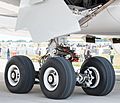
The A350-900 has a four-wheel main gear for a 283-tonne takeoff weight.
-
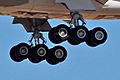
The A350-1000 has a six-wheel main landing gear to support a 322-tonne takeoff weight.
.jpg)

See Also
 In Spanish: Airbus A350 para niños
