
Euro facts for kids
Quick facts for kids Euro |
|||||
|---|---|---|---|---|---|
|
|||||
| ISO 4217 Code | EUR | ||||
| User(s) | primary: § members of Eurozone (21), also: § other users |
||||
| Inflation | 2.1% (November 2025) | ||||
| Source | ec.europa.eu | ||||
| Method | HICP | ||||
| Pegged by | see § Pegged currencies | ||||
| Subunit | |||||
| 1⁄100 | euro cent (Name varies by language) |
||||
| Symbol | € | ||||
| euro cent | c | ||||
| Plural | Varies, see language and the euro | ||||
| euro cent | (Varies by language) | ||||
| Coins | |||||
| Freq. used | 1c, 2c, 5c, 10c, 20c, 50c, €1, €2 | ||||
| Rarely used | 1c, 2c (Belgium, Estonia, Finland, Ireland, Italy, Lithuania, the Netherlands and Slovakia) | ||||
| Banknotes | |||||
| Freq. used | €5, €10, €20, €50, €100 | ||||
| Rarely used | €200, €500 | ||||
| Printer | see § Banknote printing | ||||
.png)
.png)
The euro (symbol: €; code: EUR) is the official currency (money) used by 21 countries in the European Union (EU). This group of countries is known as the eurozone. One euro is divided into 100 cents.
The euro is the second most used currency in the world, right after the United States dollar. It is used daily by about 356 million people in Europe. It is also used by some small countries and territories that are not part of the EU.
The name "euro" was chosen in 1995. The currency was first introduced for electronic payments in 1999. Physical coins and banknotes (paper money) started being used on 1 January 2002. Today, it is one of the most important currencies for global trade.
Contents
How the Euro Works
Administration

The euro is managed by the European Central Bank (ECB), which is located in Frankfurt, Germany. The ECB works with the central banks of the eurozone countries to form the Eurosystem.
The ECB is responsible for:
- Setting interest rates to keep prices stable.
- Managing the amount of money in circulation.
- Making sure the payment systems work smoothly.
Countries that join the EU usually promise to adopt the euro once their economies are ready. However, Denmark has a special agreement to keep its own currency, and some other countries have not yet met the requirements to join.
Countries Using the Euro
Eurozone Members
There are 21 EU countries that use the euro as their main currency:


Other Places
Some small countries and territories also use the euro:
- Microstates: Andorra, Monaco, San Marino, and Vatican City have agreements to use the euro.
- Other Areas: Kosovo and Montenegro use the euro without a formal agreement. Some overseas territories of France and British bases in Cyprus also use it.
Coins and Banknotes
Coins
.jpg)
There are eight different euro coins: 1, 2, 5, 10, 20, and 50 cents, plus €1 and €2 coins.
- Common Side: One side of the coin looks the same in all countries. It shows the value of the coin and a map of Europe.
- National Side: The other side has a picture chosen by the country that made the coin. For example, an Irish coin has a harp, and a German coin might have an eagle.
You can use a euro coin from any country in any other eurozone country. For example, you can use a French euro coin to buy ice cream in Italy.
Banknotes

Euro banknotes (paper money) look the same in every country. They come in seven values: €5, €10, €20, €50, €100, €200, and €500.
- Design: The notes feature windows and gateways on the front and bridges on the back. These designs represent openness and connection between countries.
- Colors: Each note has a different size and color to make them easy to tell apart.
- Updates: A new series of notes, called the "Europa series," has been released with better security features to prevent copying. The €500 note is no longer being printed, but old ones are still worth money.
Gallery
-
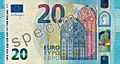
The Europa series 20 € obverse side
-
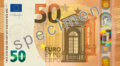
The Europa series 50 € obverse side
-
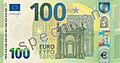
The Europa series 100 € obverse side
-
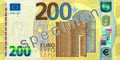
The Europa series 200 € obverse side


History of the Euro
Creating a Single Currency
The idea of a single European currency was part of the Maastricht Treaty in 1992. The goal was to bring European countries closer together and make trade easier.
- 1999: The euro was launched for banks and electronic transfers. The old currencies (like the French franc or German mark) were locked at a fixed value against the euro.
- 2002: Euro coins and banknotes were released to the public. People exchanged their old money for euros.
The Euro Symbol

The symbol for the euro is €. It was inspired by the Greek letter epsilon (Є), representing the cradle of European civilization. The two parallel lines across the middle stand for stability.
Economic Challenges

Around 2010, some eurozone countries faced difficult economic times, known as the eurozone crisis. Countries like Greece, Ireland, and Portugal had trouble paying back money they had borrowed. The EU countries and the ECB worked together to help these nations and stabilize the currency. By 2014, the situation had improved significantly.
Why Use the Euro?
Benefits
Using a single currency has several advantages:
- Easier Travel: You do not need to exchange money when traveling between eurozone countries.
- Price Comparison: It is easier to compare the price of goods in different countries.
- Trade: Businesses can buy and sell products across borders without worrying about changing exchange rates.
- Stability: A large, shared currency can be more stable and keep inflation (rising prices) low.
Exchange Rates
The value of the euro changes compared to other currencies like the US dollar or the Japanese yen.
- In July 2022, the euro and the US dollar were worth the same amount for a short time.
- On 22 December 2025, the euro reached a new high value against the Japanese yen.


Language and Spelling
The name "euro" is used in most languages, but it might be pronounced differently. On the banknotes, the name is written in the Latin (EURO), Greek (ΕΥΡΩ), and Cyrillic (ЕВРО) alphabets to respect the different languages used in the European Union.
Images for kids
-
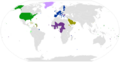
Map showing where the euro and US dollar are used or linked.
-
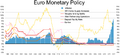
Chart showing inflation and interest rates in the eurozone.
-
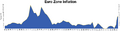
Inflation rates in the eurozone over time.
-
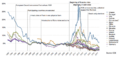
Interest rates for government borrowing in eurozone countries.
-
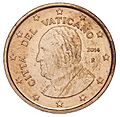
1 cent coin from Vatican City.
-
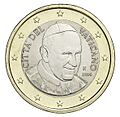
1 euro coin from Vatican City.
-
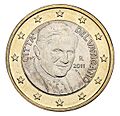
1 euro coin from Vatican City (older series).


See also
 In Spanish: Euro para niños
- Currency union
- Digital euro
- Economic and Monetary Union of the European Union
- European integration
- History of the European Union
- List of currencies in Europe
- Withdrawal from the eurozone
