
Aleksandar Vučić facts for kids
Quick facts for kids
Aleksandar Vučić
|
|
|---|---|
|
Александар Вучић
|
|
.jpg)
Vučić in 2025
|
|
| President of Serbia | |
| Assumed office 31 May 2017 |
|
| Preceded by | Tomislav Nikolić |
| Prime Minister of Serbia | |
| In office 27 April 2014 – 31 May 2017 |
|
| President | Tomislav Nikolić |
| Deputy | Ivica Dačić Rasim Ljajić Zorana Mihajlović Kori Udovički Nebojša Stefanović |
| Preceded by | Ivica Dačić |
| Succeeded by | Ivica Dačić (acting) Ana Brnabić |
| First Deputy Prime Minister of Serbia | |
| In office 27 July 2012 – 27 April 2014 |
|
| Preceded by | Office established |
| Succeeded by | Ivica Dačić |
| Minister of Defence | |
| In office 27 July 2012 – 2 September 2013 |
|
| Preceded by | Dragan Šutanovac |
| Succeeded by | Nebojša Rodić |
| Minister of Information | |
| In office 24 March 1998 – 24 October 2000 |
|
| Preceded by | Radmila Milentijević |
| Succeeded by | Ivica Dačić Biserka Matić-Spasojević Bogoljub Pejčić |
| Personal details | |
| Born | 5 March 1970 Belgrade, Yugoslavia |
| Political party | SNS (since 2008) |
| Spouses |
Ksenija Janković
(m. 1997; div. 2011)Tamara Đukanović
(m. 2013) |
| Children | 3 |
| Relatives | Andrej Vučić (brother) |
| Alma mater | University of Belgrade |
| Signature |  |
Aleksandar Vučić (born on March 5, 1970) is a well-known politician from Serbia. He has been the President of Serbia since 2017. Before becoming president, he held several important roles. He was a founding member of the Serbian Progressive Party (SNS) and led the party from 2012 to 2023. He also served as the First Deputy Prime Minister from 2012 to 2014. From 2014 to 2017, he was the Prime Minister of Serbia.
Vučić was born in Belgrade and studied law at the University of Belgrade. He started his political journey in 1993, becoming a member of the National Assembly of Serbia. He later became the secretary-general of the Serbian Radical Party. In 1998, he was named the Minister of Information. After 2000, he became a leading voice in the opposition. In 2008, he helped create the Serbian Progressive Party (SNS) with Tomislav Nikolić. The SNS grew quickly and formed a government in 2012. Vučić then became the First Deputy Prime Minister and the leader of the SNS.
Even before becoming prime minister, Vučić was very influential as the head of the largest party. He played a key role in talks between Kosovo and Serbia, working to improve their relationship with the help of the European Union (EU). He became Prime Minister in 2014. During this time, he worked on Serbia joining the EU by making economic changes. In 2015, Serbia began formal talks to join the EU. Vučić was elected President of Serbia in 2017 and re-elected in 2022.
As president, Vučić started the Open Balkan initiative, which aims to create an economic zone in the Balkans. In 2020, he signed an agreement to improve economic ties with Kosovo. He supports Serbia joining the EU while also keeping good relationships with countries like Russia and China. Some people have raised concerns about how the media operates and about freedoms in Serbia during his time as president. Others point to economic growth and balanced policies as positive achievements. In June 2026, Vučić announced that he would be stepping down from his role as president in the coming weeks, following a year of student-led protests.
Contents
Aleksandar Vučić: A Leader in Serbia
Early Life and School Days
Aleksandar Vučić was born in Belgrade on March 5, 1970. His parents were Anđelko and Angelina. He has a younger brother named Andrej. His family had moved to Belgrade after World War II.
Vučić grew up in the New Belgrade area. He went to Branko Radičević Elementary School. Later, he attended a high school in Zemun. In 1994, he graduated from the University of Belgrade Faculty of Law with a law degree.
He also spent time in Brighton, England, to learn English. He worked in London for over a year. When he returned to Yugoslavia, he worked as a journalist. As a young person, Vučić was a big fan of the Red Star Belgrade football team.
Starting a Political Journey
Vučić joined the Serbian Radical Party (SRS) in 1993. This party focused on Serbian national interests. He was elected to the National Assembly that same year. In 1996, after his party won local elections, he became the director of Pinki Hall.
Becoming a Minister
In March 1998, Vučić became the Minister of Information. He was part of the government led by Mirko Marjanović. During his time as minister, he made some rules about how news was shared. He later said that he had learned from his past actions and changed his views.
From One Party to Another
In 2008, Tomislav Nikolić, another leader, left the Radical Party. He disagreed with the party's views on Serbia joining the EU. Vučić also left the Radical Party in September 2008.
The next day, he announced he would take a break from politics. However, in October 2008, Vučić joined Nikolić's new party, the Serbian Progressive Party (SNS). He became the Deputy President of the party. He later shared that he had changed his political ideas and was proud of it.
Key Roles in Government
Serving as Minister of Defence and First Deputy Prime Minister
From July 2012 to August 2013, Vučić served as the Minister of Defence. He was also the First Deputy Prime Minister. Even though Ivica Dačić was the Prime Minister, many people believed Vučić had the most influence. This was because he led the largest party in the government.
Serving as Prime Minister
In the 2014 parliamentary election, Vučić's Serbian Progressive Party won many seats. They formed a government with the Socialist Party of Serbia. Vučić was then elected Prime Minister of Serbia.
He called for early elections in 2016 to ensure stable leadership. His party again won the most votes. They kept their majority in parliament.
Becoming President
Vučić announced he would run for president on February 14, 2017. He won the election in the first round with over 56% of the votes. He was re-elected as president in 2022.
After the 2017 election, some people protested across Serbia. They used social media to organize rallies. They wanted changes in the political and media systems. Vučić said that his political opponents organized these protests.
Vučić became President of Serbia on May 31, 2017. He promised to continue making improvements. He also said Serbia would stay neutral in military matters. Serbia would build partnerships with both NATO and Russia.
In late 2018 and early 2019, more protests happened. People accused Vučić's government of corruption. In 2019, a report noted concerns about elections and media freedom in Serbia.
In July 2020, Vučić announced new rules to stop the spread of COVID-19. This led to more protests. People accused the government of not handling the pandemic well.
In May 2023, after some tragic events, large protests took place. These protests were against Vučić's government. As a result, Vučić promised that new parliamentary elections would be held later that year.
On November 1, 2024, a part of the Novi Sad railway station collapsed. This accident killed 15 people. It led to protests in Novi Sad and other parts of Serbia. People were unhappy about government issues. Vučić described the protesters as "terrorists."
In June 2026, Vučić announced that he would resign from his position as president in the coming weeks. This announcement followed a year of student-led protests against the government.
Important Policies and Relationships
Serbia's Economy
When Vučić became prime minister in 2014, he focused on improving Serbia's economy. He introduced policies to reduce the country's budget deficit. This included cutting some public sector salaries and pensions.
In 2015, Serbia made an agreement with the IMF for financial support. These economic changes were praised by the IMF and the EU. Serbia's economy has grown, and its debt has decreased.
Working with the European Union
Vučić has strongly supported Serbia joining the EU. During the 2015–2016 European migrant crisis, he agreed with Germany's approach. He said Serbia would help with the migrant situation. He also stated that Serbia would not build fences like some other countries.
Serbia is also discussing a lithium mining project with the Rio Tinto company. This project could help Europe's lithium needs. In July 2024, Vučić signed an agreement with Germany and the EU about access to important raw materials from Serbia. This led to more environmental protests in 2024.
Relations with Neighboring Countries
Vučić has worked to improve relations with Kosovo. He has been involved in talks to find solutions for their relationship. In September 2020, Serbia and Kosovo signed an agreement in the White House to improve economic ties.
In 2019, Vučić, along with leaders from Albania and North Macedonia, started the Open Balkan initiative. This aims to create free movement of goods, money, services, and workers between their countries.
Relations with Croatia have sometimes been difficult. In 2015, Croatia closed its border with Serbia due to the migrant crisis. This caused tension, but the EU helped resolve the issue.
Global Connections
Vučić has worked to keep good relationships with Russia. He has said Serbia will continue its European path while maintaining historical ties with Russia. In June 2025, he visited Ukraine and supported its territorial integrity.
Serbia has also maintained good relations with Israel. After the October 7 attacks, Vučić condemned the attacks. In June 2025, he announced a halt on exporting arms to Israel due to the Twelve-Day War. In April 2026, it was reported that Serbia planned to open a drone factory with an Israeli company.
Vučić has also sought closer cooperation with China. He has met with Chinese President Xi Jinping several times. China has helped Serbia with medical supplies and vaccines during the COVID-19 pandemic. In October 2023, Serbia signed a free-trade deal with China.
Vučić visited the United States in July 2017. He met with U.S. Vice President Mike Pence. They discussed U.S. support for Serbia joining the EU. They also talked about improving relations with Kosovo.
Media and Public Information
There have been discussions about media freedom in Serbia. Some reports have raised concerns about how media outlets and journalists operate. They mentioned that journalists sometimes face pressure when they criticize the government.
In 2016, the ruling party held an exhibition of news articles they called "lies." They said they wanted to show unfair attacks. In 2017, a report noted a decline in press freedom in Serbia. It said that Vučić had tried to limit critical media.
During the 2017 presidential election, Vučić received much more airtime on national TV than other candidates. Some organizations noted that media had become a tool for political messages. In 2018, a report described the media situation in Serbia as challenging. It mentioned an increase in false news and pressure on journalists.
In November 2019, Vučić was hospitalized for health issues. Some people suggested that pressure from journalists contributed to his health problems. Vučić denied this, stating his health issues were long-term.
Since Vučić's party came to power, there has been an increase in online activity supporting the government. In March 2020, Twitter shut down a large network of accounts. These accounts were praising President Vučić and his party.
Personal Life and Interests
On July 27, 1997, Vučić married Ksenija Janković, a journalist. They had two children, Danilo and Milica, before they divorced. Ksenija passed away in 2022. Vučić later married Tamara Đukanović, a diplomat. They had a son in June 2017.
Besides Serbian, he speaks Russian and English fluently. He also has some knowledge of French and is learning German.
Vučić has appeared on popular TV shows. In 2006, he won the Serbian version of a talk show called The Pyramid. He also participated in a charity dance contest in 2009. In July 2020, Vučić became a student at a sports college in Belgrade. He aims to become a basketball coach for junior teams after his political career.
Awards and Recognitions
Vučić has received many awards and honors. These include state orders from countries like Bosnia and Herzegovina, Cyprus, Kazakhstan, Russia, Czech Republic, Monaco, Hungary, and China. He has also received church orders from various Orthodox churches.
He has been given honorary doctorates from universities in Moscow and Azerbaijan. Many cities in Serbia and Bosnia and Herzegovina have also made him an honorary citizen. Other awards include the Gold Medal of Merit of the City of Athens and the Friends of Zion Award.
Images for kids
-
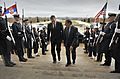
Vučić and U.S. secretary of defense Leon Panetta in Washington, D.C. in 2012
-
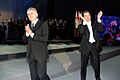
Vučić and Tomislav Nikolić on the founding congress of the Serbian Progressive Party, Belgrade, 2008
-
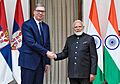
Prime minister Aleksandar Vučić with Prime Minister of India, Narendra Modi
-
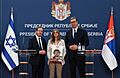
Isaac Herzog, President of Israel, President of Serbia, Aleksandar Vučić, and Idit Ohel, the mother of the abductee to Gaza, Alon Ohel. September 2024
-
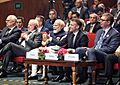
Aleksandar Vučić participated in the India–AI Impact Summit 2026 in New Delhi, where he met with Emmanuel Macron, Narendra Modi, Luiz Inácio Lula da Silva, and other world leaders.
-
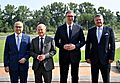
President Aleksandar Vučić with Chancellor of Germany Olaf Scholz, Belgrade, on 19 July 2024.
-
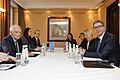
Vučić with European Commission Vice-President Josep Borrell, 17 February 2024
-
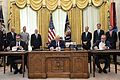
Vučić (left), Donald Trump, President of the United States (middle), and Avdullah Hoti, Prime Minister of Kosovo (right), signing the 2020 Kosovo and Serbia economic agreement in the White House
-
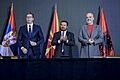
Open Balkan Summit
-
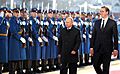
President Vučić with Russian president Vladimir Putin, Belgrade
-
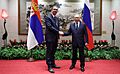
Vučić with Russian President Vladimir Putin, on 2 September 2025
-
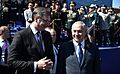
President Aleksandar Vučić with Israeli prime minister Benjamin Netanyahu during the 2018 Moscow Victory Day Parade
-
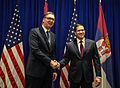
Aleksandar Vučić and Marco Rubio, New York City, New York, 23 September 2025
-
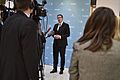
Vučić with journalists during European People's Party Congress in Helsinki (2018)
-
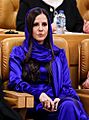
Tamara Đukanović, who married Vučić in 2013


.jpg)


.jpg)
.jpg)
See Also
 In Spanish: Aleksandar Vučić para niños
- List of current heads of state and government
- List of heads of the executive by approval rating
