
Boeing 737 facts for kids
Quick facts for kids Boeing 737 |
|
|---|---|

A Boeing 737-200, the first mass-produced 737 model, in operation with South African Airlink in 2007
|
|
| General information | |
| Role | Narrow-body jet airliner |
| National origin | United States |
| Manufacturer | Boeing |
| Status | In service |
| Primary users | Southwest Airlines |
| Number built | 12,409 as of January 2026[update] |
| History | |
| Manufactured | 1966–present |
| Introduction date | February 10, 1968, with Lufthansa |
| First flight | April 9, 1967 |
| Variants | Boeing T-43 |
| Developed into | |
The Boeing 737 is a famous American passenger plane. It is built by Boeing in Renton, Washington. This plane is known for its single aisle and two engines.
Boeing created the 737 to fly shorter trips and to smaller airports. It kept the same wide body as the Boeing 707, allowing six seats in a row. The plane has two powerful engines under its wings. First thought of in 1964, the first 737-100 flew in April 1967. It started carrying passengers for Lufthansa in February 1968.
The longer 737-200 began flying in April 1968. The 737 has changed a lot over four main versions. It can carry between 85 and 215 passengers.
The first 737-100/200 models used Pratt & Whitney engines. They could seat 85 to 130 passengers. The second version, called the Boeing 737 Classic, came out in 1984. These -300/400/500 models had more fuel-efficient CFM56 engines. They could seat 110 to 168 passengers. The third version, the Boeing 737 Next Generation (NG), arrived in 1997. These -600/700/800/900 models had updated CFM56 engines, bigger wings, and modern digital cockpits. They could seat 108 to 215 passengers. The newest version, the Boeing 737 MAX, started flying in 2017. These -7/8/9/10 models use improved LEAP-1B engines and carry 138 to 204 people.
There are also special versions for business travel, called Boeing Business Jets. Military models are also made.
By January 2026, over 17,312 Boeing 737s had been ordered, and 12,409 were delivered. For a long time, it was the most popular passenger plane ever sold. It was surpassed by the competing Airbus A320 family in orders in 2019 and in total deliveries in 2025. The 737 MAX, a newer version, was temporarily stopped from flying around the world between 2019 and 2020 after two accidents. This was done to make sure it was completely safe.
Contents
- How the Boeing 737 Was Developed
- Generations of the Boeing 737
- Design Features of the Boeing 737
- Other Special 737 Models
- Competition for the Boeing 737
- Who Uses the Boeing 737?
- Orders and Deliveries of the 737
- Safety and Incidents
- Boeing 737s on Display
- Specifications (Boeing 737-200 with JT8D-15A)
- See also
How the Boeing 737 Was Developed
Early Ideas for the 737

Boeing was looking into designs for short-haul jet planes. They saw a need for a new aircraft to fly shorter routes than the Boeing 727. Design work started in 1964. Boeing saw a market for a plane that could carry 50 to 60 passengers on flights from 50 to 1000 miles.
The first idea had engines on the back of the plane and a T-shaped tail. It would have five seats in a row. An engineer named Joe Sutter moved the engines to under the wings. This made the plane lighter and made it easier to fit six seats across inside. The engines were placed right under the wings. This meant the landing gear could be shorter, making the plane closer to the ground. This made it easier for people and luggage to get on and off. Moving the engines also allowed the tail to be attached to the back of the plane, not as a T-tail.

Boeing was a bit late to the game. Other similar planes were already flying or getting ready to fly. To build it faster, Boeing used many parts from its 727 plane, especially the main body. This wide body allowed six seats in a row, while other planes only had five. The wing shape was based on the 707 and 727. Changes near the engines helped the plane fly smoother and faster. They chose the powerful Pratt & Whitney JT8D-1 engine.
Key Design Changes Over Time

The original 737 grew into many different types of planes. These included passenger, cargo, business, and military versions. These are now grouped into four main generations:
- The first generation, called "Original": the 737-100 and -200. This also includes military versions like the T-43. These were launched in 1965.
- The second generation, called "Classic": the 737-300, -400, and -500. These were launched in 1979.
- The third generation, called "Next Generation" (NG): the 737-600, -700, -800, and -900. This also includes military planes like the C-40 and P-8. These were launched in 1993.
- The fourth and newest generation, called "MAX": the 737-7, -8, -9, and -10. These were launched in 2011.
Launching the Boeing 737
Boeing decided to build the plane on February 1, 1965. It cost about $150 million back then. The idea was to offer the comfort of a big jet on shorter flights.
Lufthansa was the first airline to order the 737 in 1965. They bought 21 planes for $67 million. Lufthansa helped Boeing decide to make the plane hold 100 passengers.
On April 5, 1965, United Airlines ordered 40 737s. United wanted a slightly bigger plane, so Boeing made the body longer. This new, longer version was called the 737-200. The original short plane became the 737-100. Both versions were designed at the same time.
The First Flights and Service

The first 737-100 was finished on January 17, 1967. It flew for the first time on April 9, 1967. The Federal Aviation Administration (FAA) approved the 737-100 for passenger flights in December 1967. It was special because it could land safely even in bad weather with low visibility. Lufthansa received its first plane in December 1967. It became the first airline outside of America to launch a new Boeing plane on February 10, 1968. Lufthansa was the main buyer of the 737-100, and only 30 were ever made.
The 737-200 was finished on June 29, 1967. It had its first flight on August 8, 1967. The FAA approved it in December 1967. United Airlines' first flight was on April 28, 1968. Airlines liked the longer 737-200 more than the 737-100. An improved version, the 737-200 Advanced, started flying with All Nippon Airways in 1971.
Sales were slow in the early 1970s. The US Air Force helped by ordering special 737-200s called T-43s. Demand grew even more when the plane got new, more efficient CFM56 engines. The 737 became the best-selling commercial plane until 2019. It held the record for total deliveries until 2025.
The main body of the plane is made in Wichita, Kansas. Then, it travels by train to the Renton factory for final assembly. The Renton factory has three assembly lines for the 737 MAX.
Generations of the Boeing 737
The First Boeing 737s: The Original Series
The "Boeing 737 Original" is the name for the first -100 and -200 models.
The 737-100 Model

The 737-100 was the first and smallest model. It was launched in 1965 and started flying with Lufthansa in 1968. Each plane cost about $3.6 million in 1968. Only 30 737-100s were made. This model was quickly overshadowed by the larger 737-200.
The first engines had a system to help slow the plane down after landing. But this system sometimes lifted the plane slightly, making the brakes less effective. Engineers improved this system. They added a longer tailpipe and new doors that redirected the engine's air. This helped the plane slow down better. These changes also helped the plane carry more weight and fly farther.
The very first 737-100, used by Boeing for testing, later went to NASA. It flew for 30 years before retiring in 2003. The last 737-100 built was used by the Mexican Air Force for 23 years. Today, the first 737-100 is on display at the Museum of Flight in Seattle. It is the only one left.
The 737-200 Model
.jpg)
The 737-200 was a longer version of the 737-100. United Airlines ordered it in 1965, and it started flying in 1968. It cost about $4 million in 1968. Later, the 737-200 Advanced came out. It had better design, stronger brakes, and more powerful engines. This meant it could carry more and fly farther. This improved version became the standard in 1971.
Boeing also made versions that could switch between carrying passengers and cargo quickly. The last 737-200 was delivered in 1988.
In the U.S., the last 737-200 passenger flights ended in 2008. Some still fly today for special charter companies.

The 737-200 could land on shorter runways. Boeing offered a special "gravel kit" for planes flying to remote areas. This kit protected the engines from rocks and dirt on unpaved runways. Airlines like Alaska Airlines used this kit for flights in Alaska. Some airlines in Northern Canada still use it today.
Many 737-200s are still flying, which is a lot for an older jet. One of the oldest jet airliners still flying today is a 737-200, which started service in 1974.
The Boeing 737 Classic: Second Generation
The "Boeing 737 Classic" is the name for the 737-300/400/500 models. These were made from 1984 to 2000. Almost 2,000 Classic series planes were delivered.
Around 2008, fuel prices became very high. Airlines started replacing older 737 Classic planes with newer, more fuel-efficient models. This made the competition between Boeing and Airbus even stronger. Special wingtips, called winglets, could be added to these planes to save fuel.
The 737-300 Model

Work on the 737's first big update started in 1979. Boeing wanted to make the plane carry more people, fly farther, and have modern features. They also wanted it to be similar enough to older 737s for pilots to fly easily. This first major update was later called the 737 Classic. It competed with planes like the MD-80 and the new Airbus A320 family.
A Boeing engineer named Mark Gregoire led a team to choose and fit new engines. They worked with CFM International. They picked the CFM56-3B-1 engine. It used much less fuel and was quieter. But it was bigger than the old engines, and the 737 sits low to the ground. This was a challenge for the engineers. They solved this by making the engine fan a bit smaller. They also placed the engine further forward under the wing. And they moved some engine parts to the sides. This gave the engine a unique, flattened shape at the bottom.
The plane's body was made longer, so it could carry up to 149 passengers. The wings were also improved. They were made a bit longer and had changes to help the plane fly better. The tail was redesigned, and the cockpit got new electronic screens. The passenger area was also made more comfortable, like on the Boeing 757. The first 737-300 flew in February 1984. Some 737-300s got special wingtips called winglets, making them "Special Performance" models. The 737-700 later replaced the 737-300.
The 737-400 Model

The 737-400 was created in 1985. It was designed to fit between the 737-300 and the larger 757-200. Boeing made the body 10 feet longer. This allowed it to carry up to 188 passengers. It also needed a special tail bumper to prevent the tail from scraping the runway during takeoff. The first 737-400 flew in February 1988. It started service with Piedmont Airlines in October of that year. The last 737-400 was delivered in 2000. The 737-800 later replaced the 737-400.
Some 737-400s were changed into cargo planes. Alaska Airlines was the first to convert some of its 400s to carry cargo. They also converted some into "combi" planes, which could carry both passengers and freight.
The 737-500 Model
_(2389306174).jpg)
The 737-500 was designed to be a modern replacement for the 737-200. Southwest Airlines launched it in 1987, ordering 20 planes. It flew for the first time in June 1989. Southwest Airlines received the first one in February 1990.
The 737-500 included all the improvements of the 737 Classic series. This made it more economical for longer flights with fewer passengers. Its body was a bit longer than the 737-200, holding up to 140 passengers. Pilots could choose between modern digital screens or older-style dials in the cockpit. The CFM56 engine also made it 25% more fuel-efficient than the older 737-200s.
Many 737-500s were retired earlier than other models because they were smaller. The 737-600 later replaced the 737-500.
The Boeing 737 Next Generation: Third Generation
The "Boeing 737 Next Generation" (NG) includes the -600, -700, -800, and -900 models. These planes have been made since 1996 and started flying in 1997. Over 7,000 NG aircraft have been delivered. The main goal was to give the 737 new, more powerful CFM56-7 engines.
By the early 1990s, the Airbus A320 family was becoming a big competitor for Boeing. Boeing launched the Next Generation program in 1993 to update the 737 Classic series. The 737 NG models had redesigned wings that were wider and larger. They could carry more fuel, fly farther, and lift more weight. They had CFM56-7 engines, a modern digital cockpit, and improved interiors. These four models can seat 108 to 215 passengers. Special versions like the Boeing Business Jet and the military Boeing P-8 Poseidon were also developed.
The 737-600 Model

The 737-600 was the smallest of the Next-Generation models. It replaced the 737-500. It did not have winglets and was similar in size to the Airbus A318. Scandinavian Airlines (SAS) was the first customer, receiving its plane in 1998. Only 69 of these planes were made. The last one was delivered in 2006.
The 737-700 Model

The 737-700 was the first Next-Generation model. It was launched in 1993 with an order for 63 planes. The -700 can seat 126 passengers in a two-class layout or 149 in a single-class layout. Southwest Airlines received the first one in December 1997. The 737-700 replaced the 737-300 and competes with the Airbus A319.
The 737-700C is a special version where the seats can be removed to carry cargo. It has a large door on the side. The United States Navy uses this version as the C-40 Clipper.
The 737-700ER (Extended Range) was launched in 2006. It has the body of the 737-700 but the stronger wings and landing gear of the 737-800. It can carry 126 passengers and fly very long distances.
The 737-800 Model
.jpg)
The 737-800 was a longer version of the 737-700. It was launched in 1994 and first flew in 1997. The -800 can seat 162 passengers in a two-class layout or 189 in a single-class layout. Hapagfly received the first one in April 1998. The 737-800 replaced the -400 and older 727-200 planes. It also filled the gap after Boeing stopped making the MD-80 and MD-90 planes. The 737-800 is a very common single-aisle plane and competes with the Airbus A320.
The 737-900 Model

The 737-900 was launched in 1997 and first flew in 2000. It is longer than the -800. However, it carries the same amount of fuel and has the same number of emergency exits. This means it could carry more passengers but fly a shorter distance. It seats about 177 passengers in a two-class layout or 189 in a single-class layout. Alaska Airlines received the first one in May 2001. Only 52 were built.
The 737-900ER (Extended Range) is the newest and largest version of the 737NG. It was launched in 2005 and first flew in 2006. Lion Air received the first one in 2007. It has extra exit doors and can seat up to 220 passengers. The -900ER helped fill the gap left by the Boeing 757-200 and competes with the Airbus A321.
The Boeing 737 MAX: Fourth Generation
The "Boeing 737 MAX" includes the MAX 7/8/9/10 models. It also has a higher-density MAX 200 version. These planes typically seat 138 to 230 passengers and can fly long distances. The 737 MAX 7, MAX 8, and MAX 9 replaced the 737-700, -800, and -900. A longer 737 MAX 10 was also added. The goal was to give the 737NG new, very efficient LEAP-1B engines. This was to compete with the Airbus A320neo family.
In 2011, Boeing announced plans for this new 737 version. American Airlines planned to order 100 of these planes. Boeing confirmed the launch of the 737 MAX in 2011. It used earlier 737 designs with more efficient LEAP-1B engines. It also had better aerodynamics, like special wingtips, and changes to the plane's body. The 737 MAX had its first flight on January 29, 2016. It was approved for flight in March 2017. The first MAX 8 was delivered in May 2017 to Malindo Air.
In March 2019, aviation authorities around the world temporarily stopped the 737 MAX from flying. This happened after two accidents that caused 346 deaths. In December 2019, Boeing paused production of the 737 MAX. Production started again in May 2020. The FAA (U.S. aviation authority) cleared the MAX to return to service in November 2020. Before flying again, planes needed repairs and airlines needed approved training programs. Passenger flights in the U.S. resumed in late 2020. The first airline worldwide to resume passenger service was Gol in Brazil, in December 2020.
The 737 MAX 7 Model
.jpg)
The 737 MAX 7 is a shorter version of the MAX 8. It was based on the 737-700. It can fly 1,000 nautical miles farther and carry two more rows of seats. It uses 18% less fuel per seat. This model uses the 737-8's wings and landing gear. It has two over-wing exits instead of one. The body is also longer in the front and back. The 737 MAX 7 replaced the 737-700. It was predicted to carry more passengers and fly farther than the competing Airbus A319neo.
The 737 MAX 8 Model
.jpg)
The 737 MAX 8 was the first version of the 737 MAX. It has a longer body than the MAX 7. Boeing finished the design for the 737 MAX 8 in 2013. Its first commercial flight was with Malindo Air on May 22, 2017. The MAX 8 replaced the 737-800 and competed with the A320neo.
The 737 MAX 200 is a special version of the MAX 8. It is designed to carry up to 200 passengers in a single-class layout. It needs an extra pair of exit doors for this many people. The MAX 200 was expected to be very fuel-efficient. The first MAX 200 for Ryanair was finished in 2018. It flew for the first time in January 2019.
The 737 MAX 9 Model
.jpg)
The 737 MAX 9 is a longer version of the MAX 8. It was launched in 2012 with an order for 201 planes. It was finished on March 7, 2017, and flew for the first time on April 13, 2017. It was approved for flight by February 2018. The first MAX 9 was delivered to Lion Air Group in March 2018. It started service with Thai Lion Air. The 737 MAX 9 replaced the 737-900 and competes with the Airbus A321neo.
The 737 MAX 10 Model
_-_003.jpg)
The 737 MAX 10 was suggested in 2016 as an even longer MAX 9. It can seat 230 passengers in a single class or 189 in two classes. This is similar to the A321neo. The MAX 10 has a slightly longer body. It uses the same wings and engines as the MAX 9. The main change is a special landing gear. The MAX 10 was launched in 2017 with many orders. It was unveiled in November 2019 and first flew on June 18, 2021.
Design Features of the Boeing 737
The 737 has changed a lot over time, but it still looks like a 737. All models are based on the same basic design.
The Plane's Body
The shape of the 737's body and nose comes from the Boeing 707 and Boeing 727. Early 737 cockpits had "eyebrow windows" above the main windshield. These were for pilots to see better. These windows were not for navigating by stars. With modern electronics, these windows were no longer needed. Many pilots covered them to block sun glare. They were removed from the 737 design in 2004.
The 737 sits low to the ground. This was designed for smaller airports in the 1960s. These airports often did not have jet bridges. The low body made it easy for passengers to board using stairs. It also made it easy to load luggage by hand. However, this design became a challenge as the 737 got bigger and more fuel-efficient engines.
The 737's main landing gear is under the wings. It rotates into special spaces in the plane's belly. The wheels are partly covered by doors. The sides of the tires are exposed to the air during flight. Special "hub caps" help the wheels be more aerodynamic. You can clearly see the dark circles of the tires when a 737 takes off or flies low.
Since 2008, new 737 NGs use lighter carbon brakes instead of steel brakes. This saves weight and helps the plane use less fuel.
737s do not have systems to dump fuel in an emergency. The original plane was too small to need one. Adding one to larger models would have made them too heavy. Instead, 737s either fly in circles to burn off fuel or land with extra weight. If they land overweight, mechanics must check the plane for damage.
-
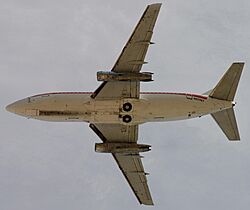
Original 737 with JT8D engines under the wing.
-
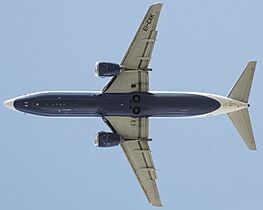
737 Classic with larger CFM56 engines mostly ahead of the wing.
-
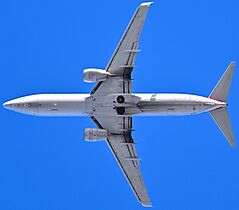
737 Next Generation with improved CFM56-7 engines and redesigned wing.
-
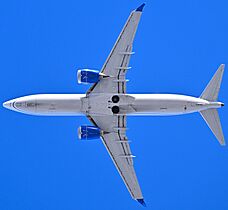
737 MAX with larger CFM LEAP engines, even further ahead of the wing.


Inside the Cabin
The first 737 Original series had a basic cabin. The 737 Classic series got a new design based on the Boeing 757 cabin. Then, the 737 Next Generation got another new design, based on the Boeing 777 cabin. Boeing later offered the "Sky Interior" for the NG. This interior has sculpted walls, new window frames, more headroom, and LED lighting. It also has larger overhead bins, like those on the 777 and 787. This means more space for luggage. The Sky Interior also makes the cabin quieter. The first 737 with the Sky Interior was delivered in 2010. The 737 MAX also uses the Boeing Sky Interior.
-
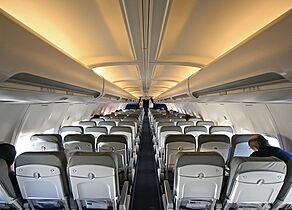
737 Classic interior.
-
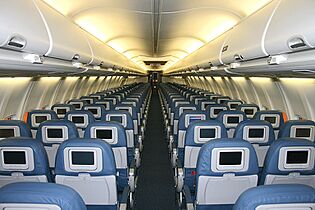
737 Next Generation standard interior.
-
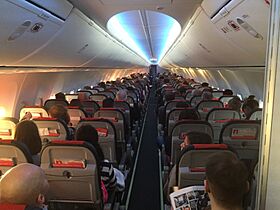
737 Next Generation Sky Interior with pivot bins and LED lighting.
-
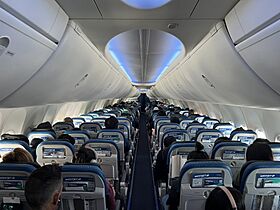
737 MAX Sky Interior.


The Cockpit
The 737 uses a mechanical flight control system. This is similar to older planes like the Boeing 707. Pilot commands go through steel cables to hydraulic systems that move the plane's surfaces. This is different from newer planes that use electrical "fly-by-wire" systems.
The main flight controls have mechanical backups. If all hydraulic power fails, the pilot can still control the plane using special tabs on the wings and tail. This is called "manual reversion."
The 737 Next Generation introduced a modern "glass cockpit" with six LCD screens. It was designed so pilots who flew older 737s could easily learn to fly it. The 737 MAX has an even newer cockpit with four large 15.1-inch LCD screens. This design comes from the Boeing 787 Dreamliner. Most controls are similar to older 737s, making it easier for pilots to switch between models.
-
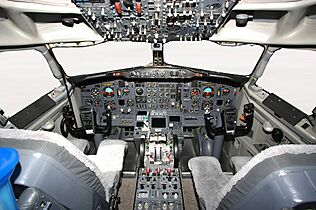
Original 737 cockpit.
-
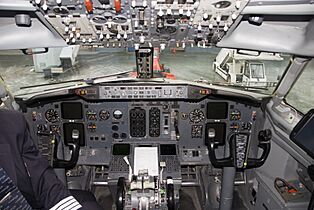
737 Classic cockpit.
-
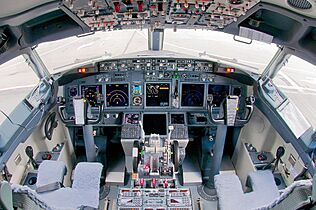
737 Next Generation cockpit.
-
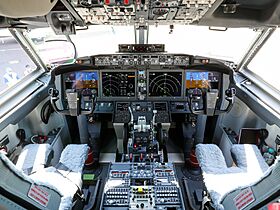
737 MAX cockpit.


The Engines
The engines on the 737 Classic and Next Generation series do not have perfectly round openings. They are flattened on the bottom. This is because the engines became larger, but the 737 sits low to the ground. The 737 Classic series used CFM56 engines. These were 25% more efficient and much quieter than the older JT8D engines on the 737 Original series.
Boeing and CFM International solved the problem of the large engines. They placed the engine further ahead of the wing. They also moved engine parts to the sides of the engine pod. This gave the 737 Classic and later models their unique, flattened engine shape.
The improved CFM56-7 engine on the 737 Next Generation is 7% more fuel-efficient. The newest 737 MAX series uses LEAP-1B engines. These engines are expected to be 10-12% more efficient than the CFM56-7B engines.
-
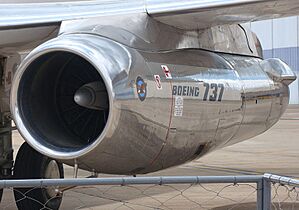
Original 737 with JT8D engine under the wing.
-
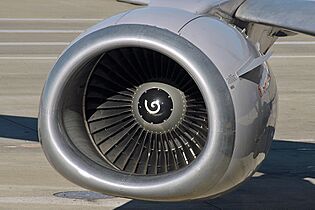
737 Classic with larger CFM56 engine and a flattened "hamster pouch" inlet.
-
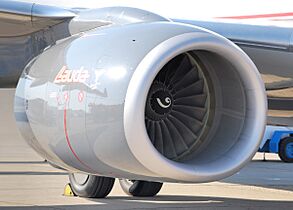
737 Next Generation with CFM56-7 engine and a more rounded inlet.
-
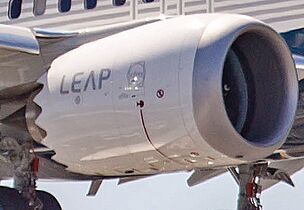
737 MAX with larger CFM LEAP engines, with a special chevron pattern.
_JT8D.jpg)


Wingtips and Winglets
The first 737-100 and -200 models did not have wingtip devices. Later, these were added to save fuel. The 737 has four types of winglets:
- The 737-200 Mini-winglet.
- The 737 Classic/NG Blended Winglet.
- The 737 Split Scimitar Winglet.
- The 737 MAX Advanced Technology Winglet.
Blended winglets became standard on the 737 NG in 2000. They can also be added to older 737 Classic models. These winglets are about 8 feet tall and are at the ends of the wings. They save up to 5% fuel by reducing drag.
Split Scimitar winglets became available in 2014 for some 737 NG models. These winglets save even more fuel, up to 5.5%. Southwest Airlines flew the first 737-800 with Split Scimitar winglets in 2014. The 737 MAX uses a new "Advanced Technology" (AT) Winglet. This winglet looks like a mix of the Blended and Split Scimitar winglets.
-
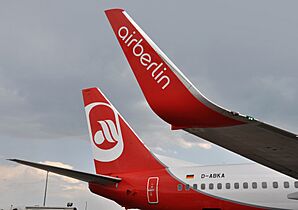
Blended Winglet, common on 737 Next Generation.
-
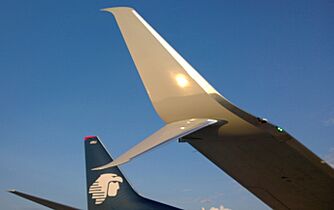
Split Scimitar Winglet on later 737 Next Generation models.
-
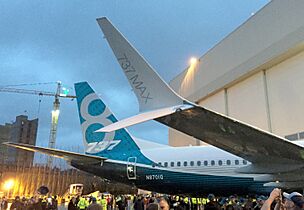
Advanced Technology Winglet on the 737 MAX.


_winglet.jpg)
Other Special 737 Models
737 AEW&C (E-7 Wedgetail)
.jpg)
The Boeing 737 AEW&C is a military plane used for Airborne Early Warning and Control. It is based on the 737-700. This plane has a special radar system on top of its body, which looks like a "top hat." Countries like Australia, Turkey, and South Korea use this plane.
T-43/CT-43A

The T-43 was a 737-200 modified for the United States Air Force. It was used to train navigators. These planes were delivered in 1973 and 1974. Two T-43s were later changed into CT-43As. These were used to transport important people. The T-43 was retired in 2010 after 37 years of service.
Boeing 737-2X9 Surveiller
_Surveiller.jpg)
The Indonesian Air Force ordered three special 737-200s. These were called "Boeing 737-2X9 Surveiller." They were used for patrolling the seas and for transport. They had a special radar system. These planes were delivered between 1982 and 1983.
C-40 Clipper

The Boeing C-40 Clipper is a military version of the 737-700C. It is used by the United States Navy and the United States Air Force. The Navy's C-40A is officially named "Clipper."
P-8 Poseidon

The P-8 Poseidon was developed for the United States Navy. It is based on the 737-800ERX. The P-8 can find submarines and ships. It can also stop ships from moving. It carries torpedoes and missiles. It can also drop and listen to special buoys to find things underwater.
Boeing Business Jet (BBJ)

In the late 1980s, Boeing offered a business jet version of the 737-300. After the Next Generation series came out, Boeing launched the Boeing Business Jet (BBJ) series. The BBJ1 was similar to the 737-700. It had stronger wings and landing gear from the 737-800. It could fly farther than other 737 models because it had extra fuel tanks. The first BBJ flew in September 1998.
In 1999, Boeing launched the BBJ2. It is based on the 737-800. It is longer than the BBJ1, with more cabin and baggage space. It also has extra fuel tanks and winglets. The first BBJ2 was delivered in 2001.
Boeing's BBJ3 is based on the 737-900ER. The BBJ3 has even more interior space and luggage space than the BBJ2. It has a system for extra fuel, allowing it to fly very long distances. The first BBJ3 was finished in 2008.
Boeing Converted Freighter Program
The Boeing Converted Freighter (BCF) program started in 2016. It changes old 737-800 passenger planes into cargo planes. The first 737-800BCF was delivered in 2018.
Experimental 737s
Four 737 planes have been used in Boeing's test programs. In 2012, a new 737-800 became the first "ecoDemonstrator" plane. This program tests new technologies to reduce the environmental impact of flying. It tested winglets for the 737 MAX and new types of fuel.
In 2018, a 737 MAX 7 prototype tested a new engine inlet designed to reduce engine noise.
A 737 MAX 9 was used as the 2021 ecoDemonstrator. It flew many tests, including using sustainable aviation fuel (SAF). It even flew to a climate change conference in Scotland.
In 2023, a 737 MAX 10 tested how SAF affects emissions and contrails. Another NASA plane flew behind it to measure the emissions.
Competition for the Boeing 737

The Boeing 737 Classic, Next Generation, and MAX series have faced strong competition. The Airbus A320 family, first introduced in 1988, is its main rival. The newer Airbus A220 family also competes with the smaller 737 models.
Between 1988 and 2018, Boeing delivered 8,918 737s. Airbus delivered 8,605 A320 family planes in a similar time.
Who Uses the Boeing 737?
.jpg)
The five largest airlines that use the Boeing 737 are Southwest Airlines, Ryanair, United Airlines, American Airlines, and Delta Air Lines.
Civilian Use
In 2006, over 4,500 Boeing 737s were flown by more than 500 airlines. They flew to 1,200 places in 190 countries. On average, 1,250 737s were in the air at any time.
In 2013, over 5,580 Boeing 737s were used by more than 342 airlines. This was over 25% of all large jet airliners worldwide. The 737 had carried over 16.8 billion passengers.
By 2018, over 7,500 Boeing 737s were in service. On average, 2,800 planes were in the air at any moment. They carried about three million passengers every day. The global 737 fleet had carried over 22 billion passengers since it first started flying.
As of June 2021, there were 9,315 Boeing 737s in service. This was slightly fewer than the 9,353 Airbus A320 family planes.
Military Use

Many countries use 737 passenger, business, and cargo versions for government or military purposes. Some of these countries include:


Orders and Deliveries of the 737
Orders
The 737 family had the most orders for any airliner until the Airbus A320 family surpassed it in October 2019. In 2019, 737 orders dropped a lot after the MAX planes were temporarily stopped from flying.
As of January 2026, 17,312 units of the 737 have been ordered. There are 4,903 orders still waiting to be built.
Deliveries

The 5,000th 737 was delivered in 2006. The 6,000th was delivered in 2009. The 7,000th was delivered in 2011. The 8,000th was delivered in 2014. The 9,000th was delivered in 2016. The 10,000th 737 was ordered in 2012 and delivered in 2018.
The 737 family had the highest total deliveries of any airliner until the Airbus A320 family surpassed it in September 2025. In total, 12,409 units of the 737 have been delivered.
| Year | Total | 2026 | 2025 | 2024 | 2023 | 2022 | 2021 | 2020 | 2019 | 2018 | 2017 | 2016 | 2015 | 2014 | 2013 | 2012 | 2011 | 2010 | 2009 | 2008 | 2007 |
|---|---|---|---|---|---|---|---|---|---|---|---|---|---|---|---|---|---|---|---|---|---|
| Deliveries | 12,409 | 37 | 447 | 265 | 396 | 387 | 263 | 43 | 127 | 580 | 529 | 490 | 495 | 485 | 440 | 415 | 372 | 376 | 372 | 290 | 330 |
| 2006 | 2005 | 2004 | 2003 | 2002 | 2001 | 2000 | 1999 | 1998 | 1997 | 1996 | 1995 | 1994 | 1993 | 1992 | 1991 | 1990 | 1989 | 1988 | 1987 |
|---|---|---|---|---|---|---|---|---|---|---|---|---|---|---|---|---|---|---|---|
| 302 | 212 | 202 | 173 | 223 | 299 | 282 | 320 | 282 | 135 | 76 | 89 | 121 | 152 | 218 | 215 | 174 | 146 | 165 | 161 |
| 1986 | 1985 | 1984 | 1983 | 1982 | 1981 | 1980 | 1979 | 1978 | 1977 | 1976 | 1975 | 1974 | 1973 | 1972 | 1971 | 1970 | 1969 | 1968 | 1967 |
|---|---|---|---|---|---|---|---|---|---|---|---|---|---|---|---|---|---|---|---|
| 141 | 115 | 67 | 82 | 95 | 108 | 92 | 77 | 40 | 25 | 41 | 51 | 55 | 23 | 22 | 29 | 37 | 114 | 105 | 4 |
Summary of 737 Models
| Generation | Model series | ICAO code | Orders | Deliveries | Unfilled orders | First flight |
|---|---|---|---|---|---|---|
| 737 Original | 737-100 | B731 | 30 | 30 | — | April 9, 1967 |
| 737-200 | B732 | 991 | 991 | — | August 8, 1967 | |
| 737-200C | 104 | 104 | — | September 18, 1968 | ||
| 737-T43A | 19 | 19 | — | March 10, 1973 | ||
| 737 Classic | 737-300 | B733 | 1,113 | 1,113 | — | February 24, 1984 |
| 737-400 | B734 | 486 | 486 | — | February 19, 1988 | |
| 737-500 | B735 | 389 | 389 | — | June 30, 1989 | |
| 737 NG | 737-600 | B736 | 69 | 69 | — | January 22, 1998 |
| 737-700 | B737 | 1,130 | 1,130 | — | February 9, 1997 | |
| 737-700C | 22 | 22 | — | April 14, 2000 | ||
| 737-700W | 14 | 14 | — | May 20, 2004 | ||
| 737-800 | B738 | 4,991 | 4,989 | 2 | July 31, 1997 | |
| 737-800A | 201 | 187 | 14 | April 25, 2009 | ||
| 737-900 | B739 | 52 | 52 | — | August 3, 2000 | |
| 737-900ER | 505 | 505 | — | September 1, 2006 | ||
| 737 BBJ | 737-BBJ1 (-700) | B73G | 122 | 122 | — | September 4, 1998 |
| 737-BBJ2 (-800) | B738 | 23 | 23 | — | N/A | |
| 737-BBJ3 (-900) | B739 | 7 | 7 | — | N/A | |
| 737 MAX | 737-7 | B37M | 7,044 | — | 291 | March 16, 2018 |
| 737-8 | B38M | 2,157 | 2,977 | January 29, 2016 | ||
| 737-9 | B39M | 199 | April 13, 2017 | |||
| 737-10 | B3XM | — | 1,420 | June 18, 2021 | ||
| Boeing 737 family | 17,312 | 12,409 | 4,903 | |||
Safety and Incidents
As of November 2023, the Boeing 737 family has been involved in 529 aviation incidents. This includes 215 accidents where the plane was a total loss. These incidents resulted in 5,779 deaths.
Boeing studied commercial jet accidents from 1959 to 2013. They found that the Original series had 1.75 total loss accidents per million flights. The Classic series had 0.54, and the Next Generation series had 0.27. As of 2023, the MAX series had 1.48 total loss accidents per million flights.
In the 1990s, some 737-200 and -300 planes had problems with their rudders. This led to several incidents. In two accidents, United Airlines Flight 585 and USAir Flight 427, the pilots lost control of the plane. This happened because the rudder moved unexpectedly. All 157 people on board died. The National Transportation Safety Board found that a design flaw caused the rudder to move on its own. Because of this, the Federal Aviation Administration ordered that rudder parts be replaced on all 737s. They also created new training for pilots.
After two 737 MAX 8 planes crashed in 2018 and 2019, causing 346 deaths, aviation authorities around the world temporarily stopped the 737 MAX from flying. In December 2019, Boeing announced it would pause production of the 737 MAX. Production started again in May 2020.
Boeing 737s on Display
.jpg)
Because the 737 has been made for so long, many older planes are now in museums.
- The very first 737-130, registered N515NA, is on display at the Museum of Flight in Seattle, Washington. It is painted in NASA colors.
- A 737-201, registered N213US, has its front part on display at the Museum of Flight in Seattle. It is painted in USAir colors.
- A 737-281, registered LV-WTX, is on display at the National Museum of Aeronautics in Argentina.
- A 737-2H4, registered C-GWJT, is on display at the British Columbia Institute of Technology in Canada. It is used for training and is painted in WestJet colors.
- A 737-2H4, registered N29SW, is on display at the Kansas Aviation Museum in Wichita, Kansas. It used to fly for Southwest Airlines.
- A 737-3H4, registered N300SW, is on display at the Frontiers of Flight Museum in Dallas, Texas. This was the first 737-300 delivered to Southwest Airlines.
- A 737-301, registered PK-AWU, is on display at ITE College Central in Singapore. It is used for training.
- A 737-436, registered G-DOCB, is on display at Cranfield University in the United Kingdom. It is used for research and teaching.
Specifications (Boeing 737-200 with JT8D-15A)
General characteristics
- Crew: 2
- Capacity: 102 passengers in two classes or 115 in one class, and 875 cu ft (24.8 m3) of cargo
- Length: 100 ft 2 in (30.53 m)
- Wingspan: 93 ft 0 in (28.35 m)
- Width: 12 ft 4 in (3.76 m) (fuselage)
- Height: 36 ft 10 in (11.23 m)
- Wing area: 979.9 sq ft (91.04 m2)
- Empty weight: 65,300 lb (29,620 kg)
- Max takeoff weight: 128,100 lb (58,105 kg)
- Fuel capacity: 5,970 US gal (22,600 L)
- Powerplant: 2 × Pratt & Whitney JT8D-15A turbofan engine, 15,500 lbf (69 kN) thrust each
Performance
- Maximum speed: Mach 0.84
- Cruise speed: 483 mph; 778 km/h (420 kn)
- Range: 2,992 mi; 4,815 km (2,600 nmi)
- Service ceiling: 37,000 ft (11,000 m)
- Takeoff distance: 6,099 ft (1,859 m)
See also
 In Spanish: Boeing 737 para niños
- Aircraft related to this one
- Boeing 737 AEW&C
- Boeing 737 Classic
- Boeing 737 MAX
- Boeing 737 Next Generation
- Boeing Business Jet
- Boeing C-40 Clipper
- Boeing P-8 Poseidon
- Boeing T-43
- Similar aircraft
- Airbus A220
- Airbus A320 family
- Boeing 717
- Comac C919
- Dassault Mercure
- Embraer 195
- McDonnell Douglas DC-9
- McDonnell Douglas MD-80
- McDonnell Douglas MD-90
- Sukhoi Superjet 100
- Yakovlev Yak-42D
