
Mole salamander facts for kids
Quick facts for kids Mole salamanders |
|
|---|---|
 |
|
| Spotted salamander (Ambystoma maculatum) | |
Scientific classification  |
|
| Kingdom: | Animalia |
| Phylum: | Chordata |
| Class: | Amphibia |
| Order: | Urodela |
| Family: | Ambystomatidae |
| Genus: | Ambystoma Tschudi, 1838 |
| Type species | |
| Salamandra maculata Shaw, 1802
|
|
Mole salamanders belong to the genus Ambystoma. They are a special group of advanced salamanders native to North America. They get their common name because adult salamanders spend most of their lives underground in a deep burrow, just like real moles! One very famous member of this group is the axolotl. Another well-known member is the tiger salamander, which is popular as a pet and serves as the official state amphibian in several places.
Contents
What Does a Mole Salamander Look Like?

A typical land-dwelling mole salamander has a sturdy body with thick legs and wide eyes. Along the sides of its body, you can see deep vertical lines called costal grooves. Many species show off bright colors on dark skin. These patterns range from vivid yellow bars to shiny blue spots.
Adults live alone on land and hunt for food at night. They eat almost any small invertebrate they can catch, including worms, slugs, and insects. Because they live in underground tunnels, people rarely see them. When winter comes, northern species stay safe from the freezing cold by using hibernating underground. They only leave their cozy dens to travel to water when spring arrives.
Life Cycle and Metamorphosis
Mole salamanders have an exciting life cycle with big changes. Most species start life in freshwater ponds before moving to land.
Eggs in the Water
All mole salamanders are egg-laying animals. Every spring, adults return to the ponds where they were born. Females lay clumps of large eggs underwater. These eggs attach to twigs, leaves, and aquatic plants.
Baby Salamanders
A baby salamander hatches into an aquatic larva. A young larva looks a bit like a tadpole, but it has three pairs of feathery external gills sticking out behind its head. These gills sit right above its gill slits to help it breathe underwater. The larva also has a broad tail fin running along its back. It soon grows four front toes and five back toes.
Changing to Adults
As the young grow, they go through a body transformation called metamorphosis. During this change, their external gills disappear. Their tails lose the swimming fins, and their skin and legs grow much thicker. They develop functioning lungs to breathe air and grow true eyelids. Once this big change is complete, they leave the water and begin their lives on land.
Staying Young Forever
Some mole salamanders never grow up in the usual way! This fascinating condition is called paedomorphosis. The salamander keeps its baby features, like feathery gills and swimming fins, even when it becomes a full adult. The famous axolotl stays in this watery stage for its entire life. Axolotls naturally lack enough of a chemical called thyroxine, which triggers metamorphosis. If given this chemical in a lab, an axolotl can transform, but this is unnatural and shortens its lifespan.
Incredible Superpowers of the Axolotl

The axolotl (Ambystoma mexicanum) has an amazing superpower known as tissue regeneration. If an axolotl loses a leg, it can grow an entire new leg back perfectly!
When an injury occurs, special cells rush to the wound to form a healing bump called a blastema. Scientists study these cells to understand how they multiply and fix broken genetic material. When cells divide quickly, they suffer DNA damage. The salamander uses an internal repair system called homologous recombination to perform DNA repair. By studying this process, scientists hope to learn secrets that could help human medicine someday.
The Amazing Tiger Salamander Complex
The tiger salamander group includes some of the biggest land salamanders in North America. They have broad heads, small eyes, and very thick bodies. Because these creatures live across huge areas, different groups have adapted to local habitats:
- The barred tiger salamander (Ambystoma mavortium) lives throughout western regions.
- The California tiger salamander (Ambystoma californiense) makes its home in the grasslands of California.
- The Plateau tiger salamander (Ambystoma velasci) lives on high plateaus in Mexico alongside the axolotl.
Unique All-Female Salamanders
In parts of North America, scientists discovered unusual all-female populations of mole salamanders. These females do something very strange called kleptogenesis. To start the development of their eggs, they take genetic material from related species, such as the blue-spotted salamander (Ambystoma laterale), the Jefferson salamander (Ambystoma jeffersonianum), the small-mouthed salamander (Ambystoma texanum), or the streamside salamander (Ambystoma barbouri).
Sometimes the mother uses this material to add extra sets of chromosomes, changing the ploidy level of her babies. Other times, she develops eggs through gynogenesis, making copies of herself. This makes them the oldest known all-female vertebrate lineage in the animal kingdom!
Discoveries from the Past

Mole salamanders have lived in North America for millions of years. Paleontologists study extinct species by finding their fossilized bones preserved in ancient rock:
- Ambystoma kansense lived during the late Pliocene epoch in Kansas.
- Ambystoma hibbardi was another ancient salamander from the Pliocene of Kansas.
- Ambystoma minshalli crawled across Nebraska during the late Miocene epoch.
How the Mole Salamander Got Its Name
The Swiss naturalist Johann Jakob von Tschudi named the genus Ambystoma in 1838. He did not write down what the name meant. Later, a scientist named Leonhard Stejneger suggested it came from ancient Greek words meaning "to cram into the mouth," describing the salamander's hearty appetite. Whatever its original meaning, these creatures remain among the most fascinating amphibians on Earth!
Species of Mole Salamanders
There are 32 known species in the Ambystoma group. The newest one discovered is A. bishopi. Some of these species live on land, some stay in their larval (neotenic) form their whole lives, and some species have populations that do both!
| Image | Species and author | Common name | Distribution | Lifestyle | IUCN status |
|---|---|---|---|---|---|
 |
A. altamirani
Dugès, 1895 |
Mountain stream salamander, Achoque | Central Mexico, west and south of the Valley of Mexico | Terrestrial and neotenic |  |
| A. amblycephalum
Taylor, 1940 |
Blunt-headed salamander | West-central Mexico (Michoacán state), near Morelia | Terrestrial and neotenic |  |
|
 |
A. andersoni
(Brandon and Krebs, 1984) |
Anderson's salamander | West-central Mexico (Michoacán state), Laguna de Zacapu | Neotenic | |
 |
A. annulatum
Cope, 1886 |
Ringed salamander | South-central United States (Arkansas, Illinois, Missouri, Oklahoma), Ozark Plateau and Ouachita Mountains | Terrestrial |  |
 |
A. barbouri
Kraus & Petranka, 1989 |
Streamside salamander | South-midwest United States (Indiana, Kentucky, Ohio, Tennessee, West Virginia) | Terrestrial |  |
| A. bishopi
Pauly, Piskurek & Shaffer, 2007 |
Reticulated flatwoods salamander | Southeast United States (Florida Panhandle and southernmost Georgia), west of the Apalachicola-Flint River | Terrestrial |  |
|
| A. bombypellum
(Taylor, 1940) |
Delicate-skinned salamander | Central Mexico (State of Mexico) near Jilotepec | Terrestrial |  |
|
 |
A. californiense
Gray, 1853 |
California tiger salamander | Central Valley of California | Terrestrial | |
 |
A. cingulatum
Cope, 1868 |
Frosted flatwoods salamander | Southeast United States (southern South Carolina and Georgia south to northern Florida) | Terrestrial | |
 |
A. dumerilii
(Dugès, 1870) |
Lake Pátzcuaro salamander, Achoque | West-central Mexico (Michoacán state), Lake Pátzcuaro | Neotenic | |
 |
A. flavipiperatum
Dixon, 1963 |
Yellow-peppered salamander, Ajolote de Chapala | West-central Mexico (Jalisco) | Terrestrial | |
 |
A. gracile
(Baird, 1859) |
Northwestern salamander | Northwest North America (southernmost Alaska to northern California) | Terrestrial | |
| A. granulosum
Taylor, 1944 |
Granular salamander, Ajolote | Central Mexico (State of Mexico) near Toluca | Terrestrial | |
|
 |
A. jeffersonianum
(Green, 1827) |
Jefferson salamander | Northeastern North America (Ontario south to Virginia and west to Illinois) | Terrestrial | |
 |
A. laterale
Hallowell, 1856 |
Blue-spotted salamander | Northeastern North America (Nova Scotia west to Manitoba and Minnesota and south to Indiana and New Jersey) | Terrestrial | |
 |
A. leorae
Taylor, 1943 |
Leora's stream salamander, Ajolote | Central Mexico (Mexico state - Puebla border), Mount Tlaloc | Terrestrial | |
| A. lermaense
(Taylor, 1940) |
Lake Lerma salamander | Central Mexico (State of Mexico), Lake Lerma near Toluca | Terrestrial and neotenic | |
|
 |
A. mabeei
Bishop, 1928 |
Mabee's salamander | Coastal southeast United States (southeast Virginia to South Carolina) | Terrestrial | |
 |
A. macrodactylum
Baird, 1950 |
Long-toed salamander | Northwest North America (Alaska south to northern California and east to Alberta and Montana) | Terrestrial | |
 |
A. maculatum
(Shaw, 1802) |
Spotted salamander | Eastern North America (Nova Scotia west to Wisconsin and south to eastern Texas and Georgia) | Terrestrial | |
 |
A. mavortium
Baird, 1850 |
Barred tiger salamander | Western North America (Manitoba south to Texas and west to Washington and California) | Terrestrial and neotenic | |
|
A. mexicanum
(Shaw and Nodder, 1798) |
Axolotl | Central Mexico (State of Mexico), Lake Xochimilco | Neotenic | |
 |
A. opacum
(Gravenhorst, 1807) |
Marbled salamander | Eastern United States (New Hampshire south to northern Florida and east to Missouri and Texas) | Terrestrial | |
| A. ordinarium
Taylor, 1940 |
Puerto Hondo stream salamander | West-central Mexico (Michoacán state), Puerto Hondo stream | Terrestrial and neotenic | |
|
 |
A. rivulare
Taylor, 1940 |
Michoacan stream salamander | Central Mexico (western State of Mexico) | Terrestrial and neotenic | |
 |
A. rosaceum
Taylor, 1941 |
Tarahumara salamander | Northwest Mexico, Sierra Madre Occidental | Terrestrial and neotenic | |
| A. silvense
Webb, 2004 |
Durango salamander | Northwest Mexico (Durango and Chihuahua), Sierra Madre Occidental | Terrestrial and neotenic | |
|
 |
A. talpoideum
Holbrook, 1838 |
Mole salamander | Southeast United States (Virginia west to Oklahoma and south to northern Florida) | Terrestrial and neotenic | |
 |
A. taylori
Brandon, Maruska, and Rumph, 1982 |
Taylor's salamander | Southeast Mexico (Puebla), Laguna Alchichica | Neotenic | |
 |
A. texanum
Matthes, 1855 |
Small-mouth salamander | South-central United States (Ohio west to Nebraska and south to Texas and Alabama) | Terrestrial | |
 |
A. tigrinum
(Green, 1825) |
Eastern tiger salamander | Eastern North America (New York northwest to Manitoba and south to Texas and northern Florida) | Terrestrial and neotenic | |
 |
A. velasci
(Dugès, 1888) |
Plateau tiger salamander | Mexican Plateau | Terrestrial and neotenic | |
Sometimes, two groups of all-female hybrid populations are also given their own species names:
- Silvery salamander (A. platineum)
- Tremblay's salamander (A. tremblayi)
Images for kids
-
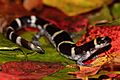
The ringed salamander has bright stripes across its back.
-
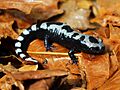
The marbled salamander displays striking silver and black patterns.
-
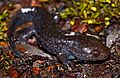
A small mole salamander hiding in the soil.
-
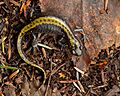
The long-toed salamander has long toes for walking.
-

A family tree diagram showing how different species are related.

See also
 In Spanish: Ambystoma para niños
- Oophila amblystomatis
