
Saturn facts for kids

Saturn and its prominent rings, as captured by the Cassini orbiter
|
|||||||||||||
| Designations | |||||||||||||
|---|---|---|---|---|---|---|---|---|---|---|---|---|---|
|
Named after
|
Saturn | ||||||||||||
| Adjectives | Saturnian Cronian / Kronian | ||||||||||||
| Orbital characteristics | |||||||||||||
| Epoch J2000.0 | |||||||||||||
| Aphelion | 1,514.50 million km (10.1238 AU) | ||||||||||||
| Perihelion | 1,352.55 million km (9.0412 AU) | ||||||||||||
| 1,433.53 million km (9.5826 AU) | |||||||||||||
| Eccentricity | 0.0565 | ||||||||||||
|
|||||||||||||
| 378.09 days | |||||||||||||
|
Average orbital speed
|
9.68 km/s | ||||||||||||
| 317.020° | |||||||||||||
| Inclination |
|
||||||||||||
| 113.665° | |||||||||||||
| 2032-Nov-29 | |||||||||||||
| 339.392° | |||||||||||||
| Known satellites | 274 with formal designations; innumerable additional moonlets. | ||||||||||||
| Physical characteristics | |||||||||||||
|
Mean radius
|
58232 km 9.1402 Earths |
||||||||||||
|
Equatorial radius
|
|
||||||||||||
|
Polar radius
|
|
||||||||||||
| Flattening | 0.09796 | ||||||||||||
| Circumference | 365882.4 km (equatorial) | ||||||||||||
|
|||||||||||||
| Volume |
|
||||||||||||
| Mass |
|
||||||||||||
|
Mean density
|
0.687 g/cm3 0.1246 Earths |
||||||||||||
| 10.44 m/s2 1.065 g0 |
|||||||||||||
|
Moment of inertia factor
|
0.22 | ||||||||||||
| 35.5 km/s | |||||||||||||
| 10 h 32 m 36 s; 10.5433 hours, 10 h 39 m; 10.7 hours |
|||||||||||||
|
Sidereal rotation period
|
10h 33m 38s +h 1m 52s −h 1m 19s |
||||||||||||
|
Equatorial rotation velocity
|
9.87 km/s | ||||||||||||
| 26.73° (to orbit) | |||||||||||||
|
North pole right ascension
|
40.589°; 2h 42m 21s | ||||||||||||
|
North pole declination
|
83.537° | ||||||||||||
| Albedo | |||||||||||||
|
|||||||||||||
| −0.55 to +1.17 | |||||||||||||
| −9.7 | |||||||||||||
| 14.5″ to 20.1″ (excludes rings) | |||||||||||||
| Atmosphere | |||||||||||||
|
Surface pressure
|
>>1000 bars | ||||||||||||
| 59.5 km | |||||||||||||
| Composition by volume | |||||||||||||
Saturn is the sixth planet from the Sun. It is the second-largest planet in the Solar System, right after Jupiter. Saturn is a gas giant, which means it is made mostly of gas and does not have a solid surface like Earth. It is famous for its beautiful and large system of rings.
Saturn is huge compared to Earth. Its radius is about nine times larger than Earth's. However, it is very light for its size. It is the only planet in the Solar System that is less dense than water. This means that if you could find a bathtub big enough to hold Saturn, the planet would float!
The planet orbits the Sun at a very far distance, about 1.4 billion kilometers away. It takes Saturn about 29 and a half Earth years to complete one trip around the Sun. Saturn has at least 274 moons, not counting the millions of small icy rocks in its rings. Its largest moon, Titan, is bigger than the planet Mercury.
Contents
Discovering the Name

Saturn has been watched by humans since ancient times because it is easily seen with the naked eye. In ancient Roman religion, the planet was named after Saturn, the Roman god of farming, agriculture, and harvest. The ancient Greeks called the planet Cronus (or Kronos), who was the father of Zeus (known to the Romans as Jupiter).
Because Saturn moves slowly and steadily across the night sky, ancient cultures often connected it with time and discipline. The Roman name also gave us our word for the seventh day of the week, Saturday ("Saturn's Day").
Physical features of Saturn
Saturn is a gas giant made mostly of hydrogen and helium. Because it spins very fast, the planet is not a perfect sphere. It is flattened at the top and bottom (the poles) and bulges out at the middle (the equator). This shape is called an oblate spheroid.
The gravity on Saturn is just a little bit stronger than on Earth. If you could stand on Saturn's cloud tops, you would feel about 1.07 times heavier than you do on Earth.
Internal structure

Even though Saturn is made of gas on the outside, the inside is different. Scientists think Saturn has a hot, rocky core at its center. This core is surrounded by a layer of metallic hydrogen. This is a special form of hydrogen that acts like a liquid metal because of the extreme pressure deep inside the planet.
Above the metallic hydrogen, there is a layer of liquid hydrogen and helium. As you go higher, this liquid gradually turns into the gas that makes up the atmosphere we see. The core is very hot, reaching temperatures of about 11,700 °C (21,100 °F). Saturn actually gives off more heat into space than it receives from the Sun.
The atmosphere and weather
Saturn's outer atmosphere is mostly hydrogen (96%) and helium (3%). It has yellow and gold bands of clouds that circle the planet. These bands are caused by super-fast winds. The winds on Saturn can reach speeds of 1,800 kilometres per hour (1,100 miles per hour), which is much faster than the strongest hurricanes on Earth.
Sometimes, large storms appear on Saturn. One famous type of storm is called the Great White Spot. These are giant white clouds that appear roughly once every 30 Earth years (one Saturn year). A massive storm was observed in 2010, and before that in 1990.
The hexagonal cloud


One of the most amazing features of Saturn is a cloud pattern at its north pole shaped like a hexagon (a six-sided shape). Each side of this hexagon is longer than the diameter of Earth. Inside this shape, there is a storm rotating. This pattern was first seen by the Voyager spacecraft in the 1980s and later studied by the Cassini spacecraft. Scientists believe it is caused by a wave pattern in the jet stream winds.
At the south pole, there is no hexagon, but there is a massive hurricane-like storm with a clear "eye" in the center.
Magnetosphere
Saturn acts like a giant magnet. It has a magnetic field that creates a bubble around the planet called a magnetosphere. This bubble protects Saturn from particles coming from the Sun. Saturn's magnetic field is weaker than Jupiter's but still much stronger than Earth's. This magnetic field creates beautiful auroras (northern and southern lights) at Saturn's poles, similar to those seen on Earth.
Orbit and rotation

Saturn is very far from the Sun, about 9.5 AU (Astronomical Units). One AU is the distance from Earth to the Sun. Because it is so far away, it takes Saturn about 10,759 Earth days (or 29.5 years) to orbit the Sun once.
Saturn spins on its axis very quickly. A day on Saturn (one full rotation) lasts only about 10 hours and 33 minutes. This fast rotation is what causes the planet to bulge at the equator.
Like Earth, Saturn is tilted on its axis. This tilt causes seasons on Saturn, just like we have summer and winter. However, because Saturn takes nearly 30 years to orbit the Sun, each season on Saturn lasts for more than seven Earth years.
The rings of Saturn
.jpg)
Saturn is best known for its spectacular rings. They extend thousands of kilometers into space but are surprisingly thin, only about 20 metres (66 ft) thick in most places.
The rings are made mostly of chunks of water ice, ranging in size from tiny dust specks to pieces as big as a house. There is also some rock and dust mixed in. The rings are divided into different sections, named alphabetically (A, B, C, etc.) in the order they were discovered.
There are gaps between the rings. The largest gap is called the Cassini Division, which separates the bright B Ring from the A Ring. Some small moons, called "shepherd moons," orbit near the rings and use their gravity to keep the ring particles in place.
Scientists are not sure exactly how old the rings are. Some think they formed with Saturn 4.5 billion years ago. Others think they are much younger, perhaps formed when a moon was destroyed by Saturn's gravity about 100 million years ago.

Moons of Saturn

Saturn has 274 known moons. 63 of them have official names. Many of these moons are small icy worlds, but a few are very large and interesting.
Titan
Titan is Saturn's largest moon and the second-largest moon in the entire Solar System. It is the only moon known to have a thick atmosphere. Titan's atmosphere is mostly nitrogen, like Earth's, but it is very cold.
Titan has lakes and seas on its surface, but they are not filled with water. Instead, they are filled with liquid methane and ethane. In 2005, a probe named Huygens landed on Titan and sent back pictures of its surface.
Enceladus
Enceladus is a smaller, icy moon. It is very bright because it is covered in fresh, clean ice. In 2006, the Cassini spacecraft discovered geysers shooting water vapor and ice particles from the moon's south pole. This suggests that Enceladus has a liquid water ocean beneath its icy crust. Scientists think this ocean could be a place where simple life might exist.
History of observation

Early discoveries
People have known about Saturn since ancient times because it is visible to the naked eye as a bright star. The Romans named it after their god of agriculture, Saturn.
In 1610, the astronomer Galileo Galilei looked at Saturn through a telescope. He saw strange bumps on the sides of the planet and thought they were two large moons. In 1655, Christiaan Huygens used a better telescope and realized that Saturn was surrounded by a flat ring.
Space missions
Several spacecraft have visited Saturn to learn more about it:
- Pioneer 11 (1979): The first spacecraft to fly by Saturn. It took low-resolution photos.
- Voyager 1 and 2 (1980-1981): These probes took detailed pictures of the rings, moons, and atmosphere. They discovered new moons and studied Titan.
- Cassini-Huygens (2004-2017): This was a joint mission by NASA and the European Space Agency. The Cassini spacecraft orbited Saturn for 13 years, sending back thousands of amazing images and data. It dropped the Huygens probe onto Titan. The mission ended in 2017 when Cassini was deliberately crashed into Saturn's atmosphere to protect the moons from contamination.
How to see Saturn

You can see Saturn from Earth without a telescope. It looks like a bright, yellowish star. However, to see the rings, you need a small telescope or very strong binoculars.
Every 15 years, the rings appear to disappear. This happens when Earth passes through the plane of the rings, so we see them edge-on. Since the rings are so thin, they become almost invisible. This event happened earlier in 2025.
Fun facts about Saturn
- Saturn is the king of moons. It has at least 274 moons that we know of. That's more than any other planet!
- The planet is named after the Roman god of agriculture and wealth. The name also gives us "Saturday."
- Saturn isn't the only planet with rings, but it has the biggest and brightest ones in our whole solar system.
- The rings we see today might not have been there when the dinosaurs lived, and they might disappear in about 100 million years as Saturn's gravity pulls them in.
- Even though it's huge, Saturn spins incredibly fast. One day on Saturn (one full spin) is only about 10.7 hours long. That means its day is less than half as long as an Earth day.
- Saturn is so light and fluffy that it would float in a bathtub… if you could find a bathtub big enough! It’s made mostly of gas (like hydrogen and helium), so it’s the least dense planet we know.
See also
 In Spanish: Saturno (planeta) para niños
- Solar System
- Gas giant
- List of missions to Saturn
Images for kids
-
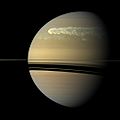
A global storm girdles the planet in 2011. The storm passes around the planet, such that the storm's head (bright area) passes its tail.
-

Auroral lights at Saturn's north pole
-
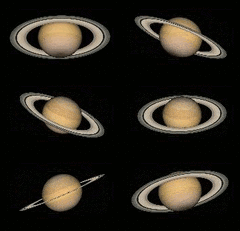
A simulated appearance of Saturn as seen from Earth (at opposition) during an orbit of Saturn, 2001–2029
-
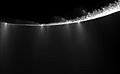
At Enceladus's south pole, geysers spray water from many locations along the tiger stripes.
-
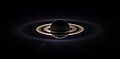
Saturn eclipses the Sun, as seen from Cassini. The rings are visible, including the F Ring.
-

Robert Hooke noted the shadows cast by both the globe and the rings on each other in this drawing of Saturn in 1666.
-
Pioneer 11 image of Saturn


