
Paleolithic facts for kids
The Paleolithic age, also known as the Old Stone Age, is the earliest and longest period of human prehistory. It started roughly 3.3 million years ago when early human ancestors first made simple stone tools. It lasted until the end of the last Ice Age, around 11,650 years ago.
During this vast era, early humans evolved physically and culturally. They lived as nomadic hunter-gatherers in small family groups. They gathered wild edible plants, fished in rivers, and hunted wild animals.
Over thousands of generations, humans learned to control fire, build shelters, and travel across vast oceans. They also created stunning cave art, carved musical instruments, and invented advanced hunting gear like bows and spear-throwers.
Contents
- The Meaning and Timeline of the Old Stone Age
- Ice Age Climates and Prehistoric Geography
- The Evolution of Early Human Species
- Prehistoric Tools and Craft Technologies
- Hunter-Gatherer Daily Life and Food
- Prehistoric Art, Music, and Culture
- Spiritual Beliefs and Ceremonies
- The End of the Paleolithic Era
- Summary of the Stone Age Eras
- Related pages
- Images for kids
- See also
The Meaning and Timeline of the Old Stone Age
The word "Palaeolithic" was created by archaeologist John Lubbock in 1865. It comes from two Greek words: palaios, meaning "old", and lithos, meaning "stone".
Scientists divide this enormous span of prehistoric time into three smaller segments:
- The Lower Paleolithic: This period began around 3.3 million years ago with the earliest stone choppers and ended around 300,000 years ago. Early human species like Homo habilis and Homo erectus appeared.
- The Middle Paleolithic: Lasting from about 300,000 to 50,000 years ago, this era saw the rise of Neanderthals and the emergence of modern humans (Homo sapiens). Toolmaking became much more precise.
- The Upper Paleolithic: Lasting from roughly 50,000 to 11,650 years ago, modern humans spread across the world. They produced remarkable art, complex bone tools, and sewn clothing.
Ice Age Climates and Prehistoric Geography


The Paleolithic took place mostly during the Pleistocene epoch, a geological time known for repeated ice ages. Immense sheets of glacial ice repeatedly expanded and retreated across continents.
When huge amounts of water froze into glaciers, ocean levels dropped by over 100 meters (330 feet). This created wide land bridges between regions that are separated by water today.
For example, a land bridge called Beringia connected Siberia and North America. This allowed animals and humans to migrate across continents on foot.
Cold Steppes and Giant Ice Age Animals

Much of northern Europe, Asia, and North America was covered by a cold grassland called the mammoth steppe. Massive mammals thrived in these chilly, open habitats.
Early humans lived alongside legendary Pleistocene megafauna, including:
- Woolly mammoths and mastodons, which provided thick hides, bone building materials, and meat.
- Woolly rhinoceroses with dense, shaggy fur coats.
- Saber-toothed cats and massive cave lions.
- Giant ground sloths and heavily armored armadillo relatives like Glyptodon.
When the climate warmed at the end of the Pleistocene around 12,000 years ago, many of these giant animals went extinct. Scientists believe a combination of rapid climate shifts and human hunting led to their disappearance.
The Evolution of Early Human Species

Human beings were not always the same as we are today. Over millions of years, several different hominin species lived and died out.
Homo habilis and Homo erectus
The earliest toolmaker in our genus was Homo habilis ("handy man"), who lived in East Africa around 2 million years ago. They had larger brains than earlier ape-like ancestors and used sharp rock chips to cut meat.
Later, Homo erectus ("upright man") evolved. They were taller, walked fully upright, and became the first hominins to migrate out of Africa into Asia and southern Europe around 1.8 million years ago. Homo erectus used larger hand axes and learned how to control fire.
Neanderthals and Denisovans
Around 400,000 years ago, Neanderthals (Homo neanderthalensis) emerged in Europe and western Asia. Neanderthals were stocky, muscular, and well-adapted to surviving freezing Ice Age winters. They were skilled big-game hunters who buried their dead and cared for injured group members.
In Asia, another related group called the Denisovans lived at the same time. Genetic studies show that modern humans occasionally interacted with both Neanderthals and Denisovans before those groups disappeared around 40,000 years ago.
The Rise of Modern Humans
Anatomically modern humans, Homo sapiens, arose in Africa around 300,000 years ago. Around 60,000 to 50,000 years ago, modern humans began expanding rapidly across the globe.
Humans reached Australia by boat at least 50,000 years ago. They entered cold regions of Siberia by 27,000 years ago, and crossed into the Americas before the close of the Ice Age.
Prehistoric Tools and Craft Technologies
.jpg)
Toolmaking was the defining achievement of the Paleolithic. Without sharp claws or powerful teeth, humans relied on their brains to shape raw materials into survival gear.
Early Stone Industries: Oldowan and Acheulean
The earliest known tool style is the Oldowan industry, which started around 2.6 million years ago. Early hominins made these tools by smashing river cobbles together to create sharp flakes and crude chopping stones.
About 1.7 million years ago, Homo erectus developed the Acheulean industry. They shaped stones on both sides to produce symmetrical, teardrop-shaped hand axes. These multi-purpose hand axes were used for cutting wood, digging roots, and butchering game.
Advanced Toolmaking and Composite Weapons
In the Middle and Upper Paleolithic, toolmakers invented the prepared-core technique. Instead of chipping away randomly, they carefully shaped a rock core so that striking it would detach uniform, razor-sharp stone blades.
Humans also created composite tools by joining different materials together:
- Stone-tipped spears: Sharp stone points were glued with natural pitch and tied with animal sinew onto wooden shafts.
- Atlatls (spear throwers): Handheld levers that let hunters launch darts much faster and farther.
- Bows and arrows: Developed around 30,000 to 25,000 years ago, allowing safe hunting from a distance.
- Bone harpoons and fishhooks: Barbed bone points designed for catching large fish and seals.
- Sewing needles: Delicate bone needles with tiny eyes allowed humans to stitch tailored, multi-layered fur coats for freezing weather.
The Discovery and Power of Fire

The ability to use fire was one of humanity's greatest milestones. Evidence shows that hominins began using fire between 1 million and 400,000 years ago.
Fire provided several critical advantages:
- Warmth: It allowed tropical hominins to survive freezing nights and expand into cold northern regions.
- Protection: Bright campfires kept dangerous nighttime predators away from campsites.
- Cooking: Cooking food broke down tough plant fibers and made meat safer to digest, providing more energy for developing bigger brains.
- Toolmaking: Fire was used to harden wooden spear tips and melt natural resins for glue.
Later in the Upper Paleolithic, humans invented "stone boiling." They heated stones in a fire and dropped them into water containers made of animal skins or wood to cook stews and broths.
Early Boats and Sea Voyages
Prehistoric people were skilled navigators. Simple wooden rafts or dugout canoes allowed early groups to cross open stretches of ocean to reach islands like Flores in Indonesia hundreds of thousands of years ago.
By 50,000 years ago, modern humans crossed deep ocean channels to reach Australia, showing they could build sturdy sea craft and navigate open waters.
Hunter-Gatherer Daily Life and Food

Paleolithic humans lived as nomadic hunter-gatherers. They did not farm crops or raise herds of livestock. Instead, they moved through the landscape following seasonal plant harvests and animal migration patterns.
What Did Prehistoric People Eat?
The Paleolithic diet varied depending on geography and local climate. In general, prehistoric humans were opportunistic eaters who consumed a healthy mix of foods:
- Wild Plants: Edible roots, tubers, berries, wild nuts, seeds, and leafy greens.
- Wild Game: Deer, wild horses, bison, mammoths, birds, and small mammals.
- Aquatic Foods: Freshwater fish, coastal shellfish, salmon, and marine mammals like seals.
- Insects and Honey: Nutritious grubs and sweet wild honey gathered from natural hives.
Because they ate a diverse array of fresh wild foods, Paleolithic people rarely suffered from the nutrient deficiencies common among later agricultural societies that relied on only one or two staple crops.
Band Society and Teamwork
Most Paleolithic humans lived in small family bands of 20 to 50 individuals. These groups were flexible and cooperative.
Decisions were typically made through group consensus rather than by powerful rulers or kings. Everyone in the band learned basic survival skills, including tracking, fire making, hide preparation, and tool shaping.
Men and women worked together to support the band. While men often hunted large game, women gathered nutritious wild plants, harvested small game, and played a central role in food production and child care.
Prehistoric Art, Music, and Culture

During the Upper Paleolithic, human creativity flourished in an explosion of artistic expression.
Cave Art and Rock Paintings
Early artists ground natural mineral pigments—such as red and yellow ochre, charcoal, and manganese—to create vivid paints. They mixed these pigments with water, animal fat, or plant oils.
Using animal-hair brushes or blowing pigment through hollow reeds, they decorated deep cave walls with breathtaking paintings of galloping horses, bison, lions, and woolly rhinos. Famous examples can be seen in caves like Lascaux in France, Altamira in Spain, and Lubang Jeriji Saléh in Indonesia.
Portable Sculptures and Carvings
Prehistoric artists also carved small figures from mammoth ivory, soft stone, and animal bone:
- Venus Figurines: Small statuettes depicting stylized female figures, found across Europe and Asia. They may have symbolized fertility, family health, or spiritual beliefs.
- Animal Carvings: Realistic carvings of swimming reindeer, roaring lions, and birds.
- Jewelry: Beads, pierced animal teeth, and polished sea shells strung into necklaces and sewn into clothing.
Prehistoric Music
Music was an important part of community life and rituals. Archaeologists have discovered prehistoric flutes crafted from hollow bird bones and mammoth ivory dating back over 35,000 years.
Early people also made drums from stretched animal hides and used rhythm sticks and bullroarers to produce music during group ceremonies.
Spiritual Beliefs and Ceremonies

As human culture grew more complex, early people developed spiritual ideas about nature and the world around them.
Burial Customs and the Afterlife
Beginning in the Middle Paleolithic, both Neanderthals and modern humans began intentionally burying their dead.
Bodies were often arranged in peaceful resting positions and covered in red ochre powder. Graves frequently included grave goods, such as stone tools, beaded necklaces, animal horns, and bouquets of wild flowers. These careful ceremonies suggest that early humans may have believed in an afterlife.
Shamanism and Nature Spirits
Many archaeologists believe Paleolithic religion centered on shamanism and animism—the belief that animals, rivers, and natural forces possess spirits.
Cave paintings featuring hybrid human-animal figures (often called "sorcerers" or "therianthropes") suggest that spiritual leaders performed rituals and dances to ask the spirit world for good health and hunting success.
The End of the Paleolithic Era
Around 11,650 years ago, Earth's climate underwent major warming as the last Ice Age ended. Glaciers melted, forests expanded across former steppes, and sea levels rose to modern coastlines.
With the environment transformed and giant Ice Age megafauna gone, human societies adapted. In Europe, this transition led into the Mesolithic (Middle Stone Age). In parts of Southwest Asia, humans gradually learned to plant crops and domesticate livestock, beginning the Neolithic Revolution and the birth of farming towns.
Summary of the Stone Age Eras
| Period | Approximate Dates | Key Human Species | Major Achievements |
|---|---|---|---|
| Lower Paleolithic | 3.3 million – 300,000 years ago | Homo habilis, Homo erectus | First stone choppers, Acheulean hand axes, control of fire |
| Middle Paleolithic | 300,000 – 50,000 years ago | Homo neanderthalensis, early Homo sapiens | Prepared-core tools, hafted spears, intentional burials |
| Upper Paleolithic | 50,000 – 11,650 years ago | Modern Homo sapiens | Cave paintings, bows, bone needles, music, global expansion |
| Mesolithic | 11,650 – 8,000 years ago | Modern Homo sapiens | Microlith tools, canoes, dog domestication, forest hunting |
| Neolithic | Starts ~10,000 years ago | Modern Homo sapiens | Agriculture, permanent villages, pottery, animal farming |
Related pages
Images for kids
-
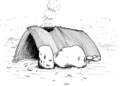
An artist's drawing of a temporary wood house, based on findings at Terra Amata in Nice, France, from 400,000 years ago.
-

This skull of Homo heidelbergensis, an early human type from the Lower Paleolithic, is between 500,000 and 400,000 years old.
-
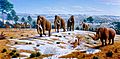
Many large mammals like woolly mammoths, woolly rhinoceroses, and cave lions lived during the Ice Age.
-

Stone ball from a set of Paleolithic bolas, used for hunting.
-
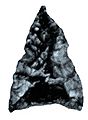
Humans may have traded rare goods and materials (like stone for tools) between groups as early as 120,000 years ago.
-
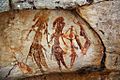
Bradshaw rock paintings found in the north-west Kimberley region of Western Australia.
-

Picture of a half-human, half-animal being in a Paleolithic cave painting in Dordogne, France. This might show early shamanic practices.


See also
 In Spanish: Paleolítico para niños
