
Conifer facts for kids
Quick facts for kids Conifer |
|
|---|---|
 |
|
| Large conifer forest of silver fir (Abies alba) at Vosges, Eastern France | |
Scientific classification  |
|
| Kingdom: | Plantae |
| Clade: | Tracheophytes |
| Clade: | Spermatophytes |
| Division: | Pinophyta |
| Class: | Pinopsida |
| Subclasses, orders, and families | |
|
|
| Synonyms | |
|
|
Conifers are a special group of plants that include many familiar trees like pines, firs, and spruces. They are mostly tall, woody trees and shrubs that stay green all year round. Conifers reproduce using special structures called cones, which hold their seeds. Most conifers have both male and female cones on the same tree. Their seeds are often carried by the wind.
These amazing plants first appeared more than 300 million years ago. For a long time, they were the most common plants on Earth, especially during the age of dinosaurs! Even though there are now many more flowering plants, conifers are still very important. You can find over 600 different kinds of conifers alive today.
Conifers are super important for our planet's environment. They form huge forests called taiga in cold northern regions. These trees have cool ways to survive harsh winters, like their cone shape that helps snow slide off. Many conifers are also valuable to humans. We use their wood for timber and making paper. Sadly, many conifer species are now endangered, meaning they are at risk of disappearing forever.
Contents
Discovering Conifers
What Makes Conifers Special?
Conifers are woody plants, meaning they have strong stems and branches. Most conifers are trees with thin, often needle-like leaves. They have separate male and female cones for reproduction. Wind carries the pollen from male cones to female cones. Their seeds usually have wings to help them fly away in the wind. Many conifers also have a special, often pleasant-smelling resin.
Did you know that the tallest and oldest trees in the world are conifers? The tallest is a coast redwood, which can grow over 116 meters (380 feet) tall! That's taller than a 30-story building. The oldest non-clonal tree is a Great Basin bristlecone pine, which has lived for an incredible 4,700 years. Some tiny conifers, like the pygmy pine from New Zealand, are only about 30 centimeters (1 foot) tall.
Conifers that live in cold places have amazing ways to survive winter. Their cone shape helps snow slide right off their branches. Their needle-like leaves have a waxy coating. This coating helps them hold onto water when it's very cold.
-
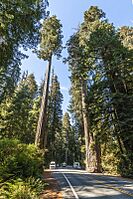
The tallest conifer, a coast redwood, can reach over 116 meters (380 feet).
-
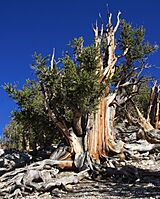
The oldest conifer, a Great Basin bristlecone pine, can live for 4,700 years.
-
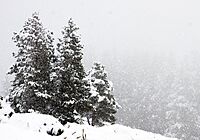
The narrow, cone-like shape of northern conifers helps them shed snow easily.


.jpg)
Amazing Conifer Leaves
Most conifers are evergreen, which means their leaves stay green all year. Their leaves come in different shapes. Many, like pines and firs, have long, thin, needle-like leaves. Others, like cypresses, have flat, scale-like leaves.
Conifer leaves are usually arranged in a spiral pattern around the stem. Some leaves can be tiny, just 2 millimeters long. Others, like those on some pines, can be as long as 60 centimeters (about 2 feet)! Tiny openings called stomata on the leaves help the plant breathe. These can close to save water when it's dry or cold.
Conifer leaves are often dark green. This helps them soak up as much sunlight as possible in places with weak sun. Some conifers, like blue spruce, have blue or silvery leaves. These colors help reflect strong sunlight. While most conifers are evergreen, a few kinds, like larch trees, are deciduous. This means they shed their leaves in the autumn, just like many other trees.
-
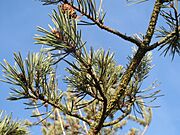
Pinaceae: Needle-like leaves of a Scots pine.
-
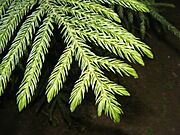
Araucariaceae: Awl-like leaves of a Cook pine.
-
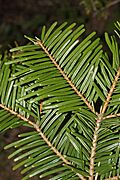
In some firs, leaves twist to catch more light.
-
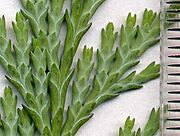
Cupressaceae: Scale-like leaves of a Lawson's cypress.


How Conifer Wood Grows
Conifer wood, also called softwood, is made mostly of long, tube-like cells called tracheids. These cells help carry water and nutrients through the tree.
Conifers grow by adding new layers of wood each year, creating growth rings. You can see these rings when you look at a tree stump. The rings show how much the tree grew each season. Wider rings mean faster growth. Conifer wood also has special channels called resin canals. These canals are filled with resin, a sticky substance. Resin helps protect the tree from insects and fungi. It flows into wounds, trapping pests and sealing the damage.
-
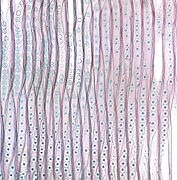
A close-up of conifer wood, showing the long, overlapping tubes that carry water.
-
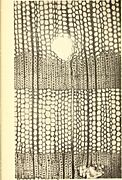
A slice of wood showing tree rings, which tell us about the tree's growth each year.
-
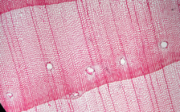
White circles in this pine wood slice are resin canals, which protect the tree.

.jpg)

Conifer Roots: Hidden Helpers
Young conifers start with a main root that grows straight down, called a taproot. As they get older, they develop a wide network of strong roots. These roots spread out to help the tree stand firm and tall.
Conifers also have many tiny roots near the surface of the soil. These fine roots work with special fungi called mycorrhizal fungi. This partnership helps the tree absorb water and important nutrients from the soil.
How Conifers Reproduce
Conifers make their seeds inside protective structures called cones. Most conifer species are monoecious. This means they have both male and female cones on the same tree. All conifers rely on the wind for pollination.
In many conifers, like pines, the cones are woody. When the seeds are ready, the cone scales open up. The seeds, which often have wings, then fall out and are carried away by the wind. For other conifers, like firs, the cones break apart to release their seeds.
Some conifers, such as pine trees, produce seeds that look like nuts. Birds like nutcrackers and jays love to eat these seeds. They help spread the seeds by breaking open the cones. Some pines, especially those adapted to fire, keep their seeds locked in closed cones for years. A forest fire is needed to open these cones and release the seeds. In trees like yews, the cone scales turn into soft, colorful, berry-like coverings called arils. Birds eat these "berries" and then spread the seeds in their droppings.
-
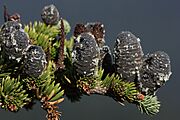
Pinaceae: Unopened female cones of a subalpine fir.
-
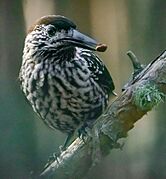
A Northern nutcracker holding a pine nut.
-
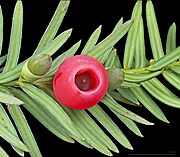
Taxaceae: The fleshy red covering around a yew seed is a modified cone scale.
-
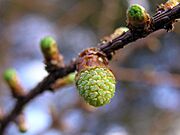
Pinaceae: A pollen cone from a Japanese larch.

.jpg)


The Conifer Life Cycle

Conifers produce two types of spores: tiny male spores and larger female spores. These spores grow on separate male and female cones, usually on the same tree.
Inside the male cones, male spores develop into pollen grains. Wind carries huge amounts of this pollen. Some pollen lands on female cones, which is called pollination. Inside the pollen grain, a cell divides to form two sperm cells. These cells help create a pollen tube that grows towards the egg. When fertilization happens, one sperm cell joins with an egg cell.
The female cone contains ovules, which hold the female spores. These female spores develop into egg cells. The fertilized egg then grows into an embryo, and a seed is formed. The female cone then opens, releasing the seeds. These seeds can grow into new conifer trees.
The life cycle of conifers in places with seasons slows down in winter. It then starts up again each spring. For most pines, it takes two years for a female cone to fully develop and release its seeds.
Conifers Through Time
Ancient Conifer History
The very first conifers appeared in the fossil record over 300 million years ago. This was during a time called the Late Carboniferous period. Scientists believe conifers are related to an older group of extinct trees called Cordaitales. Early conifers were small trees that likely grew in dry, high-up areas.
Conifers became very common during the Early Permian period. They were the main land plants during the Mesozoic era, which was the age of dinosaurs! Later, during the Cretaceous period, flowering plants started to become more common. This led to a big decrease in conifer numbers.
-
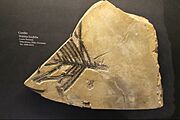
A fossil of Walchia laxifolia foliage from the Early Permian in Germany.
-
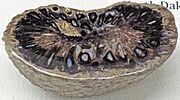
A fossil Araucaria cone from the Jurassic period in Argentina.
-
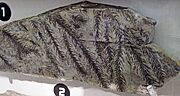
Fossil Elatides foliage from the Late Cretaceous in North America.
-
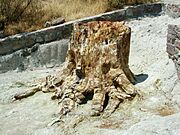
The base of a fossil conifer trunk with roots from the Early Miocene in Greece.

_(Jurassic;_Argentina)_(49021443726).jpg)
_(Judith_River_Group,_Upper_Cretaceous;_Montana_or_Canada)_(25210755717).jpg)

Living Fossils: Relict Conifers
Some conifers are called "living fossils" because they are survivors from ancient times. They now live in very small areas, even though they were once widespread. One amazing example is Wollemia nobilis, also known as the Wollemi pine. It was only discovered in 1994 in some hidden gorges in Australia! There are fewer than 60 adult trees left in the wild.
Another example is the dawn redwood. It was known from ancient fossils, but then a small group of living trees was found in China. These "relict" species remind us of how much plant life has changed over millions of years.
-
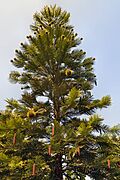
The Wollemia nobilis is a rare conifer found only in a small part of Australia.
-
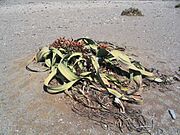
Welwitschia mirabilis is a unique conifer that looks very different from others.
-
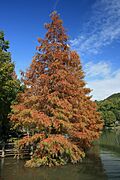
The Metasequoia glyptostroboides is a "living fossil" found in China.


Conifer Family Tree
Conifers belong to a larger group of plants called gymnosperms. They are closely related to ginkgos and cycads.
| Gymnosperms |
|
||||||||||||
_-_colored_illustrations_and_popular_descriptions_of_plants_(1916-(1964))_(16150512234).jpg)
.jpg)

Scientists use genetic studies to understand how different conifer families are related. The cladogram below shows the main groups within the conifer family.
| Pinophyta |
|
|||||||||||||||||||||||||||||||||||||||||||||


_(20959624281).jpg)
.jpg)
The name conifer means 'cone-bearing'. It comes from Latin words for 'cone' and 'to bear'. Today, scientists agree that conifers form a natural group. There are about 65 to 70 different groups (genera) and over 600 living species of conifers.
Where Conifers Live and How They Survive
Conifers are the main plants in the huge taiga forests of the Northern Hemisphere. This is the largest land biome (a major life zone) in the world. The taiga is mostly made up of larches, pines, and spruces. Larch trees are especially common in Russia.
Conifers also grow in southern Europe, Asia, and Japan. They are not just found in the north; about 200 conifer species live only in tropical areas. Others are found in Australia, Africa, and Central and South America. Places closer to the equator often have more different kinds of conifers. For example, Canada has only 9 species, but Mexico has 43!
Conifers are good at living in tough places. They can grow in acidic soils that don't have many nutrients. They also handle cold temperatures and times when water is scarce. In these environments, conifers often work with fungi in their roots. This partnership helps them get the nutrients they need.
Conifers can be harmed by diseases and insects. Some fungi cause "needle cast" diseases, which make leaves fall off. This can be very bad for young trees. Insects like wood-boring longhorn beetles and bark beetles also attack conifers. Bark beetles create tunnels just under the bark, which can weaken or kill the trees.
-
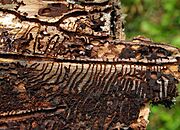
Tunnels made by bark beetles can seriously damage conifers.
-
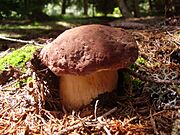
The pine bolete fungus forms a helpful partnership with several pine trees.
-
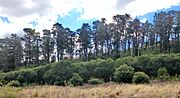
Some conifers, like this radiata pine, have become invasive species in places like Australia.


Conifers and Us
Protecting Conifers
As of 2025, many conifer species are in danger. 83 species are listed as vulnerable, 94 are endangered, and 30 are critically endangered. One of the most endangered is the Baishan fir, with only about 600 trees left in China.
Conifers are disappearing for several reasons. These include losing their homes to agriculture and building, being cut down too much, and harm from invasive species and climate change. It's important to protect these ancient and valuable trees.
Conifers in Our Daily Lives
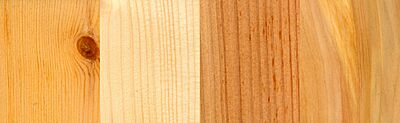
The softwood from conifers is easier to work with than hardwood from other trees. This makes it very valuable for many uses. We use conifer wood for building houses, making furniture, and creating fences. A huge amount of conifer wood is also used to make paper. In the United Kingdom, conifers provide over 90% of the timber used.
|
Conifer wood cross sections
|
Many conifers are also grown for their beauty in parks and gardens around the world. People choose them for their unique shapes, sizes, and colors.
-
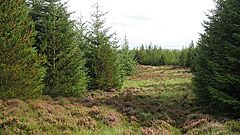
Commercial forestry uses trees like sitka spruce.
-
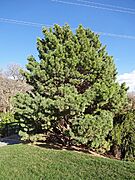
Globosa, a Scots pine grown for its ornamental shape.
-
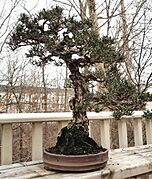
A 65-year-old bonsai made from a Japanese black pine.


Conifers give us many other useful things besides wood. They are used for Christmas trees, bonsai, and topiary (shaped plants). Their branches and leaves are used for decorative greenery and wreaths. We also get mulch and craft materials from them.
Resins from conifers are used to make products like turpentine and rosin. Essential oils from conifer leaves or wood are used in perfumes and other industries. Edible pine nuts and juniper berries (used as a spice) also come from conifers.
Conifers as Food and Drink
Some indigenous peoples, like the Sámi and North American tribes, used to eat the inner bark (cambium) of conifers. They would dry and grind it into flour.
The young tips of pine, fir, and spruce trees have been used to flavor drinks. Spruce beer was popular in early America and Canada. Today, a Finnish beer called Sahti uses juniper for flavor. In Korea, people make a special tea called Solip-cha from pine needles.
Conifers in Culture and Stories
Conifers are important in many cultures around the world. Because they stay green all year and live for a very long time, they often represent things like strength, immortality, and lasting harmony. Their constant green color has become a symbol of life's continuous journey.
In the Iroquois tradition, the eastern white pine is known as the Tree of Peace. It symbolizes the unity and lasting peace of the Haudenosaunee Confederacy. This idea is similar to other ancient stories about a "World Tree" or "Tree of Life" that connect the physical world with spiritual ideas.
See also
 In Spanish: Coníferas para niños
