
North America facts for kids
 |
|
| Area | 24.709 million km2 (9.54 million sq mi) (3rd) |
|---|---|
| Population | 592,296,233 (2021; 4th) |
| Population density | 25.7/km2 (67/sq mi) (2021) |
| GDP (nominal) | $29.01 trillion (2022 est.; 2nd) |
| GDP (PPP) | $30.61 trillion (2022 est.; 2nd) |
| GDP per capita | $57,410 (2022 est.; 2nd) |
| Religions |
|
| Demonym | North American |
| Countries | 23 sovereign states |
| Dependencies | 23 non-sovereign territories |
| Languages | English, Spanish, French, Dutch, Danish, indigenous languages, and many others |
| Time zones | UTC−10:00 to UTC+00:00 |
| Largest cities | List of urban areas: |
| UN M49 code | 003 – North America019 – Americas001 – World |

North America is a huge continent located in the Northern and Western Hemispheres. It is surrounded by oceans: the Arctic Ocean to the north, the Atlantic Ocean to the east, and the Pacific Ocean to the west and south. To its southeast, it connects with South America and borders the Caribbean Sea.
This continent includes many countries and territories. Some well-known ones are Canada, the United States, Mexico, Greenland, and the islands of the Caribbean. North America covers about 16.5% of Earth's land and 4.8% of its total surface. It is the third-largest continent by size, after Asia and Africa. It is also the fourth-largest by population, after Asia, Africa, and Europe. In 2021, over 592 million people lived in North America's 23 independent countries. This is about 7.5% of the world's population.
Scientists are still learning exactly how and when the first people arrived in North America. We know people lived here at least 20,000 years ago. The first period of human history here, called the Paleo-Indian period, ended about 10,000 years ago. Later, around 1000 AD, the Norse people from Europe were the first to explore and settle parts of North America.
In 1492, Christopher Columbus's voyages led to a big exchange of people, animals, plants, and ideas across the Atlantic Ocean. Many European settlers came to North America during the Age of Discovery. Today, the cultures and people of North America show a mix of these European settlers, native peoples, enslaved Africans, and immigrants from all over the world. Most people in North America speak European languages like English, Spanish, and French. However, some native groups in Canada, the United States, Mexico, and Central America still keep their traditional languages and cultures.
Contents
- Discovering the Name of North America
- Understanding North America's Regions
- Exploring North America's Geography
- Understanding North America's Geology
- North America's Climate Zones
- North America's Wildlife and Plants
- A Look at North America's History
- People and Cultures of North America
- North America's Economy
- North American Culture and Sports
- Images for kids
- See also
Discovering the Name of North America


The continents of the Americas were named after Amerigo Vespucci, an Italian explorer. German mapmakers, Martin Waldseemüller and Matthias Ringmann, gave the name "America" to the continent. Vespucci explored South America between 1497 and 1502. He was the first European to suggest that these lands were a new continent, not part of Asia.
In 1507, Waldseemüller published a world map. He put the name "America" on what is now South America. The land north of present-day Mexico was then called "Parias." Later, in 1553, a map by Petrus Apianus called North America "Baccalearum." This name meant "realm of the Cod fish," because there were so many cod fish on the East Coast.
Waldseemüller used the Latin form of Vespucci's name, Americus Vespucius. He made it feminine, "America," just like "Europa," "Asia," and "Africa." Over time, mapmakers started using the name "America" for North America too. In 1538, Gerardus Mercator used "America" on his map of the whole Western Hemisphere. On his map from 1569, Mercator called North America "America or New India."
The Spanish Empire called its lands in North and South America "Las Indias," meaning "The Indies." The group that managed these lands was called the Council of the Indies.
Understanding North America's Regions

The United Nations sees North America as having three main parts. These are Northern America, Central America, and the Caribbean. "Northern America" is a specific term that usually means Canada, the United States, Mexico, and Greenland. It does not include Central America.
Some countries, like France, Spain, and Italy, use a different way to count continents. They see North and South America as one big continent. In this view, "North America" often refers to a smaller area. This area includes Canada, the United States, Mexico, Saint Pierre and Miquelon, and often Greenland and Bermuda.
North America has been known by other names too. These include Spanish North America and New Spain.
Diverse Regions of North America
North America has many different regions. Each region has its own culture, economy, and geography. Some economic regions are based on trade agreements. For example, NAFTA was an agreement between Canada, Mexico, and the United States.
The continent is also divided by language and culture. The two main parts are Anglo-America and Latin America. Anglo-America includes most of North America where English is spoken. This includes Canada, the United States, and some Caribbean islands. But there are also areas like Quebec in Canada where French is the main language.
The southern part of North America includes Central America and Caribbean nations where English is not the main language. The northern part of the continent also has its own regions. For example, the term "Northern America" refers to the northernmost countries: the U.S., Bermuda, Canada, Greenland, and St. Pierre and Miquelon.
Canada and the U.S. are the largest countries by land area. They both have well-known subregions. In Canada, these include Atlantic Canada, Central Canada, and Northern Canada. In the U.S., regions include New England, the Mid-Atlantic, and the Pacific states. Some areas, like the Great Lakes region, are shared by both Canada and the U.S.
Countries and Territories in North America
North America is home to many independent countries and dependent territories. Here is a list of some of them:
| Arms | Flag | Country / Territory | Area | Population (2018) |
Population density |
Capital | Name(s) in official language(s) | ISO 3166-1 |
|---|---|---|---|---|---|---|---|---|
 |
 |
Anguilla (United Kingdom) |
91 km2 (35 sq mi) |
14,731 | 164.8/km2 (427/sq mi) |
The Valley | Anguilla | AIA |
 |
 |
Antigua and Barbuda | 442 km2 (171 sq mi) |
96,286 | 199.1/km2 (516/sq mi) |
St. John's | Antigua and Barbuda | ATG |
 |
 |
Aruba (Kingdom of the Netherlands) |
180 km2 (69 sq mi) |
105,845 | 594.4/km2 (1,539/sq mi) |
Oranjestad | Aruba | ABW |
 |
 |
The Bahamas | 13,943 km2 (5,383 sq mi) |
385,637 | 24.5/km2 (63/sq mi) |
Nassau | Bahamas | BHS |
 |
 |
Barbados | 430 km2 (170 sq mi) |
286,641 | 595.3/km2 (1,542/sq mi) |
Bridgetown | Barbados | BRB |
 |
 |
Belize | 22,966 km2 (8,867 sq mi) |
383,071 | 13.4/km2 (35/sq mi) |
Belmopan | Belize | BLZ |
 |
 |
Bermuda (United Kingdom) |
54 km2 (21 sq mi) |
62,756 | 1,203.7/km2 (3,118/sq mi) |
Hamilton | Bermuda | BMU |
 |
 |
Bonaire (Kingdom of the Netherlands) |
294 km2 (114 sq mi) |
12,093 | 41.1/km2 (106/sq mi) |
Kralendijk | Boneiru | BES |
 |
 |
British Virgin Islands (United Kingdom) |
151 km2 (58 sq mi) |
29,802 | 152.3/km2 (394/sq mi) |
Road Town | British Virgin Islands | VGB |
 |
 |
Canada | 9,984,670 km2 (3,855,100 sq mi) |
37,064,562 | 3.7/km2 (9.6/sq mi) |
Ottawa | Canada | CAN |
 |
 |
Cayman Islands (United Kingdom) |
264 km2 (102 sq mi) |
64,174 | 212.1/km2 (549/sq mi) |
George Town | Cayman Islands | CYM |
 |
 |
Clipperton Island (France) | 6 km2 (2.3 sq mi) |
0 | 0/km2 (0/sq mi) |
— | Île de Clipperton | CPT |
 |
 |
Costa Rica | 51,100 km2 (19,700 sq mi) |
4,999,441 | 89.6/km2 (232/sq mi) |
San José | Costa Rica | CRI |
 |
 |
Cuba | 109,886 km2 (42,427 sq mi) |
11,338,134 | 102.0/km2 (264/sq mi) |
Havana | Cuba | CUB |
 |
 |
Curaçao (Kingdom of the Netherlands) |
444 km2 (171 sq mi) |
162,752 | 317.1/km2 (821/sq mi) |
Willemstad | Kòrsou | CUW |
 |
 |
Dominica | 751 km2 (290 sq mi) |
71,625 | 89.2/km2 (231/sq mi) |
Roseau | Dominica | DMA |
 |
 |
Dominican Republic | 48,671 km2 (18,792 sq mi) |
10,627,141 | 207.3/km2 (537/sq mi) |
Santo Domingo | República Dominicana | DOM |
 |
 |
El Salvador | 21,041 km2 (8,124 sq mi) |
6,420,746 | 293.0/km2 (759/sq mi) |
San Salvador | El Salvador | SLV |
 |
 |
Federal Dependencies of Venezuela (Venezuela) |
342 km2 (132 sq mi) |
2,155 | 6.3/km2 (16/sq mi) |
Gran Roque | Dependencias Federales de Venezuela | VEN-W |
 |
 |
Greenland (Kingdom of Denmark) |
2,166,086 km2 (836,330 sq mi) |
56,564 | 0.026/km2 (0.067/sq mi) |
Nuuk | Kalaallit Nunaat/Grønland | GRL |
 |
 |
Grenada | 344 km2 (133 sq mi) |
111,454 | 302.3/km2 (783/sq mi) |
St. George's | Gwinàd | GRD |
 |
|
Guadeloupe (France) |
1,628 km2 (629 sq mi) |
399,848 | 246.7/km2 (639/sq mi) |
Basse-Terre | Gwadloup | GLP |
 |
 |
Guatemala | 108,889 km2 (42,042 sq mi) |
17,247,849 | 128.8/km2 (334/sq mi) |
Guatemala City | Guatemala | GTM |
 |
 |
Haiti | 27,750 km2 (10,710 sq mi) |
11,123,178 | 361.5/km2 (936/sq mi) |
Port-au-Prince | Ayiti/Haïti | HTI |
 |
 |
Honduras | 112,492 km2 (43,433 sq mi) |
9,587,522 | 66.4/km2 (172/sq mi) |
Tegucigalpa | Honduras | HND |
 |
 |
Jamaica | 10,991 km2 (4,244 sq mi) |
2,934,847 | 247.4/km2 (641/sq mi) |
Kingston | Jumieka | JAM |
 |
 |
Martinique (France) |
1,128 km2 (436 sq mi) |
375,673 | 352.6/km2 (913/sq mi) |
Fort-de-France | Martinique/Matinik | MTQ |
 |
 |
Mexico | 1,964,375 km2 (758,449 sq mi) |
126,190,788 | 57.1/km2 (148/sq mi) |
Mexico City | México | MEX |
 |
 |
Montserrat (United Kingdom) |
102 km2 (39 sq mi) |
4,993 | 58.8/km2 (152/sq mi) |
Plymouth, Brades |
Montserrat | MSR |
 |
 |
Nicaragua | 130,373 km2 (50,337 sq mi) |
6,465,501 | 44.1/km2 (114/sq mi) |
Managua | Nicaragua | NIC |
 |
 |
Nueva Esparta (Venezuela) |
1,151 km2 (444 sq mi) |
491,610 | 427.1/km2 (1,106/sq mi) |
La Asunción | Nueva Esparta | VEN-O |
 |
 |
Panama | 75,417 km2 (29,119 sq mi) |
4,176,869 | 45.8/km2 (119/sq mi) |
Panama City | Panamá | PAN |
 |
 |
Puerto Rico (United States) |
8,870 km2 (3,420 sq mi) |
3,039,596 | 448.9/km2 (1,163/sq mi) |
San Juan | Puerto Rico | PRI |
 |
 |
Saba (Kingdom of the Netherlands) |
13 km2 (5 sq mi) |
1,537 | 118.2/km2 (306/sq mi) |
The Bottom | Saba | BES |
 |
 |
San Andrés and Providencia (Colombia) |
53 km2 (20 sq mi) |
77,701 | 1,468.59/km2 (3,803.6/sq mi) |
San Andrés | San Andrés | COL-SAP |
 |
|
Saint Barthélemy (France) |
21 km2 (8.1 sq mi) |
7,448 | 354.7/km2 (919/sq mi) |
Gustavia | Saint-Barthélemy | BLM |
 |
 |
Saint Kitts and Nevis | 261 km2 (101 sq mi) |
52,441 | 199.2/km2 (516/sq mi) |
Basseterre | Saint Kitts and Nevis | KNA |
 |
 |
Saint Lucia | 539 km2 (208 sq mi) |
181,889 | 319.1/km2 (826/sq mi) |
Castries | Sainte-Lucie | LCA |
|
|
Saint Martin (France) |
54 km2 (21 sq mi) |
29,820 | 552.2/km2 (1,430/sq mi) |
Marigot | Saint-Martin | MAF |
 |
|
Saint Pierre and Miquelon (France) |
242 km2 (93 sq mi) |
5,849 | 24.8/km2 (64/sq mi) |
Saint-Pierre | Saint-Pierre-et-Miquelon | SPM |
 |
 |
Saint Vincent and the Grenadines | 389 km2 (150 sq mi) |
110,211 | 280.2/km2 (726/sq mi) |
Kingstown | Saint Vincent and the Grenadines | VCT |
 |
 |
Sint Eustatius (Kingdom of the Netherlands) |
21 km2 (8.1 sq mi) |
2,739 | 130.4/km2 (338/sq mi) |
Oranjestad | Sint Eustatius | BES |
 |
 |
Sint Maarten (Kingdom of the Netherlands) |
34 km2 (13 sq mi) |
41,940
Saint-Martin (French part)=37,264 |
1,176.7/km2 (3,048/sq mi) |
Philipsburg | Sint Maarten | SXM |
 |
 |
Trinidad and Tobago | 5,130 km2 (1,980 sq mi) |
1,389,843 | 261.0/km2 (676/sq mi) |
Port of Spain | Trinidad and Tobago | TTO |
 |
 |
Turks and Caicos Islands (United Kingdom) |
948 km2 (366 sq mi) |
37,665 | 34.8/km2 (90/sq mi) |
Grand Turk (Cockburn Town) | Turks and Caicos Islands | TCA |
 |
 |
United States | 9,629,091 km2 (3,717,813 sq mi) |
327,096,265 | 32.7/km2 (85/sq mi) |
Washington, D.C. | United States of America | USA |
 |
 |
United States Virgin Islands (United States) |
347 km2 (134 sq mi) |
104,680 | 317.0/km2 (821/sq mi) |
Charlotte Amalie | US Virgin Islands | VIR |
| Total | 24,500,995 km2 (9,459,887 sq mi) |
583,473,912 | 22.1/km2 (57/sq mi) |
|||||
Exploring North America's Geography
Landforms and Water Bodies


North America is the third-largest continent by area. It is part of the landmass often called the New World or the Americas. Its only land connection to South America is at the Darien Gap in Panama. This means almost all of Panama is in North America.
The coastline of North America is very long and uneven. The Gulf of Mexico is the largest bay that cuts into the continent. Other large water bodies include Hudson Bay and the Gulf of Saint Lawrence. Before the land bridge to Central America formed, this area was underwater.
Many islands are found off the coast of North America. These include the Arctic Archipelago, the Bahamas, and the Greater Antilles. Greenland, the world's largest island, is also part of North America geographically. It sits on the same tectonic plate as the rest of the continent.
North America's Tectonic Plates
Most of North America sits on the North American Plate. However, some parts of western Mexico and California are on the edge of the Pacific Plate. These two plates meet along the San Andreas fault. The southern part of the continent and many Caribbean islands are on the Caribbean Plate.
The continent has four main regions. These are the Great Plains, the mountainous west (including the Rocky Mountains), the flat Canadian Shield in the northeast, and the eastern region with the Appalachian Mountains. The highest point in North America is Denali in Alaska.
Understanding North America's Geology
How North America Was Formed

The core of North America is an ancient landmass called Laurentia. It formed between 1.5 and 1 billion years ago. The Canadian Shield is the largest part of this ancient land that we can see today. Long ago, North America was part of a supercontinent called Pangaea. The Appalachian Mountains formed about 480 million years ago when Pangaea came together. This makes them one of the oldest mountain ranges in the world.
Around 200 million years ago, Pangaea started to break apart. North America became part of another large landmass called Laurasia. Then, during the mid-Cretaceous period, it separated to become its own continent. The Rocky Mountains and other western mountain ranges began to form around this time. The Isthmus of Panama, which connects North and South America, formed about 12 to 15 million years ago. The Great Lakes were carved out by melting glaciers about 10,000 years ago.
North America is famous for its dinosaur fossils. Many different types of dinosaurs have been found here. This is because of the types of rocks, the climate, and the history of exploration in the region.
Geological Features of Canada

Canada is one of the oldest geological regions in the world. More than half of it is made of very old rocks that have been above sea level for a very long time. Canada has many different and large mineral resources. The Canadian Shield has huge amounts of iron, nickel, zinc, copper, gold, and uranium. Recently, large diamond mines have been developed in the Arctic. This makes Canada one of the world's biggest diamond producers.
Many mining towns are found across the Shield. The largest and most famous is Sudbury, Ontario. The Sudbury Basin is special because it is believed to be an ancient meteorite impact crater. This impact helped create the rich mineral deposits there. The Shield is also covered by huge boreal forests. These forests support an important logging industry.
Geological Features of the United States
The lower 48 U.S. states have five main land regions. These include the American Cordillera (western mountains), the northern part of the Canadian Shield, the stable central plains, the coastal plain, and the Appalachian Mountains. The geology of Alaska is similar to the cordillera. The main islands of Hawaii are made of volcanoes that formed over a hot spot.


Geological Features of Central America

Central America is a very active geological area. Volcanic eruptions and earthquakes happen often. For example, a big earthquake hit Guatemala in 1976, killing 23,000 people. The capital of Nicaragua, Managua, was destroyed by earthquakes in 1931 and 1972.
Volcanoes are common in the region. In 1968, the Arenal Volcano in Costa Rica erupted and killed 87 people. The soil from weathered volcanic rock is very fertile. This rich soil allows many people to live in the highland farming areas.
Central America has many mountain ranges. The longest ones are the Sierra Madre de Chiapas and the Cordillera de Talamanca. Between these mountains are fertile valleys. Most people in Honduras, Costa Rica, and Guatemala live in these valleys. The valleys are also great for growing crops like coffee and beans.
North America's Climate Zones

North America is a very large continent. It stretches from north of the Arctic Circle to south of the Tropic of Cancer. This means it has many different climates.
Greenland and the Canadian Shield have a tundra climate. Temperatures there are usually between 10 and 20 degrees Celsius. Central Greenland is covered by a huge ice sheet. This tundra climate extends across Canada.
West of the Cascade Range, the climate is temperate. It gets about 20 inches of rain each year. Coastal California has a Mediterranean climate. Cities like San Francisco have average temperatures from 57 to 70 degrees Fahrenheit all year.
From the East Coast to eastern North Dakota, there is a humid continental climate. This area has strong seasons with a lot of rain. For example, New York City gets about 50 inches of rain annually.
South of the humid continental climate, stretching to the Gulf of Mexico, is the humid subtropical climate. This area has some of the wettest cities in the U.S. Mobile, Alabama, gets about 67 inches of rain each year.
Further west, from the humid climates to the Sierra Nevada, are steppe and desert climates. These are the driest parts of the United States. In central Mexico and Guatemala, you find subtropical or temperate climates in the highlands. Tropical climates are found in the islands and the narrow part of the continent. These areas, near the Caribbean Sea or south of the Gulf of Mexico, have high temperatures and rain all year. This leads to rainforest, monsoon, and savanna types of weather.
North America's Wildlife and Plants
North America is home to many amazing animals. Some well-known ones include the bison, black bear, jaguar, cougar, and monarch butterfly.
Many important plants were first grown in North America. These include tobacco, maize (corn), squash, tomato, sunflower, blueberry, avocado, and chile pepper.
A Look at North America's History
Early Peoples and Cultures

The indigenous peoples of the Americas have many stories about how they came to be on this land. Scientists believe the first humans came from Asia. They likely crossed a land bridge called Beringia between Siberia and Alaska. This happened between 27,000 and 14,000 years ago. Some evidence suggests people might have arrived even earlier.
Before Europeans arrived, native peoples in North America lived in many different groups. These ranged from small family groups to large empires. They lived in different culture areas, which matched the geography and environment. For example, there were bison hunters on the Great Plains. In Mesoamerica, people were farmers.
Native groups are also grouped by their language families. However, groups with similar languages did not always share the same culture or were not always allies. The Inuit people of the high Arctic are thought to have arrived later than other native groups.
Over thousands of years, native cultures changed. One of the oldest cultures found is the Clovis culture in modern New Mexico. Later groups include the Mississippian culture and the Pueblo culture. Southern North American groups were important for growing many common crops we use today. These include tomatoes, squash, and maize.
The Mayans developed a writing system. They built huge pyramids and temples. They also had a complex calendar and developed the idea of zero around 400 CE.
The first European records of North America are in Norse sagas. They called it Vinland. Around 1000 CE, Norse explorers settled in a place called L'Anse aux Meadows in Newfoundland. This is the earliest known European contact with mainland North America. The Norse explorer Leif Erikson is believed to have visited this area.
When Spanish explorers arrived, the Mayan culture was still present in southern Mexico. But the Aztec Empire was the most powerful group. Their capital city, Tenochtitlan, was in the Valley of Mexico. The Aztecs were conquered in 1521 by Hernán Cortés.
European Exploration and Settlement (1492–1910)

During the Age of Discovery, Europeans explored and claimed parts of North America. Much of this land was already home to indigenous peoples. Native peoples reacted in different ways to the Europeans. Sometimes they were curious or traded. Other times, they resisted. The native population greatly decreased after Europeans arrived. This was mainly due to new diseases like smallpox, to which native peoples had no immunity. There were also violent conflicts.
On the southeastern coast, Spanish explorer Juan Ponce de León named La Florida in 1513. Spain, England, and France claimed large areas of North America's eastern and southern coasts. Spain built permanent settlements in the Caribbean in the 1490s. They made native people work and searched for gold. Many native people died from disease and overwork.
In 1519, Hernán Cortés sailed to Mexico. With help from local native allies, the Spanish conquered the Aztec empire in 1521. Spain then built cities in Mexico and Central America. Other European powers also started to claim Caribbean islands. France took part of Hispaniola, and Britain took Barbados and Jamaica.
Britain did not start settling on the North American mainland until about 100 years after the first Spanish settlements. The first permanent English settlement was in Jamestown, Virginia in 1607. More colonies were set up along the east coast. These became the Thirteen Colonies of British America. The first permanent French settlement was in Quebec City, Quebec in 1608.
The Seven Years' War and American Revolution
After Britain won the Seven Years' War in 1763, France gave up its claims to North American lands east of the Mississippi River to Britain. Spain gained control of lands west of the Mississippi. French colonists moved west across the Mississippi River. They partnered with midwest native tribes.
In 1776, the Thirteen Colonies in British America decided to become independent. They sent delegates to Philadelphia who adopted the Declaration of Independence on July 4, 1776. This document, mainly written by Thomas Jefferson, declared their freedom from British rule. This action started the American Revolutionary War, which had already begun in 1775. The colonies formed the Continental Army and chose George Washington as its leader.
France and Spain, who were enemies of Britain, supported the American cause. In 1783, after eight years of fighting, Britain recognized the independence of the United States. This led to the signing of the Treaty of Paris.
Westward Expansion and Canals

By the late 1700s, Russia had settled on the northern Pacific Northwest coast. They were involved in fur trade. Spain also became more interested in controlling trade on the Pacific coast. They mapped most of its coastline.
In 1803, during the time of Thomas Jefferson, the third U.S. president, France sold its remaining North American lands to the U.S. This was known as the Louisiana Purchase. These lands were west of the Mississippi River. In 1821, Mexico gained independence from Spain. The U.S. continued to expand westward. It fought the Mexican–American War and gained a large territory from Mexico. In 1867, Russia sold Alaska to the U.S.
In 1867, colonial settlers north of the United States formed the dominion of Canada. The U.S. wanted to build a canal across the Isthmus of Panama. This area was part of Colombia at the time. The U.S. helped Panamanians gain independence from Colombia. Then, the U.S. built the Panama Canal. It was finished in 1913. This canal connected the Atlantic and Pacific oceans. It made global shipping much easier.
People and Cultures of North America
Population and Development

Canada and the United States are the wealthiest and most developed nations in North America. Mexico is a newly industrialized country. The countries in Central America and the Caribbean have different levels of economic development. For example, small Caribbean island-nations like Barbados have a higher income per person than Mexico.
North America has a very diverse population. The three main groups are Whites, Mestizos (people of mixed European and Indigenous ancestry), and Blacks. There are also many Indigenous Americans and Asians.
Languages Spoken in North America

The main languages in North America are English, Spanish, and French. Danish is common in Greenland, along with Greenlandic. Dutch is spoken in the Dutch Caribbean.
The term Anglo-America refers to the English-speaking countries. These are Canada (where both English and French are official) and the U.S. Latin America refers to areas where Romance languages like Spanish and Portuguese are spoken. This includes Mexico, Central America, and most of South America.
French has always been important in North America. Canada is officially bilingual, meaning both English and French are official languages. French is the official language in the province of Quebec. Other French-speaking areas include the French West Indies and Saint-Pierre et Miquelon. In the U.S. state of Louisiana, French is also an official language.
Many Indigenous languages are still spoken in North America. About 372,000 people in the U.S. speak an indigenous language at home. There are about 150 surviving indigenous languages in the U.S. and Canada.
Religions in North America

Christianity is the largest religion in the United States, Canada, and Mexico. A 2012 survey showed that 77% of the population considered themselves Christians. The U.S. has the largest number of Christians in the world. Mexico has the second-largest number of Catholics globally.
About 17% of people in Canada and the U.S. say they have no religion. This group includes agnostics and atheists.
Canada, the U.S., and Mexico also have communities of Jews, Buddhists, and Muslims. The largest number of Jews are in the U.S. The U.S. also has the largest Muslim population in North America.
In Mexico and Central America, Christianity is the main religion (96%). When Spain colonized Mexico in the 16th century, Roman Catholicism was the only allowed religion. The Catholic Church remained very important even after countries gained independence. Since the 1960s, other Christian groups, especially Protestantism, have grown.
Christianity is also the main religion in the Caribbean (85%). Other religions in this region include Hinduism, Islam, Rastafari (in Jamaica), and Afro-American religions like Santería and Vodou.
Major Cities and Population Centers


North America is the fourth most populated continent. The U.S. has the largest population with 329.7 million people. Mexico is second with 112.3 million, and Canada is third with 37.0 million. Most Caribbean island-nations have populations under a million. However, Cuba, Dominican Republic, Haiti, and Jamaica have over a million people. Greenland has a very small population for its size, making it the least densely populated place in the world.
The largest cities in North America are Mexico City and New York City. These are the only cities on the continent with over eight million people. Other large cities include Los Angeles, Toronto, and Chicago. Cities in the warmer "Sun Belt" regions of the U.S. are growing fast. This is due to warm weather, retirees, large industries, and immigrants. Cities near the U.S. border, especially in Mexico, are also growing quickly.
Many large metropolitan areas are in the U.S. Mexico City is the largest metropolitan area in North America by population. Toronto is also one of the top ten largest metropolitan areas. Cities close to each other on the Canada–United States border and the Mexico–U.S. border have created international metropolitan areas. These areas, like Detroit–Windsor and San Diego–Tijuana, have a lot of trade and cultural activity.
| Metro Area | Population | Area | Country |
| Mexico City | 21,163,226† | 7,346 km2 (2,836 sq mi) | Mexico |
| New York City | 19,949,502 | 17,405 km2 (6,720 sq mi) | United States |
| Los Angeles | 13,131,431 | 12,562 km2 (4,850 sq mi) | United States |
| Chicago | 9,537,289 | 24,814 km2 (9,581 sq mi) | United States |
| Dallas–Fort Worth | 6,810,913 | 24,059 km2 (9,289 sq mi) | United States |
| Houston | 6,313,158 | 26,061 km2 (10,062 sq mi) | United States |
| Toronto | 6,054,191† | 5,906 km2 (2,280 sq mi) | Canada |
| Philadelphia | 6,034,678 | 13,256 km2 (5,118 sq mi) | United States |
| Washington, D.C. | 5,949,859 | 14,412 km2 (5,565 sq mi) | United States |
| Miami | 5,828,191 | 15,896 km2 (6,137 sq mi) | United States |
†2011 Census figures
North America's Economy
Economic Strength and Trade


North America is the richest continent in the world. Its GDP per person was estimated at $41,830 in 2016.
Canada, Mexico, and the U.S. have strong and complex economies. The U.S. has the largest economy in the world. In 2016, its economy was very advanced, with a high income per person. Most of the U.S. economy comes from services (like healthcare or education).
Canada's economy is growing in services, mining, and manufacturing. Its income per person was estimated at $44,656. Mexico's economy is also growing. It has both modern and older industries and farms. Its main income comes from oil, industrial exports, and manufactured goods.
The North American economy is organized around three main trade areas. These are the North American Free Trade Agreement (NAFTA), the Caribbean Community and Common Market (CARICOM), and the Central American Common Market (CACM).
NAFTA was one of the world's largest trade agreements. It started in 1994 to remove trade barriers between Canada, the U.S., and Mexico. This allowed goods to move between these countries without extra taxes. Trade between these three nations has grown a lot. The NAFTA trade area has the world's largest total economic output. In 2018, NAFTA was replaced by the U.S.–Mexico–Canada Agreement.
The Caribbean trade group (CARICOM) started in 1973 with 15 Caribbean nations. It helps these countries trade more easily. The Central American Common Market (CACM) also works to improve trade among Central American nations.
These countries also trade with other continents. Mexico has trade agreements with Europe. The U.S. has proposed trade agreements with Europe and Asian nations.
Transportation Across North America

The Pan-American Highway is a huge network of roads. It travels through mainland North and South America. Its total length is about 48,000 kilometers (30,000 miles). The U.S. and Canadian governments have not officially named specific routes as part of it.
The first transcontinental railroad in the U.S. was built in the 1860s. It connected the eastern U.S. with California on the Pacific coast. This railroad, finished in 1869, changed how people and goods moved across the country. It helped the American West grow quickly.
Communication Systems
North America shares a common telephone system called the North American Numbering Plan (NANP). This system includes 24 countries and territories. These are the U.S., Canada, Bermuda, and 17 Caribbean nations. Recently, internet services like Starlink have expanded across many North American areas.
North American Culture and Sports
Cultural Diversity

The cultures of North America are very diverse. The U.S. and English Canada share many cultural similarities. French Canada has its own unique culture, protected by law. The U.S. has a large and growing number of Spanish speakers. This is due to its history and ongoing immigration from countries south of the U.S.–Mexico border. In the southwestern U.S., there are many Hispanic cultural traditions and a lot of bilingualism.
Mexico and Central America are part of Latin America. Their cultures are different from English and French-speaking North America. However, they all have governments that are republics with written constitutions. Canada is a parliamentary democracy under a constitutional monarchy.
Canada's constitution dates back to 1867. French-speaking Canadians are mostly Catholic. The Quebec Act of 1774 guaranteed them freedom to practice their religion. It also allowed the Catholic Church to collect money for its support. French civil law was established in most cases.
The French language and culture are protected by Canadian law. Both English and French are official languages. The U.S. does not have an official language, but English is its national language.
The Canadian government works to protect Canadian culture. It limits non-Canadian content on TV and radio. In Quebec, the government promotes the use of French.
Latino culture is strong in the southwestern U.S. and Florida. Northern Mexico is also influenced by the culture of the U.S. Northern Mexico, the Western U.S., and Alberta, Canada, share a cowboy culture.
Greenland has cultural ties with the native peoples of Canada. It also has strong Danish ties because Denmark colonized it for centuries.
Popular Sports in North America
The U.S. and Canada have major sports teams that play against each other. These include baseball, basketball, hockey, and soccer/football. Canada, Mexico, and the U.S. will host the 2026 FIFA World Cup.
Here are some of the most popular sports leagues in North America:
| League | Sport | Primary country |
Founded | Teams | Revenue US$ (bn) |
Average attendance |
|---|---|---|---|---|---|---|
| National Football League (NFL) | American football | United States | 1920 | 32 | $9.0 | 67,604 |
| Major League Baseball (MLB) | Baseball | United States Canada |
1869 | 30 | $8.0 | 30,458 |
| National Basketball Association (NBA) | Basketball | United States Canada |
1946 | 30 | $5.0 | 17,347 |
| National Hockey League (NHL) | Ice hockey | United States Canada |
1917 | 32 | $3.3 | 17,720 |
| Liga MX | Football (soccer) | Mexico | 1943 | 18 | $0.6 | 25,557 |
| Major League Soccer (MLS) | Football (soccer) | United States Canada |
1994 | 28 | $0.5 | 21,574 |
| Canadian Football League (CFL) | Canadian football | Canada | 1958 | 9 | $0.3 | 23,890 |
The Native American game of lacrosse is a national sport in Canada. Curling is also an important winter sport in Canada. Boxing is a major sport in countries like Mexico, Panama, and Puerto Rico.
Images for kids
-
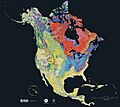
A 2003 image of North America's bedrock and terrain
-

A 2015 map of North America's cratons and basement rocks
See also
 In Spanish: América del Norte para niños
