
Mid-Atlantic (United States) facts for kids
Quick facts for kids
Mid-Atlantic
|
|
|---|---|
   .jpg)  Left to right from top: The Lower Manhattan skyline in New York City, Independence Hall in Philadelphia, Assateague Island, the Philadelphia skyline, and the Catskills seen from the Hudson River
|
|
 |
|
| Composition | |
| Metropolitan areas |
|
| Largest city | New York City |
| Area | |
| • Total | 191,299.86 sq mi (495,464.4 km2) |
| • Land | 174,468.45 sq mi (451,871.2 km2) |
| • Water | 16,831.41 sq mi (43,593.2 km2) 8.80% |
| Population
(2020)
|
|
| • Total | 60,783,913 |
| • Density | 317.741545/sq mi (122.680696/km2) |
| GDP (nominal) | |
| • Q3 2022 | $5.233 trillion |
The Mid-Atlantic is an important geographic region in the eastern United States. It generally includes seven states: New York, New Jersey, Pennsylvania, Delaware, Maryland, Virginia, and West Virginia. It also contains the nation's capital city, Washington, D.C.
This region sits between New England to the north and the deep South. Because of this unique position, the Mid-Atlantic has long served as a busy bridge for trade, travel, and new ideas.
Over 60 million people live in the Mid-Atlantic today. The area is famous for its massive cities, top-ranked universities, beautiful mountains, and historic landmarks. It contains the largest city in the nation, New York City, as well as the center of American government in Washington, D.C.
Contents
- Discovering the Geography and Boundaries of the Mid-Atlantic
- Early History and the Birth of a New Nation
- Growth, Industry, and 19th-Century Transformation
- Major Cities and Urban Life in the Megalopolis
- Culture, Arts, and Recreation
- Economic Power and Major Industries
- Education and Research Excellence
- Images for kids
- See also
Discovering the Geography and Boundaries of the Mid-Atlantic
Which States Make Up the Mid-Atlantic Region?
The exact boundaries of the Mid-Atlantic can change depending on which organization or group is defining it. Traditional historical definitions include New York, New Jersey, Pennsylvania, Delaware, Maryland, Virginia, and West Virginia.
Government groups often group these states differently to fit their needs:
- The United States Census Bureau counts only New York, New Jersey, and Pennsylvania as the Mid-Atlantic sub-region.
- The Environmental Protection Agency (EPA) focuses on water systems and excludes New York and New Jersey.
- The USGS sometimes includes parts of North Carolina because of shared river basins and coastal waterways.
- Southern Connecticut is occasionally grouped here due to its shared climate and close links to New York City.
Landforms, Waterways, and Natural Landscapes
The Mid-Atlantic features a remarkable variety of natural landscapes. Along the eastern edge lies the Atlantic Coastal Plain, which includes sandy barrier islands, salt marshes, and shallow bays. Moving inland, the land rises into the rolling green hills of the Piedmont region.
Further west, the land climbs into the Appalachian Mountains. These ancient peaks include the Adirondack Mountains and Catskill Mountains in New York, the Pocono Mountains in Pennsylvania, and the Blue Ridge Mountains stretching across Virginia and West Virginia.
Major rivers have shaped the growth and economy of the region for centuries:
- The Hudson River flows through New York, connecting the interior of the state to the Atlantic Ocean.
- The Delaware River forms borders between Pennsylvania, New York, New Jersey, and Delaware.
- The Susquehanna River is the longest river on the American East Coast, emptying into the Chesapeake Bay.
- The Potomac River flows past the capital city of Washington, D.C.
The Chesapeake Bay is the largest estuary (a body of water where freshwater meets seawater) in the United States. It provides a rich habitat for wildlife, including famous blue crabs, oysters, and migrating birds.
Early History and the Birth of a New Nation
Indigenous Peoples and First European Explorers
Long before Europeans arrived, many Native American nations lived across the Mid-Atlantic. In the north and west, the Haudenosaunee (Iroquois Confederacy) developed a powerful representative government. Along the Delaware and Hudson valleys, the Lenape people established peaceful trading villages. Near the Chesapeake Bay, the Powhatan confederacy built farming communities along the coastal rivers.
European exploration of the coastline began in the 16th century:
- In 1524, Italian explorer Giovanni da Verrazzano sailed along the Atlantic coast and entered New York Harbor.
- In 1607, English settlers founded Jamestown, Virginia, the first permanent English settlement in North America.
- In 1609 and 1611, English navigator Henry Hudson explored the river that now bears his name on behalf of the Dutch.
The Middle Colonies: A Diverse Melting Pot
During the 1600s, the area between New England and Virginia was known as the "Middle Colonies." Unlike New England, which was mostly English, the Middle Colonies attracted settlers from across Europe.
The Dutch founded New Netherland along the Hudson River, while Swedish colonists established New Sweden along the Delaware River. Eventually, England gained control over all these territories, creating the provinces of New York, New Jersey, Pennsylvania, and Delaware.
These colonies became famous for welcoming people with different religious beliefs:
- Maryland was created in 1632 as a haven where Catholics could practice their faith freely.
- Pennsylvania was founded in 1681 by William Penn as a safe home for Quakers.
- Penn welcomed German settlers and promised fair treatment to Native American neighbors.
Because of its rich soil and sunny weather, the region produced huge harvests of wheat, rye, and corn. It quickly earned the nickname "the Breadbasket of the Colonies."
The American Revolution and Establishing the Government
The Mid-Atlantic played a central role during the American Revolutionary War (1775–1783). Because of its central location, it saw more major battles and troop movements than any other region.
Key historical events in the Mid-Atlantic include:
- The Second Continental Congress met in Philadelphia to organize colonial defense and choose George Washington as commander of the Continental Army.
- On July 4, 1776, delegates signed the Declaration of Independence at Independence Hall.
- General Washington led famous surprise attacks at Trenton and Princeton in New Jersey during the winter of 1776.
- The Continental Army survived a harsh, defining winter at Valley Forge, Pennsylvania, in 1777–1778.
After winning independence, American leaders returned to Philadelphia in 1787 for the Constitutional Convention. There, they wrote the Constitution of the United States, which established the system of government used today.
The young country moved its capital several times within the Mid-Atlantic. New York City served as the first national capital under the Constitution in 1789. The capital then moved to Philadelphia for ten years before permanently settling in Washington, D.C., in 1800.
Growth, Industry, and 19th-Century Transformation
Building Canals, Railroads, and Modern Transport
During the 1800s, the Mid-Atlantic led the United States into the Industrial Revolution. To move goods quickly between coastal ports and the western frontier, engineers built incredible new transportation routes.
In 1825, New York completed the Erie Canal. This 363-mile waterway connected the Hudson River with the Great Lakes. It dramatically lowered shipping costs and turned New York City into the financial capital of North America.
Soon after, steam locomotives began rolling across the landscape. The Baltimore and Ohio Railroad (B&O) became the first commercial railroad in the country in 1830. Later, the Pennsylvania Railroad grew into one of the largest transportation corporations in the world.
Factories, Coal, and Steel Production

The Mid-Atlantic had huge supplies of natural resources needed for heavy industry:
- Eastern Pennsylvania mined massive amounts of anthracite coal, a clean-burning fuel that powered factories and heated homes.
- Western Pennsylvania had iron ore and rivers, turning Pittsburgh into the "Steel City."
- New Jersey and New York built large textile mills, chemical plants, and machinery factories.
- Shipyards along the Delaware River and Chesapeake Bay constructed modern merchant ships and naval vessels.
As factories multiplied, millions of European immigrants arrived seeking work. Between 1892 and 1954, more than 12 million immigrants entered through Ellis Island in New York Harbor. Many stayed to build homes and communities in cities like Baltimore, Philadelphia, Newark, Buffalo, and Rochester.
Major Cities and Urban Life in the Megalopolis
The Northeast Megalopolis
The coastal Mid-Atlantic forms the core of the Northeast megalopolis, an unbroken chain of large cities and suburbs stretching hundreds of miles. Millions of people travel daily between these cities using Interstate 95 and the high-speed Northeast Corridor passenger rail line operated by Amtrak.
Top Metropolitan Areas
The Mid-Atlantic includes some of the most populous urban areas in the world:
| Rank | Metropolitan Statistical Area | Population (2020 Census) |
|---|---|---|
| 1 | New York-Newark-Jersey City, NY-NJ-PA | 20,140,470 |
| 2 | Washington-Arlington-Alexandria, DC-VA-MD-WV | 6,385,162 |
| 3 | Philadelphia-Camden-Wilmington, PA-NJ-DE-MD | 6,245,051 |
| 4 | Baltimore-Columbia-Towson, MD | 2,844,510 |
| 5 | Pittsburgh, PA | 2,370,930 |
| 6 | Virginia Beach-Norfolk-Newport News, VA-NC | 1,799,674 |
| 7 | Richmond, VA | 1,314,434 |
| 8 | Buffalo-Cheektowaga, NY | 1,166,902 |
| 9 | Rochester, NY | 1,090,135 |
| 10 | Albany-Schenectady-Troy, NY | 899,262 |
Exploring the Region's Largest Cities


- New York City: With over 8.8 million residents, New York is the largest city in the nation. It is divided into five boroughs: Manhattan, Brooklyn, Queens, The Bronx, and Staten Island. It is a world leader in finance, global business, the arts, fashion, and international diplomacy through the United Nations headquarters.
- Philadelphia: Pennsylvania's largest city is famous for its revolutionary history, world-class medical centers, and rich culture. Historic spots like the Liberty Bell and Independence Hall sit alongside modern corporate offices and museums.
- Washington, D.C.: The capital of the United States contains the White House, the Capitol, the Supreme Court, and the famous Smithsonian Institution museum complex.
- Baltimore: Maryland's largest city is a major historic seaport. It is well known for Fort McHenry (where the U.S. national anthem was written), its revitalized Inner Harbor, and premier research centers like Johns Hopkins University.
- Pittsburgh: Located where three rivers meet in western Pennsylvania, Pittsburgh transitioned from a historic steel capital into a modern hub for robotics, healthcare, technology, and clean energy.
Culture, Arts, and Recreation
Literature and Creative Arts
The Mid-Atlantic has inspired generations of famous writers, poets, and artists.
- Early American literature was shaped by authors like Washington Irving, who wrote famous folk stories like *The Legend of Sleepy Hollow*, and James Fenimore Cooper.
- Poet Walt Whitman celebrated American life while living and writing in New York and New Jersey.
- In the 1920s, the Harlem Renaissance in Upper Manhattan became a famous cultural movement, producing groundbreaking work by African American writers, poets, and musicians like Langston Hughes and Zora Neale Hurston.
- Other famous authors connected to the region include Herman Melville, Edith Wharton, James Baldwin, John Updike, and Colson Whitehead.
Music, Theater, and Entertainment
The region is a powerhouse for music and performing arts. New York City's Broadway district is the world's most famous center for live musical theater. Lincoln Center hosts world-renowned groups like the New York Philharmonic and the Metropolitan Opera.
Cities across the region contributed greatly to American popular music:
- Philadelphia produced famous sounds in jazz, soul, and early rock and roll.
- Baltimore developed distinct dance music scenes and jazz traditions along Pennsylvania Avenue.
- New York City served as the birthplace of modern hip hop music in the Bronx during the 1970s, as well as punk rock in the East Village.
Regional Foods and Famous Cuisine
The cuisine of the Mid-Atlantic reflects its diverse cultures and plentiful coastal waters:
- Seafood: Maryland is world-famous for its seasoned steamed blue crabs and crab cakes. Coastal waters also provide fresh oysters and clams.
- Sandwiches and Street Food: Iconic favorites include the Philadelphia cheesesteak, New York pastrami on rye, bagels with cream cheese, and thin-crust New York-style pizza.
- Traditional Treats: The Pennsylvania Dutch introduced soft pretzels, funnel cakes, apple butter, and shoofly pie. Buffalo, New York, created spicy Buffalo chicken wings.
Sports and Famous Competitions
Sports are a huge part of community life in the Mid-Atlantic. The region hosts dozens of championship teams in every major professional sports league.
| Market | NFL (Football) | MLB (Baseball) | NBA (Basketball) | NHL (Hockey) | MLS (Soccer) | WNBA (Women's Basketball) |
|---|---|---|---|---|---|---|
| New York / New Jersey | Giants Jets |
Yankees Mets |
Knicks Nets |
Rangers Islanders Devils |
Red Bulls NYC FC |
Liberty |
| Washington, D.C. | Commanders | Nationals | Wizards | Capitals | United | Mystics |
| Philadelphia | Eagles | Phillies | 76ers | Flyers | Union | — |
| Pittsburgh | Steelers | Pirates | — | Penguins | — | — |
| Baltimore | Ravens | Orioles | — | — | — | — |
| Buffalo | Bills | — | — | Sabres | — | — |
The region also hosts major annual sporting events:
- The US Open Tennis Championships takes place every summer in Queens, New York.
- Two legs of horse racing's famous Triple Crown are held here: the Preakness Stakes in Baltimore and the Belmont Stakes in New York.
- Major motor racing events are held at Pocono Raceway in Pennsylvania, Watkins Glen International in New York, and Dover Motor Speedway in Delaware.
Economic Power and Major Industries
A Global Financial and Business Center
The Mid-Atlantic has an enormous economy. With a total economic output (GDP) topping $5.2 trillion, its economy would rank as the third-largest in the world if it were an independent country.
Wall Street in Lower Manhattan is the financial capital of the planet, home to the New York Stock Exchange and Nasdaq. Many of the world's largest banks, investment firms, and insurance companies keep their global headquarters in New York and surrounding cities.
Key Modern Industries
The modern Mid-Atlantic economy relies on several key sectors:
- Healthcare and Pharmaceuticals: New Jersey and Pennsylvania are international centers for medicine, biotechnology, and medical research. Major pharmaceutical companies make lifesaving medicines here.
- Government and Defense: The area surrounding Washington, D.C., in Maryland and Virginia employs hundreds of thousands of government workers, software engineers, and defense experts.
- Technology and Communications: Northern Virginia handles a vast portion of global internet traffic through huge data centers, while New York City has a rapidly growing tech startup sector known as "Silicon Alley."
- Agriculture: Outside the big cities, farmers produce large crops of apples in New York, mushrooms in Pennsylvania, tomatoes in New Jersey, and poultry on the Delmarva Peninsula.
| Company | Industry | Headquarters Location |
|---|---|---|
| JPMorgan Chase | Banking and Finance | New York, New York |
| Johnson & Johnson | Healthcare and Medical Products | New Brunswick, New Jersey |
| Mastercard | Payment Technology | Harrison, New York |
| Pfizer | Pharmaceuticals | New York, New York |
| PepsiCo | Food and Beverages | Purchase, New York |
| Verizon Communications | Telecommunications | New York, New York |
| Comcast | Media and Entertainment | Philadelphia, Pennsylvania |
| Lockheed Martin | Aerospace and Defense Technology | Bethesda, Maryland |
| IBM | Computer Technology and Cloud Computing | Armonk, New York |
Education and Research Excellence
The Mid-Atlantic is home to some of the oldest and most prestigious schools in the world. It contains four of the eight Ivy League universities, as well as renowned public and private research institutions.
Leading Universities
- Columbia University (founded 1754 in New York City)
- Princeton University (founded 1746 in Princeton, New Jersey)
- University of Pennsylvania (founded 1740 by Benjamin Franklin in Philadelphia)
- Cornell University (founded 1865 in Ithaca, New York)
- Johns Hopkins University (founded 1876 in Baltimore, Maryland, famous for medical research)
- Georgetown University (founded 1789 in Washington, D.C.)
- University of Virginia (founded 1819 by Thomas Jefferson in Charlottesville, Virginia)
- Carnegie Mellon University (founded 1900 in Pittsburgh, famous for computer science and robotics)
The region is also home to top federal service academies that train military officers, including the United States Military Academy at West Point, New York, and the United States Naval Academy at Annapolis, Maryland.
Images for kids
-
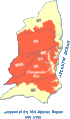
A USGS map displaying water study areas in the Mid-Atlantic region.
-
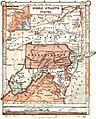
An 1897 historical geography map showing a broad view of the Middle Atlantic states.
-
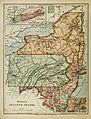
An 1886 school geography map outlining the Mid-Atlantic region.
-
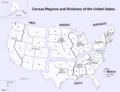
The U.S. Census Bureau map showing its three-state definition of the Mid-Atlantic division.


See also
 In Spanish: Atlántico Medio de Estados Unidos para niños
- List of regions of the United States
- Thirteen Colonies
- Northeast megalopolis
- Chesapeake Bay
- Appalachian Mountains
