
Spanish conquest of the Aztec Empire facts for kids
Quick facts for kids Spanish conquest of the Aztec Empire |
|||||||||
|---|---|---|---|---|---|---|---|---|---|
 Conquest of Mexico by Cortés, 17th-century painting |
|||||||||
|
|||||||||
| Belligerents | |||||||||
| Spanish Empire Indigenous Allies: * Tlaxcala * Texcoco (from 1521) * Totonacs |
Aztec Empire (Triple Alliance) * Tenochtitlan * Tlatelolco * Tlacopan |
||||||||
| Commanders and leaders | |||||||||
| Hernán Cortés Pedro de Alvarado Xicotencatl the Younger Ixtlilxochitl II |
Moctezuma II Cuitláhuac Cuauhtémoc |
||||||||
| Strength | |||||||||
| ~2,500 Spanish soldiers Over 80,000 Indigenous allies |
~200,000 Aztec warriors | ||||||||
| Casualties and losses | |||||||||
| ~1,800 Spaniards dead Tens of thousands of Indigenous allies dead |
Over 100,000 Aztecs dead in battle and siege Millions dead from smallpox |
||||||||
The Spanish conquest of the Aztec Empire was a major event in world history. Between 1519 and 1521, a coalition of Spanish soldiers and thousands of Indigenous warriors toppled the mighty Aztec Empire. Led by Spanish explorer Hernán Cortés, this campaign ended with the capture of the great capital city of Tenochtitlan.
Before the arrival of Europeans, the Aztec Empire was the strongest power in Mesoamerica. The Aztecs ruled over millions of people across modern-day central Mexico. However, many neighboring city-states disliked paying heavy tributes to the Aztec capital. When Cortés landed on the coast, he used these rivalries to build powerful alliances.
The fall of the Aztec capital on 13 August 1521 led to the creation of New Spain. On the ruins of Tenochtitlan, the Spanish built Mexico City. This event started centuries of Spanish rule in North America and changed the culture, language, and population of the region forever.
Contents
- Key History of the Aztec Empire and the Spanish
- How Cortés Reached Central Mexico
- The Spanish Arrival in Tenochtitlan
- The Night of Sorrows and the Siege of Tenochtitlan
- How Did the Spanish Prevail?
- Mesoamerica After the Fall of Tenochtitlan
- Legacy and Cultural Impact
- Spanish Conquest of the Aztec Empire Interesting Facts
- Images for kids
- See also
- Sources
Key History of the Aztec Empire and the Spanish
What Was the Aztec Empire?
The Aztec Empire was founded in 1428 through an agreement called the Triple Alliance. This alliance united three major city-states in the Valley of Mexico: Tenochtitlan, Texcoco, and Tlacopan. Tenochtitlan quickly became the military and political powerhouse of the group.
The ruler of the empire held the title of Hueyi Tlatoani, meaning "Great Speaker." Under rulers like Moctezuma II, the empire expanded across central Mesoamerica. The Aztecs built magnificent stone temples, advanced canal networks, and floating gardens called chinampas.
However, the Aztec Empire did not govern all lands directly. Instead, conquered towns were forced to send regular tributes of food, cotton, feathers, and gold. This system created deep resentment among subject cities. Independent kingdoms, like the nearby confederacy of Tlaxcala, fought constant wars to avoid Aztec domination.
Spanish Exploration in the Americas
In 1492, Christopher Columbus reached the Caribbean islands. Over the next two decades, Spanish adventurers explored and colonized islands such as Cuba and Hispaniola. The Spanish crown encouraged private expeditions to find new trade routes and precious metals.
Spanish expeditions sailed toward the mainland of North America in 1517 and 1518. Explorers brought back tales of large cities, organized civilizations, and great amounts of gold. Diego Velázquez de Cuéllar, the governor of Cuba, organized a third fleet in 1518 to explore the coast further.
Governor Velázquez chose Hernán Cortés to lead this mission. Cortés was an ambitious official who had lived in the Caribbean for over a decade. He invested his own fortune into buying ships, weapons, and hiring men.
Timeline of Major Events
- 1519 (February): Hernán Cortés sails from Cuba toward Mexico without the governor's final permission.
- 1519 (April): Cortés lands near modern Veracruz and founds the town of Villa Rica de la Vera Cruz.
- 1519 (September): After fighting several battles, the Spanish form an alliance with the republic of Tlaxcala.
- 1519 (November): Cortés and his army enter Tenochtitlan and meet Emperor Moctezuma II.
- 1520 (May): A battle takes place at Tenochtitlan's main temple, leading to an Aztec uprising.
- 1520 (June): Moctezuma II dies, and the Spanish are driven from the city during La Noche Triste.
- 1520 (Autumn): A deadly epidemic of smallpox strikes the Valley of Mexico.
- 1521 (May–August): Spanish and allied troops besiege Tenochtitlan by land and water.
- 1521 (13 August): Aztec Emperor Cuauhtémoc is captured, marking the surrender of Tenochtitlan.
How Cortés Reached Central Mexico
Translators and the Role of La Malinche
Cortés first stopped at Cozumel, an island off the coast of the Yucatán Peninsula. There, he rescued Gerónimo de Aguilar, a Spanish priest shipwrecked years earlier. Aguilar had learned the Mayan language, making him an excellent interpreter.
Further along the coast at Potonchán, local leaders gave Cortés twenty enslaved young women as a gift of peace. Among them was a noble Nahua woman named Malintzin, known to history as La Malinche or Doña Marina. She spoke both Mayan and Nahuatl, the language of the Aztecs.
With Aguilar translating Spanish into Mayan, and La Malinche translating Mayan into Nahuatl, Cortés could communicate with local leaders. Doña Marina quickly learned Spanish and became Cortés's main advisor and diplomatic guide. Her deep knowledge of regional customs was essential to the Spanish campaign.
Founding Veracruz and Sinking the Ships
Cortés landed on the coast of Veracruz in April 1519. To break away from the direct authority of Governor Velázquez, Cortés formed a town council. The council established the settlement of Villa Rica de la Vera Cruz.
The council appointed Cortés as Captain-General, reporting directly to King Charles V of Spain. This move allowed Cortés to lead an independent campaign of exploration and conquest.
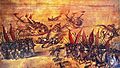
Some sailors remained loyal to the governor of Cuba and plotted to steal a ship to escape. To stop any chance of desertion, Cortés ordered his fleet to be scuttled (sunk). With the ships grounded in the shallow waters, his men had no choice but to follow Cortés inland.
Forming an Alliance with Tlaxcala

In August 1519, Cortés and his men marched west into the high mountains toward the Valley of Mexico. They soon crossed into the lands of Tlaxcala. The Tlaxcalans were fierce fighters who had resisted Aztec conquest for decades.
At first, the Tlaxcalans viewed the Spanish as invaders. Bitter fighting took place over several days, causing injuries on both sides. Recognizing the strength of Spanish steel and horses, leaders like Maxixcatzin and Xicotencatl the Elder proposed peace.
The Tlaxcalans agreed to an alliance against their mutual enemy, the Aztecs. This partnership proved to be the most critical factor in the entire campaign. Tlaxcala provided thousands of skilled warriors, food supplies, porters, and safe shelter during hard times.
The March to Cholula
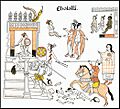
Before reaching Tenochtitlan, the Spanish and their new allies marched to Cholula. Cholula was an ancient, sacred city famous for its massive pyramid, the largest temple base in the world.
While in Cholula, relations between the city leaders and the Spanish broke down. Cortés claimed he received word through La Malinche that the Cholulans planned an ambush. In response, the Spanish and Tlaxcalan warriors carried out a surprise strike inside the temple courtyards.
The attack on Cholula shocked the surrounding cities. It demonstrated the lethal power of the foreign troops and convinced other towns along the route not to oppose Cortés's advance.
The Spanish Arrival in Tenochtitlan
Entering the Island Capital

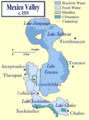
On 8 November 1519, the Spanish army walked down the grand southern causeway into Tenochtitlan. The capital sat on an island in Lake Texcoco and was linked to the mainland by wide stone roads.
The European soldiers were amazed by what they saw. Tenochtitlan was one of the largest and cleanest cities on Earth, with between 150,000 and 250,000 residents. Stone palaces, bustling markets, floating gardens, and tall pyramids rose above the blue water. Conquistador Bernal Díaz del Castillo wrote that the magnificent city seemed like an enchanted dream.
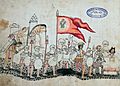
Emperor Moctezuma II met Cortés on the causeway. The emperor wore fine cotton garments, golden sandals, and a feathered headdress. The two leaders greeted each other courteously and exchanged gifts. Moctezuma invited the Spanish troops and their Tlaxcalan allies to stay in the palace of his late father, Axayacatl.
Captivity of Moctezuma II
Although treated as guests, the Spanish grew nervous living in a walled city surrounded by hundreds of thousands of Aztec citizens. Within a week, Cortés made a bold and dangerous move. He entered the royal quarters with armed guards and placed Moctezuma under house arrest.
Moctezuma continued to rule in name, but he was guarded constantly by Spanish soldiers. Cortés used the captive emperor to govern the city, demand tribute payments, and keep the population calm. The Spanish also placed a Christian altar inside the Templo Mayor, which angered the local priests and nobles.
Unrest and the Defeat of Narváez
In the spring of 1520, news arrived that Governor Velázquez had sent an army of 1,400 Spanish troops led by Pánfilo de Narváez to arrest Cortés. Leaving his lieutenant Pedro de Alvarado in charge of Tenochtitlan, Cortés hurried to the coast with a small force.
Cortés launched a surprise nighttime attack on Narváez at Cempoala. Cortés won the battle, captured Narváez, and convinced the newly arrived soldiers to join his expedition with promises of treasure.
Meanwhile, back in Tenochtitlan, tensions boiled over. Pedro de Alvarado feared an uprising during an Aztec religious festival at the main temple. Alvarado ordered his men to attack the gathering, resulting in the deaths of many Aztec nobles. The Aztec population rose in fury, surrounding the palace and trapping the Spanish inside.
The Night of Sorrows and the Siege of Tenochtitlan
La Noche Triste (The Night of Sorrows)
_(Conquest_of_Mexico)_Painting.jpg)
Cortés hurried back to Tenochtitlan in June 1520, but he found the palace heavily besieged. To calm the crowds, Cortés asked Moctezuma to step onto the palace roof and speak to the people. The citizens rejected Moctezuma's plea for peace, and stones were thrown; Moctezuma died shortly afterward.
Realizing they could not hold out, Cortés ordered a retreat from the city during the stormy night of 30 June 1520. The Aztecs had dismantled the bridges crossing the causeway gaps. As the Spanish and their Tlaxcalan allies attempted to escape across Lake Texcoco, Aztec warriors attacked from canoes and the roads.
Hundreds of Spanish soldiers and thousands of Indigenous allies lost their lives in the fighting or drowned under the weight of their armor. This disaster became known as La Noche Triste (The Night of Sorrows). Cortés and his surviving troops fought their way past an Aztec army at the Battle of Otumba and found refuge in Tlaxcala.
The Smallpox Epidemic
While the Spanish recovered in Tlaxcala, an invisible disaster struck the Aztec Empire. European ships had brought infectious diseases to which the native peoples had no natural immunity.
In late 1520, an epidemic of smallpox swept through Tenochtitlan and central Mexico. The disease killed vast numbers of people, including the new emperor Cuitláhuac and many veteran military leaders. The loss of leadership and food shortages caused by the epidemic crippled the empire's ability to organize a defense.
The Great Siege of 1521
_Painting.jpg)
Cortés prepared methodically to retake Tenochtitlan. He secured the alliance of several neighboring cities, including Texcoco. He also ordered the construction of thirteen flat-bottomed wooden warships called brigantines. Indigenous carpenters assembled these boats in pieces, carried them over the mountains, and rebuilt them on Lake Texcoco.
In May 1521, Cortés began the Siege of Tenochtitlan. The Spanish and their Indigenous allies cut the city's freshwater aqueduct at Chapultepec and blockaded all food supplies. The armed brigantines controlled the lake, preventing Aztec canoes from delivering aid.
The defense of the city was led by the young emperor Cuauhtémoc. Aztec warriors fought tenaciously from rooftops and barricades for nearly three months. Street by street, the allied army pushed into the starving city, destroying buildings as they advanced to clear pathways for their cavalry.
On 13 August 1521, Cuauhtémoc was captured trying to slip away in a war canoe. His capture ended the fighting, and the defense of Tenochtitlan came to an end.
How Did the Spanish Prevail?
Military Technology and Tactics
The Spanish had weapons that were completely new to the Indigenous peoples of the Americas:
- Steel Armor and Swords: Spanish steel blades stayed sharp and easily cut through cotton armor.
- Cavalry: Horses gave the Spanish speed and mobility. Aztec fighters had never seen horses before and found mounted charges difficult to stop.
- Firearms and Crossbows: Cannons and early muskets (arquebuses) caused panic, though gunpowder was often scarce.
Aztec weapons were made of stone, wood, and obsidian (volcanic glass). The macuahuitl, a wooden club lined with razor-sharp obsidian blades, was effective in hand-to-hand combat, but could not pierce heavy metal breastplates.
Indigenous Alliances and Local Politics
The Spanish could not have conquered the Aztec Empire alone. Cortés arrived with roughly 500 soldiers, while Tenochtitlan contained tens of thousands of experienced warriors.
The victory was largely achieved through tens of thousands of Indigenous allies, especially the Tlaxcalans. Subject peoples viewed the Spanish as powerful allies who could free them from Aztec taxes and military domination. Native warriors provided food, scouts, frontline troops, and boat crews for the final siege.
The Impact of European Disease
The spread of smallpox was perhaps the most decisive factor in the collapse of the Aztec defenses. The virus struck the capital at the height of the war, killing both commoners and commanders. This biological shock destroyed the empire's command structure and weakened the population just when maximum strength was needed.
Mesoamerica After the Fall of Tenochtitlan
The Birth of New Spain
Following the fall of Tenochtitlan, the Spanish established the Viceroyalty of New Spain. Hernán Cortés served as its first governor and captain-general. In 1535, King Charles V appointed Antonio de Mendoza as the first viceroy to oversee royal government.
Tenochtitlan was completely rebuilt as Mexico City, the new capital of the Spanish colony. European-style plazas, cathedrals, and government buildings were constructed over the ancient Aztec foundations, using stone taken from the ruined temples.
Changes for Indigenous Communities
The Spanish introduced the Encomienda system to govern the colony. Under this system, the Spanish crown granted Spanish settlers the right to collect tribute and labor from specific Indigenous communities. In exchange, the settlers were supposed to protect the people and teach them the Catholic faith.
Spanish friars, including the Franciscans and Dominicans, worked to convert the local populations to Catholicism. Friars like Bernardino de Sahagún studied Nahuatl and worked with native elders to preserve detailed records of Aztec traditions, languages, and history in manuscripts like the Florentine Codex.
Over the next two centuries, European diseases and harsh labor conditions caused massive population declines among Indigenous communities. At the same time, cultural mixing between Europeans, Indigenous peoples, and Africans shaped the modern Mexican nation.
Legacy and Cultural Impact
The conquest of the Aztec Empire remains one of the most studied events in history. It dramatically reshaped global trade, introducing American crops like corn, tomatoes, and chocolate to Europe, while bringing horses, wheat, and cattle to the Americas.
In Mexico, the conquest is viewed with complex emotions. Modern Mexicans often see their heritage as a blend of both Indigenous and Spanish ancestry, known as mestizo. Emperor Cuauhtémoc is honored as a national hero who defended his home, while monuments and museums throughout Mexico City teach visitors about the rich civilisations that existed before European arrival.
Spanish Conquest of the Aztec Empire Interesting Facts
- Before the Spanish arrived, the Aztec Empire was one of the most powerful and advanced civilizations in the world.
- Their capital city, Tenochtitlan, was a marvel of engineering. It was so clean and well-organized that the Spanish soldiers were amazed when they first saw it. They described it as being more beautiful and orderly than many cities in Spain.
- The Aztecs had never seen horses before. At first, they thought the horse and the rider were a single, strange creature!
- The Spanish had brought smallpox, a disease that the people in the Americas had never encountered before. Because they had no natural immunity, the disease spread rapidly, weakening the Aztec army and the population of the city significantly.
- The famous Aztec Sun Stone, often called the Aztec Calendar, was buried by the Spanish after the conquest. It was not rediscovered until 1790, buried deep under the main square of modern-day Mexico City.
- Mexico City was built directly on top of the ruins of Tenochtitlan. If you visit the Zócalo, the main square of Mexico City today, you are standing exactly where the heart of the Aztec Empire once was.
- One of the most important facts about the conquest is that the Spanish did not defeat the Aztecs alone. The Aztec Empire was very large, and they had conquered many neighboring groups. These groups were bitter enemies of the Aztecs. The Spanish were able to recruit thousands of local warriors who wanted to see the Aztec Empire fall. Without these allies, it would have been nearly impossible for the small group of Spanish soldiers to challenge the might of the Aztec Empire.
Images for kids
-
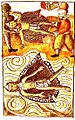
The death of Moctezuma depicted in the Florentine Codex
-
Bernal Díaz del Castillo's True History of the Conquest of New Spain
-
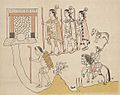
Tlaxcalan allies depicted in the Lienzo de Tlaxcala
-
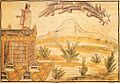
A comet interpreted as an omen in Diego Durán's history
-
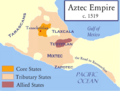
Map of the Aztec Empire in 1519
-
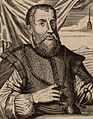
Governor Diego Velázquez de Cuéllar
-
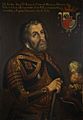
Portrait of Hernán Cortés
-
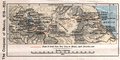
Route of Cortés from Veracruz to Tenochtitlan
-
Cortés and La Malinche meeting Moctezuma in the Codex Azcatitlan
-

Coat of arms of Villa Rica de la Vera Cruz
-
Cortés scuttles his fleet off the Mexican coast
-
The attack at Cholula from the Lienzo de Tlaxcala
-
Map of Lake Texcoco and the Valley of Mexico
-
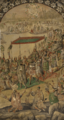
17th-century artwork showing Moctezuma receiving Cortés
-
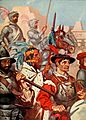
Spanish and allied forces enter the capital
-
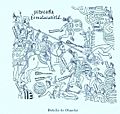
The Battle of Otumba in the Lienzo de Tlaxcala
-
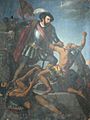
Painting showing hand-to-hand combat during the conquest
-
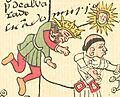
Pedro de Alvarado depicted in the Codex Telleriano-Remensis
-
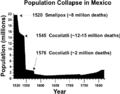
Chart of native population changes following European diseases
-
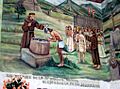
Church mural depicting religious conversion in New Spain
-
Modern stage scene from the opera La Conquista


.jpg)


_-_Reciviento_de_Motecuhzuma,_danzas_de_los_mexicanos,_Miguel_Gonz%C3%A1lez_%26_Juan_Gonz%C3%A1lez_(1698).png)


See also
 In Spanish: Conquista de México para niños
Sources
Primary sources
- Cortés, Hernán. Letters from Mexico. Translated by Anthony Pagden. Yale University Press, 1986.
- Díaz del Castillo, Bernal. The Discovery and Conquest of Mexico: 1517–1521. Translated by A. P. Maudslay. Da Capo Press, 1996.
- Lockhart, James. We People Here: Nahuatl Accounts of the Conquest of Mexico. University of California Press, 1991.
- Sahagún, Bernardino de. General History of the Things of New Spain (The Florentine Codex). Book 12. University of Utah Press, 1979.
Secondary sources
- Berdan, Frances F. The Aztecs of Central Mexico: An Imperial Society. Holt, Rinehart and Winston, 1982.
- Hassig, Ross. Mexico and the Spanish Conquest. Longman, 1994.
- Prescott, William H. History of the Conquest of Mexico. Modern Library, 2001.
- Restall, Matthew. Seven Myths of the Spanish Conquest. Oxford University Press, 2003.
- Thomas, Hugh. Conquest: Montezuma, Cortés, and the Fall of Old Mexico. Simon & Schuster, 1993.
