
Viktor Orbán facts for kids
Quick facts for kids
Viktor Orbán
|
|
|---|---|
.jpg)
Orbán in 2025
|
|
| Prime Minister of Hungary | |
| In office 29 May 2010 – 9 May 2026 |
|
| President |
|
| Deputy |
|
| Preceded by | Gordon Bajnai |
| Succeeded by | Péter Magyar |
| In office 6 July 1998 – 27 May 2002 |
|
| President | |
| Deputy | István Stumpf |
| Preceded by | Gyula Horn |
| Succeeded by | Péter Medgyessy |
| President of Fidesz | |
| Assumed office 17 May 2003 |
|
| Preceded by | János Áder |
| In office 18 April 1993 – 29 January 2000 |
|
| Preceded by | Office established |
| Succeeded by | László Kövér |
| Leader of the Fidesz Group in the National Assembly |
|
| In office 23 May 1990 – 18 April 1993 |
|
| Preceded by | Position established |
| Succeeded by | József Szájer |
| Member of the National Assembly | |
| In office 2 May 1990 – 8 May 2026 |
|
| Constituency | National PR list (1998–2006, 2014–2026) Fejér regional list (1994–1998, 2010–2014) Pest Area (1990–1994, 2006–2010) |
| Personal details | |
| Born |
Viktor Mihály Orbán
31 May 1963 Székesfehérvár, Hungary |
| Political party | Fidesz (since 1988) |
| Spouse |
Anikó Lévai
(m. 1986) |
| Children | 5, including Gáspár |
| Education |
|
| Profession |
|
| Signature |  |
Viktor Mihály Orbán (born 31 May 1963) is a Hungarian lawyer and politician. He served as the Prime Minister of Hungary from 1998 to 2002, and again from 2010 to 2026. He is also the leader of the Fidesz political party. Fidesz is known for its conservative and nationalist ideas. He has been the party's president since 2003, and before that, from 1993 to 2000.
Orbán first became a member of the Hungarian Parliament in 1990. During his first time as Prime Minister (1998-2002), Hungary's economy improved, and the country joined NATO. After a period leading the opposition, he was re-elected Prime Minister in 2010. He won elections again in 2014, 2018, and 2022. On 29 November 2020, he became Hungary's longest-serving Prime Minister.
During his time in office since 2010, Orbán's government made several changes to Hungary's laws and government structure. These changes led to discussions about how much power the government had. Some groups, like the European Commission, said these changes might affect the independence of judges and media. In March 2019, his party, Fidesz, was suspended from a big European political group called the European People's Party (EPP). Fidesz later left the EPP in 2021.
In April 2026, Orbán's party lost the parliamentary election to the Tisza Party, led by Péter Magyar. After this, Orbán announced he would not take his seat in the new parliament. However, he planned to remain the leader of Fidesz. In terms of foreign policy, Orbán often disagreed with some European Union policies, especially on immigration. He also supported closer ties with countries like China and Russia.
Contents
Who is Viktor Orbán?
Viktor Orbán is a well-known figure in Hungarian politics. He has played a big role in shaping Hungary for many years. He is known for his strong leadership and his focus on Hungarian national interests.
Early Life and Education
Viktor Mihály Orbán was born on 31 May 1963. He grew up with two younger brothers. His family moved a few times during his childhood. In 1977, they settled in Székesfehérvár. There, Orbán attended a respected school.
After high school in 1981, Orbán completed his military service. In 1983, he began studying law at Eötvös Loránd University in Budapest. He joined a special college for law students. There, he met other students who would later become important politicians. In 1986, he wrote his master's thesis about the Polish Solidarity movement. After earning his law degree in 1987, he worked as a sociologist. In 1989, he received a scholarship to study at Pembroke College, Oxford, in England. He returned to Hungary in 1990 to enter politics.
Starting in Politics
On 30 March 1988, Orbán and other students founded the Alliance of Young Democrats (FIDESZ). This group was a new political challenge to the existing system. The college journal, Századvég, became Fidesz's newspaper.
On 16 June 1989, Orbán gave an important speech in Heroes' Square in Budapest. He spoke at the reburial of Imre Nagy, a hero of the 1956 Hungarian Revolution. In his speech, Orbán called for free elections and the removal of Soviet troops. This speech made him famous across the country. Fidesz officially became a political party in October 1989.
After returning from Oxford, Orbán was elected to the Hungarian Parliament in April 1990. He became the leader of Fidesz's group in parliament until 1993. On 18 April 1993, Orbán became the first president of Fidesz. Under his leadership, Fidesz changed from a student group to a major conservative party. This change caused some members to leave the party.
In the 1994 election, Fidesz just managed to get enough votes to stay in parliament. Orbán became a Member of Parliament for Fejér County. He worked on committees dealing with European affairs. In 1995, his party added "Hungarian Civic Party" to its name. Fidesz grew to be a very strong party on the right side of Hungarian politics. In 2000, Fidesz joined the European People's Party (EPP), a large group of conservative parties in Europe.
First Time as Prime Minister (1998–2002)
In 1998, Orbán formed a government with other conservative parties. They won the 1998 parliamentary elections. At 35, Orbán became one of Hungary's youngest prime ministers.
Hungary's Economy and NATO Membership
Orbán's government focused on improving the economy. They aimed to lower taxes and social contributions. They also worked to reduce inflation and unemployment. Some of their first actions included removing university tuition fees and bringing back maternity benefits. The economy saw good results, with inflation falling and the country's debt decreasing.
In March 1999, Hungary joined NATO, a military alliance. This was an important step for Hungary's security. Hungary also gained international attention for a "status law" it passed. This law aimed to help ethnic Hungarian minorities living in neighboring countries. Some neighboring governments were concerned, but agreements were later reached.
Leading the Opposition (2002–2010)
In the 2002 parliamentary elections, Orbán's party lost to the Hungarian Socialist Party. Orbán then became the leader of the opposition. In the 2004 European Parliament election, Fidesz won a large number of votes and seats.
Orbán ran for prime minister again in 2006 but did not win. However, his position as Fidesz leader became stronger. In 2006, Fidesz won many local elections, which gave them more power at the local level.
In 2008, a national vote took place on government reforms. Fidesz started this vote to challenge new fees for doctors and university tuition. The public voted to remove these fees, which was a big win for Fidesz. In the 2009 European Parliament election, Fidesz won by a large amount.
Second Time as Prime Minister (2010–2026)
In the 2010 parliamentary elections, Orbán's party won a very large majority of seats. This allowed them to make significant changes. He was re-elected in 2014, 2018, and 2022.
Changes to Hungary's Laws
In 2011, Orbán's government created a new constitution. This new constitution included support for traditional values and Christianity. It also changed the number of seats in the Hungarian Parliament. The new constitution became law on 1 January 2012.
His government also introduced a flat tax system for personal income. Orbán described his government as "pragmatic." He mentioned changes like rules for early retirement and a new central banking law. In 2014, Hungary signed an agreement with Russia to build the Paks II nuclear power plant.
Dealing with Migration
During the 2015 European migrant crisis, Orbán ordered the building of a fence on Hungary's border with Serbia. This was to control the entry of people into Hungary. His government took many steps to manage immigration. Orbán opposed the European Union's plans for sharing migrants among member countries. He believed each country should decide its own migration policy.
Hungary's Place in Europe and the World
Orbán's government maintained close ties with China. Hungary joined China's Belt and Road Initiative in 2015. He also met with Chinese leaders to discuss cooperation.
Hungary's relations with Ukraine became difficult over the issue of the Hungarian minority in Ukraine. Orbán criticized Ukraine's education law, which made Ukrainian the main language in schools.
Orbán was seen as having friendly relations with Russia. He met with Vladimir Putin several times.
Hungary also gained observer status in the Organization of Turkic States. Orbán emphasized the historical and cultural connections between Hungarians and Turkic peoples.
The 2026 Election and Beyond
In April 2026, Viktor Orbán ran for Prime Minister for the fifth time. He faced Péter Magyar of the Tisza Party. On election night, Orbán conceded defeat to Magyar. This ended his 16 years as Prime Minister.
On April 25, 2026, after the election results, Orbán announced he would leave his seat in Parliament. However, he stated his intention to remain the head of the Fidesz party. Gergely Gulyás, his Chief of Staff, became the leader of the opposition in Parliament.
Important Ideas and Policies
Orbán's political ideas combine soft Euroscepticism, populism, and national conservatism. He has been compared to other conservative leaders around the world. He often talks about the importance of Christianity and national sovereignty.
Family and Population Policies
Orbán's government focused on policies to encourage families and increase Hungary's birth rate. These policies included financial support for families with children. For example, women with four or more children could receive a lifetime income tax exemption. The government also provided loans and subsidies for housing and cars for families. Orbán stated that Hungary needs "Hungarian children," not immigration, to solve population issues.
Economic Ideas
His government's economic approach, sometimes called "Orbánomics," aimed for strong economic growth. Unemployment decreased significantly between 2010 and 2021. In 2015, a flat rate income tax was introduced. In 2021, income taxes for those under 25 were removed. Hungary also paid off its loan from the International Monetary Fund early in 2013.
Environmental Views
Orbán has acknowledged that climate change is real and dangerous. He believes it requires global action. However, he has also criticized some of the European Union's climate plans. He warned that high energy prices resulting from these plans could harm European families. He called some climate protection plans a "utopian fantasy."
Personal Life and Hobbies
Orbán married Anikó Lévai, a lawyer, in 1986. They have five children. Their son, Gáspár, was a footballer and later became involved in a religious community.
Orbán is a member of the Reformed Church in Hungary. His wife and children were raised Catholic.
Football Interests
Orbán has loved football since he was a child. He played professionally for Felcsút FC. After his playing career, he became a major supporter of Hungarian football. He helped establish the Puskás Akadémia FC and the Puskás Cup, an international youth tournament. He is known for watching many football games. In 2009, he helped create the FIFA Puskás Award with then-FIFA President Sepp Blatter.
Awards and Recognitions
Viktor Orbán has received many awards and honors throughout his career.
Foreign
 Bosnia and Herzegovina (
 Republika Srpska):
 Order of the Republika Srpska (2024)
 France:
 Grand Cross of the National Order of Merit (2001)
 Kazakhstan:
 First Class of the Order of Friendship (2023)
 Lithuania:
 Commander's Grand Cross of the Order of the Lithuanian Grand Duke Gediminas (2009)
 North Macedonia:
 Order 8-September (2013)
 Serbia:
 First Class of the Order of the Republic of Serbia (2022)
 Vatican:
 Knight Grand Cross of the Order of St. Gregory the Great (2004)


Confessional
- Holy Cross Medal of Gratitude (Armenian Catholic Church, 2022)
- First Class of the Order of Glory and Honor (Russian Orthodox Church, 2023)
- First Class of the Order of St. Sava (Serbian Orthodox Church, 2022)
Other honors
- Honorary senator of the European Academy of Sciences and Arts (2000)
- Freedom Award by the American Enterprise Institute (2001)
- Franz Josef Strauss Prize from the Hanns Seidel Foundation (2001)
- Polak Award established by the Maria Polak Foundation (2001)
- Prize for the Social Market Economy by the German Club of Economics (2002)
- Honorary Citizen of Szék, Hungary (2002)
- Saint Stephen Award (2002)
- László Tőkés Award by the László Tőkés Foundation (2003)
- Honorary Citizen of Esztergom, Hungary, twice (2006, 2009)
- Gold Medal of the Foundation of European Merit (2004)
- World No Tobacco Day Award by the World Health Organization (2013)
- Title 'Man of the Year 2013' by Polish magazine Gazeta Polska (2014)
- 'The 28 People From 28 Countries Who Are Shaping, Shaking And Stirring Europe: Class Of 2016' by magazine Politico Europe
- Title 'Man of the Year 2015'at the Economic Forum in Poland (2016)
- FINA Order of Merit (2017)
- Golden Order of the Azeri international magazine My Azerbaijan (2022)
- Supreme Order of Turkic World (6 November 2024)
Honorary doctorates
- Tufts University (United States, 2002)
- Josai University (Japan, 2013)
- Marmara University (Turkey, 2013)
Images for kids
-
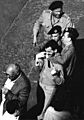
Viktor Orbán in 1988
-
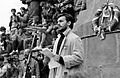
Orbán in Budapest, 1988
-
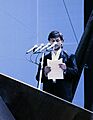
Viktor Orbán at the funeral of Imre Nagy, 1989
-
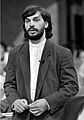
Viktor Orbán in 1990
-
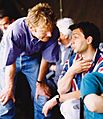
Orbán and Gábor Fodor at a meeting in 1993
-
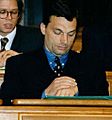
Orbán as opposition leader in 1997
-
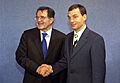
Orbán with Romano Prodi in 1999
-
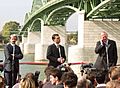
Orbán at the opening of the Mária Valéria Bridge in 2001
-
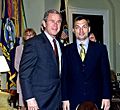
Orbán with George W. Bush in 2001
-
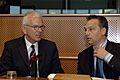
Orbán and Hans-Gert Pöttering in 2006
-
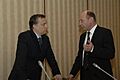
Orbán and Romanian President Traian Băsescu in 2008
-
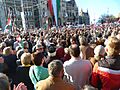
Orbán speaking at Kossuth Square in 2012
-
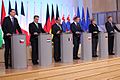
Orbán at a meeting of the Visegrád Group in 2013
-
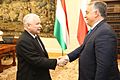
Jarosław Kaczyński with Orbán in 2017
-
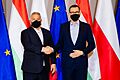
Orbán and Polish Prime Minister Mateusz Morawiecki in 2021
-
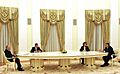
Vladimir Putin with Viktor Orbán in 2022
-
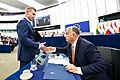
Orbán and Péter Magyar in 2024
-
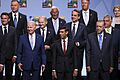
Orbán at the NATO summit in Vilnius in 2023
-
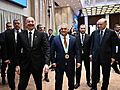
Orbán with Ilham Aliyev and Recep Tayyip Erdoğan in 2024
-
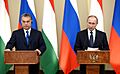
Orbán with Vladimir Putin in 2016
-
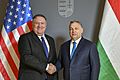
Orbán with Mike Pompeo in 2019
-
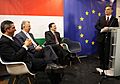
Orbán with José Manuel Barroso and Stavros Lambrinidis in 2011
-
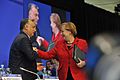
Orbán and Angela Merkel in 2015
-
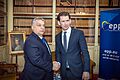
Orbán and Austrian Chancellor Sebastian Kurz in 2018
-
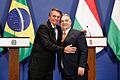
Orbán and Brazilian president Jair Bolsonaro in 2022
-
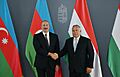
Orbán with Azerbaijani President Ilham Aliyev in 2023
-
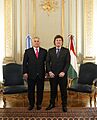
Orbán with Argentine President Javier Milei in 2023
-
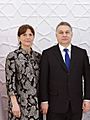
Orbán and his wife, Anikó Lévai, in 2016
-
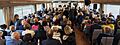
Viktor Orbán on Civic Gondola 2025


.jpg)

.JPG)


_01.jpg)
_01.jpg)

.jpg)

_11.jpg)


.jpg)
.jpg)
.jpg)
.jpg)

.JPG)
.jpg)
See Also
 In Spanish: Viktor Orbán para niños
- First Orbán Government
- Second Orbán Government
- Third Orbán Government
- Fourth Orbán Government
- Fifth Orbán Government
- Orbanomics
- List of prime ministers of Hungary by tenure
