
Joseph Stalin facts for kids
Quick facts for kids
Joseph Stalin
|
|
|---|---|
 |
|
| General secretary of the Central Committee of the Communist Party of the Soviet Union | |
| In office 3 April 1922 – 16 October 1952 |
|
| Preceded by | Vyacheslav Molotov (as Responsible Secretary) |
| Succeeded by | Nikita Khrushchev (office reestablished) |
| Chairman of the Council of Ministers | |
| In office 6 May 1941 – 5 March 1953 |
|
| First Deputies | Nikolai Voznesensky Vyacheslav Molotov |
| Preceded by | Vyacheslav Molotov |
| Succeeded by | Georgy Malenkov |
| People's Commissar for Defense of the Soviet Union | |
| In office 19 July 1941 – 25 February 1946 |
|
| Premier | Himself |
| Preceded by | Semyon Timoshenko |
| Succeeded by | Nikolai Bulganin after vacancy |
| Personal details | |
| Born | 18 December 1878 Gori, Tiflis Governorate, Russian Empire |
| Died | 5 March 1953 (aged 74) Kuntsevo Dacha, Kuntsevo, Russian SFSR, Soviet Union |
| Resting place | Kremlin Wall Necropolis, Moscow (from 31 October 1961) |
| Nationality | Georgian |
| Political party | Communist Party of the Soviet Union |
| Spouses | Ekaterina Svanidze (1906–1907) Nadezhda Alliluyeva (1919–1932) |
| Signature |  |
Joseph Stalin (born Iosif Vissarionovich Stalin; 18 December 1878 – 5 March 1953) was a powerful leader of the Soviet Union, a very large country that existed in Eastern Europe and Asia from 1922 to 1991. He led the Soviet Union for nearly 30 years, from 1924 until his death in 1953. During his time as leader, he transformed the country into a major industrial and military power, but his rule was also marked by very strict control, harsh policies, and immense suffering for millions of people. His way of governing was later called Stalinism.
Stalin's forces invaded Poland on 18 September 1939. During World War II, Stalin first signed a peace deal with Germany's leader Adolf Hitler. But then Germany attacked the Soviet Union. Stalin then led a difficult war against Germany. After the war, Stalin gained control of many parts of Eastern Europe, including a part of Germany. This helped the Soviet Union become a superpower.
Contents
- Early Life and Revolutionary Beginnings
- The Russian Revolution and Rise to Power
- Leading the Soviet Union: Rapid Change and Harsh Control (1928-1939)
- World War II (1939-1945)
- Post-War Era and the Cold War (1945-1953)
- Final Years
- Death
- De-Stalinization
- Historical Impact and Modern Views
- Personal Life
- Interesting Facts about Joseph Stalin
- Joseph Stalin Quotes
- Other Important People
- Images for kids
- See also
Early Life and Revolutionary Beginnings


Joseph Stalin (Ioseb Besarionis dze Jughashvili) was born into a poor family in Gori, a city in what is now the country of Georgia, which was then part of the vast Russian Empire. His father was a shoemaker, and his mother worked hard to support the family. Young Ioseb, or "Soso" as he was called, was a bright student and even attended a religious school to train as a priest. However, he soon became interested in new ideas about how society should be organized, particularly the ideas of Karl Marx.
He joined the Marxist Russian Social Democratic Labour Party, a group that wanted to change the Russian Empire. He became involved in revolutionary activities, helping to organize workers and spread the party's message. During this time, he adopted the name "Stalin," which means "Man of Steel" in Russian, reflecting his strong and determined personality. He was arrested several times by the empire's secret police and sent away to remote areas of Siberia, but he always managed to escape and return to his revolutionary work.
The Russian Revolution and Rise to Power
In 1917, major changes swept through Russia. First, the February Revolution led to the end of the old empire and the Tsar's rule. Then, in October, a group called the Bolsheviks, led by Vladimir Lenin, took control in what became known as the October Revolution. Stalin was an important member of the Bolshevik party, working closely with Lenin.
After the Bolsheviks came to power, Stalin was given important roles in the new government, which was called the Council of People's Commissars. He became the People's Commissar for Nationalities, dealing with the many different ethnic groups within the vast country. He also played a role during the Russian Civil War, which followed the revolution, helping to organize the Red Army.
In 1922, Lenin nominated Stalin for a new position: General Secretary of the Communist Party. This role seemed mostly about organizing the party, but Stalin used it to build a network of loyal supporters throughout the country. When Lenin became very ill and eventually passed away in 1924, there was a struggle among the top leaders to decide who would lead next. Stalin, with his strong organizational skills and network of supporters, gradually outmaneuvered his rivals, like Leon Trotsky, and by the late 1920s, he had become the supreme leader of the Soviet Union.
Leading the Soviet Union: Rapid Change and Harsh Control (1928-1939)
Once in charge, Stalin set out to rapidly transform the Soviet Union. He believed the country needed to become strong and modern very quickly to defend itself from other powerful nations.
Economic Transformation: Five-Year Plans and Collectivization
Stalin introduced a series of "Five-Year Plans," starting in 1928. These were ambitious plans to boost the country's economy, focusing heavily on industrialization. New factories, mines, and cities were built at an incredible pace. Millions of people moved from the countryside to work in these new industrial centers.
Another major change was agricultural collectivization. Stalin believed that small, individual farms were not efficient enough. He ordered that all farms be combined into large collective farms, where peasants would work together and share resources. While this was meant to modernize agriculture, it was often done by force. Many peasants resisted giving up their land and animals, leading to widespread unrest.
These rapid and forced changes in agriculture, combined with other factors like bad weather, led to a terrible famine in 1932–1933. Millions of people, especially in Ukraine (where it is known as the Holodomor), Southern Russia, and Kazakhstan, died from starvation and disease. The government's policies contributed to this crisis by taking grain from the countryside to feed the cities and for export, even as people in rural areas suffered greatly.
Social and Cultural Changes
Under Stalin, there was a big push for education, and literacy rates (the number of people who could read and write) greatly increased. The government also promoted a specific style of art and literature called "socialist realism," which was meant to show the achievements of the Soviet Union and inspire its people.
Maintaining Control: The Great Purge and Gulags
To ensure everyone followed his vision and to remove any opposition, Stalin's rule became very strict. He believed that "enemies" were always trying to undermine the Soviet Union. This led to a period known as the "Great Purge" (1936-1938), where many people, including old revolutionary leaders, military officers, and ordinary citizens, were accused of plotting against the government. Many political opponents were removed from power, and some faced the ultimate penalty.
Millions of people were also sent to Gulag camps, which were forced labor camps, often in harsh, remote areas of the country like Siberia. People sent to these camps were forced to work on large construction projects or in mines, and conditions were extremely difficult. Entire groups of people, including some ethnic minorities, were also forcibly moved from their homes to other parts of the country. These harsh policies and the widespread fear they created deeply affected millions of lives.
Foreign Policy before World War II
In the 1930s, as fascism (a type of authoritarian nationalism) grew in Europe, especially in Nazi Germany under Adolf Hitler, Stalin tried to build alliances with Western countries like France and Czechoslovakia to counter this threat. However, he also made a surprising agreement with Germany in 1939, called the Molotov–Ribbentrop Pact, which was a non-aggression pact that secretly divided parts of Eastern Europe between them. This pact allowed the Soviet Union to take control of eastern Poland and the Baltic states.
World War II (1939-1945)
World War II began in September 1939 when Germany invaded Poland. The Soviet Union also invaded eastern Poland shortly after. However, the alliance between Germany and the Soviet Union did not last.
In June 1941, Germany broke its pact and launched a massive surprise invasion of the Soviet Union, known as Operation Barbarossa. The German army advanced quickly, causing huge losses for the Soviet Union. Stalin, as the Supreme Commander, rallied the country. The war on the Eastern Front was incredibly brutal and became the largest and deadliest conflict in human history.
The Soviet people, led by the Red Army, fought fiercely to defend their homeland. A major turning point came with the Battle of Stalingrad (1942-1943), where the Soviet forces successfully defended the city against the German army in a long and bloody battle. This victory marked the beginning of the German retreat.
During the war, the Soviet Union joined the Allies, working with Great Britain (led by Winston Churchill) and the United States (led by Franklin D. Roosevelt). These three leaders, often called the "Big Three," met at important conferences like Tehran (1943), Yalta (1945), and Potsdam (1945) to plan the war effort and discuss the post-war world. Stalin pushed for the Allies to open a second front in Western Europe to relieve pressure on the Soviet Union.
The Red Army steadily pushed the German forces back across Eastern Europe. In April 1945, Soviet troops captured Berlin, the capital of Germany, leading to Germany's surrender in May. Stalin then turned his attention to the war against Japan, invading Japanese-occupied Manchuria and northern Korea in August 1945, which contributed to Japan's surrender and the end of World War II.
Key Events:
- August 1939: Molotov–Ribbentrop Pact signed with Germany.
- June 1941: Germany invades the Soviet Union.
- 1942-1943: Battle of Stalingrad, a major turning point.
- 1943-1945: Allied conferences (Tehran, Yalta, Potsdam).
- May 1945: Red Army captures Berlin, Germany surrenders.
- August 1945: Soviet Union enters war against Japan.
Post-War Era and the Cold War (1945-1953)
After World War II, the Soviet Union emerged as one of the two most powerful nations in the world, alongside the United States. This led to a period of rivalry and tension known as the Cold War.
The Soviet Union faced massive destruction from the war, and Stalin oversaw a huge effort to rebuild the country. Despite the victory, his government maintained very strict control over the population. Forced labor camps continued to be used, and many people who had been prisoners of war or were suspected of disloyalty faced severe consequences, including being sent to these camps or deported. The country also experienced another tragic famine in 1946-1947.
Stalin was determined to make the Soviet Union even stronger. He pushed for the development of the Soviet atomic bomb, which was successfully tested in 1949. The Soviet Union also established its influence over many countries in Eastern Europe, creating a group of Soviet-aligned states known as the Eastern Bloc. This division of Europe into Eastern and Western blocs became a key feature of the Cold War.
Stalin also played a role in events in Asia. In 1949, the Communist Party took power in China, and its leader, Mao Zedong, visited Stalin. In 1950, the Korean War began when North Korea, supported by the Soviet Union and China, invaded South Korea. Stalin avoided direct conflict with the United States but encouraged China to intervene.
Final Years
In his final years, Stalin's health declined, and he became increasingly suspicious of those around him. He ordered investigations and arrests of many people, including doctors, whom he accused of plotting against the government in what was known as the "doctors' plot." These actions created an atmosphere of fear and uncertainty.
Death
Joseph Stalin died on March 5, 1953, after suffering a stroke. His death was a huge event in the Soviet Union, and hundreds of thousands of people attended his funeral in Moscow.
De-Stalinization
After his death, the new leaders of the Soviet Union, particularly Nikita Khrushchev, began a process called "de-Stalinization." In a famous speech in 1956, Khrushchev criticized Stalin's harsh methods, his personality cult (where he was worshipped like a hero), and the immense suffering he caused. Stalin's body was eventually moved from Lenin's Mausoleum, and cities named after him, like Stalingrad, were renamed (Stalingrad became Volgograd).
Historical Impact and Modern Views
Stalin's legacy is one of the most debated and complex in history. On one hand, he transformed the Soviet Union from a largely agricultural country into a powerful industrial and military force, which played a crucial role in defeating Nazi Germany in World War II. Under his rule, the country saw improvements in education and life expectancy.
On the other hand, his rule came at a terrible human cost. His harsh policies, forced collectivization, purges, and the Gulag system led to the deaths of millions of Soviet citizens and deeply affected many more. Historians continue to study and debate the exact number of lives lost due to his policies, but it is clear that millions of people died from famines, forced labor, and political repression.
Today views on Stalin remain divided. While many people around the world remember him for his brutal dictatorship and the suffering he caused, some in Russia and Georgia still see him as a strong leader who modernized the country and led it to victory in World War II.
Personal Life
He was married twice. His first wife, Ekaterina Svanidze, died young, and they had one son, Yakov. His second wife was Nadezhda Alliluyeva, with whom he had two children, Vasily and Svetlana. He also adopted another son, Artyom Sergeev. His relationships with his children were sometimes complicated, especially with his sons. His second wife tragically died in 1932.
Interesting Facts about Joseph Stalin
- As a child, he faced several health problems. A smallpox infection left him with some scars on his face, and an accident at age 12 injured his left arm, causing a lifelong disability.
- Stalin was ethnically Georgian and spoke Georgian as his first language, learning Russian later. He always spoke Russian with a Georgian accent.
- During his youth, he was greatly inspired by a novel called The Patricide by Alexander Kazbegi. The main character of this book was a brave bandit named Koba, who fought against injustice. Joseph adopted "Koba" as his first revolutionary nickname, showing his early spirit of rebellion.
- Stalin was an autodidact, meaning he taught himself a lot. He was a passionate reader and had a personal library of over 20,000 books! He especially loved history and was interested in the lives of famous Russian leaders like Ivan the Terrible and Peter the Great.
- Despite his immense power, Stalin was described as a soft-spoken person and not a very flashy public speaker. He preferred to express himself through writing.
Joseph Stalin Quotes
- "If you are afraid of wolves, keep out of the woods."
- "Education is a weapon whose effects depend on who holds it in his hands and at whom it is aimed."
- "We do not want a single foot of foreign territory; but of our territory we shall not surrender a single inch to anyone."
- "A sincere diplomat is like dry water or wooden iron."
- "Gratitude is a sickness suffered by dogs."
- "I consider it completely unimportant who in the party will vote, or how; but what is extraordinarily important is this—who will count the votes, and how."
Other Important People
Images for kids
-
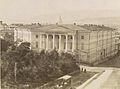
In 1894 Stalin began his studies at the Tiflis Spiritual Seminary (pictured here in the 1870s).
-
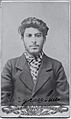
Police photograph of Stalin, taken in 1902, when he was 23 years old.
-
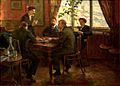
Stalin first met Vladimir Lenin at a 1905 conference in Tampere, in the Grand Duchy of Finland. Lenin became "Stalin's indispensable mentor".
-
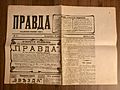
The first issue of Pravda, the Bolshevik newspaper of which Stalin was editor.
-
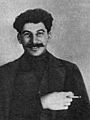
Stalin in 1915.
-
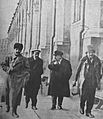
(From left to right) Stalin, Alexei Rykov, Lev Kamenev, and Grigori Zinoviev in 1925.
-
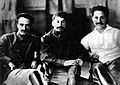
Stalin and his close friends Anastas Mikoyan and Sergo Ordzhonikidze in Tbilisi, 1925.
-
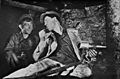
Aleksei Grigorievich Stakhanov with a fellow miner. Stalin's government started the Stakhanovite movement to encourage hard work. This helped increase production in the 1930s.
-
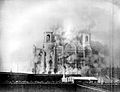
The 1931 demolition of the Cathedral of Christ the Saviour in Moscow. It was destroyed to make way for the Palace of the Soviets.
-
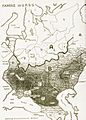
Areas most affected by the Soviet famine of 1932–33 are marked in black.
-
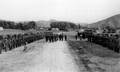
Soviet armored vehicles used by the Republican People's Army during the Spanish Civil War.
-
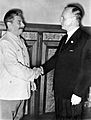
Stalin greeting the German foreign minister Joachim von Ribbentrop in the Kremlin, 1939.
-
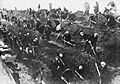
With men at the front, women dig anti-tank trenches around Moscow in 1941.
-
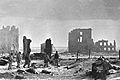
The center of Stalingrad after it was freed on 2 February 1943.
-
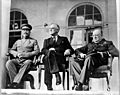
The Big Three: Stalin, U.S. President Franklin D. Roosevelt, and British Prime Minister Winston Churchill at the Tehran Conference, November 1943.
-
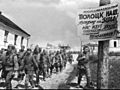
Soviet soldiers in Polotsk, 4 July 1944.
-
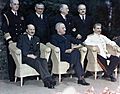
British Prime Minister Clement Attlee, U.S. President Harry S. Truman and Joseph Stalin at the Potsdam Conference, July 1945.
-
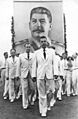
A banner of Stalin in Budapest in 1949.
-
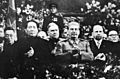
Stalin at his 71st birthday celebration with (left to right) Mao Zedong, Nikolai Bulganin, Walter Ulbricht and Yumjaagiin Tsedenbal.
-
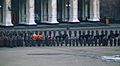
Stalin's casket on a howitzer carriage pulled by horses. This was filmed by US assistant army attaché Major Martin Manhoff from the embassy balcony.
-
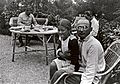
Lavrenti Beria with Stalin's daughter, Svetlana, on his lap. Stalin is seated in the background. Photographed at Stalin's dacha near Sochi in the mid-1930s.
-
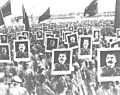
Chinese Marxists celebrate Stalin's seventieth birthday in 1949.
-
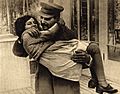
Stalin carrying his daughter, Svetlana.
-
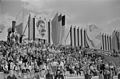
A poster of Stalin at the 3rd World Festival of Youth and Students in East Berlin, East Germany, 1951.
-
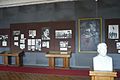
Inside the Joseph Stalin Museum in Gori, Georgia.
-
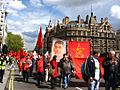
Members of the Communist Party of Great Britain (Marxist–Leninist) carrying a banner of Stalin at a May Day march through London in 2008.
-
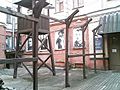
Inside the Gulag Museum in Moscow.
-
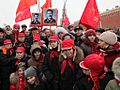
Marxist–Leninist activists laying wreaths at Stalin's Moscow grave in 2009.


,_passing_by_propaganda_poster_celebrating_the_reconquest_of_the_city_and_urging_the_liberation_of_the_Baltic_from_Nazi_German_occupation._July_4,_1944.jpg)


See also
 In Spanish: Iósif Stalin para niños
