
Papilio machaon facts for kids
Quick facts for kids Old World swallowtail |
|
|---|---|
 |
|
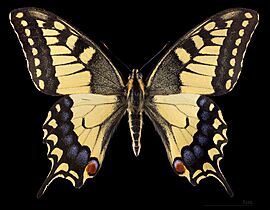
| Dorsal side, recently emerged from its chrysalis, France | |
_underside_Italy.jpg) |
|
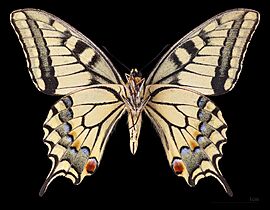
| Ventral side of P. m. gorganus, Italy | |
| Conservation status | |
Scientific classification  |
|
| Kingdom: | Animalia |
| Phylum: | Arthropoda |
| Class: | Insecta |
| Order: | Lepidoptera |
| Family: | Papilionidae |
| Genus: | Papilio |
| Species: |
P. machaon
|
| Binomial name | |
| Papilio machaon Linnaeus, 1758
|
|
| Script error: The function "autoWithCaption" does not exist. | |
| Synonyms | |
|
List
Papilio machaon var. marginalis Robbe, 1891
Papilio machaon ab. nigrofasciata Rothke, 1895 Papilio machaon ab. niger Heyne, [1895] Papilio machaon var. aurantiaca Speyer, 1858 Papilio machaon var. asiatica Ménétriés, 1855 Papilio hippocrates C. & R. Felder, 1864 Papilio machaon var. micado Pagenstecher, 1875 Papilio bairdii Edwards, 1866 Papilio asterius var. utahensis Strecker, 1878 Papilio hollandii Edwards, 1892 Papilio aliaska Scudder, 1869 Papilio machaon joannisi Verity, [1907] Papilio machaon petersii Clark, 1932 Papilio hippocrates var. oregonia Edwards, 1876 Papilio ladakensis Moore, 1884 Papilio sikkimensis Moore, 1884 Papilio machaon var. centralis Staudinger, 1886 Papilio brucei Edwards, 1893 Papilio brucei Edwards, 1895 Papilio machaon dodi McDunnough, 1939 Papilio machaon var. montanus Alphéraky, 1897 Papilio machaon alpherakyi Bang-Haas, 1933 Papilio machaon minschani Bang-Haas Papilio machaon chinensomandschuriensis Eller, 1939 Papilio machaon hieromax Hemming, 1934 Papilio machaon mauretanica Verity, 1905 Papilio machaon var. mauretanica Blachier, 1908 Papilio machaon var. mauretanica Holl, 1910 Papilio machaon var. asiatica ab. caerulescens Holl, 1910 Papilio machaon var. asiatica ab. djezïrensis Holl, 1910 Papilio sphyrus Hübner, [1823] Papilio machaon machaon maxima Verity, 1911 Papilio machaon maxima gen.aest. angulata Verity, 1911 Papilio machaon f. chrysostoma Chnéour, 1934 Papilio machaon f. archias Fruhstorfer, 1907 Papilio machaon chishimana Matsumura, 1928 Papilio machaon sylvia Esaki, 1930 Papilio machaon venchuanus Moonen Papilio machaon schantungensis Eller, 1936 |
|

Script error: No such module "Check for conflicting parameters".
The Old World swallowtail (scientific name Papilio machaon) is a big, colorful butterfly. It belongs to the butterfly family Papilionidae. Many people also call it the common yellow swallowtail. It was the very first insect called a swallowtail. This creature is the type species for its whole genus, named Papilio. That means scientists use it as an example for related butterflies. It lives in many places across the Palearctic and North America.
The insect has bright yellow wings with bold black lines. Its back wings have extensions that look like the fork of a swallow tail bird. These cool tails trick hunting birds and help the butterfly escape safely. It also has colorful red and blue spots on its lower wings. The young caterpillar looks like a bird dropping for clever camouflage. Later, it turns bright green with black bands and orange spots. It even has a hidden orange scent horn behind its head to scare enemies.
Contents
Learning About the Old World Swallowtail Butterfly
_(6779562070).jpg)
Humans have studied this amazing flying insect for centuries. Famous Swedish scientist Carl Linnaeus first described it scientifically in 1758. He included it in his big nature book called the 10th edition of Systema Naturae. Linnaeus named almost two hundred butterfly species in that important work. Later on, a French scientist named Pierre André Latreille studied the insect family tree. He picked this insect to represent the group Papilio.
The butterfly gets its name from ancient Greek mythology. Long ago, the famous Greek poet Homer wrote epic poems about brave heroes. One character was named Machaon, a skilled healer in ancient stories. Machaon was the son of Asclepius, the ancient Greek god of medicine. Linnaeus loved old legends, so he named this gorgeous creature after the hero. Today, nature lovers around the globe still use that historic scientific name.
How to Identify This Swallowtail Butterfly
An adult butterfly, known to scientists as an imago, has large yellow wings. These wings have thick black veins running through them. Its wingspan measures between 65 and 86 millimeters across. When its wings are open, it looks like a bright floating flower. Each hindwing has a long tail sticking out backwards. Near each tail sits a bright red eye spot ringed with blue. Six extra blue spots run along the edge of each hindwing.
It looks quite similar to another rare European insect called Papilio hospiton. They live in the same areas, sharing a status called sympatry. You can find both of them together on islands like Corsica and Sardinia. However, our swallowtail has noticeably longer tails on its wings. Another cousin is Papilio saharae, which lives in the dry deserts of Algeria. Scientists can tell them apart only by carefully counting segments on the antennae.
-
♂
-
♂ △
-
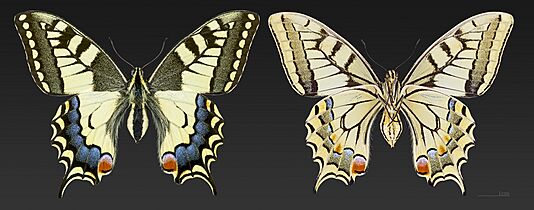
♀ Top (L) and bottom (R) sides, (MHNT)
_Papilio_machaon_-_Ch%C4%99ciny_(Mazovie)_-_Poland_-_male_dorsal.jpg)
_Papilio_machaon_-_Ch%C4%99ciny_(Mazovie)_-_Poland_-_male_ventral.jpg)

Amazing Subspecies Across the World

Because this butterfly lives in so many regions, it has 41 subspecies. A subspecies is a local group that looks slightly different from others. In Europe, the traveler form called Papilio machaon gorganus wanders far and wide. It flies across many habitats, including farmland, meadows, and hillsides. In the United Kingdom, you find a special type called P. m. britannicus. This British butterfly is endemic, meaning it lives naturally only in Britain. It has thicker black markings than the mainland European butterflies.
Another unique island subspecies called P. m. melitensis lives on the sunny Maltese Islands. In North America, you can spot kinds like Papilio machaon oregonius. Asian mountains shelter special varieties like P. m. ladakensis and P. m. sikkimensis. In Japan, people admire the giant subspecies called P. m. hippocrates. Each group adapts well to its local weather, mountains, and native plants.
-
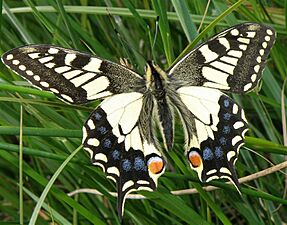
P. m. britannicus
-
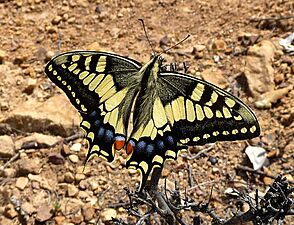
P. m. gorganus
-
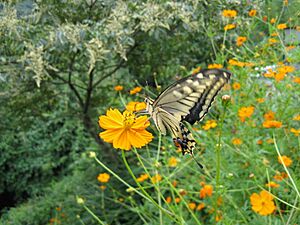
P. m. hippocrates
-
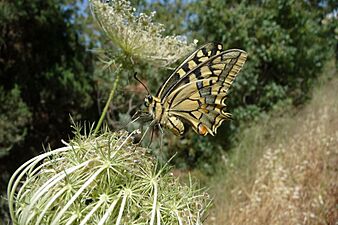
P. m. syriacus
-
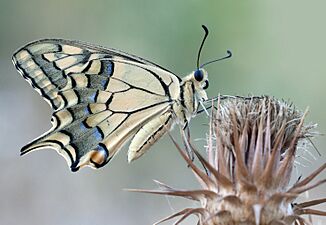
In Turkey


.JPG)

Where Does the Old World Swallowtail Live?
This insect covers a huge geographical area across the northern half of Earth. It flies throughout the entire Palearctic wildlife zone, from Europe to eastern Asia. It lives in Russia, China, Japan, the snowy Himalayas, and the island of Taiwan. Despite being named for the Old World, it also lives in North America. You can find it across wild regions of Alaska, Canada, and the United States.
In hot southern Asia and the Middle East, it reaches into Saudi Arabia. It flies over flowers in Oman and the high green mountains of Yemen. It also lives happily in Lebanon, Iran, and Israel. Further east, it appears in Pakistan, Kashmir, Nepal, and Bhutan. It travels across northern India through places like Sikkim, Assam, and Arunachal Pradesh. You can even see it fluttering along high hills in northern Myanmar.
European Homes and Wet Fenlands
In continental Europe, this butterfly is common and flies through many open spaces. But in the United Kingdom, it lives only in the Norfolk Broads in East Anglia. There, it prefers wet bogs, marshy riversides, and reed beds called fens. It holds the proud title of the largest resident butterfly in Great Britain. The famous monarch (Danaus plexippus) is a tiny bit larger. However, monarchs do not live there year-round and only arrive as rare travelers.
The British fens provide a quiet sanctuary where humans protect delicate wetland plants. Because the British swallowtail stays near these fens, it rarely visits normal town gardens. Continental swallowtails are much more adventurous and fly over big towns and high mountains.
How Swallowtails Survive in High Mountains
In the dry mountain valleys of Kashmir, this butterfly enjoys high alpine meadows. It starts flying at lower elevations around 2,000 feet in the valleys. Yet explorers have spotted it flying as high as 16,000 feet up. That happens high up in the rugged Garhwal Himalayan mountains. Few insects can survive the icy winds and freezing nights at those high altitudes.
In other parts of northern India, such as Himachal Pradesh, it stays high up. It lives only at elevations above 4,000 feet in that state. In the cool mountain air of Sikkim, it flies above 8,000 feet. The sunny rocky slopes absorb heat during the day, keeping the insects warm. Short mountain summers mean the butterflies must feed, mate, and lay eggs quickly.
Population Status and Legal Protection
Because this insect lives in so many countries, it is not globally endangered. Scientists consider its wild population stable in most large natural areas. In Armenia, experts assessed it and found healthy, steady butterfly counts. However, pollution, farm sprays, and wetland loss can hurt local populations. It is listed as vulnerable in Red Data Books for Austria and South Korea. It also held protected status in the Red Data Book of the former Soviet Union.
Many governments passed strict nature laws to keep these lovely insects safe. Six provinces in Austria protect the butterfly, as do the Czech Republic and Slovakia. It also enjoys full legal protection in Hungary, Romania, and Moldova. The United Kingdom protects its rare fenland swallowtails by law. In India, people are strictly forbidden from harming the rare subspecies verityi.
In late 2017, the Estonian Society of Lepidopterists invited people to vote online. They wanted to pick an official National Butterfly for the nation of Estonia. Almost 5,000 citizens voted, and our swallowtail won with 2,664 votes. Because it won the vote, it became Estonia's proud national symbol. The society also named it the official Butterfly of the Year for 2018.
Habitat and Flying Habits
_na_mladom_k%C3%B4pri.jpg)
Adult swallowtails are powerful, athletic fliers that glide gracefully through the air. They flap their wings rapidly to gain speed across open fields. When feeding, they hover lightly over colorful wildflowers to drink sweet flower nectar. They love visiting warm hillsides, sunny woodland clearings, and lush green meadows. In warmer European countries, they happily visit suburban flower gardens and vegetable patches.
Male butterflies show a fascinating social behavior known to insect scientists as hilltopping. On warm afternoons, males fly up to the highest point of a hill. They flutter near hilltops and tree summits to establish their own tiny territories. They zoom around, chasing off rival males and watching for arriving females. This clever habit makes it easy for mates to find each other across huge landscapes.
Favorite Food Plants of the Caterpillars
Most other swallowtail cousins like to eat leaves from the citrus family Rutaceae. But our Old World swallowtail prefers plants from the family Umbelliferae. Plants in this family usually have umbrella-shaped clusters of tiny flowers. Mother butterflies search carefully and lay their eggs one at a time on tender leaves.
In the United Kingdom, caterpillars eat almost exclusively milk parsley, also called marsh hog's fennel. If milk parsley disappears from a marsh, the British caterpillars cannot survive. Across mainland Europe and North America, caterpillars enjoy a much wider menu. They munch happily on garden fennel (Foeniculum vulgare) and wild carrot (Daucus carota). They also eat wild angelica (Angelica sylvestris) and sturdy hogweeds (Heracleum).
In domestic kitchen gardens, females lay eggs on aromatic herbs like dill and parsley. These tender spring herbs provide soft, nutritious food for newly hatched caterpillars. On the sunny Maltese Islands, caterpillars also munch on rue plants (Ruta chalepensis). Mother butterflies use tiny chemical sensors on their feet to taste each leaf first. This guarantees they leave their precious babies on the correct healthy food plant.
The Amazing Swallowtail Life Cycle

.jpg)


The life story of this creature involves a total change called metamorphosis. It passes through four distinct life stages: egg, caterpillar, chrysalis, and adult butterfly. Depending on local summer temperatures, a population may raise two or three broods each year. In cold far-northern regions, butterflies only have time for a single generation, called univoltine. In intermediate areas like Great Britain, the population is described as being partially bivoltine. That means some butterflies emerge the same summer, while others wait until spring.
From Tiny Egg to Hungry Caterpillar
A female deposits each round, smooth egg carefully onto a host plant leaf. The egg starts out pale yellow and darkens as the baby grows inside. After about a week, a tiny black and white caterpillar chews its way out. The baby caterpillar looks just like an unappealing bird dropping. Birds hunting for food ignore it because it looks like waste rather than food. This clever disguise keeps the tiny baby safe while it grows bigger.
As the caterpillar molts its skin, its appearance changes completely. It develops a bright, smooth skin patterned with vibrant green, black, and orange. This pattern breaks up its body outline among the feathery garden leaves. The caterpillar feeds almost non-stop, storing energy for its upcoming transformation into a butterfly.
Clever Defense Mechanisms

Even with bright camouflage colors, a caterpillar must defend itself against hungry garden hunters. When a hunting bird or curious mouse approaches, the caterpillar uses threatening postures. It raises the front of its body high in the air to look bigger.
If an attacker gets closer, the caterpillar deploys a secret weapon called an osmeterium. This is a bright orange, fleshy fork hidden behind its head. The caterpillar inflates this fork like a tiny party balloon. At the same time, the organ shoots out a foul, pungent smell. The terrible odor quickly drives away ants, spiders, and praying mantises. Once the danger passes, the caterpillar pulls the smelly orange horns back inside.
Chrysalis and Butterfly Emergence


When fully grown, the plump caterpillar stops eating and looks for a safe stem. It spins a small silken pad and a strong silk support belt. It straps itself securely to the plant stem facing head upward. After resting quietly for a day, it sheds its outer skin one last time. Underneath lies a hard shell known as a pupa or chrysalis. Chrysalises come in green or mottled brown to blend in with natural twigs.
Inside this shell, the insect rebuilds its body into an elegant winged adult. In warm weather, the transformation takes only one or two weeks. If autumn brings cold weather, the chrysalis sleeps through frost and snow until spring. When ready, the chrysalis splits open during the process called eclosing. The newly emerged insect pumps warm fluid into its soft, crumpled wings. Within an hour, its wings dry flat and harden, ready for magical summer flight.
Raising Swallowtails in Gardens
Many nature lovers enjoy raising these magnificent butterflies at home or school. You can easily attract wild females to your backyard by growing their favorite herbs. Planting beds of sweet fennel, curly parsley, dill, and common rue works wonders. Female butterflies will spot these plants from the sky and visit to lay eggs.
Young caterpillars can be protected in airy insect cages with mesh tops. It is best to give them plenty of space so they do not bump into each other. They must receive fresh, clean food plant leaves every single day. Caterpillars will not eat tough, woody stems, so pick only soft, tender foliage. Never feed them leaves sprayed with garden chemicals, which make caterpillars sick.
When caterpillars enter the pupa stage, keep them attached to their natural sticks. Place the chrysalises in a warm, dry room out of direct harsh sunlight. Keep absorbent paper towels under them because butterflies release fluids when hatching. If a butterfly gets trapped in puddles, its wings might dry crooked. Once the adult stretches its wings fully, you can release it into your garden. Watching a homegrown butterfly take its first flight into the blue sky is unforgettable.
See Also
- List of butterflies of India (Papilionidae)
- List of butterflies of Great Britain
