
Steamboat facts for kids
_on_Tennessee_River_-_NARA_-_5289791_restored.jpg)

A steamboat is a special kind of boat that moves using the power of steam. Imagine a giant teapot on water! Instead of sails or regular engines, steamboats use a steam engine to turn big paddlewheels or propellers. These boats usually traveled on lakes, rivers, and short trips along coastlines. When steamboats became bigger and stronger, they were called steamships and could even cross oceans! Sometimes, you might see steamboats called SS (for 'Screw Steamer') or PS (for 'Paddle Steamer'), but these names are more common for the larger ocean-going steamships.
Contents
How Steam Engines Work
Early, Simple Engines
The very first ideas for steamboats used engines like the Newcomen steam engine. These engines were huge and very heavy, but they didn't make much power. It was like trying to power a bicycle with a car engine! Because the engine was so heavy, the boats had to be super strong. Also, these engines moved back and forth, which made it tricky to connect them to the boat's paddles.
Making Engines Stronger and Faster
A brilliant inventor named James Watt made steam engines much better. He found ways to make them more powerful without being quite so heavy. His engines could also create a spinning motion, which was perfect for turning paddlewheels on a boat. This made it much simpler to build a steamboat. Even with Watt's improvements, the engines were still quite heavy for the power they produced.
The real breakthrough came with high-pressure steam engines. These engines were much lighter and more powerful for their size, and they used less fuel. This made steamboats truly practical! Engineers learned to build stronger boilers and engine parts that could handle the high pressure. However, because they didn't have good tools to measure pressure, sometimes these boilers could explode, which was very dangerous. Inventors like Richard Trevithick and Oliver Evans helped develop these powerful new engines after 1800.
Later, in the late 1800s, engineers invented compound steam engines. These engines were even more efficient because they used the steam twice! This meant ships could travel much further using less coal. This was a huge deal for shipping goods all over the world.

Finally, the most efficient type of steam engine for ships was the steam turbine. These were invented around the late 1800s and were used for many years in the 20th century.
The Exciting History of Steamboats
First Ideas and Attempts
People dreamed of steam-powered boats for a long time! One story says Denis Papin built a steamboat in 1705, but it was actually powered by hand. In 1729, an English doctor named John Allen patented a steamboat design. Then, in 1736, Jonathan Hulls got a patent for a steamboat that would use a Newcomen engine. But these early ideas weren't very practical until James Watt made steam engines much better.
An American named William Henry from Pennsylvania tried to build a steamboat after learning about Watt's engine. His first boat sank, but he kept trying and might have inspired others.

The first actual steam-powered ship, called Pyroscaphe, was built in France in 1783 by Claude de Jouffroy. It was a paddle steamer that traveled upstream on the Saône River for about 15 minutes before its engine stopped. It was likely fixed easily and made more trips.
Around the same time, in 1785, John Fitch in Philadelphia, USA, and William Symington in Scotland also built similar boats. Fitch even started a regular passenger service on the Delaware River in 1788, carrying up to 30 people! His boat could go about 7 to 8 miles per hour. However, it wasn't a big business success because people could already travel easily by road.
In Scotland, Patrick Miller of Dalswinton worked with engineer William Symington to build a steamboat that was successfully tested in 1788.
The First Successful Steamboats

In Scotland, engineer William Symington built a very important steamboat called the Charlotte Dundas in 1803. It was named after Lord Dundas's daughter, who supported the project. This boat was 56 feet long and had a powerful engine that turned a large paddlewheel.
On its first big test, the Charlotte Dundas successfully towed two heavy barges for almost 20 miles along a canal to Glasgow. It did this even against a strong wind that stopped other boats! This showed everyone that steam power could really work for moving ships. Many people consider the Charlotte Dundas to be the first truly practical steamboat.

The American inventor Robert Fulton saw the Charlotte Dundas and was very interested. He designed his own steamboat, which sailed on the River Seine in France in 1803.
In 1804, John Stevens designed and built the Little Juliana, which was the first boat to use a screw propeller instead of paddlewheels.

Fulton later brought a steam engine to America. In 1807, he built his famous steamboat, the North River Steamboat (also known as Clermont). This boat carried passengers between New York City and Albany, New York. The Clermont could travel 150 miles in 32 hours. It was the first commercially successful steamboat, making regular trips and showing how useful steam travel could be.
In 1811, John Stevens's Juliana became the first steam-powered ferry between Hoboken and New York City.
In 1812, Henry Bell's PS Comet started the first commercial passenger service in Europe, sailing on the River Clyde in Scotland.
The Margery, launched in 1814, became the first steamboat on the River Thames in London in 1815. It later became the first steamboat to cross the English Channel to France.
Crossing Oceans with Steam Power

The first steamboat to travel on the open sea was Richard Wright's Experiment in 1813. It steamed from Leeds to Yarmouth in England.
By 1826, steamboats were common for coastal trips and even crossed the Irish Sea and the English Channel.
Early steamships had to carry a lot of coal for fuel, which took up space that could have been used for cargo. This made sailing ships cheaper for long journeys for a while. But as steam engines got better and more efficient, they needed less coal. By the 1860s, steamships became cost-effective for crossing the Atlantic Ocean. The opening of the Suez Canal in 1869 made it much easier for steamships to reach places like South Asia from Europe. By the 1890s, steamships were so good that they could travel long distances, like from Great Britain to its colonies in Asia, leading to the decline of sailing ships.
Steamboats Around the World
Steamboats in the United States

Early American Steam Travel
The steamboat era in the United States began in Philadelphia in 1787. John Fitch successfully tested his 45-foot steamboat on the Delaware River. He later ran a passenger and freight service between Philadelphia and Burlington, New Jersey. This was the first time steam power was used for regular passenger transport.
Oliver Evans designed an improved high-pressure steam engine in 1801. His engines were much more powerful for their weight, making them great for steamboats.

Robert Fulton's Clermont became a huge success on the Hudson River in 1807. This led to many more steamboats appearing on major US rivers. In 1811, the first river steamboat began a continuous service from Pittsburgh down the Ohio River to the Mississippi and on to New Orleans. In 1817, the first US steamboat, Ontario, started operating on Lake Ontario and the Great Lakes. Famous author Mark Twain wrote many stories about life on these riverboats.
Different Kinds of Steamboats
By the mid-1800s, ships were changing from sail to steam and from wood to metal. There were different types of steamboats. River steamboats usually had flat bottoms and shallow hulls with rear-mounted paddles. This allowed them to carry large loads on calm, sometimes shallow, rivers. Ocean-going paddle steamers often had side-mounted paddles and deeper hulls to handle rough seas.

The SS Savannah was the first paddle-steamer to make a long ocean voyage in 1819, crossing the Atlantic. However, it was too small to carry much fuel, so its engine was mostly used in calm weather or near harbors. It was later converted back to a sailing ship.
By the 1840s, the screw propeller was invented. This new way of moving ships slowly replaced paddlewheels, especially as ships started being built with iron instead of wood. Iron ships could handle the stress of propellers better.
Gold Rush and Western Expansion
In the mid-1840s, the US gained Oregon and California, opening up the West Coast. Steamboats became very important for travel and trade. In 1848, the Pacific Mail Steamship Company started regular mail, passenger, and cargo routes in the Pacific Ocean, connecting Panama City to San Francisco and Oregon.
When the California Gold Rush was confirmed in late 1848, thousands of people rushed to Panama City to catch ships to California. The SS California arrived in San Francisco in February 1849, packed with twice the number of passengers it was designed for!
Traveling from the East Coast to California via Panama by steamboat and land crossing took about 40 days. This was much faster than the 100-160 days it took by wagon or sailing around Cape Horn. Between 1849 and 1869, about 800,000 travelers used the Panama route. Most of the gold found in California was also shipped East via this route. The completion of the Panama Railroad in 1855 made the Panama route even faster and more reliable.
Steamboats During the Civil War

During the US Civil War, steamboats played a key role. The Battle of Hampton Roads in March 1862 was fought between steam-powered ironclad warships, the Monitor and the Merrimack. This battle changed naval warfare forever.
In the western part of the war, controlling major rivers like the Mississippi and Tennessee was crucial. Paddlewheelers were used in battles like the Battle of Vicksburg. The USS Cairo is a surviving ironclad from that battle.

One of the worst steamboat accidents happened at the end of the Civil War in April 1865. The steamboat Sultana, carrying too many Union soldiers who were returning home from prison camps, exploded. More than 1,700 people died in this terrible tragedy.
Life on the Mississippi River
For most of the 1800s, paddle-wheel steamboats dominated trade on the Mississippi River. They helped cities grow quickly and made it easier to transport farm products and goods to markets.
However, the many steamboats also caused environmental problems. They used a lot of wood for fuel, leading to deforestation along the riverbanks. This made the banks unstable and caused the river to become shallower and wider, making navigation difficult.
Many steamboats were destroyed by boiler explosions, fires, or by hitting underwater obstacles called "snags." From 1811 to 1899, 156 steamboats were lost to snags or rocks between St. Louis and the Ohio River.
Women also became steamboat captains! Mary Millicent Miller earned her master's license in 1884, becoming the first woman to do so. Callie Leach French and Blanche Douglass Leathers were other famous women captains. Mary Becker Greene earned her license in 1897 and started the Greene Line with her husband.

Modern Steamboats Today
The Belle of Louisville is the oldest operating steamboat in the United States, and the oldest Mississippi River-style steamboat still running in the world. It was built in 1914 and is located in Louisville, Kentucky.
Today, five major commercial steamboats operate on US waterways. The American Queen offers week-long cruises on the Mississippi and other rivers. Other day boats include the Chautauqua Belle, Minne Ha-Ha, the Belle of Louisville, and the Natchez in New Orleans.

Canadian Steamboat Adventures

In Canada, steamboats were vital for transportation and trade, especially in places like the Skeena River in British Columbia. The first steamer entered the Skeena in 1864. By 1891, the Caledonia successfully navigated a difficult canyon to reach Hazelton.
Sternwheelers were very important for developing Western Canada. Their simple design and shallow bottoms meant they could travel on most rivers and lakes, reaching remote communities. They also helped build railroads by hauling supplies to construction camps.
Many Canadian sternwheelers had wooden hulls and used a system of "hog rods" to make them stronger. They often had short lifespans due to hard use.

Today, two historic sternwheelers are preserved in the Yukon: the SS Klondike in Whitehorse and the SS Keno in Dawson City. In British Columbia, the Moyie, built in 1898, is on display in Kaslo and is the world's oldest intact sternwheeler. The SS Samson V is the only Canadian steam-powered sternwheeler still afloat, serving as a museum in New Westminster.
The oldest operating steam-driven vessel in North America is the RMS Segwun, built in Scotland in 1887, which cruises the Muskoka Lakes in Ontario, Canada.
The first woman steamboat captain on the Columbia River was Minnie Mossman Hill, who earned her license in 1887.
Steamboats in Great Britain

The first commercially successful steamboat in Europe was Henry Bell's Comet in 1812, which led to a rapid growth of steam services on the Firth of Clyde in Scotland. Within ten years, there were almost fifty steamers on the Clyde!
People especially loved the Clyde puffers, which were small steam freighters designed to use Scottish canals and serve the remote Highlands and Islands.
In the English Lake District, Windermere was home to many elegant steam launches from 1850 to the early 1900s. Many of these beautiful boats, like SL Dolly (1850), are now preserved at the Windermere Steamboat Museum.
Today, the 1900 steamer SS Sir Walter Scott still sails on Loch Katrine. The paddle steamer Waverley, built in 1947, is the last seagoing paddle steamer in the world and offers cruises around Britain.
The River Thames also saw many steamboats, starting in 1815. They replaced many sail and rowed ferries, carrying hundreds of thousands of passengers each year. The Aaron Manby, built in 1821, was the first steamboat made of iron.
A few genuine steamboats still operate on the River Thames, such as the SL Nuneham, a Victorian steamer built in 1898, and the SL Streatley, an Edwardian steamer from 1915.
European Steamboat Journeys

In Norway, the PS Skibladner, built in 1856, is the oldest steamship still operating, serving towns along Lake Mjøsa.
Denmark also had many steamboats for recreation. The Hjejlen, built in 1861, is the second oldest steamship in operation and sails on Lake Julsø.
Swiss lakes are home to several large steamships. On Lake Lucerne, five paddle steamers are still in service, including the Uri (1901) (1901) and the Stadt Luzern (Schiff, 1928) (1928), the last steamship built for a Swiss lake.
In Austria, the paddle-wheeler Gisela (1871) from 1871 still operates on Traunsee.
In The Netherlands, a steamboat called Pakjesboot 12 is used for the annual Sinterklaas celebration, as tradition says Sinterklaas always arrives by steamboat.
Steamboats in New Zealand and Vietnam
The New Zealand-built 1912 steamer TSS Earnslaw still makes regular sightseeing trips across Lake Wakatipu, a beautiful alpine lake near Queenstown.
In Vietnam, Emperor Minh Mạng tried to build his own steamboats in the 1830s after seeing French designs. After some challenges, his engineers successfully created three steamers. The Emperor believed it was important for his people to learn modern machinery.
Images for kids
-

Rocket paddle steamer off Dhaka, Bangladesh
-
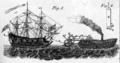
1736 steamboat English patent.
-
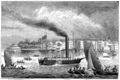
Robert Fulton's Clermont.
-

The Élise (ex Scottish-built Marjorie).
-
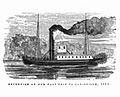
"Enterprise on her fast trip to Louisville, 1815"
-
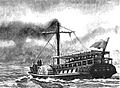
Elizaveta, The first Russian steamship, 1815
-
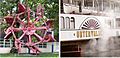
Left: original paddlewheel from a paddle steamer on the lake of Lucerne. Right: detail of a steamer.
-
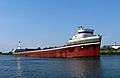
730-foot lake freighter Edward L Ryerson
-
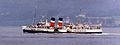
Paddle steamer PS Waverley steaming down the Firth of Clyde.
-
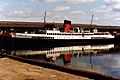
Turbine steamer TS Queen Mary.
-
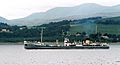
SS Shieldhall steams down the Firth of Clyde.
-
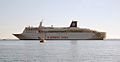
Sky Wonder last steam-powered cruise ship built 1984
-
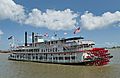
Natchez
-
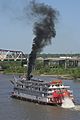
Delta Queen racing
-
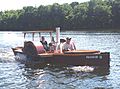
Steam Sidewheeler
-
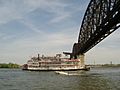
Belle of Cincinnati, a participant in the Great Steamboat Race
-
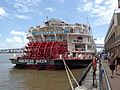
American Queen docked at the Riverwalk in 2015


.jpg)


See also
 In Spanish: Barco de vapor para niños
- Allan Line Royal Mail Steamers.
- Chain boat navigation
- Charles Baird, engineer who was responsible for Russia's first steamboat.
- Howard Steamboat Museum
- List of steamboats on the Columbia River
- Lists of ships
- Motor ship or Motor vessel, a ship propelled by an engine, usually a diesel engine. The name of motor ships are often prefixed with MS, M/S, MV or M/V.
- Murray-Darling steamboats
- Naphtha launch
- President, a preserved English steam narrowboat
- PS Rising Star
- Riverboat
- Steam Navigation Company, a list of companies that share the name
- Steam-powered vessels
- Steam yacht
- Steamship
- Steamship Historical Society of America
- Tourist sternwheelers of Oregon
