
Time in physics facts for kids
Quick facts for kids Time |
|
|---|---|
|
Common symbols
|
t |
| SI unit | second (s) |
|
Other units
|
see unit of time |
| Dimension |  |

Time is one of the most fundamental concepts in all of science. In physics, time is often defined very simply: time is what a clock measures. We use time every day to schedule our classes, count our birthdays, and describe how fast things move.
Without time, we could not describe motion, changes in energy, or the history of our world. Along with length and mass, time is considered a fundamental building block of the physical universe.
Scientists use mathematics to connect time with other physical ideas. For example, dividing distance by time gives us speed. Studying how to measure time accurately is called timekeeping, and it has shaped human civilization for thousands of years.
Contents
- What Is Time in Physics?
- How Humans Learned to Measure Time
- The Scientific Standard for Time
- Classical Views: Newton and Absolute Time
- Modern Views: Einstein and Relativistic Time
- The Arrow of Time and Thermodynamics
- Time in Quantum Mechanics
- Time and the Story of the Universe
- Interesting Modern Ideas About Time
- Summary of Key Ideas
- Images for kids
- See also
What Is Time in Physics?
In basic physics, time is treated as a continuous flow that moves in one direction. It allows us to put events in order, from the past, through the present, and into the future.
Time is a scalar quantity. A scalar quantity has magnitude or size, but no specific direction in space. This means we describe time with a single number, such as 5 seconds or 10 minutes. In physics equations, time is almost always represented by the letter t.
By using time, physicists can calculate how things change. When you run a race, your position changes over time. When water boils, its temperature increases over time. Because time lets us track change, it is essential for calculating kinetic energy, acceleration, and force.
Why Clocks Matter in Science
Physicists often use what is called an "operational definition" for time. This means that instead of debating the philosophical nature of time, they define time by how they measure it.
To measure time, you need an event that repeats over and over at a steady pace. This repeating event is called a periodic process. A ticking pendulum, a vibrating crystal, or the spin of the Earth are all natural clocks.
Every clock contains two main parts:
- An oscillator (something that moves back and forth regularly).
- A counter (something that counts each repetition and displays the result).
When you look at a stopwatch, you are reading the total number of regular ticks recorded by the mechanism inside.
How Humans Learned to Measure Time
Long before people had wristwatches or smartphones, they looked at nature to tell time. Ancient cultures needed ways to know when to plant crops, when to harvest, and when seasons would change.
Natural cycles provided the first clocks:
- The rising and setting of the Sun marked the cycle of day and night.
- The phases of the Moon marked the passage of months.
- The changing positions of the stars marked the passage of years.
In ancient Egypt, priests watched for the first appearance of the bright star Sirius just before sunrise. This event, known as the heliacal rising, warned them that the flooding of the Nile river was about to begin. This yearly flood brought fertile soil for farming.
Ancient Timekeeping Inventions

As societies grew, people needed to divide the day into smaller parts. They invented clever tools to track the hours:
- Sundials and Gnomons: A gnomon is a stick or pillar that casts a shadow on the ground. As the Sun moves across the sky, the shadow moves and changes length, showing the hour of the day.
- Water clocks (Clepsydras): These devices measured time by letting water flow at a steady rate into or out of a marked bowl. Water clocks worked even at night or on cloudy days when sundials were useless.
- Sandglasses: These used fine sand falling through a narrow opening between two glass bulbs. Sailors on ships used sandglasses to keep track of four-hour watch shifts and to estimate their sailing speed.
- Candle clocks: Marked candles burned down at a known rate, allowing people to estimate the time indoors.
The Invention of Mechanical Clocks
During the Middle Ages, inventors in Europe designed the first mechanical clocks. In the 1330s, an English monk named Richard of Wallingford designed an extraordinary mechanical clock and astronomical model called an orrery.
These early mechanical clocks used heavy falling weights and an arrangement of gears called an escapement. The escapement controlled the release of energy, allowing the clock hands to advance at a steady speed.
Large clocks were built inside church bell towers so that entire towns could hear the hours ring. Over time, clockmakers learned to make smaller gears and coiled springs, leading to pocket watches and mantel clocks.
Galileo and the Discovery of the Pendulum
In 1583, the Italian scientist Galileo Galilei made an important discovery about timekeeping. While sitting in the cathedral of Pisa, he watched a hanging chandelier swing back and forth. Using his own pulse to time the swings, Galileo noticed something amazing: each swing took the exact same amount of time, whether the swing was wide or narrow.
This steady swinging motion is called simple harmonic motion. Galileo realized that a swinging weight, known as a pendulum, could be used to make clocks vastly more accurate.
In 1656, Dutch scientist Christiaan Huygens built the first working pendulum clock. This invention dramatically improved timekeeping accuracy, reducing clock errors from fifteen minutes a day to just a few seconds a day.
The Scientific Standard for Time
To make sure scientists across the globe agree on measurements, the world uses the International System of Units (known as the SI system). In this system, the base unit of time is the second (abbreviated as s).
Originally, a second was defined as a fraction of a day: exactly 1/86,400 of an average solar day. However, scientists discovered that the Earth's rotation is slowly slowing down due to tidal friction from the Moon. This meant the length of a day is not perfectly constant!
The Atomic Second
To create an unchanging standard, scientists turned to atoms. In 1967, the definition of the second was officially updated using the properties of the caesium atom.
A single second is defined as the time it takes for a caesium-133 atom to vibrate exactly 9,192,631,770 times between two specific energy levels.
These vibrations are counted by an atomic clock. Because every caesium-133 atom in the universe is identical, an atomic clock provides an exceptionally steady and reliable measurement.
World Time Standards
Today, the world runs on Coordinated Universal Time (UTC). UTC combines the steady ticking of hundreds of atomic clocks located in laboratories around the world.
The organization that coordinates these measurements is the International Bureau of Weights and Measures (BIPM), located near Paris, France. BIPM works under the international Metre Convention to keep global measurements unified.
Modern atomic clocks are so accurate that they will not gain or lose a single second in over 30 million years!
The Smallest Unit of Time
What is the shortest possible amount of time? In theoretical physics, the smallest measurable slice of time is known as the Planck time.
The Planck time is roughly:

This is an unimaginably tiny fraction of a second. Scientists believe that our current understanding of physics breaks down at intervals smaller than the Planck time.
Classical Views: Newton and Absolute Time
In the 1600s, Sir Isaac Newton laid the foundations of modern physics. Newton viewed time as a giant, invisible clock that ticked at the exact same rate everywhere in the universe.
Newton called this idea "absolute time." In his famous book, the Principia, Newton wrote that absolute time flows smoothly and steadily on its own, without being affected by anything happening around it.
Under Newton's rules:
- A second on Earth was identical to a second on the Moon or near Jupiter.
- All observers, no matter how fast they were moving, would measure the exact same time between two events.
- Time was treated as a steady background against which all motion took place.
For hundreds of years, Newton's ideas worked perfectly. They allowed scientists to predict the orbits of planets, design steam engines, and build bridges. However, at the start of the 20th century, new discoveries showed that time was far stranger than Newton had imagined.
Modern Views: Einstein and Relativistic Time
In 1905, a young physicist named Albert Einstein published his theory of special relativity, which changed our understanding of time forever. Einstein realized that time is not absolute—it is relative!
The Speed of Light is Always Constant
Einstein based his theory on a crucial scientific fact: the speed of light in a vacuum (denoted by the letter c) is always the same for all observers, no matter how fast they are moving. Light travels at approximately 299,792,458 meters per second (about 186,282 miles per second).
If you are riding on a super-fast train and shine a flashlight forward, a person standing on the ground does not see the light moving faster. Both you and the stationary observer measure the light moving at exactly the speed c.
Because speed is distance divided by time, if the speed of light stays constant for everyone, then space and time themselves must bend and adjust!
Time Dilation: Moving Clocks Run Slow

One of the most surprising consequences of special relativity is time dilation. When an object moves very fast (close to the speed of light), time slows down for that object compared to a stationary observer.
The mathematical formula for time dilation is:
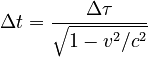
In this equation:
 is the "proper time" measured by the clock moving along with the object.
 is the time measured by an observer watching the object move past.
 is the speed of the moving object.
 is the speed of light.
This means that if an astronaut traveled in a spaceship at 99% of the speed of light for what felt like one year, several years would pass for people back on Earth! This effect is not science fiction; it is proven daily in particle accelerators, where fast-moving subatomic particles live much longer before decaying than stationary ones.
Spacetime and the Fabric of the Universe
Einstein showed that space and time cannot be separated. Instead, they are woven together into a single four-dimensional fabric called spacetime.
We live in three dimensions of space (up/down, left/right, forward/backward) and one dimension of time. Every object follows a path through spacetime called its world line.
Because of spacetime, events that appear to happen at the exact same moment for one observer might happen at different times for an observer who is moving. This concept is known as the relativity of simultaneity.
Gravity Bends Time
In 1915, Einstein expanded his ideas into the theory of general relativity. In this theory, gravity is not just an invisible pulling force; it is the curving of spacetime caused by heavy objects like stars and planets.
Einstein predicted that where gravity is stronger, time runs slower. This effect is called gravitational time dilation.
- A clock placed on top of a tall mountain (where gravity is slightly weaker) ticks slightly faster than a clock at sea level.
- A clock near a supermassive black hole would tick extremely slowly compared to a clock far away in deep space.
Real-World Example: GPS Satellites
You experience the effects of relativistic time every time you use a map on a smartphone or car GPS.
The Global Positioning System uses 24 or more satellites orbiting Earth. Because the satellites move rapidly in orbit (around 14,000 km/h), special relativity causes their clocks to run slower by about 7 microseconds per day.
At the same time, because the satellites are 20,000 kilometers above the Earth where gravity is weaker, general relativity causes their clocks to run faster by about 45 microseconds per day.
Combining these two effects, satellite clocks tick about 38 microseconds faster per day than clocks on the ground. Engineers program the satellites to correct for this difference automatically. If they ignored Einstein's theories of time, GPS calculations would be off by several kilometers every single day!
The Arrow of Time and Thermodynamics
In our everyday lives, time always moves forward. You can watch an egg fall and break, but you will never see a broken egg put itself back together and jump back onto a table. Why does time move in only one direction?
This one-way flow of time is called the arrow of time. Physicists explain this using the laws of thermodynamics, which is the study of heat and energy.
Entropy and the Second Law of Thermodynamics
The second law of thermodynamics introduces a property called entropy. Entropy is a scientific measure of disorder or randomness in a physical system.
The law states that in an isolated system, entropy always increases over time.
- A clean, neatly arranged room naturally gets messy over time unless someone uses energy to tidy it.
- A drop of ink placed into a glass of water spreads out until the liquid is evenly colored; the ink never spontaneously gathers back into a single droplet.
Because the universe moves from states of lower entropy (order) to higher entropy (disorder), the increase of entropy points like an arrow from the past toward the future.
Three Different Arrows of Time
Famous physicist Stephen Hawking described three distinct arrows of time:
- Thermodynamic Arrow: The direction in which disorder or entropy increases.
- Psychological Arrow: The way our brains remember the past but cannot remember the future.
- Cosmological Arrow: The direction of time in which the entire universe is expanding rather than contracting.
Scientists believe that our human sense of time (the psychological arrow) exists because our brains and bodies are physical systems that rely on the thermodynamic arrow!
Time in Quantum Mechanics
In the world of the ultra-small—the realm of atoms, electrons, and photons—physics is described by quantum mechanics.
In quantum theory, time plays an interesting role. While quantities like position, momentum, and energy are represented by mathematical operators, time is usually treated as an external background parameter, much like in classical physics.
The Energy-Time Uncertainty Principle
One of the cornerstones of quantum physics is the uncertainty principle, formulated by Werner Heisenberg. There is a version of this principle that connects energy and time:

In this relationship:
 is the uncertainty in measuring energy.
- is the uncertainty in measuring the time interval during which the event happens.
 is the reduced Planck constant.
This principle means that you cannot measure both the precise energy of a state and the precise duration of time it lasts at the same moment. If a quantum process happens over an extremely short window of time, the energy involved has a large range of uncertainty.
Time and the Story of the Universe

Did time have a beginning? Modern cosmology—the scientific study of the entire universe—answers yes.
According to the Big Bang model, the entire universe, including all space, matter, and time itself, began approximately 13.8 billion years ago in an extremely hot, dense point called a singularity.
Looking Back into the Past
Because light takes time to travel through space, when astronomers look at distant stars and galaxies through telescopes, they are literally looking back in time!
- The Sun is about 150 million kilometers away, so we see sunlight that left the Sun about 8 minutes ago.
- The Andromeda Galaxy is 2.5 million light-years away, meaning we see it as it was 2.5 million years ago.
- Giant space telescopes can see light from ancient galaxies that traveled across space for more than 13 billion years.
By observing the afterglow of the Big Bang, called the cosmic microwave background radiation, scientists have mapped what the universe looked like just 380,000 years after time began.
Interesting Modern Ideas About Time
Science continues to explore new and exciting ideas about time:
Time Crystals
In 2012, Nobel Prize-winning physicist Frank Wilczek proposed the concept of a time crystal.
Normal crystals, such as diamonds or snowflakes, have atoms arranged in a repeating pattern in space. A time crystal is a special state of matter whose atoms repeat a pattern in time, oscillating back and forth continuously without using up any energy. In recent years, physicists have successfully created time crystals in advanced laboratories!
Can We Travel in Time?
According to Einstein's theories, traveling forward in time is not only possible—it has already been done! By traveling at speeds close to light or staying near strong gravitational fields, astronauts can age slower than people on Earth, effectively leaping into Earth's future.
However, traveling backward into the past remains deeply challenging. Traveling into the past creates logical paradoxes, such as the famous "grandfather paradox." Most physicists believe that the fundamental laws of nature prevent backwards time travel, protecting the cause-and-effect structure of the universe.
Summary of Key Ideas
- Definition: In physics, time is defined operationally as what a clock measures.
- Units: The standard international unit of time is the second, defined using vibrations of the caesium-133 atom.
- Classical View: Isaac Newton thought time was absolute and ticked at the same rate everywhere.
- Relativistic View: Albert Einstein showed that time is relative. Moving fast or being near strong gravity slows down time (time dilation).
- Arrow of Time: Time flows in one direction from past to future because the entropy (disorder) of the universe is constantly increasing.
- Cosmology: Time and space began together about 13.8 billion years ago during the Big Bang.
Images for kids
-
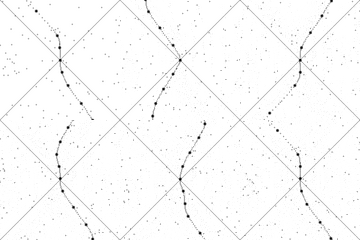
A diagram showing how an object travels along its world line through spacetime.

See also
- Relativistic dynamics
- Time in astronomy
