
1940s facts for kids
The 1940s was a ten-year period from January 1, 1940, to December 31, 1949. It is often called "the '40s" or "the Forties".
This decade was shaped by World War II, a massive global conflict that affected many countries. After the war ended in 1945, the world began to rebuild. New organizations like the United Nations were created to help keep peace. Many countries also gained their independence, such as India, Pakistan, and Israel.
The 1940s also saw the start of amazing new technologies. These included early computers, nuclear power, and jet engines. Many of these ideas first appeared during the war. They were later improved for everyday use. The world's population grew from about 2.25 billion to 2.5 billion during this time.
Global Conflicts and Political Shifts in the 1940s
.png)
.png)
.png)
Major Wars and Their Impact


- World War II (1939–1945) was the biggest event of the decade.
- Nazi Germany invaded many European countries from 1939 to 1941. These included Poland, Denmark, Norway, Benelux, and France.
- The Soviet Union also invaded parts of Poland, Finland, and occupied other countries.
- Germany fought the United Kingdom in the Battle of Britain in 1940. This was a major air battle.
- Germany attacked the Soviet Union on June 22, 1941.
- The United States joined World War II after the attack on Pearl Harbor on December 7, 1941. The US then fought Japan in the Pacific War.
- Key battles like Stalingrad, El Alamein, and Midway turned the tide against Germany, Italy, and Japan.
- The Warsaw Ghetto Uprising in 1943 was a brave act of resistance by Jewish people in Poland.
- The Normandy landings happened on June 6, 1944. Allied forces landed in France to push back against Nazi Germany.
- The Yalta Conference in 1945 brought together leaders from the US, UK, and Soviet Union. They discussed how to rebuild Europe after the war.
- The Holocaust was a horrific period during World War II. Nazi Germany systematically killed about six million European Jewish people. They also targeted millions of others, including Poles, Romani people, and people with disabilities.
- Germany officially surrendered on May 7–8, 1945. This day is known as Victory in Europe Day.
- The atomic bombings of Hiroshima and Nagasaki in August 1945 led to Japan's surrender.
- World War II officially ended on September 2, 1945.
- Indo-Pakistani War of 1947 was a conflict between India and Pakistan.
- 1948 Arab–Israeli War (1948–1949) involved the new State of Israel and its Arab neighbors. This war began after the British Mandate of Palestine ended.
- Indonesian War of Independence (1945–1949) led to Indonesia's freedom from the Netherlands.
- First Indochina War (1946–1954) began as France tried to regain control of Vietnam.
New Global Organizations
- The United Nations Charter was established on June 26, 1945. It officially started on October 24, 1945. The UN aims to promote peace and cooperation worldwide.
- The defense alliance NATO was formed on April 4, 1949.
Internal Conflicts and Revolutions
- The Chinese Communist Party won the Chinese Civil War. This led to the creation of the People's Republic of China.
- The Greek Civil War began in 1946 and lasted until 1949.
Countries Gaining Independence

- 1944 – Iceland became independent from Denmark.
- 1945 – Indonesia declared independence from the Netherlands.
- 1945 - Korea was freed after Japan surrendered.
- 1946 – Syria and Lebanon became independent from France. The Philippines also gained independence from the US.
- 1947 – British India was divided into India and Pakistan. This event, called the Partition of India, caused many challenges.
- 1948 – Burma became independent from British rule. The State of Israel was established.
- 1949 – The People's Republic of China was officially announced.
Important Political Events

- The 1943 Argentine Revolution changed the government in Argentina.
- After the war, Germany and Japan were occupied by Allied forces starting in 1945.
- In 1945, workers gathered in Plaza de Mayo to support Juan Perón in Argentina. This event is known as Loyalty Day.
- Italy changed from a monarchy to a republic after the 1946 Italian institutional referendum.
- The League of Nations ended on April 20, 1946. Many of its resources were transferred to the United Nations.
Economic Changes in the 1940s
The Bretton Woods Conference took place in 1944. Delegates from 44 Allied nations met to plan the world's financial system after World War II. This meeting created the International Bank for Reconstruction and Development (IBRD) and the International Monetary Fund (IMF). These organizations helped stabilize the global economy.
Notable Figures and Events
Assassinations and Attempts
| Date | Description |
|---|---|
| August 20, 1940 | Leon Trotsky, a Russian revolutionary, was attacked and died the next day. |
| May 27, 1942 | Reinhard Heydrich, a high-ranking Nazi official, was killed in an attack in Prague. |
| December 24, 1942 | François Darlan, a French Admiral and political figure, was assassinated in Algiers. |
| April 18, 1943 | Japanese admiral Isoroku Yamamoto, who planned the attack on Pearl Harbor, was killed when his plane was shot down. |
| July 20, 1944 | Adolf Hitler, the German fascist dictator, survived a bomb attack by anti-Nazi resistance members. |
| January 30, 1948 | Mahatma Gandhi, the Indian independence leader, was assassinated. |


Science and Technology Breakthroughs
New Technologies Developed
- The Atanasoff-Berry computer was one of the first electronic digital computing devices. It was built between 1937 and 1942.
- The Colossus computer was used by British codebreakers during World War II to read secret German messages. It was operational until 1946.
- The Z3 was the world's first working programmable, fully automatic computing machine.
- The first test of an atomic weapon, called the Trinity test, happened in 1945. This was part of the Manhattan Project.
- The sound barrier was broken in October 1947.
- The transistor was invented in December 1947 at Bell Labs.
- Other important developments included radar, ballistic missiles, and jet aircraft.
- The Jeep became a famous vehicle.
- Commercial television began to develop.
- Fun inventions like the Slinky, microwave oven, Velcro, Tupperware, and the Frisbee also appeared.
-
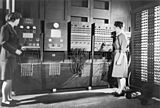
ENIAC, an early electronic computer, operated by Betty Jennings and Frances Bilas
-
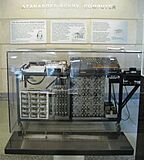
Atanasoff–Berry Computer replica at Iowa State University
-
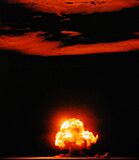
July 16, 1945 - The Manhattan Project - The atomic age began with the Trinity nuclear test in New Mexico
-
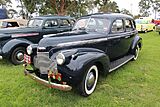
A typical 1940s car, the 1940 Chevrolet Special Deluxe Sedan.
.jpg)


.jpg)
Scientific Discoveries and Explorations
- Physics saw major advances in quantum theory and nuclear physics.
- In mathematics, game theory and cryptography were developed.
- In 1947, Thor Heyerdahl's raft Kon-Tiki crossed the Pacific Ocean. This showed that people from South America could have settled Polynesia long ago.
- On June 14, 1949, Albert II, a rhesus macaque monkey, became the first mammal in space.
- Willard Libby created radiocarbon dating. This process helped archaeologists figure out the age of ancient objects.
-
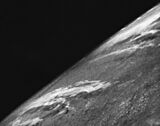
October 24, 1946: A V-2 rocket took the first picture of Earth from outer space.
-
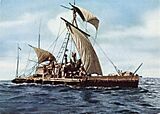
Thor Heyerdahl's raft Kon-Tiki crossed the Pacific Ocean.

.jpg)
Important People of the 1940s
Military Leaders
-
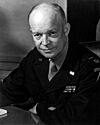
Dwight D. Eisenhower, American General who led the Allied forces during the Normandy invasion.
-
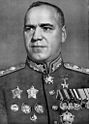
Georgy Zhukov, Soviet Union Field Marshal who led the Red Army during the Battle of Berlin.
-
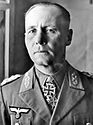
Erwin Rommel, German Field Marshal who led the Nazis during the North African Campaign.
-
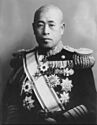
Yamamoto Isoroku, Japanese Fleet Admiral who led the Imperial Army during the attack on Pearl Harbor.
-
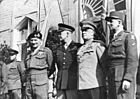
The Supreme Commanders on 5 June 1945 in Berlin: Bernard Montgomery, Dwight D. Eisenhower, Georgy Zhukov and Jean de Lattre de Tassigny.


.jpg)


 Field Marshal Erwin Rommel
- Reichsmarschall Hermann Göring
 General Hideki Tōjō
- Fleet Admiral Isoroku Yamamoto
 Field Marshal Georgy Zhukov
 General Dwight D. Eisenhower
- General Douglas MacArthur
 Field Marshal Bernard Montgomery
 Brigadier general Charles de Gaulle
Activists and Religious Leaders
-
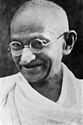
Mohandas Gandhi during the 1940s
-
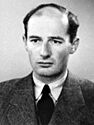
Raoul Wallenberg, c. 1944
-
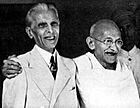
Muhammed Ali Jinnah with Gandhi, 1944.
-
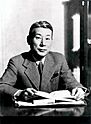
Chiune Sugihara c.1940s


- Mohandas Gandhi, a leader for Indian independence.
- Muhammad Ali Jinnah, a key figure in the creation of Pakistan.
- Pope Pius XII, the head of the Catholic Church.
- Raoul Wallenberg, who saved many Jewish people during the Holocaust.
- Chiune Sugihara, a diplomat who helped Jewish refugees.
Political Leaders
.jpg)
- Juan Perón, President of Argentina.
- Franklin D. Roosevelt, President of the United States during most of World War II.
- Winston Churchill, Prime Minister of the United Kingdom during World War II.
- Joseph Stalin, Premier of the Soviet Union during World War II.
- Mao Zedong, leader of the Chinese Communist Party.
Scientists and Engineers
Actors and Entertainers

_01_Crisco_edit.jpg)

.jpg)
_01.jpg)
Musicians
-
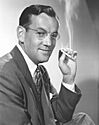
Glenn Miller, 1941
-
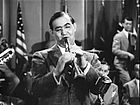
Benny Goodman performing in Stage Door Canteen (1943)
-
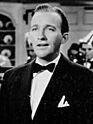
Bing Crosby, 1942
-
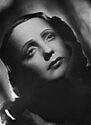
Édith Piaf, 1946
-
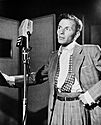
Frank Sinatra, 1947


_(cropped).jpg)


Popular Bands

- The Andrews Sisters
- The Ink Spots
- The Mills Brothers
Sports Heroes
During the 1940s, sports were greatly affected by World War II. The 1940 and 1944 Olympic Games were cancelled. Many athletes, including famous baseball and boxing stars, served in the armed forces. They put their careers on hold to help their countries.
The Summer Olympics resumed in 1948 in London. The Winter games were held that year in St. Moritz, Switzerland.
In 1947, Jackie Robinson broke the color barrier in Major League Baseball for the Brooklyn Dodgers. This was a huge step for equality in sports. Soon after, Wataru Misaka became the first person of color to play in modern professional basketball.
Baseball Stars
.jpg)
Boxing Champions

Joe Louis was a very popular heavyweight boxer. His rematch against German boxer Max Schmeling in 1938 became a symbol of the fight between democracy and Nazism. Louis won the fight and later served in the U.S. Army during World War II. He was a national hero and helped challenge racial barriers in the United States.
See also
 In Spanish: Años 1940 para niños
