
William Tecumseh Sherman facts for kids
Quick facts for kids
William Tecumseh Sherman
|
|
|---|---|
_(cropped).jpg)
Photograph by Mathew Brady, May 1865. Sherman is wearing a black ribbon mourning the assassination of Abraham Lincoln.
|
|
| Commanding General of the U.S. Army | |
| In office March 4, 1869 – November 1, 1883 |
|
| President | |
| Preceded by | Ulysses S. Grant |
| Succeeded by | Philip Sheridan |
| Acting United States Secretary of War | |
| In office September 6, 1869 – October 25, 1869 |
|
| President | Ulysses S. Grant |
| Preceded by | John Aaron Rawlins |
| Succeeded by | William W. Belknap |
| Personal details | |
| Born | February 8, 1820 Lancaster, Ohio, U.S. |
| Died | February 14, 1891 (aged 71) New York City, U.S. |
| Resting place | Calvary Cemetery, St. Louis, Missouri, U.S. |
| Political party | Republican |
| Spouse |
Eleanor Boyle Ewing
(m. 1850; died 1888) |
| Children | 8, including Thomas |
| Parent |
|
| Relatives |
|
| Education | United States Military Academy (BS) |
| Signature |  |
| Nicknames |
|
| Military service | |
| Allegiance | United States |
| Branch/service | |
| Years of service |
|
| Rank |
|
| Commands |
|
| Battles/wars | |
William Tecumseh Sherman (February 8, 1820 – February 14, 1891) was an important American soldier, businessman, and writer. He became a famous general in the Union Army during the American Civil War (1861–1865). Sherman was known for his clever military strategy and for using tough tactics to end the war quickly. A famous historian called him "the most original genius of the American Civil War" and "the first modern general."
Sherman was born in Lancaster, Ohio. He graduated from the United States Military Academy at West Point in 1840. After some time in business, he became the superintendent of a military school in Louisiana. He resigned when Louisiana left the Union. Sherman then joined the Union Army. He fought in many key battles, including First Battle of Bull Run, Battle of Shiloh, and the Vicksburg campaign. He worked closely with General Ulysses S. Grant.
In 1864, Sherman took command in the Western Theater. He led the successful capture of Atlanta, which helped President Abraham Lincoln win re-election. His famous "March to the Sea" through Georgia and the Carolinas involved destroying military and civilian resources. This strategy aimed to make the Confederate States unable and unwilling to continue fighting. After the war, Sherman became the Commanding General of the United States Army. He served from 1869 to 1883. He also wrote his memoirs, which are a well-known account of the Civil War.
Contents
Early Life and Education
Sherman was born in 1820 in Lancaster, Ohio. His father, a lawyer and judge, died when William was nine. He was then raised by a family friend, Thomas Ewing, who was a U.S. senator. William had several brothers who became successful, including John Sherman, a founder of the Republican Party.
His Unique Name
Sherman's middle name, Tecumseh, came from a famous Shawnee chief. Some stories say he was first named only Tecumseh. Later, when he was about nine, he was baptized and given the name William. As an adult, he always signed his name "W. T. Sherman." His friends and family called him "Cump."
Military Training at West Point

Senator Ewing helped Sherman get into the United States Military Academy at West Point when he was 16. Sherman was a good student, especially in subjects like drawing and math. He was known as a bright and popular cadet. He graduated in 1840.
After West Point, Sherman became a second lieutenant in the U.S. Army. He served in Florida during the Second Seminole War. He also spent time in Georgia and South Carolina.
Adventures in California
During the Mexican–American War, Sherman was sent to California. He arrived after most of the fighting ended. He helped survey the new city of Sacramento. He also opened a store and earned money from land sales. Even though he was promoted to captain, he felt his army career was moving slowly. He was one of the few high-ranking Civil War officers who did not fight in Mexico.
Marriage and Family Life

In 1850, Sherman married his foster sister, Ellen Boyle Ewing. She was a devout Catholic, and their eight children were raised in her faith.
Sherman left the army in 1853 to work in banking in San Francisco. He faced challenges in the fast-paced business world. After his bank closed in 1857, he tried working as a lawyer in Kansas, but it wasn't very successful.
Leading a Military College

In 1859, Sherman became the first superintendent of the Louisiana State Seminary of Learning & Military Academy. This school later became Louisiana State University. He was a well-liked leader there.
Sherman was against the Southern states leaving the Union. He believed it would lead to a terrible war. He famously warned that the country would be "drenched in blood." In January 1861, when Louisiana left the Union, Sherman resigned his position. He declared he would not do anything against the United States government.
Joining the Union Army
After leaving Louisiana, Sherman went to Washington, D.C. He met with President Abraham Lincoln. Sherman was worried about the North's lack of preparation for war. He then moved to St. Louis.
After the attack on Fort Sumter in April 1861, Sherman decided to join the regular army. He believed the war would be long and difficult. His brother, Senator John Sherman, helped him get a commission.
Sherman's Role in the Civil War
Early Battles and Challenges

Sherman's first command was a brigade of volunteers at the First Battle of Bull Run in July 1861. This battle was a defeat for the Union. However, Sherman was praised for his leadership during the retreat. President Lincoln promoted him to brigadier general.
Later, while commanding in Kentucky, Sherman faced a period of intense stress and doubt about the war. He needed a short break to recover. He soon returned to duty and formed a strong partnership with General Ulysses S. Grant.
Working with General Grant

Sherman served under Grant in several important battles. These included the Battle of Shiloh in 1862. At Shiloh, Sherman was caught by surprise but rallied his troops. He was wounded twice and had three horses shot from under him. His actions helped the Union win the next day. This success greatly boosted his confidence.
Sherman also played a key role in the Vicksburg campaign in 1863. Vicksburg was a Confederate stronghold on the Mississippi River. Capturing it was a major victory for the Union. It gave the Union control of the entire Mississippi River.
After Vicksburg, Sherman was promoted to brigadier general in the regular army. Sadly, his nine-year-old son, Willie, died from typhoid fever during a visit to his camp.
The Chattanooga Campaign
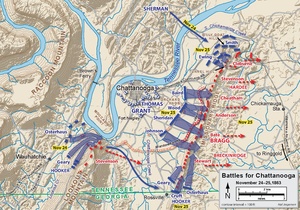
Sherman then helped relieve Union forces at Chattanooga, Tennessee. He led an attack on the right side of the Confederate lines. Although his initial attack faced strong resistance, the Union forces eventually routed the Confederates. This completed the successful Chattanooga campaign.
In early 1864, Sherman led an expedition to Meridian, Mississippi. His goal was to destroy Confederate railroads and communications. His army destroyed many miles of track and bridges, weakening the enemy's ability to move supplies.
Capturing Atlanta

In 1864, General Grant became the overall commander of Union armies. He put Sherman in charge of the Western Theater. Sherman then began his Atlanta campaign to invade Georgia. He used clever flanking maneuvers to outsmart the Confederate army.

Sherman's forces captured the important city of Atlanta on September 2, 1864. This victory was a huge boost for the Union. It helped President Lincoln win re-election in November, showing that the war could be won. After taking Atlanta, Sherman ordered military buildings to be burned.
The March to the Sea

After Atlanta, Sherman began his famous Sherman's March to the Sea. With 62,000 soldiers, he marched through Georgia to the coast. His army lived off the land and destroyed anything that could help the Confederate war effort. This included railroads, factories, and farms. The goal was to break the Confederacy's ability and will to fight.
His troops captured the port city of Savannah, Georgia, on December 21. Sherman sent a message to President Lincoln, offering him Savannah as a "Christmas present."
Campaigns in the Carolinas

Grant then ordered Sherman to march north through the Carolinas. Sherman wanted to target South Carolina, as it was the first state to leave the Union. His army continued to destroy military resources.
Sherman captured Columbia, South Carolina, the state capital, on February 17, 1865. Fires broke out that night, destroying much of the city. There is still debate about how these fires started. Some say Union troops caused them, while others say they were accidental, partly due to cotton bales left burning by retreating Confederates.

Sherman's troops then moved into North Carolina. They caused less damage there, as North Carolina was seen as a less eager Confederate state. After a battle at Battle of Bentonville, Sherman's forces met up with other Union troops.
In late March, Sherman met with Lincoln and Grant in Virginia. This was the only time these three leaders met during the war. On April 9, Sherman shared the news that General Robert E. Lee had surrendered to Grant.
Confederate Surrender

After Lincoln's assassination, Sherman met with Confederate General Joseph E. Johnston to discuss surrender terms. Sherman offered generous terms, hoping to prevent further fighting. However, the U.S. government rejected these terms. They wanted stricter conditions after Lincoln's death.
Grant then offered Johnston purely military terms, similar to Lee's surrender. Johnston accepted these terms on April 26, 1865. This was the largest surrender of the war, ending fighting in the Carolinas, Georgia, and Florida. Sherman then marched with his troops in a grand parade in Washington.
Slavery and Freedom

Before the war, Sherman was not an abolitionist. However, during his marches, tens of thousands of enslaved people escaped and followed his army. Their freedom became an important issue.

In January 1865, Sherman met with black leaders in Savannah. He listened to their needs and ideas. Four days later, he issued Sherman's Special Field Orders, No. 15. These orders set aside land for freed slaves in South Carolina, Georgia, and Florida. This plan was later canceled by President Johnson.
Later in his life, Sherman's views on race changed. In 1888, he wrote an essay supporting full civil rights for black citizens. He urged the South to "let the negro vote, and count his vote honestly."
Sherman's Military Strategies

Sherman is remembered for his brilliant military strategies. He was skilled at planning how to move supplies and troops. Historians call him "the first modern general" because of his new ways of fighting.
Maneuver Warfare
Sherman was a master of "maneuver warfare." This means he tried to defeat the enemy by surprise and disruption, rather than always attacking head-on. He would often move his army around the enemy's defenses. This forced the enemy to move or be surrounded. His moves during the Atlanta campaign are a great example of this.
Hard War Tactics

Sherman, like Grant and Lincoln, believed that to end the war, the Confederacy's ability to fight had to be completely broken. He used "hard war" tactics. This meant destroying military supplies and infrastructure. His marches through Georgia and the Carolinas involved widespread destruction of railroads, bridges, and other resources.

Sherman explained that war is "cruelty, and you cannot refine it." He believed that these tough actions would bring a quicker end to the fighting. His troops would destroy railroads by heating the rails and twisting them into "Sherman's neckties." This made them very hard to repair. While looting was forbidden, the goal was to make it impossible for the enemy to continue the war.
Post-War Service
After the Civil War, Sherman was given command of a large territory in the American West. This area stretched from the Mississippi River to the Rocky Mountains. His main job was to protect important wagon roads and settlers. In 1866, he was promoted to lieutenant general.
The Indian Wars
Sherman played a role in the Indian Wars during this time. He worked to protect the construction of railroads, which were expanding across the country. He believed railroads were vital for the nation's growth. He also served on the Indian Peace Commission, which tried to negotiate treaties with Native American leaders.
Sherman's approach to the Indian Wars was firm. He authorized his generals to use tough tactics to stop resistance. He also believed that the decline of the bison herds would weaken Native American tribes.
General of the Army
When Grant became president in 1869, Sherman was appointed Commanding General of the United States Army. He was promoted to the highest rank, full general. He served in this role until 1883.
In 1875, Sherman published his memoirs. This book became one of the most famous first-hand accounts of the Civil War. He also famously said, "War is hell," to describe the terrible nature of conflict.
One of his important contributions was establishing the Command School (now the Command and General Staff College) at Fort Leavenworth in 1881. Sherman retired from the army in 1884.
Later Years and Legacy
Sherman spent his final years in New York City. He enjoyed theater and painting. He was a popular speaker at events. He was even considered as a candidate for president in 1884, but he famously refused, saying, "I will not accept if nominated and will not serve if elected." This kind of strong refusal is now called a "Shermanesque statement."
Death and Remembrance
Sherman died of pneumonia in New York City on February 14, 1891, at age 71. President Benjamin Harrison ordered flags to be flown at half-staff. His funeral was attended by many, including Joseph E. Johnston, the Confederate general he had fought against. Johnston served as a pallbearer, showing respect for his former opponent.
Sherman's body was taken to St. Louis, where he was buried in Calvary Cemetery.
How Sherman is Remembered
After the war, Sherman was very popular in the North. In the South, his "hard war" tactics led to some negative views. However, many historians today see him as a brilliant strategist. They believe his methods helped end the Civil War more quickly.
Many monuments honor Sherman. A famous gilded bronze statue of him on horseback stands in Grand Army Plaza in New York City. The M4 Sherman tank from World War II was named after him. Also, the giant General Sherman Tree in California, one of the largest trees in the world, bears his name.
He has also been honored on U.S. postage stamps multiple times.
Images for kids
-
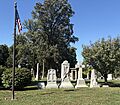
Graves of Sherman and family at Calvary Cemetery
-
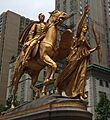
Statue in Grand Army Plaza (Manhattan)
-
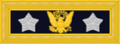
This shoulder strap insignia was introduced by Sherman in 1872 for his use as General of the Army.
-
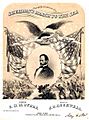
"Sherman's March to the Sea" is a song, with sheet music, celebrating Sherman's military campaign.
-
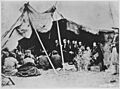
Sherman (third from left) and other Indian Peace Commissioners in council are with native chiefs and headmen, at the signing of the Treaty of Fort Laramie in 1868.
-
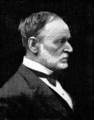
Sherman in his later years, in civilian evening clothes
-
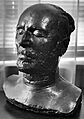
Sherman's death mask
-
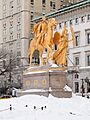
The 1902 Sherman monument by Augustus Saint-Gaudens is in Grand Army Plaza in Manhattan, New York City.
-
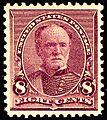
1st Sherman stamp, Issue of 1893
-
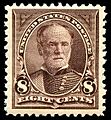
Sherman, Issue of 1895
-
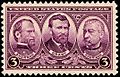
Sherman, 1937 commemorative issue
_and_family_at_Calvary_Cemetery,_St._Louis.jpg)


See also
 In Spanish: William Tecumseh Sherman para niños
