
Opuntia facts for kids
Quick facts for kids Opuntia |
|
|---|---|
 |
|
| A type of prickly pear cactus (Opuntia littoralis var. vaseyi) | |
Scientific classification  |
|
| Kingdom: | Plantae |
| Clade: | Tracheophytes |
| Clade: | Angiosperms |
| Clade: | Eudicots |
| Order: | Caryophyllales |
| Family: | Cactaceae |
| Subfamily: | Opuntioideae |
| Tribe: | Opuntieae |
| Genus: | Opuntia Mill. |
| Species | |
|
Many, see List of Opuntia species |
|
| Synonyms | |
and see text |
|
The Opuntia, often called the prickly pear cactus, is a group of flowering plants in the cactus family. Many are known for their tasty fruit and beautiful flowers. Cacti originally come from North and South America. They are very good at living in dry places. However, changes in rain and temperature from climate change can still affect them. These plants have also been brought to Australia, southern Europe, the Middle East, and parts of Africa.
The name prickly pear can mean both the fruit and the plant itself. Other names for the plant and its parts include tuna (for the fruit), sabra, sabbar, and nopal (for the flat pads). The word nopal comes from the Nahuatl language. The genus name Opuntia comes from an ancient Greek city called Opus. Both the fruit and the flat stems (pads) of these cacti are edible. The most common type eaten is the "Barbary fig" (Opuntia ficus-indica).
Sometimes, when prickly pear species are brought to new places outside their natural home, they can grow too much. They can become invasive species, meaning they spread aggressively and can harm the local environment.
Contents
What Prickly Pears Look Like

The O. ficus-indica is a large cactus. It has a main trunk and flat, segmented pads. It can grow up to 5 to 7 meters (about 16 to 23 feet) tall. Its crown can spread over 3 meters (about 10 feet) wide. The trunk can be 1 meter (about 3 feet) thick.
The large pads, also called cladodes, are green or blue-green. They have few spines, which can be up to 2.5 centimeters (1 inch) long. Some types may even be spineless. Prickly pears usually have flat, round pads. These pads have large, smooth, fixed spines. They also have tiny, hair-like prickles called glochids. These glochids easily stick to skin or hair and then break off the plant.
The flowers are usually large and grow alone. They have many petals and stamens (the parts that make pollen). The fruit is a berry with seeds inside. Prickly pear plants can look very different from each other. Most are shrubs, but some, like O. galapageia from the Galápagos Islands, can grow into trees.
How Prickly Pears Grow
-
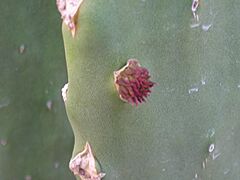
A new bud appears
-
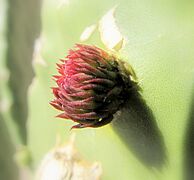
The bud starts to grow
-
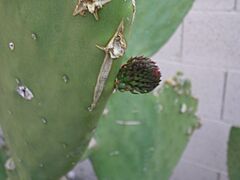
The bud begins to turn into a pad
-
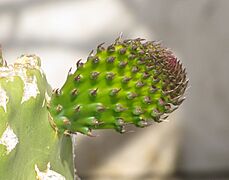
The bud has become a pad
-
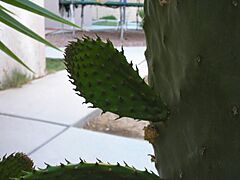
The pad continues to grow
-
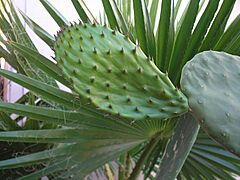
An edible young pad (tender)
-
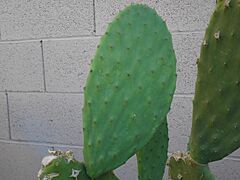
A mature pad
-
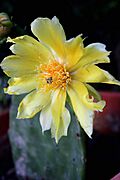
A mature pad with a flower


Prickly Pear Family Tree

_-_Buds.jpg)
In 1753, a scientist named Carl Linnaeus grouped all known cactus types into one genus called Cactus. A year later, in 1754, another botanist named Philip Miller separated them into different groups, including Opuntia. He mainly looked at the shape of their flowers and fruits to tell them apart.
It can be tricky to classify all Opuntia species. This is because different types can easily mix and create new kinds. Scientists use DNA sequencing to help understand these relationships better.
Different Types of Prickly Pears
- See List of Opuntia species
Opuntia plants can easily hybridize, meaning they can cross-breed with different species. This makes it hard to classify them sometimes.
Cacti Once Grouped with Opuntia

Some cacti that were once thought to be Opuntia are now in their own groups. These include:
- Austrocylindropuntia
- Brasiliopuntia
- Corynopuntia
- Cylindropuntia
- Micropuntia
- Miqueliopuntia
Chollas
Chollas are a type of cactus now in the genus Cylindropuntia. They are different from prickly pears because their stems are round, not flat. They also have large, barbed spines. The stem parts of some chollas, like the jumping cholla (C. fulgida), break off very easily. This happens when their barbed spines stick to clothes or animal fur. This is how they spread and grow new plants. The barbed spines can stay in the skin, causing pain.
Improving Prickly Pear Plants
Mexico, one of the original homes of the cactus pear, started a special program in the 1960s. This program aimed to make prickly pear plants better. For example, they worked on making them more resistant to cold weather.
Natural Compounds in Prickly Pears
Opuntia plants contain many natural compounds. Scientists are studying these compounds to learn more about them. For example, O. ficus-indica has special red and yellow pigments called betalains in its fruits.
Where Prickly Pears Grow
Prickly pears are naturally found only in North and South America. However, people have brought them to many other parts of the world. They grow in large numbers in Mexico, especially in the central and western areas. They are also common in the Caribbean islands.
In the United States, prickly pears grow in many dry and semi-dry areas of the West and South Central regions. You can find them in the lower parts of the Rocky Mountains and southern Great Plains. Some types, like O. phaeacantha and O. polyacantha, are very common there. They also grow along the East Coast, from Florida up to southern Connecticut. Here, species like O. humifusa and O. stricta are found.
Some Opuntia species can even handle cold weather. They grow in western and southern Canada. One type, O. fragilis, has been found in north-eastern British Columbia.
Prickly pears produce a fruit called tuna. This fruit is often eaten in Mexico and around the Mediterranean region. It is also used to make refreshing drinks called aguas frescas. The fruit can be red, wine-red, green, or yellow-orange.
In the Galápagos Islands, the Galápagos prickly pear (O. galapageia) is a very important food source for the giant tortoises. This shows how important they are in the local food chain. Charles Darwin noticed that the flowers of these cacti have special parts called anthers. When touched, these anthers curl over to drop pollen on insects, helping with pollination.
Animals like antelopes, monkeys, elephants, and birds eat prickly pear fruits. This helps spread the seeds. However, the sharp parts of the plant can hurt animals' mouths and stomachs.
Prickly pears were first brought to Europe in the 1500s. Now, they grow widely in the Mediterranean parts of Northern Africa, like Algeria and Morocco. They are also found in southern Europe, such as Spain and Italy, and on the island of Malta. They were brought to South Africa from South America and now grow in huge numbers there.
The prickly pear is considered an invasive species in places like Australia, Ethiopia, South Africa, and Hawaii. This means they grow too much and can harm the local environment.
Prickly Pears in Australia
The first prickly pears were brought to Australia in 1788 from Brazil. Over time, different types were introduced. Farmers used them for fences and as food for animals during dry times.
However, the cactus became a huge problem in the dry inland areas of New South Wales and Queensland. It spread so much that it turned over 101,000 square miles (261,000 square kilometers) of farmland into a thick, green jungle. This "green hell" grew up to 20 feet (6 meters) high. It spread at a rate of 1 million acres (400,000 hectares) each year. Many farmers had to leave their land.
In 1919, the Australian government created a board to stop the cactus. They tried removing it by hand and using poisons, but it didn't work. As a last idea, they tried using biological control. In 1925, they brought in the Cactoblastis cactorum moth from South America. The moth's larvae (young) ate the cactus and quickly brought the problem under control. A hall in Boonarga, Queensland, celebrates the success of this moth. Also, tiny insects called cochineal, which eat the cactus, helped stop its spread.
Prickly Pears in South Africa
In South Africa, many types of Opuntia are also considered invasive species. The government has classified them as serious invaders. This means it's against the rules to import, grow, or trade them. These invasive cacti have also been found to affect beetle populations and change the soil in places like Kruger National Park.
How Prickly Pears Live
O. ficus-indica grows best in places with mild winters and long dry periods. It also likes hot summers with some rain and not too much humidity. It grows well in different types of soil, as long as the soil drains water easily. Its roots are shallow, so it can grow in thin soils, like on mountain slopes. Opuntia plants can spread into large groups, which is why they are sometimes seen as a noxious weed.
Most Opuntia species are pollinated by bees. Some bees are special because they only visit Opuntia flowers. A few Opuntia types, like O. cochenillifera, are pollinated by hummingbirds.
Many animals eat Opuntia, including snails, iguanas, and birds. Birds especially love the fruit, which helps them spread the seeds. Some tiny fungi and viruses can also affect Opuntia.
Are Prickly Pears Safe to Eat?
The plants are edible, but you should not eat the pointed hairs. Also, be careful with similar plants that have milky sap, as they might not be safe.
Uses for Prickly Pears
| Nutritional value per 100 g (3.5 oz) | |
|---|---|
| Energy | 172 kJ (41 kcal) |
|
9.6 g
|
|
| Dietary fiber | 3.6 g |
|
0.5 g
|
|
|
Protein
|
0.7 g
|
| Vitamins | Quantity
%DV†
|
| Vitamin A equiv. |
3%
25 μg |
| Riboflavin (B2) |
8%
0.1 mg |
| Niacin (B3) |
3%
0.5 mg |
| Vitamin B6 |
8%
0.1 mg |
| Folate (B9) |
2%
6 μg |
| Vitamin C |
17%
14.0 mg |
| Vitamin E |
0%
0 mg |
| Minerals | Quantity
%DV†
|
| Calcium |
6%
56 mg |
| Iron |
2%
0.3 mg |
| Magnesium |
24%
85 mg |
| Phosphorus |
3%
24 mg |
| Potassium |
7%
220 mg |
| Zinc |
1%
0.1 mg |
| Other constituents | Quantity |
| Water | 88 g |
|
Full Link to USDA Database entry
|
|
| †Percentages estimated using US recommendations for adults. | |
Nutrition Facts
Raw prickly pear leaves are mostly water (88%). They have some carbohydrates (10%) and small amounts of protein and fat. A 100-gram serving gives you 41 calories. It also provides 16% of your daily vitamin C and 20% of your daily magnesium.
Prickly Pears as Food

The fruit of prickly pears is edible. It is often called cactus fruit, cactus fig, or tuna in Spanish. You must peel it carefully to remove the small spines on the skin. If you don't remove them properly, the tiny glochids can get stuck in your throat, lips, or tongue. Native Americans used to roll the fruit in sand or burn off the glochids with fire. Today, you can find types of fruit without seeds. The seeds can also be used to make flour.
In Mexico, prickly pears are used in many dishes. They appear in appetizers, soups, salads, and main courses. The young stem pads, called nopales, are also edible. They are common in Mexican cuisine in dishes like huevos con nopales (eggs with nopal) or tacos de nopales. Nopales are also important in New Mexican cuisine. They can even be pickled.
Opuntia ficus-indica was brought to Europe and grows well in places like southern France and southern Italy. In Sicily, they are called fichi d'India. In Sardinia, they are called figumorisca. You can also find them in Bulgaria, southern Portugal, and Spain. In Greece, they are known as frangosyka. In Albania, they are called fiq deti (sea figs). They also grow in Cyprus, where they are called papoutsósyka.
Prickly pears grow widely on the islands of Malta. Maltese people enjoy them as a summer fruit, calling them bajtar tax-xewk (spiny figs). They also use them to make a popular drink called bajtra. The cactus is so common in Malta that it's often used as a natural fence between fields.
The prickly pear was brought to Eritrea when Italy colonized the area. It is known there as beles and is plentiful in late summer.
In Morocco, Tunisia, Libya, Saudi Arabia, and other parts of North Africa and the Middle East, yellow and orange prickly pears grow by farms and roads. Street vendors sell them in summer as a refreshing fruit.
Tungi is the local name for cactus pears on St. Helena island. The plants were brought there in the 1850s. Tungi cactus now grows wild in the dry coastal areas. There are three main types: the "English" with yellow fruit, the "Madeira" with large red fruit, and the small, firm "spiny red". Tungi also gives its name to a local spirit made from the cactus.
Organizations like ICARDA are promoting cactus pear in India, Jordan, and Pakistan. It is becoming a more important crop there. In some areas, it has helped increase milk production for animals.
Traditional Health Uses
In Mexican folk medicine, the pulp and juice of prickly pear were traditionally used. People believed they could help with wounds and swelling in the digestive and urinary tracts. However, there is no strong scientific proof that using prickly pear for these purposes has any health benefits.
Before modern medicine, Native Americans and Mexicans used Opuntia to help stop bleeding from open wounds. They would split the stem or scrape out the pulp and apply it.
Other Uses for Prickly Pears
Natural Dyes

Dactylopius coccus is a tiny insect that lives on Opuntia cacti. It produces a special red dye called cochineal. This insect is native to South America and Mexico. It feeds on the cactus sap. The insect makes carminic acid, which protects it from other insects. This acid can be taken from the insect's body and eggs to make the red dye.
Cochineal is mainly used as a red food colouring and in cosmetics. The Aztec and Maya peoples of Central and North America, and the Inca in South America, used cochineal dye. It became Mexico's second most valuable export after silver. The dye was very popular in Europe.
Today, the biggest producers of cochineal are Peru, the Canary Islands, and Chile. Because people are looking for more natural food additives, cochineal dyes are popular again. This has made growing cacti for these insects a good opportunity in places like Mexico.
Besides cochineal, a red dye called betanin can be taken directly from some Opuntia plants. The Navajo people traditionally made a reddish dye from prickly pear fruit to color wool.
Animal Food
Cactus is used as food for animals in dry regions. Some farmers prepare it by fermenting it. This removes the spines and makes it easier for animals to digest.
Vegan Leather
The thick skin of the nopal cactus can be harvested. It is used as an environmentally friendly replacement for animal leather.
Biofuel
Some Opuntia species can be used to produce bioethanol, a type of fuel.
Prickly Pears in Culture
The prickly pear cactus has been used for hundreds of years. It serves as a food source and a natural fence to keep livestock in and mark land boundaries. These plants are tough and often grow back even after being removed.
.svg)
The emblem of Malta from 1975 to 1988 included a prickly pear. It was shown with a traditional boat, farm tools, and the rising sun.
The prickly pear is the official plant of Texas, made so by law in 1995.
The cactus is mentioned in a song by the British jazz group Portico Quartet. The song "My Rival" by the American jazz-pop group Steely Dan also mentions the smell of prickly pear.
In 1961, Cuban troops planted an 8-mile (13-kilometer) barrier of Opuntia cactus. This was along the fence around the Guantanamo Bay Naval Base. It was meant to stop people from leaving Cuba to seek safety in the United States. This barrier was nicknamed the "Cactus Curtain."
Uruguayan footballer Bruno Fornaroli is nicknamed "prickly pear" because of his sometimes spiky hairstyles.
Prickly Pears in Mexico

The coat of arms of Mexico shows a Mexican golden eagle. It is perched on an Opuntia cactus and holding a rattlesnake. This symbol comes from an Aztec legend. The Aztecs were a traveling tribe looking for a sign from their god, Huitzilopochtli. They were told to find an eagle eating a snake, sitting on a cactus that grew on a rock in a lake. After 200 years, they found this sign on a small island in Lake Texcoco. There, they built their capital city, Tenochtitlan. The cactus (O. ficus-indica), full of fruits, represents the island of Tenochtitlan.
Prickly Pears and Israeli Culture
In Hebrew, the cactus fig is called tzabar. This cactus is also the origin of the term sabra. This word describes any Jewish person born in Israel. The idea is that like the cactus, these people might seem tough or "thorny" on the outside. But inside, they are soft and sweet. This term comes from the Arabic word ṣubbār, which also means "patience" or "tenacity." Prickly pear was likely brought to the area of Israel (the Levant) around the 1700s.
Prickly Pears and Palestinian Culture
The prickly pear is also a national symbol of Palestine. It has grown across historic Palestine for centuries. Traditionally, it was used to mark land boundaries. Palestinians see the plant as a symbol of strength and patience. This is shown in the proverb saber as-sabbar ("the patience of the cactus"). The plant's ability to grow almost anywhere is also seen as a reflection of the experiences of Palestinians living in different places.
Gallery
-

Prickly pear fruit at a market in Zacatecas, Mexico
-
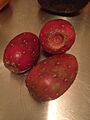
Close-up of fruit
-
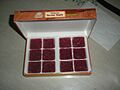
A box of prickly pear candy, often sold in Southwest U.S. gift shops


See also
- Pitaya
- Sabra (character)
- Sabra (person)
