
Anabaptism facts for kids


| Anabaptism | |
|---|---|
| Orientation | Anabaptist |
| Scripture | Bible |
| Polity | Congregational |
| Territory | Worldwide |
| Founder | Conrad Grebel, Felix Manz, George Blaurock |
| Separated from | Reformed Church |
| Congregations | 8,500+ |
| Members | 2.12 million (2022) |
Script error: No such module "Check for conflicting parameters".
Anabaptism is a Christian movement that started in the 1500s during a time of big changes in religion called the Radical Reformation. Anabaptists believe that baptism should only happen when a person is old enough to understand and choose to follow Jesus. This idea is called believer's baptism. It means they do not baptize babies, because babies cannot make that choice for themselves.
The word "Anabaptist" means "one who baptizes again." This name was given to them by others because they baptized adults who had already been baptized as babies. However, Anabaptists believed that their adult baptism was their first true baptism, as infant baptism was not something they found in the Bible.
Early Anabaptists wrote down their main beliefs in a document called the Schleitheim Confession in 1527. This document helped guide many Anabaptist groups. Today, groups like the Amish, Hutterites, and Mennonites are direct descendants of this early movement. Other groups, such as the Schwarzenau Brethren and Bruderhof, also follow Anabaptist teachings.
Anabaptists often focus on living a simple life, being kind to everyone, and avoiding violence. They believe in following the teachings of Jesus very closely, especially the Sermon on the Mount. This includes ideas like turning the other cheek and not using force. Because their beliefs were different from the main churches supported by governments, Anabaptists faced a lot of challenges and were often treated unfairly in the 16th century and beyond. They believed their loyalty was first to God's kingdom, not to earthly governments.
Contents
How Anabaptism Started

Early Ideas and Influences
Anabaptists are seen as starting with the Radical Reformation in the 1500s. However, some people and groups before them had similar ideas. For example, Petr Chelčický in the 1400s taught many beliefs that later became important to Anabaptists.
These earlier groups and Anabaptists shared some common beliefs. They believed Christians should not swear oaths or go to court to solve problems. They also believed Christians should not fight in wars or use weapons. They saw government as part of the world, and that Christians should obey it passively but not hold government positions.
Social Changes and Early Movements
In the early 1520s, there was a lot of social unrest in Germany. Some preachers, like Thomas Müntzer, spoke about big changes needed in society. These ideas contributed to the German Peasants' War in 1525. This war was a revolt against unfair treatment.
While these preachers were not Anabaptists themselves, their ideas helped set the stage. The Anabaptist movement shared some of the same goals for a fairer society. However, most Anabaptists chose peaceful ways to achieve their goals.
Different Views on Anabaptist Beginnings
Historians have different ideas about how the Anabaptist movement truly began. Some believe it started in one place, Zürich, Switzerland, and spread from there. They often point to January 21, 1525, as the start date. On this day, Conrad Grebel baptized George Blaurock, and Blaurock then baptized others. These were the first known "re-baptisms" in the movement.
Other historians think Anabaptism started in several different places at the same time. They suggest that different groups developed similar ideas independently. This shows that many people across Europe were looking for new ways to practice their Christian faith.
Anabaptist History Across Europe
Switzerland: The Birthplace of Anabaptism
Anabaptism in Switzerland grew out of the church reforms led by Huldrych Zwingli in Zürich. Zwingli questioned many Catholic practices, including infant baptism. Some of his followers felt he was not changing things fast enough.
This group of followers, including Conrad Grebel and Felix Manz, began to study the Bible on their own. They believed the Bible should be the final authority, not the city council. In January 1525, the city council ordered all parents to baptize their infants.
On January 21, 1525, a group of these reformers met. After praying, George Blaurock asked Conrad Grebel to baptize him based on his faith. Grebel did, and Blaurock then baptized others. This event marked the official beginning of Swiss Anabaptism.
Tyrol: A Place of Hope and Persecution
Anabaptist ideas came to Tyrol through the work of people like George Blaurock. There was a desire for social justice in Tyrol, similar to the German Peasants' War. Many people were looking for radical change.
Jacob Hutter became an important Anabaptist leader in Tyrol. He led many Anabaptists to Moravia, where there was more religious tolerance. However, persecution continued, and Hutter was captured and executed in 1536. By 1540, Anabaptism in Tyrol had mostly faded due to people moving away.
Low Countries and Northern Germany

Melchior Hoffman helped bring Anabaptist ideas to the Low Countries (modern-day Netherlands and Belgium). He was baptized in 1530 and then baptized many others. Hoffman's ideas were sometimes linked to more radical groups, but he was generally peaceful.
Later, Menno Simons became a key leader in this region. He emphasized the importance of the Bible and peaceful living. Many Anabaptists from this area, known as Mennonites, later moved to the Vistula delta and then to Ukraine. From there, many migrated to North and South America, forming large communities.
Moravia, Bohemia, and Silesia
Moravia became a major center for Anabaptists because it offered more religious freedom. Many religious refugees from other parts of Europe came here. Hans Hut and Balthasar Hübmaier were important evangelists in the area.
Different Anabaptist groups gathered in Moravia. Some, like the Hutterites, practiced community of goods, meaning they shared all their possessions. Persecution eventually forced many Hutterites to move, first to Transylvania, then Ukraine, and finally to North America in 1874.
Persecution and Migration
Both Catholics and Protestants persecuted Anabaptists. They used harsh methods to try and stop the movement from growing. Felix Manz was the first Anabaptist to be executed in 1527.
The book Martyrs Mirror tells the stories of thousands of Anabaptists who were persecuted and executed between 1525 and 1660. This ongoing persecution in Europe led to many Anabaptists, like the Amish, Hutterites, and Mennonites, moving to North America to find religious freedom.
Anabaptist Beliefs and Practices
Anabaptists see themselves as a distinct branch of Christianity. Their core beliefs were written down in the Schleitheim Confession in 1527. This document guides groups like the Mennonites, Amish, Hutterites, and Bruderhof.
Anabaptists believe that true faith means a new spiritual beginning. They teach that salvation comes through repentance, self-denial, faith, and a heart filled with new love, which leads to obedience. After this spiritual rebirth, believers receive baptism. Anabaptists strongly emphasize living an obedient life as a follower of Jesus.
They aim to follow the beliefs of early Christianity. Their practices often include living differently from the rest of the world. This can involve feetwashing, the holy kiss, and communion. Many also practice Christian headcovering for women, nonconformity to the world, nonresistance (avoiding violence), forgiveness, and sharing possessions. Some communities, like the Bruderhof, practice communal living.
Different Kinds of Anabaptists
There are different types of Anabaptists, though they all share core beliefs. Some historians group them by region, such as Swiss Anabaptists, Dutch Anabaptists, and South German Anabaptists.
Another way to understand them is by their approach to society. Some early Anabaptists were more radical and believed in using force to create a new society. However, most Anabaptists, like the Mennonites, were and still are pacifists, meaning they believe in nonviolence.
Anabaptist Spirituality
Anabaptists believed in the "free course" of the Holy Spirit in their worship. They felt that everyone in the congregation should be able to share their spiritual gifts. This meant that worship was not just one person speaking, but a community experience.
They believed that God could still perform miracles. Stories of miraculous events are recorded in their historical writings, like the Hutterite Chronicle and the Martyrs Mirror. These stories show their strong faith in God's power.
Anabaptists Today


As of 2022, there were over 2.12 million baptized Anabaptists in 85 countries around the world. About 36% live in Africa, 30% in North America, and 20% in Asia and the Pacific.
The main branches of Anabaptist Christianity today include the Amish, Schwarzenau Brethren, River Brethren, Hutterites, Mennonites, Apostolic Christian Church, and Bruderhof. Within many of these traditions, there are different groups:
- Old Order Anabaptists: These groups, like the Old Order Amish, keep very traditional ways of life. They often use horse and buggy for travel and avoid modern technology like electricity.
- Conservative Anabaptists: Groups such as the Dunkard Brethren Church keep traditional beliefs and dress. However, they allow for some modern conveniences and technology.
- Mainline Anabaptists: These groups, like the Mennonite Church USA, are more integrated into modern society. Their members often dress and live much like the general population.
While many people see groups like the Amish and Hutterites as ethnic groups, only they are mainly descendants of early European Anabaptists. Mennonites today come from many different backgrounds. The Bruderhof Communities were founded in Germany in 1920 and later joined the Hutterites. They moved to England, then Paraguay, and eventually to the United States.
Modern Movements Inspired by Anabaptism
Neo-Anabaptism is a newer movement in American evangelical Christianity. It takes inspiration from Anabaptist ideas, even though its followers may not be part of traditional Anabaptist churches. This movement often focuses on pacifism, social justice, and helping those in poverty.
Anabaptists and Baptists: Key Differences
Some similarities exist between Anabaptists and Baptists, such as the practice of believer's baptism. Both groups also value religious freedom. However, there are important differences.
Early Baptist churches, like those led by John Smyth, did interact with Mennonites. Some historians believe Anabaptist ideas influenced early Baptists. However, Baptists soon made it clear they were different from Anabaptists.
In practice, Anabaptists often follow the Sermon on the Mount more literally. This includes beliefs against violence and swearing oaths. Traditional Anabaptists also often require women to wear head coverings, and for all members to wear plain dress and live simply. Most Baptists do not have these same requirements.
Anabaptist Impact on Society
Anabaptist beliefs from the 1500s still influence modern Christianity and society today.
- Voluntary Church Membership: The idea that people should freely choose to join a church and be baptized as believers.
- Freedom of Religion: The belief that everyone should have the liberty to follow their conscience in religious matters, separate from government control.
- Nonconformity to the World: Living a life that is distinct from mainstream society's values and practices.
- Nonresistance: A commitment to peaceful living and avoiding violence, often interpreted as pacifism.
- Priesthood of All Believers: The idea that all Christians have direct access to God and can serve Him.
Anabaptists were among the first to promote the idea of a free church and religious freedom. In their time, the idea of religion being separate from the state was revolutionary. Their vision of following Jesus' teachings closely and living peacefully has left a lasting mark.
Images for kids
-
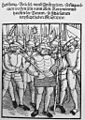
Twelve Articles of the Peasants pamphlet of 1525
-
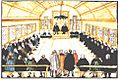
Dissatisfaction with the outcome of a disputation in 1525 prompted Swiss Brethren to part ways with Huldrych Zwingli.
-
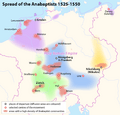
Spread of the early Anabaptists in Central Europe
-

Thomas Müntzer led the German peasants against the landowners.
-

Schleitheim Confession printed in 1550, displayed in the Anabaptist Room of the Local History Museum in Schleitheim, Switzerland
-

Memorial plate at Schipfe quarter in Zürich for the Anabaptists executed in the early 16th century by the Zürich city government
-

The Goshen College Music Center in Goshen, Indiana, Mennonite Church USA
-

John Smyth


See also
 In Spanish: Anabaptismo para niños
- Adrianists
- Amish Mennonite
- Christian anarchism
- Christian communism
- Christian socialism
- Clancularii
- Conservative Mennonites
- Donatists (first historical occurrence of re-baptism)
- Funkite
- List of Anabaptist churches
- Martyrs Mirror
- Melchior Rink, a central-German Anabaptist leader during the 16th century
- Peace churches
- Plain people
- Restorationism
- Shtundists
- Tabor College (Kansas)
