
House of Plantagenet facts for kids
Quick facts for kids House of Plantagenet |
|
|---|---|
| Royal house | |

Gules three lions passant guardant in pale or
|
|

The planta genista symbol (badge) of the Plantagenets
|
|
| Parent house | House of Ingelger (Cognatic) |
| Country |
|
| Founded | 12th century |
| Founder | Geoffrey V of Anjou |
| Current head | Henry Somerset, 12th Duke of Beaufort (Beaufort branch) |
| Final ruler | Richard III of England |
| Titles |
See list
 King of England King of England King of France (claim) King of France (claim) King of the Romans (titular) King of the Romans (titular) King of Sicily (claim) King of Sicily (claim) King of Castile (claim) King of Castile (claim) Lord of Ireland Lord of Ireland Lord of Cyprus Lord of Cyprus Prince of Wales Prince of Wales Duke of Aquitaine Duke of Aquitaine Duke of Normandy Duke of Normandy Duke of Brittany Duke of Brittany Duke of Gascony Duke of Gascony Duke of Cornwall Duke of Cornwall Duke of Gloucester Duke of Gloucester Duke of Clarence Duke of Clarence.svg) Duke of Aumale Duke of Aumale Count of Anjou Count of Anjou Count of Maine Count of Maine Count of Mortain Count of Mortain Count of Nantes Count of Nantes Count of Poitou Count of Poitou Earl of Buckingham Earl of Cornwall Earl of Buckingham Earl of Cornwall Earl of Chester Earl of Chester Earl of Essex Earl of Essex Earl of Ulster Earl of Ulster Earl of Norfolk Earl of Norfolk Earl of Kent Earl of Kent Earl of Lancaster Earl of Lancaster Earl of Leicester Earl of Leicester Earl of Salisbury Earl of Salisbury Earl of Richmond Earl of Richmond |
| Dissolution |
|
| Deposition | 1485 |
| Cadet branches |
|


The House of Plantagenet (pronounced plan-TAJ-in-it) was a powerful royal family from France. They ruled England for over 300 years, from 1154 to 1485. During their time, England changed a lot, even though the kings didn't always plan it that way.
The Plantagenet kings often had to make deals, like the famous Magna Carta. This document limited the king's power and gave more rights to others. By the end of their rule, the Plantagenets helped shape England's identity. They even started using Middle English, the language of ordinary people, for government business.
In the 1400s, the Plantagenets faced many problems. They lost a big war with France, called the Hundred Years' War. There were also many social and economic issues, leading to revolts. The family itself split into two main branches: the Lancasters and the Yorks. These two families fought a long and bitter war for the English throne, known as the Wars of the Roses.
The Wars of the Roses ended in 1485 with the death of King Richard III in battle. This marked the end of the Plantagenet kings. Henry VII, a descendant of the Lancasters, became king. He married Elizabeth of York, uniting the two rival families. This brought peace and led to the rise of the Tudor dynasty. Every king and queen of England and the United Kingdom since Henry VII is a descendant of the Plantagenets.
Contents
Understanding the Plantagenet Name
What Does "Plantagenet" Mean?
The name "Plantagenet" became popular in the 1400s. It was adopted by Richard of York, 3rd Duke of York, to show his royal family connection. The name comes from a nickname for his ancestor, Geoffrey, who lived in the 1100s.
One popular story says Geoffrey's nickname came from a yellow flowering plant. This plant is called genista in Latin, which means "broom flower." It's a bright and common plant. Historians started using "Plantagenet" for the whole family much later, in the late 1600s.
Who Were the Angevins?
The word "Angevin" (pronounced ANN-jeh-vin) is French for "from Anjou." Anjou was a region in France. The first three Plantagenet kings of England are sometimes called the Angevins. These were Henry II, his son Richard I, and his other son John.

These kings ruled a large area that included England and many lands in France. This collection of lands is sometimes called the "Angevin Empire." However, these lands didn't have one single set of laws. Each area kept its own rules and traditions.
How the Plantagenet Family Began
The Plantagenet family started in France. They were counts of a region called Anjou. In the early 1100s, Geoffrey of Anjou married Empress Matilda. Matilda was the only surviving child of King Henry I of England. She was also the heir to the English throne.
This marriage was very important. It meant that Geoffrey's son, Henry, would inherit both French lands and the English throne. This is how the Plantagenet family began its rule in England. Geoffrey's father, Fulk V, had tried several times to create a strong link with Normandy. This marriage finally achieved his goal.
The First Plantagenet Kings: The Angevins
Henry II Comes to Power

When Henry II was born in 1133, his grandfather, King Henry I, was very happy. He called the boy "the heir to the kingdom." Henry I wanted to make sure his lands would pass to his own family.
After King Henry I died in 1135, Matilda's cousin Stephen took the English crown. This led to a long period of fighting called the Anarchy. Henry's father, Geoffrey, focused on conquering Normandy in France.
Henry was sent to England several times to lead campaigns. It became clear he would be king if England was won. In 1150, Geoffrey gave Normandy to Henry.
Three key events helped Henry become king:
- Geoffrey died in 1151. He had planned to divide his lands between Henry and his younger brother, Geoffrey. But the younger Geoffrey died in 1158 before this could happen.
- In 1152, Henry married Eleanor of Aquitaine. She was a powerful duchess who brought vast lands in France to Henry's control.
- Stephen's wife and elder son died in 1153. This led to the Treaty of Wallingford. The treaty recognized Henry as Stephen's heir. Stephen died soon after, and Henry became king in late 1154.
Henry II's Family and Challenges
Henry II and Eleanor had eight children in thirteen years. Their most famous sons were Richard I and John. Henry also had other children outside of his marriage.
Henry wanted to control the English Church. In 1162, he made his friend Thomas Becket the Archbishop of Canterbury. But Becket defied the king, leading to many arguments. They disagreed about who had more power: the king or the church.
Henry tried to make Becket follow ancient customs that favored the king. Becket fled England for five years. When he returned, the arguments continued. Henry famously expressed his frustration with Becket. Four of Henry's knights then killed Becket in Canterbury Cathedral. Many people in Europe blamed Henry for Becket's death. As a penance, Henry walked barefoot to Canterbury Cathedral and was whipped by monks.
Henry also claimed control over Ireland. He invaded in 1171 to assert his authority. He later gave Ireland to his youngest son, John.
In 1173, Henry's wife and three eldest sons rebelled against him. They were supported by the King of France. Henry eventually defeated the rebels. His son, Henry the Young King, rebelled again but died of illness. Another son, Geoffrey, died in a tournament. In 1189, Henry II was forced to name Richard as his only heir. The old king died two days later.
Richard I: The Lionheart

After Henry II died, Richard I became king. He quickly prepared for a Crusade to the Middle East. Richard was known for his military skills. He won many battles during the Third Crusade but did not capture Jerusalem.
On his way back from the Crusade, Richard was captured by Leopold V. He was held captive for 18 months. His mother had to raise a huge ransom to free him. While Richard was away, the King of France took some of his lands. His brother John also tried to gain control in England.
After returning, Richard forgave John. He then spent five years fighting France to get his lands back. He died in 1199 after being injured during a siege. Richard had no legitimate children, which caused problems for the next king.
King John and the Loss of French Lands
.jpg)
Richard's death led to a fight for the throne between his nephew Arthur and his brother John. The King of France supported Arthur. John won a key battle and captured Arthur.
John's harsh treatment of his prisoners angered many nobles. As a result, he lost control of many important French lands, including Anjou. This greatly weakened the Plantagenet power in France.
John's reputation suffered further from rumors that he had killed Arthur. By 1214, John tried to regain his French lands with a grand plan. However, his allies were defeated, and John had to agree to a truce.
John's defeat also weakened his power in England. In 1215, his barons forced him to sign the Magna Carta. This document limited the king's power and protected the rights of his subjects. Both sides soon broke the agreement, leading to a civil war. John died in 1216 before the war ended. His death marked the end of the Angevin period and the start of the main Plantagenet line.
The Main Plantagenet Line
Henry III and the Rise of Parliament

John's son, Henry III, became king at just nine years old. A regent ruled for him at first. Support for the French prince who had invaded England soon faded. The Magna Carta was reissued as a basis for government.
Henry III had a long reign, but he spent a lot of money on wars and lavish projects. This led to financial problems. The Pope offered Henry's brother, Richard, the Kingdom of Sicily, but it was too expensive. Henry bought the kingdom for his own son, Edmund, which angered many powerful barons.
Led by Simon de Montfort, the barons forced Henry to agree to reforms. In France, Henry gave up his claim to his ancestors' French lands in exchange for the title of Duke of Aquitaine.
Disagreements between the king and the barons grew. De Montfort and the barons captured Henry and his son, Edward, in 1264. De Montfort then called the Great Parliament. This was important because it was the first time cities and towns sent representatives. Prince Edward later escaped, defeated de Montfort, and restored his father's authority.
Edward I: Law and Expansion

Edward I became king after his father, Henry III, died. Edward was known for his legal reforms. He introduced laws that strengthened the king's power and improved the justice system. He also expanded Parliament to include lesser landowners and merchants, making it more representative.
Edward I wanted to unite the British Isles. He conquered Wales, making it part of England. His son was later proclaimed the first English Prince of Wales. Edward also claimed feudal authority over Scotland. He intervened in Scottish succession disputes and invaded Scotland, deposing John Balliol. He fought against Scottish leaders like William Wallace and Robert the Bruce. Edward died while on another campaign to Scotland.
Edward II and His Downfall
Edward II became king in 1307. He faced challenges from nobles who disliked his close friends, called "favorites." Parliament forced him to exile his favorite, Piers Gaveston, several times. Gaveston was eventually executed.
Edward's defeat by Robert the Bruce at the Battle of Bannockburn in 1314 confirmed Scotland's independence. This further weakened Edward's position.
His wife, Queen Isabella, was sent to France to negotiate with her brother, the French king. She refused to return unless Edward dismissed his favorites. Isabella became involved with Roger Mortimer. They invaded England and captured the king. Edward II was forced to give up his throne to his son, Edward. Edward II died in captivity soon after.
Edward III and the Hundred Years' War

In 1328, the French king died without a male heir. Queen Isabella claimed the French throne for her son, Edward, through her family line. However, the French chose Philip of Valois as their king.
In 1337, Philip took some of Edward's French lands. In response, Edward declared himself King of France. This started the Hundred Years' War. Edward won important battles like the Battle of Sluys and the Battle of Crécy. He also captured the port of Calais.
The Black Death arrived in England, killing many people and pausing the war. Edward III's daughter, Joan, died from the plague.

Edward's son, Edward, the Black Prince, continued the war. He won a great victory at the Battle of Poitiers, capturing the French king. A treaty was signed, but fighting continued. The Black Prince later became ill and returned to England, where he died.
Edward III's long reign helped create a new English identity. Middle English became the language of government. He is seen as the first truly "English" Plantagenet king.
Richard II and the End of the Main Line

The Black Prince's son, Richard II, became king at age ten. His government introduced unpopular taxes, which led to the Peasants' Revolt in 1381.
Richard faced challenges from powerful nobles, known as the Lords Appellant. They wanted to limit his power. Richard eventually had some of them executed or exiled.
When his uncle John of Gaunt died, Richard took his son Henry's inheritance. In response, Henry Bolingbroke (John of Gaunt's son) invaded England. Henry deposed Richard and became King Henry IV. Richard died in captivity the next year. This ended the main Plantagenet line of kings.
The House of Lancaster
Henry IV's Reign
Henry IV had to justify his claim to the throne. He faced many challenges, including financial problems and frequent rebellions. He defeated a Scottish invasion and a major rebellion in the north of England. He also put down Owain Glyndŵr's rebellion in Wales. Henry suffered from chronic illnesses throughout his reign.
Henry V's Victories

When Henry IV died in 1413, his son Henry V became king. He took advantage of instability in France and invaded. Henry V won a famous victory against the French at the Battle of Agincourt in 1415.
He later married a French princess, Catherine of Valois. The Treaty of Troyes stated that Henry's heirs would inherit the French throne.
Henry VI's Troubles
Henry V died in 1422, leaving his nine-month-old son, Henry VI, as king. During Henry VI's childhood, his Plantagenet uncles argued over who should rule.
England also faced economic problems, known as the "Great Slump." This was caused by the loss of French lands, piracy, and poor trade. The king's government struggled with huge debts.
The House of York
Richard of York's Claim
The House of York was founded by Edmund, a son of Edward III. His grandson, Richard of York, became very powerful. He was descended from Edward III through both his father and his mother. This gave him a strong claim to the throne if the Lancastrian line failed. Richard was the first to use the Plantagenet surname in 1448. He became the wealthiest noble in England, second only to the king.
The Wars of the Roses Begin

When King Henry VI suffered a mental breakdown, Richard of York was named regent. However, Henry later had a son, which complicated the succession. When Henry recovered, his supporters regained power.
Richard of York and his allies, the Nevilles, fought against them. They won a skirmish at the First Battle of St Albans. Richard then claimed the throne. Parliament agreed that Henry would remain king for life, but Richard would succeed him.
Henry VI's wife, Queen Margaret, would not accept this for her son. The conflict continued. Richard of York was killed at the Battle of Wakefield. His head was displayed as a warning.
Richard's son, Edward, then became king. He secured his position with a victory at the Battle of Towton.
Edward IV and Richard III
Edward IV married Elizabeth Woodville. His preference for her family angered some powerful nobles, including Warwick and Edward's brother George. They helped Queen Margaret briefly put Henry VI back on the throne. However, Edward returned, and Clarence switched sides. Warwick was killed in battle.
The Battle of Tewkesbury in 1471 saw the death of Henry VI's son, Edward. Henry VI himself died in captivity soon after. This ended the House of Lancaster.
Edward IV's family seemed secure, with several sons and brothers. However, his brother George, Duke of Clarence, plotted against him and was executed.
After Edward IV's early death in 1483, his two young sons, Edward and Richard, were declared illegitimate. Their uncle, Richard III, became king. The fate of the young princes, known as the Princes in the Tower, is still a mystery.
Richard III's own son died before him. In 1485, Henry Tudor invaded England. Richard III was killed at the Battle of Bosworth Field. This battle ended the Plantagenet line of kings. Henry Tudor became King Henry VII, starting the Tudor dynasty.
Plantagenet Descendants After 1485
The Tudor Dynasty

When Henry VII became king, many other Plantagenet descendants had stronger claims to the throne. To strengthen his rule, Henry married Elizabeth of York, the eldest daughter of Edward IV. This marriage united the Houses of Lancaster and York. Their children were heirs to both families.
However, some Plantagenet relatives still tried to challenge Henry VII. Margaret of York, Edward IV's sister, supported rebellions. Henry imprisoned Edward, Earl of Warwick, the last legitimate male Plantagenet. Warwick was later executed in 1499 to secure the Tudor dynasty. With his death, the direct male line of the Plantagenets ended.
Other Plantagenet Families
Other Plantagenet descendants, like the de la Pole and Pole families, continued to exist. They sometimes posed a threat to the Tudor kings. For example, Margaret Pole, Countess of Salisbury, a niece of Edward IV, was executed by Henry VIII in 1541. This was due to political and religious reasons, as well as her family connections.
The Stafford family also had strong Plantagenet ties. Edward Stafford, 3rd Duke of Buckingham, was executed by Henry VIII in 1521. This was partly because of prophecies that he might become king.
Even as late as 1600, when the Tudor line was ending, some people still considered older Plantagenet descendants as possible claimants to the throne. However, by the 1600s, the Plantagenet royal house was no longer considered to be in existence.
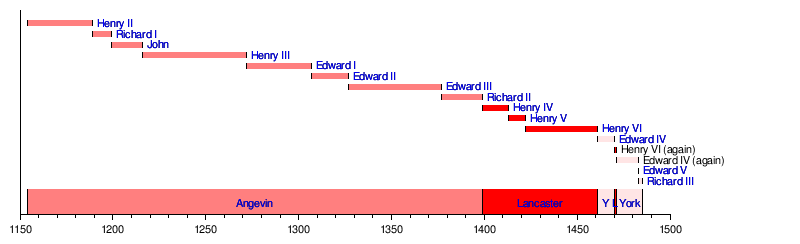
Timeline of Plantagenet Monarchs
Genealogy
- This family tree includes selected members of the House of Plantagenet who were born legitimate.
House of Lancaster House of York
| Geoffrey V, Count of Anjou 1113–1151 |
|||||||||||||||||||||||||||||||||||||||||||||||||||||||||||||||||||||||||||||
| Henry II, King of England 1133–1189 |
Geoffrey, Count of Nantes 1134–1158 |
William FitzEmpress 1136–1164 |
|||||||||||||||||||||||||||||||||||||||||||||||||||||||||||||||||||||||||||
| Henry the Young King 1155–1183 |
Richard I, King of England 1157–1199 |
Geoffrey II, Duke of Brittany 1158–1186 |
John, King of England 1167–1216 |
||||||||||||||||||||||||||||||||||||||||||||||||||||||||||||||||||||||||||
| Arthur I, Duke of Brittany 1187–1203 |
Henry III, King of England 1207–1272 |
Richard, King of Germany 1209–1272 |
|||||||||||||||||||||||||||||||||||||||||||||||||||||||||||||||||||||||||||
| Edward I, King of England 1239–1307 |
Edmund, 1st Earl of Lancaster 1245–1296 |
Henry of Almain 1235–1271 |
Edmund, 2nd Earl of Cornwall 1249–1300 |
||||||||||||||||||||||||||||||||||||||||||||||||||||||||||||||||||||||||||
| Alphonso, Earl of Chester 1273–1284 |
Edward II, King of England 1284–1327 |
Thomas, 1st Earl of Norfolk 1300–1338 |
Edmund, 1st Earl of Kent 1301–1330 |
Thomas, 2nd Earl of Lancaster c. 1278–1322 |
Henry, 3rd Earl of Lancaster c. 1281–1345 |
||||||||||||||||||||||||||||||||||||||||||||||||||||||||||||||||||||||||
| Edward III, King of England 1312–1377 |
John, Earl of Cornwall 1316–1336 |
Edmund, 2nd Earl of Kent 1326–1331 |
John, 3rd Earl of Kent 1330–1352 |
Henry, Duke of Lancaster c. 1310–1361 |
|||||||||||||||||||||||||||||||||||||||||||||||||||||||||||||||||||||||||
| Edward, Prince of Wales 1330–1376 |
John, Duke of Lancaster 1340–1399 |
Edmund, 1st Duke of York 1341–1402 |
Lionel, Duke of Clarence 1338–1368 |
Thomas, Duke of Gloucester 1355–1397 |
|||||||||||||||||||||||||||||||||||||||||||||||||||||||||||||||||||||||||
| House of Beaufort |
Two generations skipped |
||||||||||||||||||||||||||||||||||||||||||||||||||||||||||||||||||||||||||||
| Richard II, King of England 1367–1400 |
John Beaufort, Earl of Somerset (legitimated) |
Henry IV, King of England 1367–1413 |
Edward, 2nd Duke of York c. 1373–1415 |
Richard, Earl of Cambridge 1385–1415 |
Anne Mortimer 1388–1411 |
Humphrey, Earl of Buckingham 1382–1399 |
|||||||||||||||||||||||||||||||||||||||||||||||||||||||||||||||||||||||
| Henry V, King of England 1386–1422 |
Thomas, Duke of Clarence 1387–1421 |
John Beaufort, Duke of Somerset 1404–1444 |
John, Duke of Bedford 1389–1435 |
Humphrey, Duke of Gloucester 1390–1447 |
Richard, 3rd Duke of York 1411–1460 |
||||||||||||||||||||||||||||||||||||||||||||||||||||||||||||||||||||||||
| Henry VI, King of England 1421–1471 |
Margaret Beaufort 1443–1509 |
Edward IV, King of England 1442–1483 |
Edmund, Earl of Rutland 1443–1460 |
George, Duke of Clarence 1449–1478 |
Richard III, King of England 1452–1485 |
Elizabeth, Duchess of Suffolk 1444 – c. 1503 |
|||||||||||||||||||||||||||||||||||||||||||||||||||||||||||||||||||||||
| House of Tudor | |||||||||||||||||||||||||||||||||||||||||||||||||||||||||||||||||||||||||||||
| Edward, Prince of Wales 1453–1471 |
Henry VII, King of England 1457–1509 |
Elizabeth of York 1466–1503 |
Edward V, King of England 1470–? |
Richard of Shrewsbury 1473–? |
Margaret Pole, Countess of Salisbury |
Edward, Earl of Warwick 1475–1499 |
Edward, Prince of Wales 1473–1484 |
House of York-de la Pole |
|||||||||||||||||||||||||||||||||||||||||||||||||||||||||||||||||||||
| House of Pole | |||||||||||||||||||||||||||||||||||||||||||||||||||||||||||||||||||||||||||||
Male, male-line, legitimate, non-morganatic members of the house who either lived to adulthood, or who held a title as a child, are included. Kings of England are in bold.
- Henry II of England, 1133–1189
- Henry the Young King, 1155–1183
- Richard I of England, 1157–1199
- Geoffrey, Duke of Brittany, 1158–1186
- Arthur I, Duke of Brittany, 1187–1203
- John of England, 1167–1216
- Henry III of England, 1207–1272
- Edward I of England, 1239–1307
- Henry III of England, 1207–1272
* Edward II of England, 1284–1327 ** Edward III of England, 1312–1377 *** Edward, the Black Prince, 1330–1376 **** Richard II of England, 1367–1400 *** Lionel of Antwerp, 1st Duke of Clarence, 1338–1368 *** John of Gaunt, 1st Duke of Lancaster, 1340–1399 **** Henry IV of England, 1366–1413 ***** Henry V of England, 1386–1422 ****** Henry VI of England, 1421–1471 ******* Edward of Westminster, 1453–1471 ***** Thomas, Duke of Clarence, 1387–1421 ***** John, Duke of Bedford, 1389–1435 ***** Humphrey, Duke of Gloucester, 1390–1447 *** Edmund of Langley, 1st Duke of York, 1341–1402 **** Edward of Norwich, 2nd Duke of York, 1373–1415 **** Richard of Conisburgh, 3rd Earl of Cambridge, 1375–1415 ***** Richard Plantagenet, 3rd Duke of York, 1411–1460 ****** Edward IV of England, 1442–1483 ******* Edward V of England, 1470–? ******* Richard of Shrewsbury, 1st Duke of York, 1473–? ****** Edmund, Earl of Rutland, 1443–1460 ****** George Plantagenet, 1st Duke of Clarence, 1449–1478 ******* Edward Plantagenet, 17th Earl of Warwick, 1475–1499, the last legitimate male-line Plantagenet ****** Richard III of England, 1452–1485 *** Thomas of Woodstock, 1st Duke of Gloucester, 1355–1397 **** Humphrey, 2nd Earl of Buckingham, 1381–1399 ** John of Eltham, Earl of Cornwall, 1316–1336 * Thomas of Brotherton, 1st Earl of Norfolk, 1300–1338 ** Edward of Norfolk, 1313–1334 * Edmund of Woodstock, 1st Earl of Kent, 1301–1330 ** Edmund, 2nd Earl of Kent, 1326–1331 ** John, 3rd Earl of Kent, 1330–1352
-
-
-
- Edmund Crouchback, 1st Earl of Lancaster, 1245–1296
-
-
* Thomas Plantagenet, 2nd Earl of Lancaster, 1278–1322 * Henry, 3rd Earl of Lancaster, 1281–1345 ** Henry of Grosmont, 1st Duke of Lancaster, 1310–1361 * John of Beaufort, Lord of Beaufort, 1286–1317
-
-
- Richard, 1st Earl of Cornwall, 1209–1272
- Henry of Almain, 1235–1271
- Edmund, 2nd Earl of Cornwall, 1249–1300
- Richard, 1st Earl of Cornwall, 1209–1272
-
See also
 In Spanish: Casa de Plantagenet para niños
