
United States Space Force facts for kids
Quick facts for kids United States Space Force |
|
|---|---|
 |
|
| Founded |
|
| Country | United States |
| Type | Space force |
| Role | Space warfare |
| Size | 14,000 military personnel |
| Part of | United States Armed Forces Department of the Air Force |
| Headquarters | The Pentagon Arlington County, Virginia, U.S. |
| Motto(s) |
|
| March | "Semper Supra" |
| Anniversaries | 20 December |
| Equipment | See spacecraft and space systems |
| Engagements | Vietnam War Persian Gulf War Global War on Terrorism Afghanistan Campaign |
| Commanders | |
| Commander-in-Chief |  President Joe Biden President Joe Biden |
| Secretary of Defense |  Lloyd Austin Lloyd Austin |
| Secretary of the Air Force |  Frank Kendall III Frank Kendall III |
| Chief of Space Operations |  Gen B. Chance Saltzman Gen B. Chance Saltzman |
| Vice Chief of Space Operations |  Gen Shawn N. Bratton Gen Shawn N. Bratton |
| Chief Master Sergeant of the Space Force |  CMSSF John F. Bentivegna CMSSF John F. Bentivegna |
| Insignia | |
| Flag |
.svg) |
| Logo |
 |
| Emblem |
 |
The United States Space Force (USSF) is a branch of the United States Armed Forces that focuses on space. It was created on December 20, 2019. The Space Force is part of the United States Department of Defense. It is one of the six main armed forces and one of eight uniformed services in the United States. It is the second independent space force ever formed, after Russia's. Today, it is one of only two independent space forces in the world, along with China's.
The U.S. Space Force started from military space programs in the Air Force, Army, and Navy during the Cold War. U.S. military space forces first helped in combat during the Vietnam War. They have been part of every U.S. military operation since then. The Persian Gulf War was even called the "first space war" because space technology played such a big role. In the 1980s, the idea of protecting space became very important. This led to the creation of Air Force Space Command.
Leaders first thought about creating a U.S. Space Force in the 1980s. This was part of a plan called the Strategic Defense Initiative. In the late 1990s and early 2000s, Congress also looked into creating a Space Corps or Space Force. The idea came back in the late 2010s because other countries like Russia and China were developing their own military space programs. This led to the Space Force being officially established on December 20, 2019.
The Space Force works alongside the U.S. Air Force as part of the Department of the Air Force. A civilian leader, the Secretary of the Air Force, leads the Department of the Air Force. The U.S. Space Force itself is led by the Chief of Space Operations. The plan is for the Space Force to eventually become a fully independent department with its own civilian leader.
Contents
Protecting Our Interests in Space
Secure our Nation's interests in, from, and to space.
The Space Force has important jobs to do, as explained in U.S. law. It is set up to:
- Make sure the United States can operate freely in, from, and to space.
- Carry out space operations.
- Protect U.S. interests in space.
The Department of Defense also says the Space Force must:
- Provide freedom to operate for the United States in, from, and to space.
- Offer quick and ongoing space operations.
- Protect U.S. interests in space.
- Stop others from acting aggressively in, from, and to space.
- Conduct space operations.
The Space Force focuses on three main areas to achieve its mission:
- Space superiority (protecting things in space).
- Global mission operations (using space to help missions from space).
- Assured space access (making sure we can get to space).
Achieving Space Superiority

Space superiority means defending against threats in space. This includes protecting our own spacecraft and stopping enemies from using their spacecraft to cause harm. The Space Force needs to control the space environment. This way, the U.S. can always use its spacecraft and prevent enemies from using theirs or their space-enabled tools.
Tasks that help achieve space superiority include orbital warfare (operations in orbit), electromagnetic warfare (using radio waves), and space battle management (directing actions in space).
Supporting Global Missions from Space
_(7414560082).jpg)
Global mission operations use space to help military actions everywhere. Through space, the U.S. military and its allies can see, communicate, and find their way. Space operations also protect forces on Earth by giving early warnings about incoming missiles or other attacks. The Space Force explains that these global operations allow the rest of the U.S. military to defend land, air, and sea.
Important tasks for global mission operations include missile warning, satellite communications, and positioning, navigation, and timing (like GPS).
Ensuring Assured Space Access
.jpg)
Assured space access means the Space Force can launch and maintain equipment in outer space. This involves launching rockets and guiding spacecraft to avoid collisions with space debris. The Space Force says that assured access means it can keep launching and operating in space 24/7.
Missions that support space access include launching rockets, controlling launch areas, cyber protection, and space domain awareness (knowing what's in space).
History of Space Defense
Early Steps into Space
In the long haul, our safety as a nation may depend upon achieving "space superiority." Several decades from now, the important battles may not be sea battles or air battles, but space battles, and we should be spending a certain fraction of our national resources to ensure that we do not lag in obtaining space supremacy.

After World War II, the Air Force began looking at the possibilities and dangers of space. General Bernard Schriever was asked to find and develop new technologies with scientists. The U.S. Army, U.S. Navy, and U.S. Air Force each started their own space and rocket programs. The U.S. Air Force created the first military space group in 1954.
The Army launched America's first satellite, Explorer 1, on January 31, 1958. Military groups continued to explore space until NASA was created later that year. The military then helped NASA by providing astronauts and space launch vehicles. They also helped with astronaut recovery and launch support.
By the early 1960s, the Air Force was seen as the main military service for space. The Army and Navy played supporting roles. Early military space efforts focused on creating satellites for weather, spying, communications, and navigation. On August 18, 1961, the Air Force and National Reconnaissance Office launched the first CORONA spy mission. It took pictures of a large area of the Soviet Union.

The Air Force was worried about the Soviet Union's space programs. They wanted a military program for human spaceflight. General Curtis LeMay compared space operations in the 1960s to early aviation in World War I. He noted how quickly flying went from simple reconnaissance to combat. He believed the same would happen in space. Even though the Air Force worked on projects like the X-20 spaceplane, the Department of Defense did not allow them to become operational.
In 1968, the Central Intelligence Agency reported that the Soviet Union had successfully tested a way to destroy satellites. The U.S. had started its own Project SAINT to develop anti-satellite weapons. However, this project was canceled due to budget issues. Despite this, the Air Force did create the Program 437 anti-satellite weapon system. It used nuclear missiles to destroy enemy spacecraft.
Military space forces were spread across different commands within the Air Force. To bring them together, the Air Force created Air Force Space Command in 1982. Then, in 1985, the joint United States Space Command was formed. This brought together Air Force Space Command, Naval Space Command, and Army Space Command under one leader. These changes, along with President Ronald Reagan's Strategic Defense Initiative, boosted military space operations in the 1980s.

Space forces were first used in combat during the Vietnam War. Air Force weather and communication satellites helped ground, sea, and air operations. During Operation Urgent Fury in Grenada, satellite communications were used for command and control for the first time. Later operations used information from space-based intelligence systems.
The Persian Gulf War showed the full power of military space forces. More than sixty satellites provided 90% of communications for a large international army. They also gave weather support, missile warning of Iraqi missiles, and navigation for forces moving across the desert. Space forces played a key role in the victory, leading to the Persian Gulf War being called "the first Space War."
U.S. space forces supported all U.S. military operations in the 1990s. Operation Allied Force was the first time GPS-guided weapons were used, starting a new era of precise bombing. After the September 11 attacks, U.S. space forces helped in the Global War on Terrorism and other operations.
The Journey to a Separate Space Service
Creating a new military service...would be a dramatic step. Perhaps a "Space Corps" would be a step toward a Space Force. Maybe the Air Force will preempt these dramatic changes by truly becoming the "Space and Air Force."
.jpg)
The idea of a separate space service began in the 1960s. Military space activities were briefly grouped under the Advanced Research Projects Agency in 1958. The Air Force, Army, and Navy worried this would become a "fourth service" for space. So, authorities were returned to the individual services.
The first direct call for a U.S. Space Force happened in 1982. A government report suggested reorganizing the U.S. Air Force as the U.S. Aerospace Force or creating an independent U.S. Space Force. This led the Air Force to speed up its plans to create a space command within its service.
After the Persian Gulf War, the Air Force and Defense Department said that "space power has now become as important to the nation as land, sea, and air power." However, some in Congress felt that space was not getting enough attention. In 1998, Senator Bob Smith publicly called for a Space Force if the Air Force did not fully embrace spacepower. He suggested a Space Corps within the Department of the Air Force as a first step.

In 2000, Senator Smith helped create a commission to study national security space. The 2001 Space Commission, also known as the Rumsfeld Commission, released its report in 2001. It warned of a "Space Pearl Harbor," referring to a surprise attack. The commission criticized the Air Force's handling of space. Many believed the Air Force did not prioritize space capabilities enough. The commission's main recommendation was to create a Space Corps within the Department of the Air Force. This would eventually become a fully independent Department of the Space Force. They expected this to happen between 2006 and 2011.
Air Force leaders did not like these recommendations. The day after the report, Air Force chief of staff General Michael E. Ryan said an independent Space Force was not needed for another 50 years. He believed it should only be considered when space operations went beyond Earth's orbit. Despite the Air Force's resistance, they did follow some recommendations. They moved the Space and Missile Systems Center to Air Force Space Command and created the National Security Space Institute. However, the commission's main recommendations were not fully carried out. This was because the focus shifted to counterterrorism after the September 11 attacks.
.jpg)
While the U.S. focused on counterterrorism, Russia and China increased their military space abilities. They saw how much the U.S. relied on its space forces. In 2001, the Russian Space Forces were reestablished. In 2007, China tested an anti-satellite weapon. This created the largest amount of space debris ever. After this, another commission, the Allard Commission, reevaluated space organization. It found that the U.S. depended more on space, but its space assets were not much safer. It also noted that space responsibilities were still scattered. Like the Rumsfeld Commission, the Allard Commission recommended creating a Space Corps or a separate Department of the Space Force.
It took until 2017 for Congress members to act on these recommendations. Representatives Mike Rogers and Jim Cooper proposed creating a Space Corps. However, the Air Force and Defense Department opposed it, and it failed in the Senate. In 2018, President Donald Trump publicly supported creating a Space Force. He told the Defense Department to develop plans for it. The plan was to first organize the U.S. Space Force under the Department of the Air Force. Then, it would become a separate Department of the Space Force later. In 2019, Congress passed a law to establish the U.S. Space Force. On December 20, 2019, the National Defense Authorization Act was signed into law. This created the U.S. Space Force as the sixth armed service. It met the recommendations for a Space Corps but not yet for a fully separate department.
The Sixth Service
We are at the dawn of a new era for our Nation’s Armed Forces. The establishment of the U.S. Space Force is an historic event and a strategic imperative for our Nation. Space has become so important to our way of life, our economy and our national security that we must be prepared as a Nation to protect it from hostile actions.

When the U.S. Space Force was established on December 20, 2019, General Jay Raymond became its first member and chief of space operations. Air Force Space Command was immediately renamed United States Space Force. However, its 16,000 Airmen technically remained part of the Air Force at first. On April 3, 2020, Chief Master Sergeant Roger A. Towberman became the Space Force's second member and its first senior enlisted leader. The service gained its first new officers when 86 members of the U.S. Air Force Academy class of 2020 joined on April 18, 2020. Air Force space operators began transferring to the Space Force in September 2020. The service gained its first astronaut when Colonel Michael S. Hopkins joined the Space Force from the International Space Station on December 18, 2020.

The Space Force also started building its own culture and identity. The Space Force chose "Guardian" as the title for its personnel. This is similar to how Marines are called Marines and Airmen are called Airmen. The term "Guardian" comes from Air Force Space Command's 1983 motto: "Guardians of the High Frontier." The Space Force also adopted Semper Supra as its official motto and unveiled its service song with the same name. The Space Force decided to use a rank structure similar to the Army and Air Force.
.jpg)
The Space Force officially began bringing in former Air Force Space Command units in 2020 and 2021. It created field commands, similar to the Air Force's major commands. It also grouped Air Force wings and groups into "mission deltas" and "space base deltas." These are like Army brigades or Air Force air base wings. Former Air Force bases and stations also began to be renamed Space Force bases and stations. Examples include Patrick Space Force Base and Cape Canaveral Space Force Station.

One main reason for creating the Space Force was to combine space forces from the U.S. Air Force, U.S. Army, and U.S. Navy. In 2020, the Space Training and Readiness Delta (Provisional) was created. This formed the basis for Space Training and Readiness Command. It brought together Air Force space units. Space Systems Command took over space equipment buying activities. The Space Force also began taking in space personnel from the U.S. Army, U.S. Navy, and U.S. Marine Corps. In 2022, the Naval Satellite Operations Center and the Army's Satellite Operations Brigade moved to the Space Force. This put satellite communications under one service for the first time. In 2023, the Space Force took over the Army's Joint Tactical Ground Station. This placed all space-based missile warning under the Space Force.
The Space Force's first major action happened less than a month after it was created. It provided missile warning when Iran launched missile strikes against U.S. troops in January 2020. In 2021, Russia conducted an anti-satellite weapon test. This destroyed a satellite and put the International Space Station at risk.
How the Space Force is Organized

The Space Force has a headquarters staff that leads the force. It also has field commands that train and equip its members, called Guardians. Deltas support the field commands and focus on specific missions. Squadrons specialize in areas like buying equipment, cyber operations, engineering, intelligence, and space operations.
Here is how the Space Force's military units are structured:
- A section has two or more Guardians.
- A flight is made up of individual Guardians or sections.
- Two or more flights form a squadron. A squadron is led by a major or lieutenant colonel. It is the smallest command level and is usually known by a number and its job.
- Two or more squadrons form a delta. A delta is led by a colonel. There are three types of deltas:
- A mission delta handles a whole set of missions for the service.
- A space base delta manages support for Space Force bases.
- A space launch delta handles both base support and launch missions for its Space Force base.
- Field commands are led by a major general or lieutenant general. They are responsible for training and equipping thousands of Guardians worldwide. A field command focuses on a specific mission, like Space Training and Readiness Command. It reports directly to the headquarters at the Pentagon.
- Service component field commands are led by a colonel or brigadier general. They connect Space Force abilities with other military branches and commands.
Space Force Headquarters
At its main headquarters, the Space Force is led by the Chief of Space Operations. This is a four-star general who reports to the Secretary of the Air Force. The Chief of Space Operations gives military advice to the civilian leaders of the Department of Defense and the White House. The Air Force and Space Force together form the Department of the Air Force. This is similar to how the Navy and Marine Corps form the Department of the Navy.
| Title | Current holder | ||
|---|---|---|---|
 |
Chief of space operations (CSO) | _(cropped).jpg) |
Gen B. Chance Saltzman |
 |
Vice chief of space operations (VCSO) | .jpg) |
Gen Shawn Bratton |
 |
Chief Master Sergeant of the Space Force (CMSSF) |  |
CMSSF John F. Bentivegna |
 |
Director of staff (SF/DS) |  |
Lt Gen David N. Miller |
 |
Deputy chief of space operations for human capital (SF/S1) | .jpg) |
Katharine Kelley |
 |
Deputy chief of space operations for intelligence (SF/S2) |  |
Maj Gen Brian Sidari |
|
Deputy chief of space operations for operations (SF/S3/6/10) | _(cropped).jpg) |
Lt Gen Douglas Schiess |
|
Deputy chief of space operations for strategy, plans, programs, requirements, and analysis (SF/S5/8) | |
Lt Gen David N. Miller |
|
Deputy chief of space operations for cyber and data (SF/S6) | .jpg) |
Charleen D. Laughlin |
 |
Mobilization Assistant to the Chief of Space Operations |  |
Maj Gen Robert Claude |
 |
Assistant Chief of Space Operations for Future Concepts and Partnerships |  |
AM Paul Godfrey |
Field Commands and Units
The Space Force has three main field commands. These commands are designed for specific tasks like organizing, training, and equipping Guardians. Component field commands help combine space forces into military plans. Direct reporting units are centers for new ideas and special knowledge within the Space Force.
| Field command | Mission | Headquarters | |
|---|---|---|---|
 |
Space Force Combat Forces Command (CFC) | Prepares and supports space warfighting abilities for military commanders | Peterson SFB, Colorado |
 |
Space Systems Command (SSC) | Develops, buys, and maintains strong space capabilities | Los Angeles AFB, California |
 |
Space Training and Readiness Command (STARCOM) | Trains Guardians to succeed in space through education and testing | Peterson SFB, Colorado |
| Component field command | Mission | Headquarters | |
 |
U.S. Space Forces – Space (SPACEFOR–SPACE) | The Space Force part of U.S. Space Command. It plans and uses military space power for all U.S. military operations starting 100 kilometers above sea level | Vandenberg SFB, California |
 |
U.S. Space Forces – Central (SPACEFOR–CENT) | The Space Force part of U.S. Central Command. It plans and uses military space power across Northeast Africa, the Middle East, and Central and South Asia | MacDill AFB, Florida |
 |
U.S. Space Forces – Europe and Africa (SPACEFOR–EURAF) | The Space Force part of U.S. European Command and U.S. Africa Command. It plans and uses military space power across Europe, parts of Asia, the Middle East, Arctic, and Atlantic Oceans, and Africa | Ramstein AB, Germany |
 |
U.S. Space Forces – Indo-Pacific (SPAFOR-INDOPAC) | The Space Force part of U.S. Indo-Pacific Command. It plans and uses military space power across the Asia-Pacific region | JB Pearl Harbor-Hickam, Hawaii |
 |
U.S. Space Forces Southern (SPACEFOR–SOUTH) | The Space Force part of U.S. Southern Command. It combines space power with other partners to support security in Central America, South America, and the Caribbean. | Davis-Monthan Air Force Base, Arizona |
 |
U.S. Space Forces Northern
(SPACEFOR-NORTH) |
The Space Force part of U.S. Northern Command. It focuses on continental defense, awareness across different areas, missile warning, navigation, and space warfare. | Peterson Space Force Base, Colorado |
| Space Force Element | Mission | Headquarters | |
 |
Space Force Element National Reconnaissance Office (SFELM NRO) | Helps design, develop, launch, and maintain America's spy satellites | Chantilly, Virginia |
| Direct Reporting Unit | Mission | Headquarters | |
 |
Space Development Agency (SDA) | Creates and tests strong military space-based sensors and data systems | The Pentagon, Arlington County, Virginia |
 |
Space Rapid Capabilities Office (SpRCO) | Quickly develops and deploys space capabilities for urgent needs | Kirtland AFB, New Mexico |
| Field Operating Agency | Mission | Headquarters | |
 |
National Space Intelligence Center (NSIC) | Provides expert knowledge and intelligence to help leaders and warfighters in space | Wright-Patterson AFB, Ohio |
Space Force Bases
The Space Force headquarters is in Washington, D.C. However, its other parts are located across the United States and in other countries. As of 2024, it has locations in 18 states and territories, and at 46 bases.
| Name | Location | Garrison | |
|---|---|---|---|
| Buckley Space Force Base | Aurora, Colorado |  |
Space Base Delta 2 |
| Peterson Space Force Base | Colorado Springs, Colorado |  |
Space Base Delta 1 |
| Schriever Space Force Base | Colorado Springs, Colorado | |
Space Base Delta 1 |
| Los Angeles Air Force Base | El Segundo, California |  |
Space Base Delta 3 |
| Patrick Space Force Base | Satellite Beach, Florida |  |
Space Launch Delta 45 |
| Vandenberg Space Force Base | Lompoc, California |  |
Space Launch Delta 30 |
| Cape Canaveral Space Force Station | Cape Canaveral, Florida | |
Space Launch Delta 45 |
| Cheyenne Mountain Space Force Station | Cheyenne Mountain, Colorado | |
Space Base Delta 1 |
| Cape Cod Space Force Station | Sagamore, Massachusetts |  |
6th Space Warning Squadron |
| Cavalier Space Force Station | Cavalier, North Dakota |  |
10th Space Warning Squadron |
| Clear Space Force Station | Clear, Alaska |  |
13th Space Warning Squadron |
| Kaena Point Space Force Station | Kaena Point, Hawaii |  |
21st Space Operations Squadron |
| New Boston Space Force Station | Hillsborough County, New Hampshire |  |
23rd Space Operations Squadron |
| Maui Space Force Station | Maui, Hawaii |  |
15th Space Surveillance Squadron |
| Pituffik Space Base | Pituffik, Greenland |  |
821st Space Base Group |
Future of the Space Force
Becoming a Separate Department
As the United States Space Force matures, and as national security requires, it will become necessary to create a separate military department, to be known as the Department of the Space Force.
The Space Force is currently part of the Department of the Air Force. This is like a first step towards becoming fully independent. Leaders like Senator Bob Smith and the Rumsfeld and Allard Commissions imagined that a Space Corps would first be created under the Air Force. Then, it would grow into a fully independent Space Force. In 2019, Space Policy Directive-4 said the Space Force would start under the Department of the Air Force. The goal is to eventually create an independent Department of the Space Force. This new department would take over all space missions from the Department of the Air Force. The Secretary of Defense is asked to regularly review when to recommend this change to the President.
Some people have suggested renaming the Department of the Air Force to the Department of the Air and Space Forces. This would show that it includes both the U.S. Air Force and the U.S. Space Force. There have also been calls for the Space Force to have its own public affairs and legal teams, separate from the Air Force.
Combining Army Space Activities
.jpg)
When the Space Force was created in 2019, the idea was to combine all military space forces from the Army, Navy, and Air Force. While the Navy and Air Force transferred their space assets, the Army was more hesitant.
The Army did transfer its satellite communications and missile warning assets. However, some still believe the 1st Space Brigade and 100th Missile Defense Brigade should also move to the Space Force. These brigades operate important systems like the Ground Based Interceptor. Experts have suggested moving missile defense and intercontinental ballistic missile missions to the Space Force. The Army still has its own space operations officers and maintains the 1st Space Brigade. However, studies have suggested transferring it to the Space Force.
Working with Other Space Groups
National Aeronautics and Space Administration (NASA)

The U.S. Space Force and its earlier groups have a long history of working with NASA. NASA is the main government agency for civilian spaceflight. The Space Force's predecessors provided NASA with early rockets and many of its astronauts.
.jpg)

The Space Force hosts NASA rocket launches at Vandenberg Space Force Base and Cape Canaveral Space Force Station. NASA sometimes hosts U.S. Space Force launches at Kennedy Space Center. The Space Force helps NASA's human spaceflight missions. It also tracks threats to the International Space Station and other spacecraft with people on board.
The Space Force and NASA work together on things like space domain awareness (knowing what's in space) and planetary defense (protecting Earth from space objects). Space Force members can also become NASA astronauts. Colonel Michael S. Hopkins was the first Space Force astronaut. He joined the Space Force from the International Space Station in December 2020.
National Reconnaissance Office (NRO)

The National Reconnaissance Office (NRO) is a Department of Defense agency. It is part of the United States Intelligence Community. The NRO designs, builds, launches, and maintains spy satellites. The Space Force helps launch NRO satellites and makes up 40% of the agency's staff. Some people have suggested combining the NRO into the Space Force. This would create a Space Force Intelligence, Reconnaissance, and Surveillance Command.

The USSF's Space Systems Command (SSC) works with the National Reconnaissance Office. Together, they manage the National Security Space Launch (NSSL) program. This program uses government and private rockets to launch important government satellites. NSSL supports both the USSF and NRO. NRO leaders say their agency is vital for American space leadership. They provide "unrivaled situational awareness and intelligence" and the best imagery and signals data on Earth.
National Oceanic and Atmospheric Administration (NOAA)

The Space Force and the National Oceanic and Atmospheric Administration (NOAA) work together. They operate the military's weather satellites. Also, NOAA's Office of Space Commerce handles civilian space situational awareness and space traffic management.
The job of managing space traffic moved from the military to the Department of Commerce. This happened because there are many more commercial spacecraft now. It is similar to how the Federal Aviation Administration handles air traffic, not the U.S. Air Force.
People and Culture
Symbols of the Space Force
The Delta Symbol
In the past, scientists developed the Tsiolkovsky rocket equation. This equation made spaceflight possible. In it,  means the change in speed. Since the 20th century, the delta symbol has been used to represent a rocket or an arrow. In 1940, the United States Army Air Forces used the delta on its shield.
After World War II, the delta became a symbol for the space program. It appeared on the joint U.S. Air Force-NASA X-15 aircraft. In 1962, the Air Force Ballistic Missile Division was the first military space group to use the delta. In the Air Force Space Command shield, it showed the Air Force's push into space and the rockets used to launch satellites. This delta later became the basic shape for the U.S. Space Force's seal and logo in 2020.
Guardians
.jpeg)
Members of the Space Force are called Guardians. This is like how U.S. Marine Corps members are called Marines. The title "Guardian" comes from Air Force Space Command's 1983 motto, Guardians of the High Frontier. Before December 18, 2020, Space Force members were called space professionals.
Semper Supra
The Space Force's motto is Semper Supra. This means "Always Above." It is similar to the mottos of the Marine Corps (Semper Fidelis – Always Faithful) and Coast Guard (Semper Paratus – Always Ready). The Space Force's service song also shares this name.
Specialties and Badges

Space Force Officer Training Course |
 Space Operations |
 Intelligence |
 Cyberspace Operations |
 Acquisition and engineering |
|---|---|---|---|---|
| Officer | ||||
|
|
|
|
|
| Enlisted | ||||
|
|
|
||
Space operators are the largest career field in the Space Force. They lead space operations, including orbital warfare and space access. Space operations officers (13S) plan and lead these missions. Enlisted Space Systems Operators (5S) carry out these operations. Both officers and enlisted operators earn the Space Operations Badge after training.

The Space Force currently has two astronauts (13A). They fly as Space Force officers assigned to NASA. Space Force astronauts command and operate crewed spacecraft. They also work on the International Space Station and advise the Department of Defense. They must complete NASA Astronaut Candidate training. After a spaceflight, they receive the observer badge with an astronaut rating.
Intelligence officers (14N) lead the Space Force's intelligence, surveillance, and reconnaissance efforts. They perform intelligence activities and analysis. They lead enlisted analysts who specialize in different types of intelligence. These officers and analysts earn their intelligence badge after training.

Cyberspace effects operations officers (17S) operate cyber weapon systems and satellite communications. They also command cyber teams. They lead enlisted Cyberspace Operations Guardians. These officers and enlisted operators earn the cyberspace operator badge after training.
Acquisition and engineering are officer-only career fields. Developmental engineers (62E) include aeronautical engineers, astronautical engineers, computer systems engineers, electrical/electronic engineers, mechanical engineers, and human factors engineers. Acquisition managers (63A) handle the process of buying new equipment for the Space Force.
Spacepower Disciplines
.jpeg)
The U.S. Space Force has seven main areas of expertise for its personnel:
- Orbital warfare: Knowing how to move in orbit and use offensive and defensive actions to keep access to space. This ensures U.S. space forces can keep helping the military while stopping enemies.
- Space electromagnetic warfare: Understanding and using the electromagnetic spectrum to prevent enemies from using vital communication links.
- Space battle management: Knowing how to operate in space and make decisions to protect missions. This includes identifying hostile actions and directing responses.
- Space access and sustainment: Knowing how to maintain and support operations in space. This means being able to provide and use space power.
- Military intelligence: Using intelligence to guide operations and defend space. This involves working with the wider intelligence community.
- Engineering and acquisition: Ensuring the Space Force has the best equipment to defend space. This involves working with science, technology, and other partners.
- Cyber operations: Protecting the global networks that military space power relies on. This includes cyber security and cyber defense of space systems.
Rank Structure
Officers


Officers are the leaders of the U.S. Space Force. They plan operations and manage personnel. Space Force officers join the service in three ways: by graduating from the United States Air Force Academy, the Air Force Reserve Officer Training Corps, or the Air Force Officer Training School.
The U.S. Air Force Academy is a top way for Space Force officers to begin their careers. About 10% of each class becomes U.S. Space Force officers. The Air Force Academy has a long history with space, offering space majors and courses. On April 18, 2020, the Air Force Academy commissioned 86 officers into the Space Force. They were the first group to join after the first Chief of Space Operations and the senior enlisted advisor.
The Air Force Reserve Officer Training Corps program is available at many colleges. It also commissions officers directly into the Air Force or Space Force. The Air Force Officer Training School is another way to become a Space Force officer. It graduated its first Space Force officers in October 2020.
The Space Force partners with Johns Hopkins University for advanced education. Officers also have other training opportunities, including the National Security Space Institute and the U.S. Air Force Weapons School.
| US DoD pay grade |
O-10 | O-9 | O-8 | O-7 | O-6 | O-5 | O-4 | O-3 | O-2 | O-1 | Officer candidate |
|---|---|---|---|---|---|---|---|---|---|---|---|
| NATO code | OF-9 | OF-8 | OF-7 | OF-6 | OF-5 | OF-4 | OF-3 | OF-2 | OF-1 | OF(D) | |
| Insignia |  |
 |
 |
 |
 |
 |
 |
 |
 |
 |
Various insignia |
| Service dress uniform (Class A) |  |
 |
 |
 |
 |
 |
 |
 |
 |
 |
 |
| Title | General | Lieutenant general | Major general | Brigadier general | Colonel | Lieutenant colonel | Major | Captain | First lieutenant | Second lieutenant | Cadet / Officer trainee |
| Abbreviation | Gen | Lt Gen | Maj Gen | Brig Gen | Col | Lt Col | Maj | Capt | 1st Lt | 2d Lt | Cdt / OT |


Enlisted Members

Enlisted members help with and support operations. Space Force enlisted members complete Basic Military Training at Joint Base San Antonio. This training is similar to the Air Force's, but with added Space Force-specific lessons. In October 2020, the first four individuals enlisted into the Space Force. In December 2020, the first seven enlisted members graduated from Basic Military Training. In May 2022, the Space Force started its own all-Guardian Basic Military Training to strengthen Space Force culture.
Space Force enlisted members can earn an associate's degree from the Community College of the Air Force. They also receive professional military education at the Forrest L. Vosler Non-Commissioned Officer Academy.

The Space Force's enlisted rank designs feature a hexagon. This represents the Space Force as the sixth military service. The horizontal stripes for Specialist ranks were inspired by early Air Force rank ideas. The delta symbol represents the Space Force. The specialist stripes show the strong foundation of skills in the Space Force. Noncommissioned officer ranks have traditional chevrons and a "Delta, Globe, and Orbit" symbol. This represents the entire Space Force. Senior noncommissioned officer ranks have "orbital chevrons" at the top. These show higher levels of responsibility and a willingness to explore. The Chief Master Sergeant of the Space Force has a "Delta, Globe, and Orbit" in a hexagonal wreath.
-
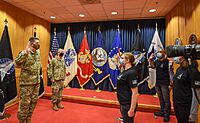
Vice Chief of Space Operations General David D. Thompson swore in the first four enlisted Space Force recruits on October 20, 2020.
-
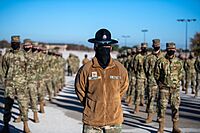
The first seven enlisted Guardians graduated from Basic Military Training on December 10, 2020.
.jpg)
.jpg)
| US DoD pay grade | Special | E-9 | E-8 | E-7 | E-6 | E-5 | E-4 | E-3 | E-2 | E-1 | |
|---|---|---|---|---|---|---|---|---|---|---|---|
| NATO code | OR-9 | OR-8 | OR-7 | OR-6 | OR-5 | OR-4 | OR-3 | OR-2 | OR-1 | ||
| Insignia |  |
 |
 |
 |
 |
 |
 |
 |
 |
 |
 |
| Title | Senior Enlisted Advisor to the Chairman | Chief Master Sergeant of the Space Force | Chief master sergeant | Senior master sergeant | Master sergeant | Technical sergeant | Sergeant | Specialist 4 | Specialist 3 | Specialist 2 | Specialist 1 |
| Abbreviation | SEAC | CMSSF | CMSgt | SMSgt | MSgt | TSgt | Sgt | Spc4 | Spc3 | Spc2 | Spc1 |
Uniforms
| Air Force Mess Dress Uniform (interim) | Service Dress Uniform Class "A" |
Service Uniform Class "B" |
Air Force Service Dress Uniform (interim) | OCP Uniform | Physical Training Uniform | |
|---|---|---|---|---|---|---|
.jpg) |
 |
.jpg) |
 |
 |
 |
 |

The Space Force is creating its own unique uniforms. For now, Guardians wear Air Force uniforms with some changes. These changes include Space Force insignia, special buttons, and hexagonal nametags. Enlisted members also wear Space Force ranks and hexagonal U.S. insignia.
The main Space Force uniform is the OCP Uniform. This uniform was adopted from the U.S. Air Force and Army. The Space Force uses unique "space blue" thread for ranks and badges. It also wears a full-color flag and patches.
.jpeg)
The Space Force's special blue and gray service dress uniform was shown in 2021. The dark blue represents outer space. The six buttons show that the Space Force is the sixth armed service. The Space Force's Physical Training Uniform was also shown in September 2021. The official service dress uniform was unveiled on January 13, 2026. A date for when it must be worn has not yet been set.
Space Force cadets at the Air Force Academy wear similar uniforms to Air Force cadets. However, in their parade dress uniforms, they wear a platinum sash instead of a gold one.
Awards and Decorations

As part of the United States Department of the Air Force, the Space Force and United States Air Force share many of the same awards.
In November 2020, the Secretary of the Air Force renamed several awards. He changed "Air Force" to "Air and Space" to include the Space Force. For example, the Air Force Commendation Medal became the Air and Space Commendation Medal. He also removed "Air Force" from the Air Force Combat Action Medal.
The Space Force is developing its own Good Conduct Medal for enlisted members. This was approved on August 30, 2023.
| Arctic "A" Device | Arrowhead Device | Combat "C" Device | Oak leaf cluster | Remote "R" device | Service Star | Valor "V" Device | ||
|---|---|---|---|---|---|---|---|---|
 |
 |
 |
 |
 |
 |
 |
 |
 |
Decorations
| Medal of Honor | Air Force Cross | Distinguished Service Medal | Silver Star Medal | Legion of Merit | Distinguished Flying Cross | Airman's Medal | Bronze Star Medal | Purple Heart | Meritorious Service Medal | Air Medal | Aerial Achievement Medal | Air and Space Commendation Medal | Air and Space Achievement Medal |
|---|---|---|---|---|---|---|---|---|---|---|---|---|---|
 |
 |
 |
 |
 |
 |
 |
 |
 |
 |
 |
 |
 |
 |
 |
 |
 |
 |
 |
 |
 |
 |
 |
 |
 |
 |
 |
 |
Unit Awards
| Presidential Unit Citation | Gallant Unit Citation | Meritorious Unit Award | Air and Space Outstanding Unit Award | Air and Space Organizational Excellence Award |
|---|---|---|---|---|
 |
 |
 |
 |
 |
Campaign, Expeditionary, and Service Awards
| Combat Action Medal | Combat Readiness Medal | Space Force Good Conduct Medal | Air and Space Recognition Ribbon | Remote Combat Effects Campaign Medal | Air and Space Campaign Medal | Nuclear Deterrence Operations Service Medal | Air and Space Overseas Service Ribbon (Short Tour) | Air and Space Overseas Service Ribbon (Long Tour) | Air and Space Expeditionary Service Ribbon | Air and Space Longevity Service Award | Developmental Special Duty Ribbon | Air Force Enlisted Professional Military Education Graduate Ribbon | Basic Military Training Honor Graduate Ribbon | Small Arms Expert Marksmanship Ribbon | Air and Space Training Ribbon | |
|---|---|---|---|---|---|---|---|---|---|---|---|---|---|---|---|---|
 |
 |
 |
 |
 |
 |
|||||||||||
 |
 |
 |
 |
 |
 |
 |
 |
 |
 |
 |
 |
 |
 |
 |
 |
 |
Spacecraft and Space Systems
Spacecraft
| Name | Spacecraft image | Mission | Operator | Number |
|---|---|---|---|---|
| Advanced Extremely High Frequency (AEHF) |
 |
Satellite communications | Space Delta 8 | 6 |
| Advanced Technology Risk Reduction (ATRR) |
 |
Space surveillance | Space Delta 9 | 1 |
| Defense Meteorological Satellite Program (DMSP) |
 |
Environmental monitoring | Mission Delta 2 | 4 |
| Defense Satellite Communications System (DSCS) |
 |
Satellite communications | Space Delta 8 | 6 |
| Defense Support Program (DSP) |
 |
Missile warning | Mission Delta 4 | |
| Electro-optical/Infrared Weather System – Geosynchronous (EWS-G) |
 |
Environmental monitoring | Mission Delta 2 | |
| Fleet Satellite Communications System (FLTSAT) |
 |
Satellite communications | Space Delta 8 | |
| Global Positioning System (GPS) |
 |
Positioning, navigation, and timing | Mission Delta 31 | 32 |
| Geosynchronous Space Situational Awareness Program (GSSAP) |
 |
Space surveillance | Space Delta 9 | 6 |
| Milstar |
 |
Satellite communications | Space Delta 8 | 5 |
| Mobile User Objective System (MUOS) |
 |
Satellite communications | Space Delta 8 | |
| Operationally Responsive Space-5 (ORS-5) |
.jpeg) |
Space surveillance | Space Delta 9 | 1 |
| Space-Based Infrared System (SBIRS) |
 |
Missile warning Missile defense Battlespace awareness Technical intelligence |
Mission Delta 4 | 7 |
| Space Based Space Surveillance (SBSS) |
 |
Space surveillance | Space Delta 9 | 1 |
| Ultra High Frequency Follow-On (UFO) |
 |
Satellite communications | Space Delta 8 | |
| Wideband Global SATCOM (WGS) |
.jpg) |
Satellite communications | Space Delta 8 | 10 |
| X-37B Orbital Test Vehicle |
.jpg) |
Orbital test spaceplane | Space Delta 9 | 2 |
Space Systems
| Name | Space system image | Mission | Operator |
|---|---|---|---|
| AN/FPS-85 |
 |
Space surveillance | Mission Delta 2 |
| C-Band Space Surveillance Radar System |
_Radar-_One_year_on_(4181476).jpeg) |
Space surveillance | Mission Delta 2 |
| Cobra Dane |
 |
Missile defense Space surveillance |
Mission Delta 4 |
| Ground-Based Electro-Optical Deep Space Surveillance (GEODSS) |
.jpeg) |
Space surveillance | Mission Delta 2 |
| Long Range Discrimination Radar (LRDR) |
 |
Missile defense Space surveillance |
Mission Delta 4 |
| Perimeter Acquisition Radar Attack Characterization System (PARCS) |
 |
Missile warning Space surveillance |
Mission Delta 4 |
| Satellite Control Network (SCN) |
.jpeg) |
Ground station | Space Delta 6 |
| Space Fence |
 |
Space surveillance | Mission Delta 2 |
| Space Surveillance Telescope |
 |
Space surveillance | Mission Delta 2 |
| Upgraded Early Warning Radar (UEWR) |
 |
Missile warning Missile defense Space surveillance |
Mission Delta 4 |
Space Launch Vehicles
| Name | Space launch vehicle image | Class | Contractor |
|---|---|---|---|
| Atlas V |
 |
Medium-lift launch vehicle | United Launch Alliance |
| Electron |
_(cropped).jpg) |
Small-lift launch vehicle | Rocket Lab |
| Falcon 9 |
.jpg) |
Medium to Heavy-lift launch vehicle | SpaceX |
| Falcon Heavy |
.jpg) |
Heavy to Super heavy-lift launch vehicle | SpaceX |
| Pegasus |
.jpg) |
Air launched small-lift launch vehicle | Northrop Grumman |
Modernization and Budget
| United States Space Force budget | 2020 | 2021 | 2022 | 2023 | 2024 | 2025 | 2026 (requested) |
|---|---|---|---|---|---|---|---|
| Operation & maintenance | $40,000,000 | $2,492,114,000 | $3,611,012,000 | $4,086,883,000 | ~$4,900,000,000 | ~$5,300,000,000 | ~$5,800,000,000 |
| Procurement | — | $2,310,994,000 | $2,787,354,000 | $4,462,188,000 | ~$4,700,000,000 | ~$4,300,000,000 | ~$3,700,000,000 |
| Research, development, test & evaluation | — | $10,540,069,000 | $11,794,566,000 | $16,631,377,000 | ~$18,670,000,000 | ~$18,700,000,000 | ~$29,000,000,000* |
| Military personnel | — | — | — | $1,109,400,000 | ~$1,200,000,000 | ~$1,200,000,000 | ~$1,400,000,000 |
| Total | $40,000,000 | $15,343,177,000 | $18,192,932,000 | $26,289,848,000 | ~$29,500,000,000 | $28,700,000,000 | ~$39,900,000,000† |
- *The 2026 RDT&E request includes $13.5 billion in mandatory funding proposed through reconciliation, significantly inflating this category compared to previous years.
- †The 2026 Total represents the combined baseline and reconciliation request (~$40 billion). The baseline appropriation request alone is approximately $26.3 billion.

NASA's return to the Moon through the Artemis program is leading to a greater emphasis on cislunar domain awareness.

Concept for a space-based solar power spacecraft

SpaceX's Starship, a contender for the Rocket Cargo program
|
Even though it's a new service, the U.S. Space Force is working hard to update its technology. The Deep Space Advanced Radar Capability (DARC) will track objects in geosynchronous orbit from three locations around the world.
Oracle is a spacecraft developed for the Space Force. It will test technologies needed to track objects between Earth and the Moon. This helps with NASA's Artemis program to return to the Moon. It also helps track dangerous objects near Earth for planetary defense.
Another project for the Space Force is Arachne. This experiment aims to prove technologies for a space-based solar power system. This system could power military bases on Earth from space. This would make it safer to provide power to remote locations. If successful, space-based solar power could also be used by civilians, just like GPS.
The Navigation Technology Satellite-3 (NTS-3) is another important project. It will test new ways to improve GPS and make it more reliable for everyone.
The Space Force's Rocket Cargo program is exploring using rockets to quickly transport military supplies anywhere in the world. This could allow up to 100 tons of cargo to be delivered rapidly.
See also
 In Spanish: Fuerza Espacial de los Estados Unidos para niños
- National Security Space Launch
- Air & Space Forces Association
- Militarization of space
- Space Force Association
- Starlink in the Russo-Ukrainian War
- Strategic Defense Initiative
- Women in the United States Space Force
