
Guanches facts for kids

Statue of Tegueste at Candelaria, Tenerife
|
|
| Regions with significant populations | |
|---|---|
| Languages | |
| Guanche (historically) | |
| Religion | |
| Animism (Guanche mythology) | |
| Related ethnic groups | |
| Berbers, Canary Islanders |
The Guanches were the first people to live on the Canary Islands. These islands are in the Atlantic Ocean, about 100 kilometers west of Morocco in North Africa. The Guanches spoke their own language, called Guanche. Experts believe it was similar to the Berber languages spoken in North Africa. Sadly, the Guanche language disappeared in the 17th century, after the islands were taken over by Spain.
Historians think the Guanches first arrived on the islands around 1000 BC. They were the only native people known to live in the Macaronesian islands before Europeans arrived. Other nearby island groups, like Cape Verde, Madeira, and the Azores, did not have native populations.
When the Spanish began their conquest of the Canary Islands in the early 15th century, many Guanches died. Some were killed in battles, and others got sick from new diseases brought by the Europeans. The Guanches who survived eventually blended into the new Spanish society and culture. However, parts of their ancient culture still exist today. For example, the unique whistled language of La Gomera island, called Silbo, comes from Guanche traditions. Some Guanche words are also part of Canarian Spanish.
Recent scientific studies, like one in 2017, looked at Guanche DNA. These studies confirmed that the Guanches originally came from North Africa. Their genes are most similar to ancient Berbers, who lived in the deserts of mainland Africa.
Contents
Understanding the Name Guanche
The word "Guanche" comes from an old term, guanachinet. This word meant "person of Tenerife" in their language. Guan meant "person," and Achinet was the name for Tenerife.
Later, the Spanish changed guanachinet to "Guanche." Even though it first referred only to people from Tenerife, the name "Guanche" is now used for all the native people of the Canary Islands before the Spanish arrived.
Guanche History and Origins
Ancient Times on the Islands

Scientists have studied Guanche genes and language. They found that many early Guanches came from North Africa. This happened after the Sahara Desert became very dry, around 6000 BC. The Guanche language shares links with Berber languages from North Africa, especially in how they counted.
Over time, other groups also visited the Canary Islands. These included people from ancient civilizations like the Numidians, Phoenicians, and Carthaginians. Even the Romans visited between the 1st and 4th centuries AD. They left behind artifacts on islands like Lanzarote, showing they traded with the locals. However, the Romans never settled or took over the islands.

Archaeological finds show that the Guanches used different levels of technology. When the Spanish arrived, the Guanches were living in a way similar to the Neolithic (New Stone Age) period.
An ancient Roman writer, Pliny the Elder, wrote about an expedition around 50 BC. This expedition, from Mauretania (an ancient kingdom in North Africa), found old building ruins on the islands. But there were no people living there at the time. This might mean that the Guanches weren't the only or first inhabitants. Or, perhaps the expedition didn't explore all the islands.
Evidence from the Cave of the Guanches in Tenerife shows people lived there as early as the 6th century BC. This was discovered by studying old ceramics and pottery.
For a long time, the Guanches lived quite isolated until the Spanish arrived around the 14th century. Before that, ships from places like Genoa, Portugal, and Castile might have visited for trade. The Spanish eventually used the name "Guanche" for all the native people of the seven Canary Islands. The Guanches on Tenerife were often seen as the most important.
The Guanche language, though mostly lost, has some words and names that are similar to Berber languages. The first written record of Guanche words, including numbers, came from an explorer in 1341.
The Guanches did not have a widely used writing system when the Europeans arrived. However, many inscriptions, rock paintings, and carvings have been found across the islands. These Petroglyphs sometimes resemble ancient scripts from other Mediterranean cultures.
Early European Contacts

Ancient Roman writers like Pliny the Elder and Strabo mentioned the "Fortunate Isles" (likely the Canaries). However, they didn't write much about the people living there.
Around 1150 AD, an Arab geographer named Muhammad al-Idrisi wrote about a journey by sailors from Lisbon. They reached an island where they found many sheep. Then they found another island with a village. The people there were often fair-haired and beautiful. One person spoke Arabic and helped them communicate. This story suggests the Guanches had some contact with people from the mainland. Al-Idrisi described Guanche men as tall with reddish-brown skin.
During the 14th century, the Guanches likely had more contact with sailors from the Balearic Islands in Spain. This is based on Balearic artifacts found on some of the Canary Islands.
The Spanish Conquest

The Spanish conquest of the Canary Islands began in 1402. Jean de Béthencourt and Gadifer de la Salle led an expedition to Lanzarote. Gadifer then took over Lanzarote and Fuerteventura.
The other five islands resisted for many years. El Hierro and its people, the Bimbache, were next to be conquered. Then came La Gomera, Gran Canaria, La Palma, and finally Tenerife in 1496.
In the First Battle of Acentejo on May 31, 1494, the Guanches surprised the Spanish. They ambushed the Spanish in a valley and defeated many of them. Only a few Spanish soldiers survived, including their leader, Alonso Fernandez de Lugo.
Lugo later returned to Tenerife with help from some southern Guanche kings. He defeated the Guanches in the Battle of Aguere. The northern Guanche kingdoms, or Menceyatos, fell after the Second Battle of Acentejo in 1496. This battle saw the defeat of Bentor, the king of Taoro, which is now the Orotava Valley.
The conquest of the Canary Islands had a profound impact on the Guanche people and their culture. Many natives died during the conflicts or from new diseases. The survivors were eventually integrated into the new Spanish society. The methods used in the Canary Islands during the 15th century influenced later Spanish colonization efforts in the Americas.
Guanche Language
The native Guanche language is mostly lost today. We know it from a few sentences, individual words, and many place names. Many language experts believe it belongs to the Berber languages family, which is part of the Afroasiatic languages.
While some Guanche words, especially those related to farming, are similar to Berber words, the grammar is different. There are also many Guanche words that don't resemble Berber at all.
The Guanche counting system shows strong similarities to Berber languages. Some experts suggest that the Guanche language separated from other Berber languages very early in its development.
Guanche Beliefs and Traditions
Religion and Mythology

We know little about the Guanche religion. They generally believed in a supreme being. This god was called Achamán in Tenerife, Acoran in Gran Canaria, Eraoranhan in Hierro, and Abora in La Palma. The women of El Hierro worshipped a goddess named Moneiba. People believed these gods lived in mountains and came down to hear prayers. On other islands, people honored the sun, moon, earth, and stars.
They also believed in an evil spirit. The demon of Tenerife was called Guayota, and he lived inside the Teide volcano. This volcano was seen as a kind of hell called Echeyde. In Tenerife and Gran Canaria, smaller demons were thought to be wild black dogs. They were called Jucanchas in Tenerife and Tibicenas in Gran Canaria. These dogs lived in mountain caves and attacked animals and people at night.

In Tenerife, people also worshipped Magec, the god of the Sun, and Chaxiraxi, the mother goddess. During dry times, Guanches would take their animals to special places. They would separate lambs from their mothers, hoping the lambs' cries would move the Great Spirit. During religious festivals, all fighting and arguments stopped.
Some ancient statues, called idols, have been found. Examples include the Idol of Tara in Las Palmas de Gran Canaria and the Guatimac in Tenerife. Many more figures have been found across the islands.
Most researchers agree that Guanches worshipped outdoors. They used sacred trees like pine or drago trees, or sacred mountains like Mount Teide. Mount Teide was very important to the Guanches and is now a World Heritage Site. Sometimes, they also worshipped in caves, like the "Cave of Achbinico" in Tenerife.

| God | Role |
|---|---|
| Achamán | The supreme god of the Guanches on Tenerife; he was the father god and creator. |
| Chaxiraxi | The native Guanche goddess, known as "supporter of he who holds the world." |
| Achguayaxerax/Xerax or Chijoraji | A divine child, son of Chaxiraxi and "supporter of Heaven and Earth." |
| Magec | The god of the Sun and light, considered one of the main gods. |
| Achuguayo | The "Supreme Being," according to old stories. |
| Achuhucanac | Rain god, sometimes seen as the supreme god (Achamán). |
| Guayota | The main evil god and Achamán's enemy, who lived inside Mount Teide. |
| Being | Role |
|---|---|
| Maxios | Good minor gods or spirits; they were like house spirits and guardians of special places. |
| Tibicenas | Demons shaped like black dogs, believed to be children of Guayota, the evil god. |
Aboriginal Priests
The Guanches had priests or shamans who were connected to the gods. They had different roles depending on the island:
| Religious authority | Jurisdiction | Definition |
|---|---|---|
| Guadameñe or Guañameñe | Tenerife | Spiritual advisors to the Menceyes (Aboriginal kings), who led the worship. |
| Faykan or Faicán | Gran Canaria | A spiritual and religious person in charge, who led the worship. |
| Maguadas or Arimaguadas | Tenerife
Gran Canaria |
Women priestesses dedicated to worship. They took part in some rituals. |
| Kankus | Tenerife | Priests responsible for worshipping ancestor spirits and Maxios (minor gods or spirits). |
Festivities
Beñesmen or Beñesmer was an important Guanche festival. It marked the end of the harvest season and was dedicated to the goddess Chaxiraxi. During this festival, held around August 15th, the Guanches shared milk, gofio (a type of flour), and meat from sheep or goats. Today, this festival coincides with a pilgrimage to the Basilica of the Virgin of Candelaria, the patron saint of the Canary Islands.
Some current holidays and traditions in the Canary Islands still show traces of these ancient Guanche customs. Examples include the Romería Relief in Güímar (Tenerife) and the lowering of the Rama in Agaete (Gran Canaria).
Funerals and Mummies
The Guanches preserved their dead, a process known as mummification. This practice was especially advanced on Tenerife. In Gran Canaria, there's a discussion about whether mummification was intentional. Some researchers believe the good preservation of bodies there was due to natural environmental factors. On La Palma, bodies were also preserved by the environment. For La Gomera and El Hierro, it's not clear if mummification happened. It is believed not to have occurred on Lanzarote and Fuerteventura.
The Guanches used special methods to embalm their dead. Many mummies found are very dry and light. The embalming process varied. In Gran Canaria, bodies were simply wrapped in animal skins. In Tenerife, a special resin was used to preserve the body. Then, the body was placed in a hard-to-reach cave or buried under a mound of earth. Special people handled the embalming, with women preparing female bodies and men preparing male bodies. Not everyone was mummified.
The Museo de la Naturaleza y el Hombre in Santa Cruz de Tenerife displays mummies of the original inhabitants of the Canary Islands.
In 1933, the largest Guanche burial site, or necropolis, was found at Uchova in Tenerife. This site was largely looted, but it's estimated to have contained between 60 and 74 mummies.
Sacrifices
The Guanches performed animal sacrifices as offerings. In Tenerife, during the summer solstice, they would kill livestock and throw them into a fire for the gods. It is likely that animals were also sacrificed on other islands.
Guanche Society and Government

The Guanches had different ways of organizing their society and government. On some islands, like Gran Canaria, kings inherited their power through their mothers' families. On others, leaders were chosen by election. In Tenerife, all land belonged to the kings, who then allowed their people to use it.
Anyone accused of a crime had to go to a public trial called a Tagoror. This was a public court where people were judged and sentenced.

The island of Tenerife was divided into nine small kingdoms, called menceyatos. Each was ruled by a king, or Mencey. The Mencey was the main leader of his kingdom. Sometimes, the different kings would meet together. When the Spanish invaded, some southern kingdoms joined them, hoping for richer lands in the north. However, the Spanish did not keep their promises after winning the Battles of Aguere and Acentejo.
Kings (Menceys) of Tenerife
- Acaimo or Acaymo of Menceyato de Tacoronte
- Adjona of Menceyato de Abona
- Añaterve of Menceyato de Güímar
- Bencomo of Menceyato de Taoro
- Beneharo of Menceyato de Anaga
- Pelicar of Menceyato de Adeje
- Pelinor of Menceyato de Icode
- Romen of Menceyato de Daute
- Tegueste of Menceyato de Tegueste
Long ago, the grand Mencey Tinerfe and his father Sunta ruled a united Tenerife. Later, Tinerfe's children divided the island into these nine kingdoms.
Guanche Clothing and Tools
Guanches wore clothes made from goat skins or woven plant fibers. These garments were called Tamarcos. They have been found in tombs on Tenerife. They liked to wear jewelry, such as necklaces made of wood, bone, and shells. These were crafted into different designs. Beads made of baked earth, often black and red, were also common.

They made simple pottery, usually without many decorations. Sometimes, they used fingernail marks to create patterns. Dr. René Verneau suggested that baked clay objects called pintaderas were used to paint their bodies with various colors.
Guanche weapons were made from materials found on the islands. They used wood, bone, obsidian (volcanic glass), and stone. Later, they were influenced by European weapons. Common weapons included javelins (called Banot on Tenerife), round polished stones, spears, and maces. Maces were common in Gran Canaria and Tenerife, known as Magado and Sunta. They also used shields, which were small in Tenerife and human-sized in Gran Canaria (called Tarja). These shields were made of Drago wood and painted with geometric shapes. After Europeans arrived, some Guanche nobles in Gran Canaria used large wooden swords, which were very effective in battle. Wooden weapons were often hardened with fire. They also used obsidian knives called Tabona.

Guanches lived in natural caves or caves they dug into mountains. In places without caves, they built small round houses. The Spanish noted that they also built simple fortifications.
| Spanish | Guanche |
|---|---|
| Tenerife | Achinech |
| Achineche | |
| Asensen | |
| La Gomera | Gomera |
| Gomahara | |
| La Palma | Benahoare |
| El Hierro | Eseró |
| Heró | |
| Gran Canaria | Tamaran |
| Lanzarote | Titerogakaet |
| Titeroigatra | |
| Fuerteventura | Maxorata |
| Erbania | |
| Erbani |
Images for kids
-
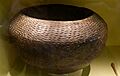
Pottery
-
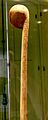
Mencey baton
-
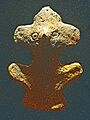
Guatimac idol
-
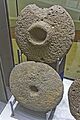
Stone artefacts


Guanche Genetics

Scientists have studied the DNA of ancient Guanches. These studies help us understand where they came from and how they are related to people today.
Research on Guanche DNA shows they had strong genetic links to people from North Africa, especially ancient Berbers. This suggests that the Guanches migrated from mainland North Africa. Their DNA also shows some connections to European populations, which might have come from early migrations across the Mediterranean Sea.

Modern Canary Islanders have a mix of Guanche, European, and some Sub-Saharan African ancestry. Studies show that Guanche women contributed more to the genetic makeup of today's islanders than Guanche men. This is likely due to the impact of the Spanish conquest.

Some studies suggest that the Guanches arrived in at least two different waves of migration. The people of La Gomera, for example, seem to be descended from the earliest settlers. Genetic diversity is highest on islands like Gran Canaria, Tenerife, and La Palma, while islands like La Gomera and El Hierro have less diversity.

Overall, Guanche DNA is most similar to ancient North Africans. However, it also shows some unique features that place them closer to Europeans in some ways. This suggests a complex history of migrations and mixing. Modern Canary Islanders get about 16–31% of their DNA from the Guanches. Physical traits like skin color, hair color, and eye color in ancient Guanche samples varied, showing light to medium skin, dark hair, and brown eyes.
_of_haplogroup_H1_in_western_Eurasia_and_North_Africa..png)
Guanche Ancestry Today
Studies of modern Canary Islanders' DNA show a mix of ancestries. On average, the population is about 80% European, 17% North African (Guanche), and 3% Sub-Saharan African. These percentages can vary slightly from island to island.
| North African Ancestry | Sub-Saharan African Ancestry | |||||
|---|---|---|---|---|---|---|
| Minimum | Average | Maximum | Minimum | Average | Maximum | |
| Fuerteventura | 0.218 | 0.255 | 0.296 | 0.011 | 0.027 | 0.046 |
| Lanzarote | 0.214 | 0.254 | 0.296 | 0.014 | 0.032 | 0.057 |
| Gran Canaria | 0.155 | 0.200 | 0.264 | 0.005 | 0.032 | 0.082 |
| Tenerife | 0.149 | 0.208 | 0.255 | 0.002 | 0.015 | 0.057 |
| La Gomera | 0.160 | 0.221 | 0.289 | 0.013 | 0.048 | 0.092 |
| La Palma | 0.170 | 0.200 | 0.245 | 0.000 | 0.013 | 0.032 |
| El Hierro | 0.192 | 0.246 | 0.299 | 0.005 | 0.020 | 0.032 |
Important Guanche Sites
Archaeological Discoveries
The Canary Islands have many important archaeological sites where we learn about the Guanches:
- Lanzarote: Zonzamas
- Fuerteventura: Montaña de Tindaya
- Gran Canaria: Painted Cave of Gáldar
- Tenerife: Masca's solar station
- La Gomera: Fortress of Chipude
- La Palma: Cave of Belmaco
- El Hierro: Archaeological zone of El Julan
Museums to Visit

Many museums on the islands have collections of Guanche artifacts and human remains. These help us understand the ancient history of the Canary Islands. Some of the most important museums are:
- Museo de la Naturaleza y el Hombre (Santa Cruz de Tenerife).
- Museo Canario (Las Palmas de Gran Canaria).
- Museum of History and Anthropology of Tenerife (Casa Lercaro, San Cristóbal de La Laguna, Tenerife).
- Archaeological Museum of Puerto de la Cruz (Puerto de la Cruz, Tenerife).
Modern Guanche Culture
In 2001, a group called the Church of the Guanche People (Iglesia del Pueblo Guanche) was founded in San Cristóbal de La Laguna (Tenerife). This is a modern movement that follows some ancient Guanche beliefs.
Famous Guanche People
- Beneharo, mencey (king) of Taoro on the island of Tenerife
- Bencomo, a powerful mencey of Taoro
- Tinguaro, a brave sigoñe (warrior) of Tenerife and half-brother of Bencomo
- Dácil, a princess and daughter of Bencomo. She is known as the Pocahontas of the Canary Islands. She met the King of Spain with her father and later married a Spanish settler.
- Tanausu, ruler of Aceró on the island of Benahoare
- Fernando Guanarteme (born Tenesor Semidan), a king who helped the Spanish conquest
- Maninidra, brother of Guanarteme
- Acaimo, mencey of Tacoronte on Tenerife
- Abenchara, queen of Gran Canaria
- Francisca de Gazmira, a woman who helped mediate between the native peoples and the Spanish, and defended native rights
See also
- Guanche language
- Hamitic
- Silbo Gomero – a Guanche whistling language, still extant
- Isleños
- First Battle of Acentejo
- Battle of Aguere
- Second Battle of Acentejo
- Teide
- Achinet
- Animero
- Beñesmen
