
History of Tbilisi facts for kids
The city of Tbilisi, the capital of Georgia, has a long and exciting history that goes back to at least the 5th century AD. From the time it was founded by the king of an ancient Georgian kingdom called Iberia, Tbilisi has been a super important place for culture, politics, and business in the Caucasus region. It has been the capital city for many different Georgian kingdoms and republics over the years. When Russia ruled from 1801 to 1917, Tbilisi was called Tiflis and was the main city for the Russian governor who ruled the entire Caucasus area.
Tbilisi is located near busy trade routes that connect the East and West. This made the city a valuable prize for different empires who often fought over it. Even today, its location means it's a key spot for trade and travel. Tbilisi's interesting history can be seen in its buildings, which are a mix of old medieval styles, classic designs, and Soviet-era structures.
Contents
- How Did Tbilisi Begin?
- Tbilisi Becomes the Capital
- The Emirate of Tbilisi
- Georgia Takes Back Tbilisi and a Golden Age Begins
- Mongol Rule and Difficult Times
- Tbilisi Under Iranian Influence
- Tbilisi Under Russian Rule
- Independence: 1918–1921
- Tbilisi During the Soviet Period
- After the Soviet Union Broke Apart
- Who Lives in Tbilisi?
- See also
- Images for kids
How Did Tbilisi Begin?

Stories say that the area where Tbilisi stands today was a thick forest until about 458 AD. This is when old Georgian history books say King Vakhtang I Gorgasali of Iberia (also known as Kartli, which is eastern Georgia today) founded the city.
However, scientists who study old sites have found that people lived in the Tbilisi area much earlier, around 4000 BC. The first written records about a settlement here are from the late 4th century AD. At that time, a fortress was built during the rule of King Varaz-Bakur (around 364 AD). By the end of the 4th century, the Persians took over the fortress, but the kings of Kartli got it back by the mid-5th century.
One famous story tells how King Vakhtang Gorgasali (who ruled from 447-502 AD) was hunting in the dense forest with his falcon. The falcon caught a pheasant, but both birds fell into a nearby hot spring and died. King Vakhtang was so amazed by the hot springs that he decided to build a city right there. The name Tbilisi comes from an old Georgian word "Tpili," which means "warm." So, Tbili or Tbilisi means "warm location" because of the many sulfuric hot springs in the area. These springs are still used today, especially for public baths, in the Abanotubani district. While this story is popular, archaeological findings suggest that King Vakhtang likely rebuilt or improved parts of the city, like Abanotubani or the Metekhi palace, rather than founding it from scratch.
Tbilisi Becomes the Capital

King Dachi, the son of Vakhtang Gorgasali, is believed to have moved the capital of Iberia from Mtskheta to Tbilisi in the early 6th century. He did this to follow his father's wishes. During his rule, Dachi also finished building the fortress wall that protected the city's new borders. From the 6th century onwards, Tbilisi grew steadily. Its great location along important trade routes between Europe and Asia helped it become a thriving city.
However, this important location also meant that many powerful empires wanted to control Tbilisi. For centuries, different groups fought over it. In the 6th century, Persia and the Byzantine Empire were the main powers fighting for control of the Caucasus. In the second half of the 6th century, Tbilisi was mostly under Persian control, and the kingdom of Iberia was ended around 580 AD. In 627, Tbilisi was attacked and taken by armies from the Byzantine Empire and the Khazars, who were allies.
The Emirate of Tbilisi

Around 737 AD, Arab armies led by Marwan II Ibn-Muhammad entered Tbilisi. The Arab conquerors created the Emirate of Tbilisi, a state ruled by an emir. Arab rule brought a sense of order to the region and introduced a more formal legal system to Georgia. Tbilisi became rich from trading with the entire Middle East. Arab rule greatly influenced the city's culture. While few Georgians became Muslim during this time, Tbilisi became a mostly Muslim city.
In 764, the Khazars attacked Tbilisi again, even though it was still under Arab control. The emirate grew into a powerful local state and often tried to become independent from the larger Arab empire. In 853, the armies of Arab leader Bugha al-Kabir (known as "Bugha the Turk" in Georgian writings) invaded Tbilisi to bring the emirate back under the control of the Abbasid Caliphate. Arab rule in Tbilisi lasted until the late 11th century. The new Kingdom of Georgia tried many times to capture the city but didn't succeed for a long time. However, the emirate became smaller, the emirs had less power, and a "council of elders" (a group of local merchants) often ran the city. In 1068, the city was attacked again, this time by the Seljuk Turks led by Sultan Alp Arslan.
Georgia Takes Back Tbilisi and a Golden Age Begins
In 1122, after fierce battles with the Seljuks, the troops of King David the Builder of Georgia stormed Tbilisi. The battles for Tbilisi ended with David's victory. He then moved his royal home from Kutaisi (in Western Georgia) to Tbilisi, making it the capital of a united Georgian state. This marked the start of the Georgian Golden Age. From the 12th to the 13th centuries, Tbilisi became a very powerful city in the region. It had a strong economy with lots of trade and skilled workers, and a well-organized society. By the end of the 12th century, Tbilisi's population reached 100,000 people. The city also became an important center for literature and culture, not just for Georgia but for the entire Eastern Orthodox world at that time. During Queen Tamar's rule, the famous writer Shota Rustaveli worked in Tbilisi while writing his legendary epic poem, The Knight in the Panther's Skin. This time is often called the Georgian Golden Age or the Georgian Renaissance.
Mongol Rule and Difficult Times


Tbilisi's Golden Age lasted for about a century. In 1236, after losing big battles to the Mongols, Georgia came under Mongol control. Georgia still kept some independence and didn't completely lose its statehood, but Tbilisi was greatly influenced by the Mongols for the next hundred years, both in politics and culture. In the 1320s, the Mongols were forced out of Georgia, and Tbilisi became the capital of an independent Georgian state once again. Sadly, a terrible disease called the plague hit the city in 1366.
From the late 14th century until the end of the 18th century, Tbilisi was repeatedly attacked by different foreign invaders. Several times, the city was completely burned to the ground. In 1386, Tbilisi was invaded by the armies of Tamerlane (Timur). In 1444, Jahan Shah (the Shah of Tabriz in Persia) invaded and destroyed the city. From 1477 to 1478, the city was controlled by the Ak Koyunlu tribesmen led by Uzun Hassan.
Tbilisi Under Iranian Influence
By the early 1510s, Tbilisi, Kartli, and Kakheti became territories that had to pay tribute to Safavid Iran. In 1522, a large Safavid army was stationed in Tbilisi for the first time. After the death of the Iranian king (shah) Ismail I (who ruled from 1501-1524), King David X of Kartli drove the Iranians out. During this time, many parts of Tbilisi were rebuilt. However, four military campaigns by King Tahmasp I (who ruled from 1524-1576) led to Kartli and Kakheti being taken over again. From 1551 onwards, a Safavid army was permanently based in Tbilisi. With the 1555 Treaty of Amasya, and more strongly from 1614 to 1747 (with short breaks), Tbilisi was an important city under Iranian rule. It served as the home for the Iranian-appointed Georgian kings of Kartli, who were given the title of vali. A wall was built around the city in 1675 by Shah Suleiman I. Under the later rules of Teimuraz II and Erekle II, Tbilisi became a lively political and cultural center, free from foreign control. But in 1795, the city was captured and destroyed by the Iranian Qajar ruler Agha Mohammad Khan, who wanted to bring the region back under Iran's traditional power.
At this point, King Erekle believed his Georgian territories of Kartli-Kakheti couldn't stand against Iran alone. So, he asked Russia for help. This led to Georgia losing its independence more completely than in past centuries, but it also started the gradual change of Tbilisi into a European-style city.
Tbilisi Under Russian Rule


In 1801, the Georgian kingdom of Kartli-Kakheti, with Tbilisi as its capital, was taken over by the Russian Empire. This meant Iran officially lost control over the city and the wider Georgian lands it had ruled for centuries. Under Russian rule, the city became the center of the Tbilisi Governorate. From the early 19th century, Tbilisi began to grow in terms of its economy and political importance. New buildings, mostly in European styles, were built throughout the city. New roads and railroads were constructed to connect Tbilisi to other important cities in Russia and other parts of Transcaucasia, like Batumi, Poti, Baku, and Yerevan. By the 1850s, Tbilisi was once again a major center for trade and culture. Many famous people like Ilia Chavchavadze, Akaki Tsereteli, Mirza Fatali Akhundzade, Iakob Gogebashvili, and Alexander Griboedov lived in Tbilisi. The city was also visited many times by famous writers like Alexander Pushkin, Leo Tolstoy, Mikhail Lermontov, and members of the Romanov royal family. The main new street built by the Russians was Golovin Avenue (now called Rustaveli Avenue), where the Russian governors of the Caucasus had their residence.
Throughout the 19th century, Tbilisi's role in politics, economy, and culture was very important, not just for Georgia but for the entire Caucasus region. It was a city with many different ethnic groups, religions, and cultures. Tbilisi changed its appearance, gaining new architectural landmarks and becoming an international city with its own unique city stories and language, known as the specific Tbilisuri (meaning "belonging to Tbilisi") culture.
Independence: 1918–1921

After the Russian Revolution in 1917, Tbilisi became the home of the temporary government for the Transcaucasus region. In the spring of 1918, this government created the short-lived independent Transcaucasian Federation, with Tbilisi as its capital. It was here, in the former Caucasus Vice royal Palace, that the independence of three Transcaucasian nations – Georgia, Armenia, and Azerbaijan – was declared between May 26 and 28, 1918. From then on, Tbilisi served as the capital of the Democratic Republic of Georgia until February 25, 1921. From 1918 to 1919, the city also hosted the military headquarters for German and British forces.
Under the national government, Tbilisi became the first university city in the Caucasus after the Tbilisi State University was founded in 1918. This had been a long-held dream for Georgians, but it was forbidden by the Imperial Russian authorities for many decades. On February 25, 1921, the Bolshevist Russian 11th Red Army entered Tbilisi after tough fighting on the city's outskirts and declared Soviet rule.
Tbilisi During the Soviet Period

In 1921, the Red Army invaded the Democratic Republic of Georgia from Russia, and a Bolshevik government was put in place in Tbilisi. Between 1922 and 1936, Tbilisi was the main city for the Transcaucasian SFSR, which brought together the three Caucasus republics. After this group was dissolved, Tbilisi remained the capital city of the Georgian Soviet Socialist Republic until 1991. In 1936, the official Russian name of the city was changed from Tiflis to Tbilisi, which led to the city's name gradually changing in most other languages too.
During Soviet rule, Tbilisi's population grew a lot. The city became more industrial and turned into one of the most important political, social, and cultural centers of the Soviet Union, alongside cities like Moscow, Kiev, and Leningrad. Large buildings, like the current Parliament of Georgia, were built on the main streets. However, most of the older neighborhoods kept their unique character. Many religious buildings were destroyed during campaigns against religion, such as the Vank Cathedral. As the city expanded, new places for culture and fun were built, similar to other big Soviet cities. Vake Park opened in 1946, and the Sports Palace in 1961. New, standardized housing areas were built from the 1960s, like Gldani and Varketili. To connect all these new areas with the old city center, a Metro system was developed, which opened in stages starting in 1966.
In the 1970s and 1980s, the old part of the city was significantly rebuilt. Shota Kavlashvili, the architect who planned the reconstruction, wanted the city center to look like it did in the 19th century. The rebuilding started near Baratashvili Avenue, where some homes were taken down to reveal parts of the 18th-century city wall.
Tbilisi saw large protests against Soviet rule in 1956 (protesting against Nikita Khrushchev's policies), 1978 (defending the Georgian language), and 1989 (the April 9 tragedy). Both the 1956 and 1989 protests were violently stopped by the authorities, leading to many deaths.
After the Soviet Union Broke Apart
.jpg)
Since the Soviet Union broke up, Tbilisi has gone through times of great instability and trouble. After a short civil war that lasted two weeks from December 1991 to January 1992 (when groups supporting Zviad Gamsakhurdia fought against opposition forces), Tbilisi became a place where different groups often had armed clashes. Even during the time of Edvard Shevardnadze (1993–2003), crime and corruption were widespread. Many people became poor because there weren't enough jobs due to the struggling economy. Citizens of Tbilisi became more and more unhappy with the quality of life in the city and the country. Large protests happened in November 2003 after parliamentary elections were rigged. More than 100,000 people took to the streets, leading to the Rose Revolution. Since 2003, Tbilisi has become much more stable. Crime rates have gone down, the economy is getting better, and the tourism industry is growing, perhaps even more than it did during Soviet times.
Who Lives in Tbilisi?
Tbilisi is a city with many different cultures and is home to over 100 ethnic groups. About 89% of the people are ethnic Georgians. There are also many Armenians, Russians, and Azeris. Besides these groups, Tbilisi is home to Ossetians, Abkhazians, Ukrainians, Greeks, Germans, Jews, Estonians, Kurds (both Yazidi and Muslim), Assyrians, and others.
More than 95% of Tbilisi's residents are Christians. The most common Christian faith is the Georgian Orthodox Church. The Russian Orthodox Church, which is connected to the Georgian one, and the Armenian Apostolic Church also have many followers in the city. A smaller group of people (about 4%) practice Islam, mostly Shia Islam. About 2% of Tbilisi's population practices Judaism. There is also a Roman Catholic church and a Yazidism temple (Sultan Ezid Temple).
Tbilisi has always been known for its religious tolerance. You can clearly see this in the city's Old Town, where a mosque, a synagogue, and Eastern and Oriental Orthodox churches are all located very close to each other, less than 500 meters (about 1,640 feet) apart.
See also
- Timeline of Tbilisi
- Hundred Thousand Martyrs of Tbilisi
Images for kids
-
-
-
-
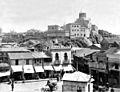
Tatar bazaar and Metekhi palace
-
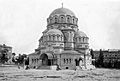
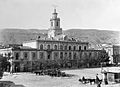
Military Cathedral (site of the Parliament building)


.jpg)
