
Los Angeles Rams facts for kids
Quick facts for kids Los Angeles Rams |
|||||||||||||
|---|---|---|---|---|---|---|---|---|---|---|---|---|---|
 Current season Current season |
|||||||||||||
|
|||||||||||||
| General information | |||||||||||||
| Founded | February 12, 1937 | ||||||||||||
| Stadium | SoFi Stadium Inglewood, California |
||||||||||||
| Headquartered | Rams Village at Warner Center Los Angeles, California |
||||||||||||
| Colors | Rams royal, sol, white, midnight |
||||||||||||
| Mascot | Rampage | ||||||||||||
| Personnel | |||||||||||||
| Owner | Stan Kroenke | ||||||||||||
| General manager | Les Snead | ||||||||||||
| Head coach | Sean McVay | ||||||||||||
| President | Kevin Demoff | ||||||||||||
| Nicknames | |||||||||||||
|
|||||||||||||
| Team history | |||||||||||||
|
|||||||||||||
| Home fields | |||||||||||||
|
|||||||||||||
| League / conference affiliations | |||||||||||||
| American Football League (1936) National Football League (1937–present)
|
|||||||||||||
| Championships | |||||||||||||
League championships: 4
|
|||||||||||||
Conference championships: 8
|
|||||||||||||
Division championships: 19
|
|||||||||||||
| Playoff appearances (34) | |||||||||||||
|
|||||||||||||
| Owners | |||||||||||||
|
|||||||||||||


.png)
Script error: No such module "Check for conflicting parameters".
The Los Angeles Rams are a professional American football team. They play in the Greater Los Angeles region of California. The team competes in the National Football League (NFL). They are part of the National Football Conference (NFC) West division. Their home games take place at SoFi Stadium in Inglewood, California. They share this modern building with the Los Angeles Chargers. The Rams' headquarters is at the Rams Village at Warner Center in Los Angeles.
The club was founded back in 1936 as the Cleveland Rams in Cleveland, Ohio. They won the 1945 NFL Championship Game in that city. After that victory, the team moved out west to Los Angeles in 1946. That choice made room for the Cleveland Browns of the All-America Football Conference. The Rams became the first NFL champion to play the next year in another city. They played at the Los Angeles Memorial Coliseum until 1980. Then they moved to Anaheim Stadium in Orange County, California. The Rams reached Super Bowl XIV during the 1979 NFL season. They lost that big contest to the Pittsburgh Steelers.
After the 1994 NFL season, the Rams relocated to St. Louis, Missouri. In the Midwest, they were called the St. Louis Rams. The squad won Super Bowl XXXIV against the Tennessee Titans. Fans loved this high-scoring group, known as "The Greatest Show on Turf". They played in Super Bowl XXXVI too, falling to the New England Patriots. After the 2015 NFL season, the club returned home to Southern California. They reached Super Bowl LIII, losing another battle to the Patriots. The Rams won Super Bowl LVI by beating the Cincinnati Bengals at home. They are the only NFL club to win titles representing three different home cities.
Contents
- History of the Los Angeles Rams Football Team
- Culture and Fanbase
- Team Rivalries
- Uniforms and Team Colors
- Pro Football Hall of Fame Members
- Broadcasting
- Images for kids
- See also
History of the Los Angeles Rams Football Team
Cleveland Rams (1936–1945)
Attorney Homer Marshman and player-coach Damon Wetzel founded the team on April 11, 1936. Wetzel previously played for the Chicago Bears and Pittsburgh Pirates. Wetzel picked the team name because he loved the Fordham Rams of Fordham University. Marshman was the main owner and agreed with this choice. The team joined the American Football League first. They took second place in the 1936 season behind the Boston Shamrocks. Early stars included William "Bud" Cooper, Harry "The Horse" Mattos, Stan Pincura, and Mike Sebastian.
The team entered the NFL on February 12, 1937. They were placed in the league's Western Division. The squad was the fourth NFL team in Cleveland history. Previous teams were the Cleveland Tigers, Cleveland Bulldogs, and Cleveland Indians. The Rams played home games at Cleveland Stadium, League Park, and Shaw Stadium. In 1939, rookie halfback Parker Hall earned league Most Valuable Player honors.
Businessman Dan Reeves and partner Fred Levy Jr. bought the club in June 1941. Reeves had family connections to the Safeway grocery store chain. Levy also helped run the Riverside International Raceway. Entertainer Bob Hope was a partial owner as well. Due to World War II player shortages, the club paused operations during the 1943 NFL season. They returned to the field for the 1944 campaign.
NFL Champions of 1945
Success arrived for the squad during the 1945 NFL season. Adam Walsh served as head coach. Rookie quarterback Bob Waterfield from UCLA threw and ran amazingly well. Waterfield captured the league MVP trophy. The Rams finished with a 9–1 regular record. They faced the Washington Redskins in the 1945 NFL Championship Game. On a freezing December 16, the Rams edged Washington 15–14. A strange safety occurred when Sammy Baugh hit his own goalpost with a pass. The ball bounced into the end zone, giving the Rams two winning points.
Original Era in Los Angeles (1946–1994)
NFL team owners first denied Reeves permission to move his club to California. Reeves declared he would leave professional football completely if denied. The owners changed their minds and approved the move to the Los Angeles Memorial Coliseum. The decision helped the NFL become a true national sports league.
Before this move, there were no black players in professional American football after Joe Lillard left the Chicago Cardinals in 1933. The Coliseum commission required the Rams to sign an African-American athlete to secure the lease. The Rams signed former UCLA star Kenny Washington on March 21, 1946. They soon added another talented player named Woody Strode. These signings broke pro football's racial barrier.
The Rams were not alone in the giant Coliseum back then. A team called the Los Angeles Dons played in the All-America Football Conference. A giant exhibition crowd of 95,000 watched the Rams face the Redskins. The Rams finished second behind the Chicago Bears with a 6–4–1 record. In 1948, halfback Fred Gehrke painted sheep horns onto the leather helmets. That artwork became the first helmet emblem in pro football history.
NFL Champions of 1951

The Rams enjoyed immense success in Southern California between 1949 and 1955. They played in four NFL title games during that stretch. Bob Waterfield shared quarterback duties with passer Norm Van Brocklin. Receiver Elroy Hirsch was nicknamed "Crazy Legs" for his running style. Hall of Fame receiver Tom Fears also caught many passes. During their 1951 championship run, Hirsch caught 17 touchdowns and gained 1,495 yards. Their high-scoring games made the 1950 team the first to broadcast all games on television.

Los Angeles quickly welcomed more major pro sports teams. The Los Angeles Dodgers baseball club moved from Brooklyn in 1958. The basketball Los Angeles Lakers arrived from Minneapolis in 1960. The Los Angeles Angels began baseball play in 1961. The football Los Angeles Chargers started in the new AFL in 1960. The Chargers left for San Diego because the Rams were so popular. Rams games drew over 80,000 fans regularly.
During the 1960s, the defensive line was known as the "Fearsome Foursome". This unit included stars Rosey Grier, Merlin Olsen, Deacon Jones, and Lamar Lundy. Head coach George Allen arrived in 1966 to lead the team. He brought in young coach Dick Vermeil to help manage special teams. In the 1967 NFL season, the team drew over one million fans.
.jpg)
Quarterback Roman Gabriel led the offense from 1962 through 1972. Gabriel won the NFL MVP award in 1969. Receiver Jack Snow was his primary target on deep throws. In 1972, businessman Robert Irsay purchased the club. He quickly traded ownership with Carroll Rosenbloom, who previously owned the Baltimore Colts. Under Rosenbloom, the Rams won seven straight NFC West crowns from 1973 to 1979.
Chuck Knox and Ray Malavasi Eras (1973–1982)

Head coach Chuck Knox took control of the squad in 1973. Knox built winning teams through running plays and punishing defense. End Jack Youngblood became the star of this tough defense. Youngblood famously played with a fractured leg during the 1979 postseason. Teammates like Fred Dryer and Merlin Olsen later became famous Hollywood actors. Quarterback Joe Namath joined the team briefly in 1977. Young passer Pat Haden then took over the starting spot.
Coach Ray Malavasi took over the team for the 1978 NFL season. The club went 12–4 and beat the Minnesota Vikings. The next year, the 1979 team struggled with a 9–7 record. However, young quarterback Vince Ferragamo stepped in to guide the offense. Running back Wendell Tyler and blocker Jackie Slater helped the attack. Tough linebackers like Jack "Hacksaw" Reynolds stopped opponents on defense.
The Rams upset the Dallas Cowboys 21–19 in the playoffs. They next shut out the Tampa Bay Buccaneers 9–0. That win earned them a trip to Super Bowl XIV at the Rose Bowl. The Rams led the powerful Pittsburgh Steelers late in the game. But Pittsburgh rallied in the fourth quarter to win 31–19.
.jpg)
After Carroll Rosenbloom passed away, his widow Georgia Frontiere took control. Frontiere moved the team to Anaheim Stadium in 1980. The stadium held about 69,000 fans. This smaller size helped avoid local television blackouts. The football landscape changed when the Oakland Raiders moved to Los Angeles in 1982. The Raiders won Super Bowl XVIII, pulling away many fans.
John Robinson and Eric Dickerson (1983–1991)
.jpg)
.jpg)
Head coach John Robinson took over the team in 1983. Robinson drafted dynamic rookie running back Eric Dickerson. Dickerson set an NFL rushing record in 1984 with 2,105 yards. The squad made the playoffs regularly under Robinson's leadership. Dickerson was traded to the Indianapolis Colts in 1987. Coordinator Ernie Zampese created an exciting, pass-heavy offense. Quarterback Jim Everett connected often with wideouts Henry Ellard and Flipper Anderson.
The Rams reached the NFC Championship Game against the San Francisco 49ers. The powerful 49ers won that game easily. That game marked the end of the Rams' winning era in Anaheim.
Chuck Knox's Second Run and Move to Missouri (1992–1994)
.jpg)

Chuck Knox returned to coach the team in 1992. The Rams struggled and finished in last place three straight years. Running back Jerome Bettis was a rare bright spot. Bettis earned the nickname "The Battering Ram" for his bruising runs.
Stadium attendance dropped sharply as the team lost games. Georgia Frontiere decided to move the franchise to St. Louis. NFL commissioner Paul Tagliabue and league owners first rejected the move. Frontiere threatened legal action against the league. Owners changed their minds, and the team relocated in 1995.
St. Louis Rams (1995–2015)
The Rams began play in Missouri under head coach Rich Brooks. Young wide receiver Isaac Bruce quickly became an elite player. In 1997, the club hired former coach Dick Vermeil. The team used the 1997 NFL draft to pick offensive lineman Orlando Pace.
The Greatest Show on Turf and Super Bowl XXXIV

Before the 1999 season, starting quarterback Trent Green suffered an injury. Backup quarterback Kurt Warner stepped up to lead the team. Warner previously played for the Iowa Barnstormers and Amsterdam Admirals. Warner joined forces with running back Marshall Faulk and receiver Torry Holt. The team scored 526 points that season. Fans called the exciting offense "The Greatest Show on Turf".
The Rams reached Super Bowl XXXIV to play the Tennessee Titans. The Rams won 23–16 in a thrilling finish. Warner won the Super Bowl MVP trophy. Vermeil retired shortly after the title win. Offensive coordinator Mike Martz became the next head coach. The team returned to Super Bowl XXXVI, losing to the New England Patriots. Running back Steven Jackson joined the club in 2004.

Rebuilding Struggles in St. Louis
Coach Scott Linehan guided the team in 2006 before being replaced. Former Giants coordinator Steve Spagnuolo took over in 2009. The team struggled, winning only one game that year. Minority owner Stan Kroenke bought full control of the franchise in 2010. The Rams drafted quarterback Sam Bradford from the University of Oklahoma. Bradford earned the NFL Offensive Rookie of the Year award.
The Rams played games at the Edward Jones Dome. In 2012, they also played an international game at Wembley Stadium in London. The club traded Bradford to the Philadelphia Eagles for Nick Foles in 2015. They also drafted star runner Todd Gurley. In late 2015, the Rams played their last home game in St. Louis. Kroenke received permission to move the team back to Los Angeles.
Return to California and Championship Glory (2016–present)

The Rams officially returned to California for the 2016 NFL season. They drafted quarterback Jared Goff with the first pick in 2016. The team played home games at the historic Coliseum temporarily. Coach Jeff Fisher was let go late in the season, and John Fassel finished out the year.
Sean McVay Era and Super Bowl Appearances
.jpg)

In 2017, thirty-year-old Sean McVay became the youngest head coach in NFL history. McVay brought a high-powered offense to the city. Wideouts Robert Woods, Sammy Watkins, and rookie Cooper Kupp caught many passes. The Rams improved to 11–5 and won their division.
In 2018, the Rams added defenders Aqib Talib, Marcus Peters, and Ndamukong Suh. Blocker Rob Havenstein protected Goff on offense. Star defender Aaron Donald dominated opposing blockers. The team won an exciting 54–51 battle against the Kansas City Chiefs. In the playoffs, the Rams defeated Dallas and New Orleans to reach Super Bowl LIII. They lost a defensive battle to the New England Patriots, 13–3.

.jpg)
In 2020, the team moved into the state-of-the-art SoFi Stadium. The stadium sits on the grounds of the old Hollywood Park Racetrack. Cornerback Jalen Ramsey helped anchor a top-ranked defense. Young safety Jordan Fuller grabbed key interceptions. Backup passer John Wolford helped the team reach the playoffs when Goff was injured.
Super Bowl LVI Champions


In early 2021, the Rams traded Goff to the Detroit Lions for veteran quarterback Matthew Stafford. Wide receiver Van Jefferson stepped up alongside Kupp. Midseason trades brought superstar linebacker Von Miller and wideout Odell Beckham Jr. to the squad. Runner Sony Michel helped carry the running game. Kicker Matt Gay made clutch field goals.
The Rams defeated the Cardinals, Buccaneers, and 49ers in the postseason. That earned them a spot in Super Bowl LVI at their home stadium. Stafford threw the game-winning touchdown pass to Cooper Kupp. Aaron Donald sacked quarterback Joe Burrow to seal a 23–20 victory over Cincinnati. Kupp was named the game's Most Valuable Player. Veteran tackle Andrew Whitworth retired as a champion. Linebacker Bobby Wagner joined the defense the following season.

Recent Seasons and the Donald Era
Aaron Donald retired from playing football in early 2024. Donald made the Pro Bowl in every season of his ten-year career. The team rebuilt its defense by drafting Jared Verse and Braden Fiske. The Rams also signed safety Kamren Curl. Wide receiver Puka Nacua emerged as a premier playmaker alongside Cooper Kupp. The Rams won the NFC West title in 2024 before falling to the Philadelphia Eagles.
In 2025, Stafford led the entire league in passing yards and passing touchdowns. Stafford earned the league MVP award. Nacua set team records catching passes. The Rams reached the NFC Championship Game before losing a close contest to the Seattle Seahawks. In 2026, the team made big trades for defender Myles Garrett and cornerback Trent McDuffie. Aaron Donald also returned to the football field to rejoin the defense.
Culture and Fanbase
Mascots and Fan Groups

The team's official costumed mascot is an anthropomorphic sheep named Rampage. Rampage debuted in 2010 and entertains fans at home games.
During the 1980s, dedicated fans called themselves the Melonheads. They wore carved hollow watermelons with horns attached to their heads. In recent years, fan groups adopted the name "Mob Squad". The name comes from sheep traveling together in groups called mobs.

Famous Fans
Many entertainment stars cheer for the Rams. Actor Terry Crews was drafted by the squad in 1991. Musician Tom Morello named his son after quarterback Roman Gabriel. Rap star YG attends games frequently at SoFi Stadium. Actress Brenda Song helps create promotional videos for the club.
Guitarist Nita Strauss plays rock music on her guitar during games. The team gave Strauss an honorary championship ring after Super Bowl LVI.

Hip-hop artist Nelly cheered for the team during their years in St. Louis. He featured players like Torry Holt and Marshall Faulk in his music videos. Rock musicians Flea and Chad Smith from the Red Hot Chili Peppers attend games regularly.
Team Rivalries
NFC West Division Opponents
The rivalry with the San Francisco 49ers is one of the oldest in football history. Both California squads have shared a division since 1970. Head coaches Sean McVay and Kyle Shanahan have added new excitement to the rivalry. The Rams beat San Francisco in the 2021 NFC title game.
The rivalry with the Seattle Seahawks grew intense after Seattle joined the division in 2002. Both teams have traded division crowns over the years. The team also plays the Arizona Cardinals twice every single regular season.
Conference and Interconference Rivals
The Rams fought many playoff games against the Dallas Cowboys in the 1970s. They also have an intense history with the New Orleans Saints. That rivalry peaked during the controversial 2018 NFC Championship Game. The Rams share a local rivalry with the Los Angeles Chargers in Southern California. In Missouri, the team played the Kansas City Chiefs for the Governor's Cup trophy.
Uniforms and Team Colors

The Rams made history in 1948 by painting horns on their helmets. The classic colors were royal blue and sunny yellow-gold. The club switched to navy and metallic gold during their time in Missouri.


When the Rams opened SoFi Stadium in 2020, they updated their branding. The colors were named "Rams Royal" blue and "Sol" yellow. The team also added white road jerseys and special dark "Midnight Blue" alternate uniforms.
Pro Football Hall of Fame Members


Many Rams players and coaches have been inducted into the Pro Football Hall of Fame in Canton, Ohio:
- Bob Waterfield (Quarterback)
- Norm Van Brocklin (Quarterback)
- Elroy "Crazy Legs" Hirsch (Receiver)
- Tom Fears (Receiver)
- Deacon Jones (Defensive End)
- Merlin Olsen (Defensive Tackle)
- Jack Youngblood (Defensive End)
- Eric Dickerson (Running Back)
- Tom Mack (Offensive Guard)
- Jackie Slater (Offensive Tackle)
- Kurt Warner (Quarterback)
- Marshall Faulk (Running Back)
- Orlando Pace (Offensive Tackle)
- Isaac Bruce (Wide Receiver)
- Dick Vermeil (Head Coach)
- George Allen (Head Coach)
- Dan Reeves (Owner)
Broadcasting
The Rams made television history by broadcasting home games in 1950. Famous announcers over the years include Dick Enberg and Steve Savard. Games in Los Angeles air locally on stations like KTTV and KABC-TV. Radio broadcasts are heard on KSPN 710 AM and KWKW in Spanish.
Images for kids
-
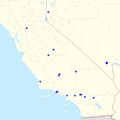
Radio affiliates map

See also
 In Spanish: Los Angeles Rams para niños
