
Spotted lanternfly facts for kids
Quick facts for kids Spotted lanternfly |
|
|---|---|
.jpg) |
|
| At Brooklyn Botanic Garden, New York | |
.jpg) |
|
| Nymph | |
Scientific classification  |
|
| Kingdom: | Animalia |
| Phylum: | Arthropoda |
| Class: | Insecta |
| Order: | Hemiptera |
| Infraorder: | Fulgoromorpha |
| Family: | Fulgoridae |
| Genus: | Lycorma |
| Species: |
L. delicatula
|
| Binomial name | |
| Lycorma delicatula (White, 1845)
|
|
| Subspecies | |
|
|
| Script error: The function "autoWithCaption" does not exist. | |
| Synonyms | |
|
|
Script error: No such module "Check for conflicting parameters".
The spotted lanternfly (Lycorma delicatula) is a colorful insect. It is a type of planthopper. This insect is native to parts of China and Vietnam. People often call it by the acronym SLF. It has spread outside its homeland as an invasive species. The insect now lives in South Korea, Japan, and the United States. It also lives in parts of Canada near Windsor, Ontario.
This bug loves to live on the tree of heaven (Ailanthus altissima). This tree is also an invasive plant from Asia. The bug attacks many farm crops as well. It feeds on grapes, soybeans, and stone fruits like peaches. It also feeds on apple trees from the genus Malus. In Asia, tiny parasitic wasps eat lanternflies. These natural enemies keep their numbers low in the wild.
In places where it is new, this insect causes serious trouble. It drinks the sap of trees and garden vines. It creates a sticky mess called honeydew. This waste coats leaves and attracts dark mold. It hurts how plants make food. The spotted lanternfly does not bite or sting humans. Still, it damages big orchards, forests, and farms. Scientists and citizens work together to stop its spread.
Contents
What Is a Spotted Lanternfly?

The spotted lanternfly is not really a fly. It is a true bug that belongs to the family Fulgoridae. These bugs are called planthoppers because they jump really well. They belong to the subfamily Aphaeninae. The bug was first named by a scientist named Adam White in 1845. He wrote down the first species description. White called it Aphaena delicatula.
The first scientific specimens were collected near Nanking in China. Later, in 1863, another scientist named Carl Stål placed it in the genus Lycorma. Its scientific name is now Lycorma delicatula. The Latin word delicatula means delicate or dainty. The insect has several close cousins in Asia. These include Lycorma imperialis, Lycorma meliae, and Lycorma punicea.
Scientists studied its full genome through DNA sequencing in 2019. This genetic study showed that it is related to bugs like Ahaena amabilis and Pyrops candelaria. Researchers learned that the bug began long ago in southwest China. It traveled slowly north along the famous Yangtze River. Today, scientists use genetics to see how it moves across the world.
How Does the Insect Look and Move?
.jpg)
Adult spotted lanternflies are about 25 millimeters long. They are around 12 millimeters wide. They have a black head and long gray-brown forewings. These front wings feature bold black spots. The tips of the front wings look like tiny bricks. This pattern is often called a brick-and-mortar look.
When the insect rests, its bright colors hide under the front wings. When it opens its wings, you see amazing bright red patches. The lower wings have black spots, a white stripe, and dark tips. The bug's abdomen is yellow with black and white stripes. It has short, bright orange antennae on its head.

Female lanternflies look a little different from male lanternflies. This difference between sexes is called Sexual dimorphism. Female bugs are slightly larger than males. A grown female has red structures called valvifers at the end of her body. When she is full of eggs, her belly swells up. She walks very slowly when she is heavy with eggs.
Planthoppers do not fly across long distances easily. Instead, they use their powerful back legs to hop. Their wings simply help them glide after they make huge leaps. If a lanternfly tumbles while jumping, it rights itself in midair. It can bounce off objects safely and land on its feet. This hopping skill helps the bug travel quickly through thick forests.
Life Cycle and How Lanternflies Grow

The spotted lanternfly goes through several stages during its life cycle. The eggs stay quiet through the freezing winter. The baby bugs hatch during late spring, usually in April or May. Young planthoppers that hatch from eggs are called nymphs. They look like tiny crawling bugs without wings.
Lanternflies grow through four distinct steps called instars. As the nymph grows too big for its skin, it goes through molting. It sheds its hard outer skin to reveal a larger body. The young bugs hop around constantly looking for tender plant shoots.
The Stages of Growth
- First Instar: The tiny nymph is completely black with white spots. It is only a few millimeters long.
- Second Instar: The nymph grows larger but keeps its black-and-white color pattern.
- Third Instar: The bug gets even larger and keeps feeding on small plants.
- Fourth Instar: Bright red pigmentation appears on its body. It has red patches, white dots, and small black wing pads.
- Adult: In July, the final nymphs turn into winged adults. Adults have full gray and red wings.
.jpg)
Young nymphs feed on many soft herbaceous plants. They crawl over garden weeds, wildflowers, and small bushes. As they grow into their fourth instar, they need larger woody plants. Grown adults prefer feeding on large tree trunks and woody vines. Adults do not eat soft garden herbs very often.
Mating and Egg Laying
Adults spend the summer eating sap and gaining energy. By late September, adults begin their mating season. The insects gather in huge groups on tree trunks. They perform small courtship behaviors before mating. Mating can last for several hours at a time. Adult bugs fly short distances to find mates and egg sites.
In the autumn, females lay eggs on firm vertical surfaces. They love smooth tree bark, flat rocks, and wooden posts. They also lay eggs on cars, boats, trailers, and outdoor furniture. Females lay groups of 30 to 50 eggs together. They cover the eggs with a waxy gray secretion called an egg case.
This gray mud-like covering protects the growing embryos inside. The covering keeps them warm and hides them from hungry birds. The eggs enter a winter resting phase known as diapause. The eggs can survive freezing conditions during the cold months. Adults cannot survive the cold and die off by late December.
What Plants Do Lanternflies Eat?

The spotted lanternfly feeds on more than 173 different plant species. It is a serious threat to farms, orchards, and vineyards. Its favorite plant is the tree of heaven (Ailanthus altissima). This tree grows quickly along roads and railroad tracks. When this tree is present, lanternfly swarms grow very fast.
Lanternflies feed on many important crops and forest trees. They attack valuable plants from multiple plant groups:
- Grapevines: They love the wild fox grape (Vitis labrusca) and farmed vineyard grapes.
- Nut Trees: They drink sap from the eastern black walnut (Juglans nigra).
- Fruit Trees: They feed on apple trees and stone fruits in the Rosaceae family.
- Forest Trees: They attack native maple, birch, and willow trees.
- Garden Plants: They harm ornamental vines like Virginia creeper (Parthenocissus quinquefolia).
The spotted lanternfly does not chew leaves or bite into fruits. It has straw-like mouthparts designed for piercing plant stems. It pushes these needles into the plant's internal phloem tubes. The insect sucks the sweet phloem sap directly out of the plant. A large swarm of bugs steals vital energy from the tree.
As lanternflies feed, they produce large puddles of sticky honeydew. This sugary liquid covers leaves below the tree canopy. A dark fungus called black sooty mold quickly grows over the sweet liquid. This mold blocks sunlight from reaching green leaves. It slows down the process of photosynthesis. Wounds in the bark also leak sap, attracting stinging wasps, bees, and ants.
Where Did the Spotted Lanternfly Come From?

The spotted lanternfly evolved millions of years ago in subtropical Asia. Ancient fossils show that its ancestors lived during the ancient Ypresian era. Over long periods, it adapted to live alongside Asian trees. In its native home, predatory bugs and diseases keep it under control.
In China, the bug lives across many provinces. It lives in Shanxi, Shandong, and Hebei. It is also found in Anhui, Beijing, Guangdong, Henan, and Jiangsu. People also find it in Sichuan, Yunnan, and Zhejiang. The insect was used in traditional Chinese medicine for hundreds of years. People believed the dried bug could help reduce painful swelling.
Spread Across Asia
In 2006, the spotted lanternfly was accidentally introduced to South Korea. Within a year, it became a major farm pest. It swarmed over vineyards, hurting grape production across the country. Scientists used computer models to predict where it would spread next. The bug found plenty of tree of heaven plants growing near Korean highways.
The insect also traveled to Japan. A group was found in Komatsu City in 2009. By 2013, populations spread across Fukui Prefecture. Genetic tests showed that these bugs arrived from major Chinese port cities. They likely hitched rides on cargo ships leaving Shanghai, Tianjin, or Qingdao.
Arrival in North America

In September 2014, scientists found the bug in Berks County, Pennsylvania. Berks County is located northwest of the city of Philadelphia. The bugs likely arrived two years earlier as egg masses hidden on imported stone shipments. The eggs survived the freezing cold winter of 2013.
State agencies immediately responded to protect native trees. The Pennsylvania Department of Agriculture set up strict quarantine rules. Officials banned the moving of firewood, lawnmowers, and outdoor equipment. Despite these rules, the insect spread across Pennsylvania counties. The bugs hitched rides on trucks, trains, and campers.
Researchers at Penn State calculated the damage. The bug threatened the state's forestry industry and fruit farms. The insect spread quickly into nearby states. Populations were discovered in New Jersey, New York, Delaware, and Maryland. By 2021, bugs were confirmed in Connecticut, Massachusetts, Ohio, Indiana, Virginia, and West Virginia.
The insect continued marching into new territories. It appeared in North Carolina, Michigan, and Rhode Island. In September 2023, state scientists found bugs in Illinois. Officials also found bugs in Davidson County, Tennessee, making it the sixteenth state affected. By late 2024, the insect spread into Northern Kentucky, especially near Covington.
Dead specimens have also turned up in western states like Kansas, Oregon, and California. Scientists watch these areas closely. Vineyards in California and the hop fields of the Pacific Northwest could suffer great damage. In Canada, inspectors found bugs near Windsor, Ontario in 2024. Officials work hard to keep it from spreading deeper into Canadian farm country.
Sightings in Europe
Scientists worry that the spotted lanternfly could spread into Europe. The European and Mediterranean Plant Protection Organization lists it as a dangerous pest. Many parts of southern and central Europe have warm summers and host trees. A traveler spotted an adult lanternfly using iNaturalist in Madrid, Spain. In August 2026, inspectors confirmed a wild population living on trees in Moldova.
How Do Scientists and Citizens Stop It?
People use several clever methods to fight this pest. These tools help reduce bug numbers without damaging nature. Stopping the spotted lanternfly protects grapes, apples, and hardwood forests.
Removing Eggs and Tree Traps

Every autumn, officials teach people how to hunt for egg masses. People scrape the gray egg cases off tree trunks with plastic cards. They drop the eggs directly into rubbing alcohol or hand sanitizer. This stops new nymphs from hatching out the next spring.
Property owners also remove tree of heaven plants from their land. They cut down female trees to stop the spread of seeds. They leave a few male trees to act as "trap trees." Scientists wrap these trap trees with brown sticky traps to catch climbing nymphs. Wildlife experts place chicken wire over sticky tape to protect birds, squirrels, and bats.
Lanternflies are attracted to certain plant scents called kairomones. Adults and nymphs are attracted to the smell of spearmint oil and methyl salicylate. Scientists put these plant oils inside special traps to catch more bugs. Trained sniffer dogs can even find hidden egg masses in shipping yards!
Biological Control and Natural Enemies
Scientists study natural enemies to control bug numbers. This technique is called biological pest control. Researchers study tiny Asian wasps that lay eggs inside lanternfly eggs and nymphs. These beneficial insects include Dryinus sinicus and Anastatus orientalis.
Another wasp, Ooencyrtus kuvanae, was brought to America in 1908 to battle gypsy moths. In 2017, scientists found that this wasp also attacks lanternfly eggs. Researchers test these wasps inside secure laboratories. They want to make sure the wasps will not hurt native North American bugs.
Natural fungi can also help defeat the pest. Four types of insect-killing fungi, called entomopathogens, naturally attack lanternflies:
- Beauveria bassiana: A soil fungus used to create natural biopesticides.
- Batkoa major: A woodland fungus that infects adult lanternflies.
- Metarhizium pemphigi: A fungal mold that naturally targets sap-sucking insects.
- Ophiocordyceps delicatula: A specialized fungus that attacks lanternflies.
A tree disease called Verticillium nonalfalfae also helps kill invasive tree of heaven plants. Scientists hope that combining these natural tools will keep the spotted lanternfly under control for years to come.
Images for kids
-
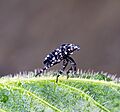
Spotted lanternfly early-instar nymph on a grape leaf
-
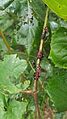
Late-instar nymphs on wild grapes in Pennsylvania
-
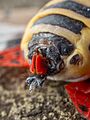
Red valvifers visible on the tip of a female bug
-
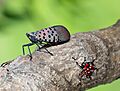
Two spotted lanternflies resting on a tree branch
-
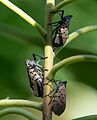
Adult spotted lanternflies in Brooklyn Botanic Garden
-
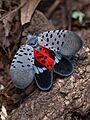
Adult spotted lanternfly with wings spread open
-
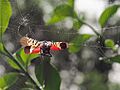
Adult spotted lanternfly caught in a spider web
-
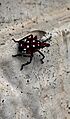
Fourth-instar nymph showing its bright red spots


.jpg)


