
List of scheduled monuments in Sedgemoor facts for kids
Sedgemoor is a flat area of land in Somerset, England, located near the sea. It's part of the Somerset Levels and Moors, which is a large wetland area between the Mendip Hills and the Blackdown Hills National Landscape.
Long ago, during the Neolithic period (New Stone Age), people used the natural resources from the reed swamps here. They even built wooden paths, called trackways, to help them move around. One of these, the Post Track, is the oldest known wooden path in the world, dating back to around 3800 BC! Later, during the Iron Age, villages like the Glastonbury Lake Village and two others at Meare Lake Village were built on the Levels. People also built settlements and strongholds on natural "islands" of higher land, such as Brent Knoll Camp and Glastonbury. When the Romans were here, they collected sea salt and set up many small towns along the Polden Hills.
Contents
What are Scheduled Monuments?
Imagine a special list of places that are super important for understanding history! These are called scheduled monuments. They are archaeological sites or old structures that are given legal protection by the government. This means they can't be dug up or changed without special permission.
English Heritage is the main group that helps find and protect these sites. The rules for protecting them come from a law called the Ancient Monuments and Archaeological Areas Act 1979.
A "monument" isn't just a statue! It can be any place that was built or used by people a long time ago. This includes:
- Very old prehistoric sites like standing stones and burial mounds.
- Remains from the Roman Empire.
- Medieval buildings like castles and monasteries.
- Even more recent structures, such as old factories or buildings from the World Wars and the Cold War.
These sites are protected because they teach us so much about how people lived in the past.
Sedgemoor's Ancient Treasures
Sedgemoor is home to 79 scheduled monuments! These sites tell us stories from thousands of years ago right up to more recent times.
The oldest monuments are from the Neolithic (New Stone Age), Bronze Age, and Iron Age. These include:
- Hill forts: These were strongholds built on hills for protection.
- Bowl barrows: These are round mounds of earth built over burials.
- Caves: Some caves, especially in Cheddar Gorge, show signs of ancient human activity.
For example, Cannington Camp (also known as Cynwit Castle) dates back to the Bronze Age. Brent Knoll Camp, an Iron Age hill fort, was even used again by the Romans!
The Romano-British period (when Romans lived in Britain) also left its mark with several sites. From the Middle Ages, you can find remains of motte-and-bailey castles (a type of castle with a mound and a walled area) and old church or village crosses.
More recently, industrial sites in Bridgwater are protected. These include old brick and tile kilns and a special telescopic railway bridge that could move to let boats pass. The newest monuments are World War II bunkers and fake bombing targets on Black Down, which were used to trick enemy planes.
Here are a few examples of these amazing sites:
Athelney Abbey and Anglo-Saxon Burh

Near Lyng, you can find the site of Athelney Abbey. This abbey was started by the famous King Alfred in 888 AD. He stayed here before a big battle. Back then, Athelney was a small island surrounded by swamps. Today, you won't see any abbey buildings, but a monument marks the spot.
Close by is the site of an Anglo-Saxon burh (a fortified town) at East Lyng. This burh was also important during King Alfred's time. It had defensive banks and was connected to Athelney Abbey by a path over the marshland.
Balt Moor Wall
Balt Moor Wall is an old earthwork on the Somerset Levels near the River Tone. It's a raised bank, about 6 to 10 meters wide and up to 2 meters high. This structure is a rare example of medieval engineering. It was likely built during the Middle Ages to protect the nearby Salt Moor from floods.
Brent Knoll Hillfort

Brent Knoll Camp is an impressive hill fort on top of a 137-meter-high hill. This hill stands out in the flat Somerset Levels. People have lived here since at least the Bronze Age. Around 2,000 BC, it became an Iron Age fort, covering about 1.6 hectares. It was protected by a 10-meter-high wall and a ditch. The Romans also used this hill as a fort.
Bridgwater's Industrial Past

In Bridgwater, you can see reminders of its industrial history. One is a brick and tile kiln from the 19th century, which is part of the Somerset Brick and Tile Museum. It's a tall, 21-meter-high circular kiln.
Another cool site is the telescopic railway bridge over the River Parrett. Built in 1871, this bridge could actually slide back to let boats pass! It was used for a railway line that went to the docks. It was last opened in 1953 and part of it was taken down in 1974.
Ancient Caves in Cheddar Gorge

Cheddar Gorge has several fascinating caves that are scheduled monuments:
- Gough's Cave: This cave is 90 meters deep and over 2 kilometers long! It has huge chambers and rock formations. The Cheddar Yeo river, Britain's largest underground river, flows through it. In 1903, the remains of "Cheddar Man" were found here. He is Britain's oldest complete human skeleton, about 7,150 years old! Even older skull cups (from 14,700 BC) have been found.
- Gough's Old Cave and Great Oone's Hole: These caves also have signs of very early human life, with tools and animal bones showing how ancient people lived.
- Saye's Hole and Soldier's Hole and Sun Hole: These caves show evidence of human activity from the Iron Age and even earlier, the Late Upper Paleolithic period (around 35,000 to 10,000 years ago).
Brean Down Fort

Brean Down is a headland that sticks out into the Bristol Channel. It's 318 meters high and stretches 1.5 kilometers. This area has been used by humans since the late Bronze Age. You can find the remains of a Romano-Celtic Temple here. At the very end of the headland is Brean Down Fort, built in 1865 and used again during World War II. Today, the National Trust owns Brean Down, and it's a great place to see wildlife and learn about history.
Sweet Track and Post Track

The Somerset Levels are famous for their ancient wooden paths, called trackways. Sections of the Sweet Track and the Post Track are scheduled monuments. The Sweet Track was built around 3807 or 3806 BC! It was made of wooden poles pushed into the wet ground to support a walkway of oak planks. It was only used for about 10 years before water levels rose too high. Scientists have been able to date the wood very precisely using a method called Dendrochronology (tree-ring dating). Most of the track is still in its original spot, kept wet to preserve the wood.
Medieval Crosses
Many villages and churches in Sedgemoor have old stone crosses. These include:
- The Market cross in Cheddar, which was first built in the 15th century.
- Churchyard crosses in places like Wembdon, North Petherton, Broomfield, Enmore, Spaxton, Nether Stowey, and Fiddington. These crosses often date from the 13th to 15th centuries. Some are still quite tall, while others are just broken bases or shafts.
Stowey Castle

Stowey Castle (also known as The Mount) is a Norman motte-and-bailey castle from the 11th century. It's located in Nether Stowey on the Quantock Hills. You can still see the earthworks from this old castle.
Images for kids
-
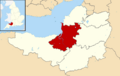
Sedgemoor shown within Somerset and England
-
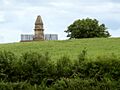
King Alfred's Monument marks the spot of Athelney Abbey.
-
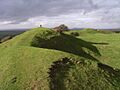
Brent Knoll hillfort stands tall over the landscape.
-
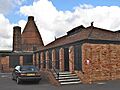
The last surviving 'pinnacle kiln' in Bridgwater.
-
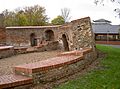
The remains of Chandos Glass Cone.
-
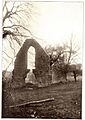
The ruins of Adscombe Chapel.
-
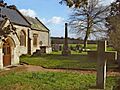
A 13th-century churchyard cross in Broomfield.
-
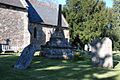
The churchyard cross at St Michael's Church, Enmore.
-
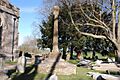
The churchyard cross at St Margaret's Church, Spaxton.
-
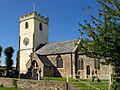
The churchyard cross at St Martin's Church, Fiddington.
-
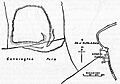
Map showing Cynwit Castle (Cannington Camp).
-
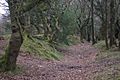
Dead Woman's Ditch, a Bronze Age earthwork.
-
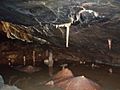
Inside Gough's Cave, where ancient human remains were found.
-
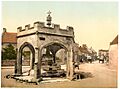
The Market Cross in Cheddar.
-
The earthworks of Down End Castle.
-
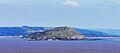
Brean Down, a headland with a long history.
-
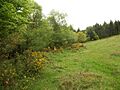
Plainsfield Camp, a possible Iron Age earthwork.
-
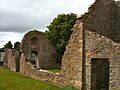
The site of Cheddar Palace, now marked by concrete slabs.
-
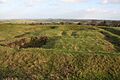
The remains of Stowey Castle.
-
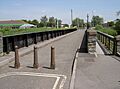
The Telescopic Bridge in Bridgwater.
-
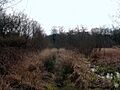
A reconstruction of the Sweet Track, an ancient wooden walkway.
-
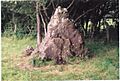
The Wimblestone standing stone.
-
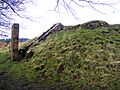
A World War II bunker on Black Down.
-
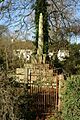
A wayside cross at Stoughton Cross.
-
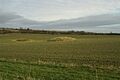
A bowl barrow near Tyning's Farm.
-
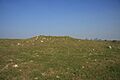
A bowl barrow east of Batts Coombe Quarry.

.jpg)


.jpg)


.jpg)


See also
- Scheduled Monuments in Somerset
- Grade I listed buildings in Sedgemoor
- Grade II* listed buildings in Sedgemoor
