
Cloisonné facts for kids


Cloisonné is an ancient technique for decorating metalwork items with bright colors. Artists create these designs using thin metal strips or wire, usually made of gold, silver, or copper. These wires form tiny walls on a metal base. The French word cloison means "partition" or "compartment." Crafters fill these little spaces with colorful materials. In modern times, artists mostly use vitreous enamel, which is colored glass paste that melts in a hot kiln. In ancient times, makers used cut gemstones, glass, or other stones.
When the artwork is fired, the glass melts into a smooth, shiny surface. The thin metal wires stay visible between the colorful sections. This creates lovely patterns, pictures of animals, or scenes of people. Cloisonné can be found on tiny jewelry pieces, large vases, and decorative bowls.
Contents
How Artists Make Cloisonné Today


Creating a piece of cloisonné takes great patience and skill. An artist begins with an object made of metal, often pure copper. Copper is popular because it is light, easy to bend, and inexpensive. Crafters also use silver or gold for special treasures.
Next, the artist bends flat strips of wire made from fine gold or pure silver. These wires outline the shapes in the design, like flowers, leaves, or geometric figures. Pliers and tweezers help shape the wire neatly. In earlier times, artists used solder to attach these wires directly to the base. Today, makers often coat the metal with clear enamel powder first. Then, they use a plant glue called gum tragacanth to stick the wires in place. When heated, the glue burns away completely, leaving the wire fused to the glass layer.
Filling the Spaces
The artist crushes colored glass into a very fine powder to make vitreous enamel. They wash this powder carefully to remove dirt. The glass mix contains minerals, lead oxide, and metal oxides that create bright colors. Crafters melt these ingredients into a glassy mixture called frit, then crush it again.
The maker mixes the powder with water and a tiny bit of gum. Using small brushes, spatulas, or droppers, they carefully drop the wet paste into each cell. The piece must dry completely before going into a kiln. In the hot oven, the glass powder melts and shrinks, just like sugar melting in heat. Because the melted glass shrinks down, the artist must add more paste and fire it several times.
Polishing to a Shine
Once the spaces are full, the surface is rough and uneven. The artist grinds the surface flat using special stones and grinding wheels. This step polishes the metal wires and the glass together until they are completely smooth and level. Finally, the metal wires may be covered using electroplating with gold, which prevents silver from tarnishing over time.
History of Cloisonné
Ancient Civilizations

The earliest forms of cloisonné began in the ancient Near East. Long before glass enamel was common, ancient makers used gold wires to hold precious stones tightly. People in Mesopotamia and Egypt used this method during the 3rd millennium BC. The famous pharaohs loved these colorful decorations. Egyptian artists created pectoral jewels using stones like turquoise, carnelian, and lapis lazuli. Beautiful pieces were found in the Tomb of Tutankhamun from around 1325 BC. Sometimes they used melted glass-paste, though true enamels were still rare during the Third Intermediate Period of Egypt.
Surviving rings from Mycenaean tombs on Cyprus show that Greek goldsmiths used thin wires and enamel around the 12th century BC. The Koban culture of the Caucasus mountains also crafted early wire-walled ornaments. Later nomadic groups, such as the Sarmatians, helped spread metalworking ideas across Europe to early tribes like the Celts.
Early Medieval Europe and Sutton Hoo
During the Late Antique era and the Migration Period, European artisans loved bright red designs. Migration Period art often featured shiny red garnets set into tiny gold boxes. Christians saw the red garnet as a symbol of Christ. Beautiful weapons and jewelry have been found across Europe from this time.
In England, Anglo-Saxon art reached amazing heights. Archaeologists digging at the ship burial of Sutton Hoo discovered stunning gold items from the 7th century. Makers cut garnets into wafer-thin slices so the patterned gold underneath sparkled through. They also used colorful checkerboard glass called millefiori glass. Pieces like the Sutton Hoo purse-lid mixed cut garnets with blue and white glass elements. Similar styles appeared in Spain among the Visigoths.
Byzantine Mastery

Artists in the Byzantine Empire took cloisonné enameling to its highest level. Byzantine goldsmiths figured out how to use extremely thin gold wires. This allowed them to make detailed pictures of saints, kings, and religious scenes, known as an icon. Many Byzantine gifts were sent to royal courts across Europe, inspiring styles in Carolingian art and Ottonian art.
Byzantine artisans used two main styles of work:
- Vollschmelz: The entire gold plate is covered with enamel from edge to edge. The background is colored glass.
- Senkschmelz: The artist hammers hollow spaces into a gold plate, placing the enamel figures inside. This left a shiny background of plain gold around the figures, similar to Byzantine mosaics.
Famous examples include panels on the Holy Crown of Hungary and the golden altarpiece called the Pala d'Oro inside St Mark's Basilica in Venice.
Western Europe Changes Styles
During the Middle Ages, European craftspeople began using another method called champlevé enamel. In champlevé, workers carved hollow grooves into thick copper plates instead of soldering wires on top. Because copper was cheaper than gold, champlevé became very popular. Craftsmen could make larger items, like boxes and statues, and use gilding to cover the copper with gold leaf. Regions famous for this work included Mosan art workshops and factories producing Limoges enamel.
Artists also invented plique-à-jour, a technique where the enamel has no metal backing. Light shines through it like a tiny stained-glass window. Sometimes makers placed this clear enamel over pieces of rock crystal.
-
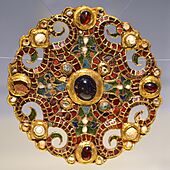
The Dorestad Brooch, c. 800, found in the Netherlands. Gold, pearls, with cloisonné almandine, enamel, and glass.
-
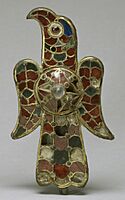
Visigothic 6th-century eagle-fibula, from Spain with garnets, amethysts, and colored glass, and some cloisons now empty.
-

Plaque with Saint Peter showing the unique transitional technique of the Holy Crown of Hungary (see text)

.jpg)

.jpg)
Cloisonné in Asia
Golden Age in China
.jpg)
Cloisonné methods traveled to China around the 13th or 14th century, probably along trade routes from the Middle East. Some historians think Byzantine artists moving east after the Fall of Constantinople in 1453 may have shared their skills. Chinese craftspeople quickly mastered the craft. Instead of making only small jewelry, they created massive vases, large basins, and incense burners.
Chinese cloisonné became world-famous during the Ming Dynasty. The reign of the Xuande Emperor and the Jingtai Emperor produced magnificent pieces. Because blue enamel was so common, the Chinese named the craft jingtailan, meaning "Jingtai blue ware." Later, during the Qing dynasty, emperors like the Kangxi Emperor set up royal workshops inside the palace grounds. Chinese pieces often used heavy bronze or brass bodies, turning into lighter copper pieces in later centuries. Unlike painted Chinese porcelain, true cloisonné always kept visible wire outlines.
-
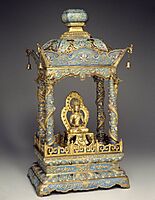
Chinese shrine for a Bodhisattva, 1736–1795. Shrine: Cloisonné enamel on copper alloy; Figure is copper with gems
-
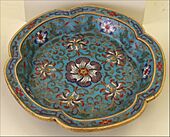
Qing dynasty cloisonné dish
-
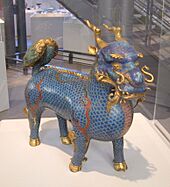
Chinese cloisonné enamel incense burner, 17th-18th centuries
-
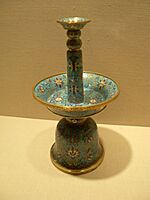
Chinese enameled and gilt candlestick from the 18th or 19th century, Qing dynasty


Japanese Shippo Ware

.jpg)
_-_Japanese_Cloisonn%C3%A9_Collection_-_George_Walter_Vincent_Smith_Art_Museum_-_DSC03746.JPG)
Japan started making cloisonné in huge numbers during the 19th century. In Japan, this art is called shippō-yaki, meaning "seven treasures ware." Japanese makers developed amazing skills during the Meiji era, especially between 1890 and 1910.
Workshops sprang up in cities like Nagoya, home of the Ando Cloisonné Company. Master artists like Namikawa Yasuyuki in Kyoto and Namikawa Sōsuke in Tokyo created unbelievable designs. They showed scenes of blooming flowers, flying birds, and misty landscapes. These masterpieces were sent to international world's fair events, including the 1893 World's Columbian Exposition, where they won major prizes.
-
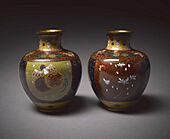
Matching Pair of Cloisonné Vases, c. 1800–1894, from the Oxford College Archives of Emory University
-
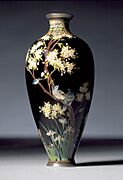
Kyoto Cloisonne Enamel, by Namikawa Yasuyuki (1845–1927)
-
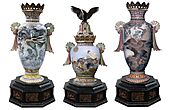
Khalili Imperial Garniture. Meiji period, the largest cloisonné enamel in history at the time and was exhibited at the World's Columbian Exposition in 1893.
-
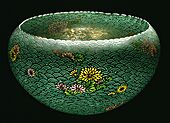
Tokyo Cloisonne Enamel, Shōtai Shippō by Namikawa Sōsuke (c. 1900), translucent plique-a-jour enamel on silver.
-
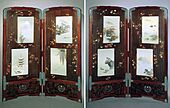
Pair of Two-fold Screens 1900–1905, Nagoya, Japan
-
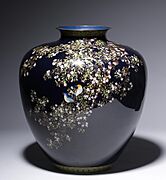
Ando Cloisonné Company, (c. 1910)
-
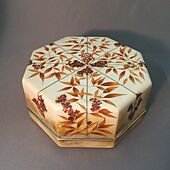
Owari Cloisonne Enamel Octagon by Takemasa Tamura

.jpg)

.jpg)


Russia

In Eastern Europe, artists in Kievan Rus learned cloisonné from Byzantine teachers. After the Mongol invasion of Russia, metalworkers in Novgorod used champlevé instead. During the 19th century, famous Russian jewelry houses revived cloisonné. Companies like Khlebnikov and the famous House of Fabergé created boxes, spoons, and a special tea caddy made of silver gilt. Fabergé developed a raised style where shiny metal curves stood out above the colorful enamel paste.
Architecture and Modern Uses
Builders even used the word for buildings. In Byzantine architecture, workers created "cloisonné masonry." They framed blocks of squared stone using thin red brick, matching the look of wire around enamel. The ancient Pammakaristos Church in Istanbul shows this neat brickwork.
Today, real cloisonné is still made by dedicated jewelers. However, many metal pins, school badges, and car logos like those on BMW vehicles are made with cheaper molds. In these badges, machines stamp the metal compartments in place before workers add colored resin or acrylic paste. True cloisonné remains one of the most beautiful and complex art forms in human history.
Famous Examples
- The Alfred Jewel, a famous 9th-century Anglo-Saxon gold and enamel treasure.
- The Ardagh Chalice, an 8th-century silver cup found in Ireland.
- The Khakhuli triptych, a huge golden altarpiece in Georgia with over one hundred enamel plaques.
- The Golden Madonna of Essen, an early German sculpture with cloisonné eyes.
- The Treasure of Pouan and the Treasure of Gourdon, ancient burial hoards from early European history.
Museum Collections
You can see amazing collections of cloisonné around the world:
- The Victoria and Albert Museum in London features hundreds of Asian and European pieces.
- The Metropolitan Museum of Art in New York holds ancient Egyptian jewelry and Byzantine plaques.
- The G.W. Vincent Smith Art Museum in Springfield, Massachusetts, displays over 150 Chinese cloisonné treasures.
- The Namikawa Yasuyuki Cloisonné Museum in Kyoto is located right inside a master artist's historic workshop.
- The Khalili Collection of Japanese Meiji Art contains the famous Khalili Imperial Garniture, one of the largest enamel sets ever created.
Images for kids
-
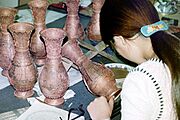
Adding cloisons according to the pattern previously transferred to the workpiece
-
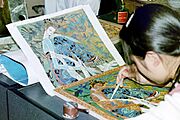
Adding frit with dropper after sintering cloisons. Upon completion the piece will be fired, then ground (repeating as necessary) then polished and electroplated
-
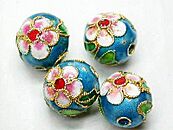
Modern cloisonné enamel beads
-

Cloisonné artwork of Korea (namjung cloisonné)
-
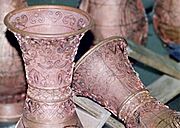
Detail showing pattern and partially completed cloisons


.jpg)

Related Pages
- Champlevé, carving hollows in metal for enamel
- Pottery, ceramic items decorated with glazes
- Yūzen, a Japanese fabric method using dye barriers
See also
 In Spanish: Esmalte alveolado para niños
