
Han dynasty facts for kids
Quick facts for kids
Han
|
|||||||||||||||||||
|---|---|---|---|---|---|---|---|---|---|---|---|---|---|---|---|---|---|---|---|
|
|||||||||||||||||||
.svg)
The Western Han dynasty in 2 AD
|
|||||||||||||||||||
| Capital | |||||||||||||||||||
| Common languages | Old Chinese | ||||||||||||||||||
| Religion |
|
||||||||||||||||||
| Government | Monarchy | ||||||||||||||||||
| Emperor | |||||||||||||||||||
|
• 202–195 BC (first)
|
Emperor Gaozu | ||||||||||||||||||
|
• 141–87 BC
|
Emperor Wu | ||||||||||||||||||
|
• 74–48 BC
|
Emperor Xuan | ||||||||||||||||||
| Chancellor | |||||||||||||||||||
|
• 206–193 BC
|
Xiao He | ||||||||||||||||||
|
• 193–190 BC
|
Cao Shen | ||||||||||||||||||
|
• 189–192 AD
|
Dong Zhuo | ||||||||||||||||||
|
• 208–220 AD
|
Cao Cao | ||||||||||||||||||
|
• 220 AD
|
Cao Pi | ||||||||||||||||||
| Historical era | Imperial | ||||||||||||||||||
| 206 BC | |||||||||||||||||||
|
• Battle of Gaixia; Liu Bang proclaimed emperor
|
202 BC | ||||||||||||||||||
| 9–23 AD | |||||||||||||||||||
|
• Abdication to Cao Wei
|
220 AD | ||||||||||||||||||
| Area | |||||||||||||||||||
| 50 BC (est. Western Han peak) | 6,000,000 km2 (2,300,000 sq mi) | ||||||||||||||||||
| 100 AD (est. Eastern Han peak) | 6,500,000 km2 (2,500,000 sq mi) | ||||||||||||||||||
| Population | |||||||||||||||||||
|
• 2 AD
|
57,671,400 | ||||||||||||||||||
| Currency |
|
||||||||||||||||||
|
|||||||||||||||||||

The Han dynasty was a very important time in Chinese history, lasting for about 400 years (202 BC – 9 AD, and 25–220 AD). It was founded by Liu Bang, who became Emperor Gaozu. This dynasty came after the short-lived Qin dynasty and a period of fighting called the Chu–Han Contention. The Han dynasty was briefly interrupted by the Xin dynasty (9–23 AD) led by Wang Mang, but it was later restored. Because of this, historians divide it into two parts: the Western Han and the Eastern Han. Many people consider the Han dynasty a "golden age" because of its great achievements. Even today, most Chinese people call themselves "Han people", and their language and writing are called "Han language" and "Han characters".
The Han emperors were at the top of society. They led the government but also shared power with nobles and educated ministers. The empire was divided into areas directly controlled by the government and some semi-independent kingdoms. Over time, these kingdoms became less independent. During the reign of Emperor Wu of Han (141–87 BC), the government officially supported Confucianism in schools and politics. The Han dynasty had times of great wealth and saw a lot of growth in its money system. Coins made by the government in 119 BC were used for a very long time, until the Tang dynasty (618–907 AD). To pay for wars and new territories, the Han government took control of salt and iron industries, but these monopolies were later ended. There were amazing discoveries in science and technology during the Han period, like papermaking, rudders for ships, negative numbers in math, and even seismometers to detect earthquakes.
The Han dynasty often had conflicts with the Xiongnu, a group of nomadic people from the northern steppes. After an early defeat, the Han tried to make peace with the Xiongnu through marriage alliances and gifts. However, the Xiongnu continued to raid the borders. In 133 BC, Emperor Wu began military campaigns against them. Han forces took control of important trade routes like the Hexi Corridor and parts of the Tarim Basin, which helped establish the famous Silk Road. The Xiongnu were eventually defeated and became allies of the Han. Emperor Wu also expanded the empire south into what is now Vietnam and Yunnan, and east into the northern Korean Peninsula.
Later in the Eastern Han period, palace officials called eunuchs became very powerful in government, leading to many power struggles with other influential families. Large religious groups also caused problems, leading to major rebellions like the Yellow Turban Rebellion. After the death of Emperor Ling of Han in 189 AD, military leaders fought for control, dividing the empire. The Han dynasty officially ended in 220 AD when Cao Pi took the throne from Emperor Xian, starting the Three Kingdoms period.
Contents
The Name "Han"
The name "Han" comes from the Han River. After the Qin dynasty ended, Liu Bang was made prince of a small area called Hanzhong, which was near this river. When Liu Bang won the war and started his own dynasty, he named it "Han" after his former territory. The Chinese character for Han (漢) also meant "Sky River" or the Milky Way.
A Look Back: Han Dynasty History
Western Han: The Beginning (202 BC – 9 AD)
China's first big empire was the Qin dynasty. But after the first emperor, Qin Shi Huang, died, the Qin dynasty quickly fell apart due to rebellions. Two rebel leaders, Xiang Yu and Liu Bang, then fought to control China. Liu Bang won the Battle of Gaixia in 202 BC. His followers urged him to become emperor, and he became known as Emperor Gaozu of Han. He chose Chang'an (modern Xi'an) as the capital for his new empire.

At first, the Western Han empire had areas directly controlled by the central government and many semi-independent kingdoms. Emperor Gaozu gave some of his commanders land to rule as kings. But soon, the Han court replaced these non-royal kings with members of the royal Liu family. After some rebellions, especially the Rebellion of the Seven States in 154 BC, the emperor started to limit the power of these kingdoms. Kings could no longer choose their own officials, and their territories were divided into smaller areas controlled by the central government.
To the north, a powerful group of nomadic people called the Xiongnu had formed a large empire. Emperor Gaozu was worried about the Xiongnu getting Han weapons, so he stopped trade with them. In response, the Xiongnu attacked and defeated Han forces in 200 BC. To make peace, the Han agreed to a "heqin" agreement, which involved royal marriages and sending gifts like silk and food to the Xiongnu.
Despite this agreement, some Xiongnu leaders continued to raid Han borders. In 133 BC, Emperor Wu of Han decided to fight back. He launched many military campaigns against the Xiongnu. These wars helped the Han gain control of important areas like the Hexi Corridor and the Tarim Basin. This was key to establishing the famous Silk Road, a trade route connecting China with the West. Han forces even reached as far north as Lake Baikal.
.jpg)
After Emperor Wu's reign, fighting with the Xiongnu continued. Eventually, one Xiongnu leader, Huhanye, became an ally of the Han in 51 BC. Another rival leader, Zhizhi Chanyu, was defeated by Han forces in what is now Kazakhstan.
The Han also expanded their territory in other directions. They conquered Nanyue (modern Guangdong, Guangxi, and northern Vietnam) in 111 BC and the Dian Kingdom in Yunnan in 109 BC. They also took control of parts of the northern Korean Peninsula. In 2 AD, the first nationwide census counted over 57 million people in the Han empire.
To pay for his military expansions, Emperor Wu took control of several private industries, like salt, iron, and liquor production. These became government monopolies. He also made the government the only one allowed to mint coins. These monopolies were later ended during the Eastern Han period, except for coin minting.
Wang Mang's Short Reign and Civil War (9–23 AD)
A powerful relative of the empress, Wang Mang, became regent for a young emperor. In 9 AD, he claimed that the gods wanted him to start his own dynasty, called the Xin dynasty. He promised to give up power later, but he didn't.
Wang Mang tried to make big changes, like outlawing slavery and sharing land equally among families. He also introduced new types of money, which caused problems. But his rule faced its biggest challenge from massive floods of the Yellow River around 3 AD and 11 AD. These floods displaced thousands of farmers, who then joined rebel groups, like the Red Eyebrows.
Wang Mang's armies couldn't stop these rebels. Eventually, a rebel group attacked his palace and killed him.

A distant cousin of the Han emperors, Gengshi Emperor, tried to bring back the Han dynasty. But he was also defeated by the Red Eyebrow rebels. Another cousin, Liu Xiu, who became known as Emperor Guangwu, successfully restored the Han Empire. He made Luoyang his new capital in 25 AD. By 36 AD, he had defeated all the other warlords and reunified China under the Han dynasty.
The period before Wang Mang's reign is called the Western Han, with its capital at Chang'an. The period from Emperor Guangwu's reign until the fall of the empire is called the Eastern Han or Later Han, with its capital at Luoyang.
Eastern Han: Restoration and Decline (25–220 AD)
The Eastern Han dynasty officially began on August 5, 25 AD, when Emperor Guangwu of Han took the throne. During the chaos of Wang Mang's rule, China had lost control of some territories. The Han quickly re-established control over its Korean commanderies by 30 AD.
In 40 AD, the Trưng Sisters led a rebellion in Vietnam, but it was crushed by Han general Ma Yuan a few years later. The Han also dealt with the Xiongnu again. In 50 AD, one Xiongnu leader, Bi, became an ally of the Han, creating two rival Xiongnu groups: the Southern Xiongnu (allies) and the Northern Xiongnu (enemies).
The Northern Xiongnu had taken control of the Tarim Basin, using it to attack the Han. Han generals launched campaigns to push them back. After the Northern Xiongnu fled into the Ili River valley in 91 AD, another nomadic group, the Xianbei, took over their former lands.

Han general Ban Chao even sought help from the Kushan Empire (which covered parts of South and Central Asia) to control areas like Kashgar. The Han empire also had contact with distant lands. Buddhist monks from places like Parthia and the Kushan Empire traveled to China, translating important Buddhist texts. A Roman embassy from Emperor Marcus Aurelius is recorded to have reached China in 166 AD, though it might have been Roman merchants. Roman goods and coins have been found in China and Vietnam, showing these connections.

After 92 AD, palace eunuchs became very involved in court politics. They often had power struggles with the families of empresses and empresses dowager. Emperors sometimes relied on eunuchs to balance the power of other noble families. For example, Emperor He of Han used eunuchs to remove the powerful family of Empress Dowager Dou. Later, Emperor Huan of Han used eunuchs to depose the powerful regent Liang Ji.
However, the eunuchs themselves became very powerful and sometimes corrupt. Students from the imperial university even protested against them. Emperor Huan also spent a lot on grand projects and his personal life, which upset many officials during a time of economic trouble. This led to periods where officials who opposed the eunuchs were banned from government service.
The End of the Han Dynasty (220 AD)

The bans on officials were lifted during the Yellow Turban Rebellion and the Five Pecks of Rice Rebellion in 184 AD. These were large religious uprisings led by faith healers. Although the Yellow Turbans were defeated quickly, many generals who were appointed to fight them kept their armies. These generals then became powerful warlords, challenging the emperor's authority.
In 189 AD, General-in-chief He Jin plotted with Yuan Shao to overthrow the powerful eunuchs. The eunuchs found out and assassinated He Jin. In response, Yuan Shao and his brother attacked the palaces, killing about two thousand eunuchs. The young Emperor Shao and his brother, Liu Xie (who would become Emperor Xian of Han), fled.
General Dong Zhuo found the emperor and his brother and brought them back to the capital, taking control of Luoyang. He demoted Emperor Shao and made Liu Xie the new Emperor Xian. Many warlords, including Yuan Shao, formed a coalition against Dong Zhuo. Dong Zhuo burned Luoyang and moved the court to Chang'an. He later poisoned Emperor Shao.
Dong Zhuo was eventually killed by his adopted son, Lü Bu. Emperor Xian fled back to the ruins of Luoyang. Later, Cao Cao, a powerful governor, persuaded Emperor Xian to move the capital to Xuchang in 196 AD.
Cao Cao fought against other warlords, including Yuan Shao, whom he defeated at the Battle of Guandu in 200 AD. After Cao Cao's defeat at the naval Battle of Red Cliffs in 208 AD, China was divided into three main areas of influence: Cao Cao in the north, Sun Quan in the south, and Liu Bei in the west.
Cao Cao died in March 220 AD. By December of that year, his son Cao Pi forced Emperor Xian to give up his throne. This officially ended the Han dynasty and began the period known as the Three Kingdoms: Cao Wei, Eastern Wu, and Shu Han.
Life in Han China
Social Classes in Han Society

In Han society, the emperor was the most important person. But sometimes, a regent, like an empress dowager or her male relative, would rule if the emperor was too young. Below the emperor were the kings, who were usually members of the emperor's own family.
Everyone else, except slaves, belonged to one of twenty ranks. Each rank came with more benefits and legal rights. The highest rank was a full marquess, who received a pension and land. Scholars who worked in the government were highly respected, just below the nobles.
By the Eastern Han, educated people, teachers, and officials started to see themselves as a special "gentry class." They shared common values and focused on learning. When the government became corrupt, many gentry believed that good personal character was more important than holding public office.
Farmers who owned small plots of land were ranked just below scholars. Other farm workers, like tenants and wage laborers, had a lower status. Slaves were at the very bottom. Artisans, technicians, and craftsmen had a status between farmers and merchants.
Merchants who were officially registered with the state had a low social status. They had to wear special clothes and pay high taxes. However, some wealthy merchants and industrialists could avoid registration and become very rich and powerful, sometimes even more so than government officials.
Wealthy landowners often had people called retainers living with them. These retainers provided services, like fighting bandits or going to battle. Unlike slaves, retainers could leave their master's home whenever they wanted.
Family Life and Customs

Han families were usually small, with parents and their children living together. Unlike later dynasties, many generations of a family didn't usually live in the same house. Family members were treated with different levels of respect based on their relationship, following Confucian rules.
Marriages were very important and involved many steps, especially for wealthy families. Giving gifts, like a bride price and dowry, was essential. If these gifts weren't exchanged, the woman might be seen as a concubine, not a wife. Marriages were usually arranged by parents, with the father's opinion being most important.
Most marriages were between one man and one woman. However, wealthy nobles and officials could have concubines. Both men and women could divorce and remarry under certain customs, but not laws. If a woman became a widow and remarried, she had to return to her original family, and her children would stay with her deceased husband's family.
When it came to inheritance, all sons usually received an equal share of the family's property. Fathers often sent their married sons away with their share of the family wealth. Daughters received a smaller share through their dowries.
Women were expected to obey their father, then their husband, and then their adult son when they were old. However, there were many times when women, especially mothers and empresses, had significant influence and power. Women did not have to do annual labor duties for the government. They often worked in jobs like weaving clothes for their families or for sale. Some women became singers, dancers, doctors, or successful merchants.
Learning, Books, and Ideas

In the early Han dynasty, the government used ideas from different philosophies, including Legalism, Taoism, and Confucianism. But under Emperor Wu of Han, Confucianism became the main philosophy. In 136 BC, he removed all other academic subjects except those related to the Five Classics (important Confucian texts). In 124 BC, he started the Imperial University to teach Confucianism to future officials.
Han Confucianism was shaped by Dong Zhongshu. He combined Confucian ideas about good behavior, respect for elders, and harmony with ideas about the five phases and yin and yang (forces of nature). This helped explain why the imperial system of government fit into the natural order of the universe.

The Imperial University grew very large, with over 30,000 students by the 2nd century AD. Confucian education was also available in local schools and private schools. These schools helped spread Chinese culture to new regions.
Many important books were written during the Han dynasty. The Shiji (Records of the Grand Historian), started by Sima Tan and finished by his son Sima Qian, became the model for all official histories in China. Other important works included dictionaries and poetry.
Laws and Keeping Order

Han laws were based on earlier Qin dynasty laws, but the Han tried to be less harsh. Courts handled cases of physical harm and murder. Women, though they had fewer rights by custom, could bring charges against men.
Suspects were jailed, but convicted criminals were not usually kept in prison for long. Instead, punishments included fines, forced labor, or capital punishment.
Local officials, like county magistrates, acted as judges. Difficult cases could be sent to the Minister of Justice in the capital or even the emperor. Police chiefs maintained order in districts, and government officers kept peace in cities and neighborhoods.
What People Ate


The main foods in Han China were wheat, barley, millet, rice, and beans. People also ate fruits like chestnuts, pears, plums, peaches, and melons. Vegetables included bamboo shoots and taro.
Common meats came from chickens, ducks, geese, cows, sheep, pigs, and even dogs (some types were raised for food). Fish and turtles were caught from rivers and lakes. Hunters brought in game like pheasants and deer. Food was seasoned with sugar, honey, salt, and soy sauce. Beer and wine were popular drinks.
How People Dressed
The clothes people wore in the Han dynasty depended on their social class. Wealthy people wore silk robes, skirts, and coats made of badger or fox fur. They had fancy slippers with pearls and silk. Farmers and common people usually wore clothes made of hemp, wool, and ferret skins.
Beliefs and Religion

Han families made offerings of animals and food to gods, spirits, and ancestors at temples. They believed these offerings could be used in the spirit world. People thought each person had two parts to their soul: a spirit-soul that went to an afterlife paradise, and a body-soul that stayed in the tomb.
The emperor was the highest priest. He made sacrifices to Heaven, the main gods, and spirits of nature. People believed that if the emperor didn't act properly, it could upset the balance of nature and cause disasters like earthquakes or floods.
Some Taoists believed they could become immortal by practicing breathing exercises and using special medicines. By the 2nd century AD, Taoists formed large religious groups. They believed that the philosopher Laozi was a prophet who could offer good health if people confessed their sins and chanted from the Tao Te Ching.
Buddhism first came to China through the Silk Road during the Eastern Han dynasty. It was first mentioned in 65 AD. China's first known Buddhist temple, the White Horse Temple, was built near Luoyang during Emperor Ming's reign. Important Buddhist texts were translated into Chinese during this time.
How the Han Government Worked
The Central Government


The emperor was the most powerful person in the Han government. He was the supreme judge, lawgiver, and commander of the army. He chose officials for the highest government jobs. However, important decisions were often discussed in court meetings where ministers would try to reach an agreement. The emperor usually listened to their advice.
Below the emperor were three top officials called the Three Councillors of State.
- The Chancellor (or Minister over the Masses) was in charge of the government budget, managing land and population records, leading court meetings, and recommending officials.
- The Imperial Counsellor (or Excellency of Works) was responsible for making sure officials followed rules and for overseeing public building projects.
- The Grand Commandant (or Grand Marshal) was usually the military commander and sometimes a regent (someone who rules for a young emperor). In the Eastern Han, this role became more about civil administration.
Below these three were the Nine Ministers, each leading a special department. For example, there was a Minister for religious ceremonies, a Minister for the emperor's security, a Minister for justice, and a Minister for finance.
Local Government

The Han empire was divided into provinces, commanderies, and counties. A county was further divided into districts, which were made up of small villages.
The heads of provinces were called Inspectors or Governors. They checked on the commanderies and kingdoms in their area. Based on their reports, local officials could be promoted, demoted, or even removed. Governors had more power during emergencies, like raising armies to stop rebellions.
A commandery was a group of counties led by an Administrator. This person was the top civil and military leader in their area, handling defense, lawsuits, and farming advice. Counties were led by Prefects or Chiefs (also called magistrates). A magistrate kept law and order, registered people for taxes, organized public labor, and supervised schools and public works.
Kingdoms and Marquesses
Kingdoms were territories ruled by the emperor's male relatives. They were like semi-independent areas. At first, kings had a lot of power, even appointing their own officials. But after some rebellions, Emperor Jing reduced their power in 145 BC. Kings became more like symbolic leaders, receiving income from taxes but with less control over their administration.
Similarly, marquesses (another type of noble) also had fiefs, but their officials were appointed by the central government. Marquesses also collected a portion of taxes from their land as personal income.
Early Han emperors struggled to control these vassal kings, who sometimes allied with the Xiongnu. The Han eventually made a treaty with the Xiongnu, dividing authority and stopping rebellions. This also helped the Han expand trade through the Tarim Basin and form alliances with other nomadic groups.
The Han Military

At the start of the Han dynasty, every male commoner aged 23 had to serve in the military. This age was later lowered to 20. Soldiers trained for one year and served for another year as non-professional soldiers. They could be called back for future service and had to keep training regularly. They served on the border, in a king's court, or in the capital.
During the Eastern Han, men could pay a tax to avoid military service. The government preferred to recruit volunteer soldiers. There was a professional army called the Northern Army stationed near the capital. When the central government weakened after 189 AD, wealthy landowners and military governors used their own private armies.
During wars, the volunteer army grew, and a larger militia was raised across the country. Generals led divisions, which were divided into regiments, then companies, and finally platoons.
Han Dynasty Economy
Money and Coins


The Han dynasty used the ban liang coin, which came from the Qin dynasty. At first, Emperor Gaozu allowed private companies to mint coins. But his wife, Empress Lü Zhi, stopped private minting in 186 BC. She issued lighter coins, which caused prices to rise. Emperor Wen later allowed private minting again, but with strict weight rules.
In 144 BC, Emperor Jing made coin minting a government-only activity. Emperor Wu introduced the wuzhu coin in 119 BC, which weighed 3.2 grams. This coin became the standard in China until the Tang dynasty (618–907 AD). It was briefly stopped during Wang Mang's rule but brought back by Emperor Guangwu in 40 AD.
Because local government coins were often of poor quality, the central government took full control of coin production in 113 BC.
Taxes and Property
People paid taxes in coins and a portion of their crop yield. Adult men and women paid a poll tax (a tax per person). Merchants paid a higher rate. This poll tax encouraged the use of money, leading to billions of coins being minted.
The widespread use of coins allowed successful merchants to buy land. This was a problem for the government, which tried to limit the power of merchants through high taxes. Emperor Wu even banned registered merchants from owning land, but many found ways around this rule.
Small farmers were the main source of tax income. When many farmers fell into debt and had to work for wealthy landlords, the government lost tax revenue. To help, the Han government reduced taxes, offered loans, and provided temporary housing and work for landless farmers.
The land tax rate was reduced over time, from one-fifteenth to one-hundredth of a crop yield. To make up for lost income, property taxes were increased. Men aged 15 to 56 also had to perform one month of forced labor each year, but in the Eastern Han, they could pay a tax to avoid this.
Government Control of Industries

In the early Western Han, wealthy salt or iron business owners could be as rich as the emperor. They employed thousands of peasants, which meant fewer farmers for the government to tax. To reduce their influence, Emperor Wu made the salt and iron industries government monopolies in 117 BC. Many former business owners became officials managing these state-run industries. By the Eastern Han, these central government monopolies were ended, and production was handled by local governments and private businesses.
Liquor production was also made a government monopoly in 98 BC but was ended in 81 BC. After that, private liquor traders paid a property tax. Emperor Wu also tried to control grain prices by selling government grain at lower prices than merchants. Price controls were mostly absent during the Eastern Han.
Han Dynasty Inventions and Discoveries

The Han dynasty was a special time for science and technology in China, similar to the great advancements during the Song dynasty (960–1279).
Writing and Paper
Before the Han, people wrote on bronze, animal bones, or bamboo and wooden strips. By the Han dynasty, silk cloth and hemp paper were also used. Bamboo strips were sewn together to make scrolls.
The oldest known piece of Chinese hemp paper is from the 2nd century BC. The standard way to make paper was invented by Cai Lun in 105 AD. The oldest surviving piece of paper with writing on it was found in a Han watchtower from 110 AD.
Metalwork and Farming

The Han Chinese used advanced furnaces to turn iron ore into pig iron and then into wrought iron and steel. They made many things from bronze and iron, including weapons, cooking tools, and farming tools.
New iron farming tools were very important. The three-legged iron seed drill, invented by the 2nd century BC, allowed farmers to plant seeds neatly in rows. The heavy iron plough, also from the Han, could be controlled by one person with two oxen and could plant a large area in a single day.
To protect crops, a system called "alternating fields" was created during Emperor Wu's reign. This system switched the positions of furrows and ridges each season. The government encouraged farmers to use it. Farmers also used "pit field" systems, which involved fertilized pits that didn't need ploughs. In southern China, paddy fields were used to grow rice.
Buildings and Engineering


Wood was the main building material in Han China for palaces, towers, and houses. Because wood decays, most Han wooden buildings are gone. However, some Han ruins made of brick, stone, and rammed earth still exist. These include stone pillar-gates, brick tomb chambers, city walls, and parts of the Great Wall.
The ruins of the rammed-earth walls around the capitals Chang'an and Luoyang still stand, along with their drainage systems. Monumental stone pillar-gates called que marked entrances to shrines and tombs.
Many Han underground tombs have been found, featuring archways and domed roofs. These underground structures were strong because they were held in place by the surrounding earth.
Han writings mention different types of bridges, including wooden-trestle, arch, and floating pontoon bridges. However, there is only one known Han-era sculpture showing an arch bridge.
Miners dug deep shafts, sometimes over 100 meters, to extract metal ores. They used drilling and derricks to lift salt water (brine) to the surface, where it was distilled into salt. Natural gas was even used to heat these distillation furnaces.
Machines and Water Power


Han engineers and craftsmen made many inventions. For example, the philosopher Yang Xiong described the invention of the belt drive for a machine used in textile making in 15 BC. Around 180 AD, Ding Huan created a hand-operated fan for air conditioning in palaces. He also invented the world's first known zoetrope lamp, which showed moving pictures.
Archaeological discoveries have shown other Han inventions not mentioned in writings. For instance, tomb models show that the crank handle was used to operate winnowing machines to separate grain. The odometer cart, invented during the Han, measured distances traveled using mechanical figures that banged drums.
Modern archaeologists have also found tools like sliding metal calipers used by craftsmen for precise measurements. These tools were not mentioned in Han writings.
The waterwheel appeared in Chinese records during the Han dynasty. They were used to power machines for pounding, threshing, and polishing grain. Du Shi created a waterwheel-powered machine that worked the bellows for iron smelting. Waterwheels also powered chain pumps to lift water for irrigation.
The armillary sphere, which showed the movements of celestial bodies, was invented in the 1st century BC. The Court Astronomer Zhang Heng used a water clock, waterwheel, and gears to make his metal armillary sphere rotate mechanically.
Zhang Heng also invented a device he called an "earthquake weathervane," which is considered the ancestor of all seismographs. This device could detect the direction of earthquakes hundreds of kilometers away. It had an inverted pendulum that would trigger a mechanism to drop a metal ball from one of eight dragon mouths into a toad's mouth, indicating the earthquake's direction.
Mathematics in Han China
Three Han math books still exist. Han mathematicians solved problems with right triangles, square roots, and matrix methods. They found more accurate ways to calculate pi and proved the Pythagorean theorem.
One of the greatest Han math achievements was the world's first use of negative numbers. They appeared in a book called Nine Chapters on the Mathematical Art as black counting rods, while positive numbers were red. Negative numbers were not widely accepted in Europe until the 16th century.
Han mathematicians also applied math to music. Jing Fang realized that 53 perfect fifths were close to 31 octaves, and he created a musical scale of 60 tones.
Studying the Stars
Mathematics was essential for creating the Chinese calendar, which used the Sun and Moon to mark time. In 104 BC, the Taichu calendar was introduced, which measured the tropical year at about 365.25 days.
Han astronomers created star catalogues and recorded comets, including Halley's Comet in 12 BC. They believed the universe was a sphere surrounding the Earth in the center. They thought the Sun, Moon, and planets were spherical and that the Moon and planets shone because of sunlight. They also understood that lunar eclipses happened when the Earth blocked sunlight from the Moon, and solar eclipses happened when the Moon blocked sunlight from the Earth.
Maps, Ships, and Vehicles


Maps existed in China before the Han dynasty. Some of the oldest Han maps were found in a 2nd-century BC tomb, drawn with ink on silk. General Ma Yuan created the world's first known raised-relief map using rice in the 1st century AD. The cartographer Zhang Heng introduced the use of scales and grids on maps in the early 2nd century.
The Han used different types of ships, including the tower ship. The junk ship design was developed during this time, featuring a flat-bottomed hull and solid internal walls. Han ships were the first in the world to use a rudder at the stern for steering, allowing them to sail on the open seas.
While ox carts and chariots were used earlier, the wheelbarrow was first used in Han China in the 1st century BC. Han artwork shows that the heavy wooden yoke for horses was replaced by a softer "breast strap," which was better for the horses.
Han Dynasty Medicine

Han doctors believed the human body was connected to the natural world, following the ideas of yin and yang and the five phases. Illness was seen as a disruption of qi (vital energy) in the body. Doctors prescribed medicines to restore this balance.
For example, if an organ associated with the "fire phase" was sick, they might use medicines linked to the "wood phase" because wood was believed to promote fire. Besides diet, Han doctors also used moxibustion (burning herbs near the skin), acupuncture (using needles), and callisthenics (exercises) to maintain health.
The Chinese physician Hua Tuo performed surgery using anaesthesia to numb pain. He also prescribed ointments to help surgical wounds heal faster. Another physician, Zhang Zhongjing, wrote an important book called Shanghan Lun ("Dissertation on Typhoid Fever").
Images for kids
-
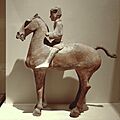
A Western Han painted ceramic mounted cavalryman from a general's tomb at Xianyang, Shaanxi.
-
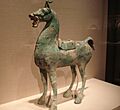
A Western or Eastern Han bronze horse statuette with a lead saddle.
-
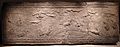
A Han dynasty brick relief with acrobats.
-
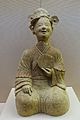
A ceramic statue of a seated woman holding a bronze mirror, Eastern Han.
-
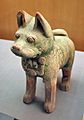
A dog figurine found in a Han tomb wearing a decorative dog collar, showing dogs were kept as pets.
-
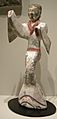
A Han pottery female dancer wearing Hanfu silk robes.
-
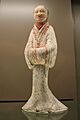
A ceramic female servant wearing Hanfu silk robes.
-
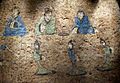
Western Han- or Xin-era murals showing men and women dressed in hanfu.
-
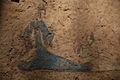
The Queen Mother of the West dressed in shenyi, from a tomb in Dongping, Shandong.
-
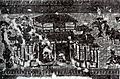
A rubbing of a Han pictorial stone showing an ancestor worship hall (cítang 祠堂).
-
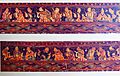
A scene of historic paragons of filial piety conversing with one another, Chinese painted artwork on a lacquerware basketwork box, excavated from a tomb of the Lelang Commandery on the Korean Peninsula dating to the Eastern Han.
-
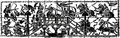
Eastern Han tombs sometimes have depiction of battles between Hu barbarians, with bows and arrows and wearing pointed hats (left), against Han troops; Eastern Han-era, Tsangshan tomb, Linyi; also visible in the Yinan tombs.
-
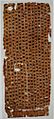
A fragmentary Daoist manuscript from the 2nd century BC, ink on silk, Mawangdui tomb #3.
-
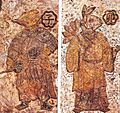
Anthropomorphized animalistic guardian spirits of day and night wearing Han-era robes, Han-era paintings on ceramic tile.
-
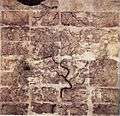
A silk map from the early Western Han depicting the kingdoms of Changsha and Nanyue in southern China, with the southern direction oriented at the top – Mawangdui tomb No. 3.
-
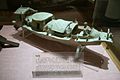
An Eastern Han pottery boat model with a steering rudder at the stern and anchor at the bow.
-
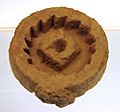
A Han era mold for making bronze gear wheels – Shanghai Museum.
-
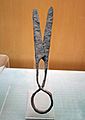
A pair of iron scissors dated to the Eastern Han period.
-
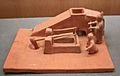
A Han dynasty pottery model of two men operating a winnowing machine with a crank handle and a tilt hammer used to pound grain.
-
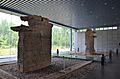
A pair of stone-carved que from the Eastern Han, at the temple of Mount Song in Dengfeng, Henan.
-
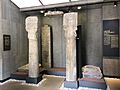
A pair of que from the Eastern Han in Babaoshan, Beijing.
-
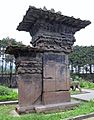
A stone-carved que 6 m in height from the Eastern Han, at the tomb of Gao Yi in Ya'an, Sichuan.
-
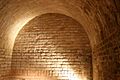
A vaulted tomb chamber made of small bricks from the Eastern Han, at Luoyang.
-
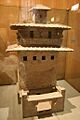
A Han pottery model of a granary tower with windows and balcony.
-
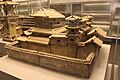
A pottery model of a palace from a Han dynasty tomb.
-
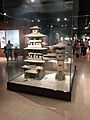
A painted ceramic architectural model depicting a fortified manor with towers, a courtyard, verandas, tiled rooftops, dougong support brackets, and a covered bridge extending from the third floor of the main tower to the smaller watchtower, found in an Eastern Han tomb at Jiazuo, Henan.
-
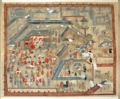
An Eastern Han (25–220) period Chinese mural of a mufu conference conducted by the Commandant-protector of the Wuhuan (护乌桓校尉) at his manor, from a Han tomb in Horinger, Inner Mongolia.


._Tsangshan_Han_tomb_in_Linyi_city.png)


See also
 In Spanish: Dinastía Han para niños
