
Lancaster County, Pennsylvania facts for kids
Quick facts for kids
Lancaster County
|
|||
|---|---|---|---|
|
|||

Location within the U.S. state of Pennsylvania
|
|||
 Pennsylvania's location within the U.S. |
|||
| Country |  United States |
||
| State |  Pennsylvania |
||
| Founded | May 10, 1729 | ||
| Area | |||
| • Total | 984 sq mi (2,550 km2) | ||
| • Land | 944 sq mi (2,440 km2) | ||
| • Water | 40 sq mi (100 km2) | ||
| Population
(2020)
|
|||
| • Total | 552,984 | ||
| • Estimate
(2025)
|
563,159  |
||
| • Density | 597/sq mi (231/km2) | ||
| Congressional district | 11th | ||


Lancaster County is an exciting and historic county found in the Commonwealth of Pennsylvania. Many people know it by its fun nicknames, such as the "Garden Spot of America" or Pennsylvania Dutch Country. The county seat, which is the main town where local leaders work, is the city of Lancaster. Over 550,000 people live in this bustling region, making it one of the most populated parts of Pennsylvania. It sits in the sunny South Central section of the state.
Visitors come from all around the planet to see the rolling green hills and traditional farms of Lancaster County. The region is famous for its large Amish population. Many Amish families travel in horse-drawn buggies instead of modern cars. Long ago, people arrived here seeking religious freedom on rich farmlands. Today, Lancaster County blends its centuries-old farming traditions with modern towns, energetic schools, and vibrant outdoor parks.
Contents
The Fascinating History of Lancaster County
Long before modern towns existed, diverse groups of Native Americans lived on this fertile land. People lived along the curving banks of the local rivers for thousands of years. They fished in the clear waters, planted crops, and built peaceful communities.
Early Native American Nations
Several distinct Native American nations made their homes across the area before European settlers arrived. These groups included the Shawnee, Gawanese, Lenape (also known as the Delaware), and Nanticoke people. Each nation had its own unique language family, traditions, and style of living. They respected the natural world and shared the abundant natural resources of the forest and waterways.
One of the most famous groups along the mighty Susquehanna River valley was the Susquehannock. Their name came from an Algonquian word meaning "Oyster River People," though they spoke an Iroquoian language. English settlers later called these people the Conestoga. That name came from their main town, Gan'ochs'a'go'jat'ga, which meant "roof-place." The Susquehannock established villages near the roaring Conewago Falls and throughout modern-day Conestoga Township.
Other Native nations and early European traders admired the Susquehannock for their great skill in trade and diplomacy. Later, they became closely connected with the famous Five Nation Iroquois Confederacy. Over the decades, many Conestoga people learned to speak English alongside their native tongues. They traded beautiful handmade baskets and brooms with European settlers, forming friendly bonds with their neighbors.
Colonial Beginnings and European Settlers
The land that became Lancaster County was included in the royal charter granted to William Penn in 1681. Penn wanted Pennsylvania to be a welcoming haven where people could worship peacefully without fear. Settlers quickly realized that the county had wonderful soil for growing healthy crops.
Lancaster County was officially organized on May 10, 1729, separating from neighboring Chester County, Pennsylvania. Leaders named it after the city of Lancaster in England. This name was chosen by an early settler named John Wright. As more families moved into the area, Lancaster County became a parent to several newer counties. Portions of its land were later carved out to help form York in 1749, Cumberland in 1750, Berks in 1752, Northumberland in 1772, Dauphin in 1785, and Lebanon in 1813.
Families from across Europe crossed the Atlantic Ocean to build new lives here. In the early 1700s, German-speaking Mennonite and Amish families arrived to farm the valleys. French Huguenot families, including believers escaping harsh laws under King Louis XIV, also settled on the land. Settlers also included English Quakers, Welsh pioneers, and Ulster Scots (often called Scotch-Irish in colonial times).
You can still see this rich cultural mix today in the names of the townships. Caernarvon and Lampeter came from Wales. Townships like Cocalico came from Native American words. Places like Warwick, Lancaster, Martic, Sadsbury, Salisbury, and Hempfield honored English homes. Settlers from Ulster, a northern province of Ireland, named Donegal, Drumore, Derry, and Leacock. Manheim came from Germany, while Earl was translated from the German family name Graf.
The Border Conflict: Cresap's War

During the 1730s, a surprising dispute broke out between Pennsylvania and its southern neighbor, Maryland. Both colonies believed that they owned the very same strip of rich farmland. Lord Baltimore, the leader of Maryland, believed his territory reached all the way north to the 40th parallel. If his claim had won, Philadelphia itself would have ended up inside Maryland!
A ferry operator named John Wright established Wright's Ferry in 1730 to carry travelers across the Susquehanna River. Soon, a Maryland man named Thomas Cresap set up a rival ferry near Peach Bottom and Columbia, Pennsylvania. Cresap claimed that Pennsylvania farmers were trespassing on Maryland property. He led armed raids to run settlers off their land, causing nearly a decade of clashes known as the Maryland-Pennsylvania boundary dispute.
The governors of both colonies argued over who had the legal right to enforce laws along the river. Pennsylvania officials arrested Cresap in 1736 after years of trouble, holding him until the King of Great Britain stepped in to restore calm. English courts eventually ruled against Maryland's big claims. Skilled surveyors were hired to draw an exact, permanent boundary between the colonies. Their famous survey line became known as the Mason–Dixon line, which officially settled the southern border of Lancaster County in 1767.
Great Leaders of the Nineteenth Century
Lancaster County was home to major political figures who helped guide the United States through turbulent times. James Buchanan, a member of the Democratic Party, lived here for many years. In 1856, Buchanan was elected the 15th President of the United States. He was the first Pennsylvania native to hold the nation's highest office. Visitors can explore his historic brick mansion, called Wheatland, which operates today as a public museum in Lancaster.
Another influential resident was Thaddeus Stevens, a prominent member of the Radical Republican group. Stevens represented Lancaster County in the United States House of Representatives during the Civil War era. He worked tirelessly to end unfair laws and championed public schools for all children. When Stevens passed away, he left money to create a school that eventually grew into the Thaddeus Stevens College of Technology. Both Buchanan and Stevens are buried in Lancaster cemeteries.
The Underground Railroad and the Quest for Freedom
Pennsylvania took an early stand against human bondage by passing An Act for the Gradual Abolition of Slavery in 1780. Because Lancaster County sat directly north of the Mason–Dixon line, it served as a vital haven for people escaping southern plantations. The wide Susquehanna River provided a natural travel route directly from the Chesapeake Bay into free northern communities.
Brave residents turned their homes into safe hiding stops along the secret network known as the Underground Railroad. Many German-speaking farmers and church groups firmly opposed slavery and helped travelers reach safety. Local researchers discovered at least seventeen different shelter stations across the county. These safe spots included hidden rooms with trapdoors, underground cellars, hillside caves, and even a secret brick tunnel running toward Octoraro Creek.
Tensions boiled over after the federal government passed the Fugitive Slave Law of 1850. This strict rule ordered northern citizens to help catch people who had escaped from southern owners. In September 1851, a Maryland plantation owner arrived in the small village of Christiana, Pennsylvania, hoping to capture several men who had fled to freedom. The escaping workers were sheltered by William Parker, a courageous free African-American leader who ran an organized self-protection group.
When the slaveholders confronted Parker's house, local neighbors gathered together to defend the freedom seekers. A fierce clash broke out, and the plantation owner was stopped. This dramatic standoff became known across the country as the Christiana Resistance. Federal officials brought many participants to trial in Philadelphia on serious charges, but the jury ruled that they were not guilty. The brave defense shown by ordinary citizens in Christiana inspired anti-slavery supporters throughout the Northern states.
Inventions and Craftsmanship from the County
Lancaster County's craftspeople and thinkers invented several famous tools and folk arts that helped build America:
- Fraktur: This colorful, hand-painted folk art features bright birds, flowers, and elegant German calligraphy. It was perfected by German Seventh Day Baptists living at the historic cloister in Ephrata.
- The Conestoga wagon: Local wagon makers designed these heavy, boat-shaped wooden wagons. Pulled by strong teams of horses, they carried pioneers and heavy goods westward. Their steering style popularized the American rule of driving on the right side of the road!
- The Pennsylvania Long Rifle: Also called the Kentucky Rifle, this lightweight and highly accurate firearm was handcrafted by Lancaster gunsmiths using spiral grooves inside the barrel.
- The Hamilton Electric 500: In 1957, the famous Hamilton Watch Company of Lancaster released the world's very first battery-powered wristwatch.
- Traditional quilts: Amish and Mennonite needleworkers became world-famous for sewing beautiful geometric quilts bursting with bold colors and tight stitching.
- The Stogie: The word for this long cigar is actually a shortened nickname for the town of Conestoga.
Geography and Natural Landscapes

According to the U.S. Census Bureau, Lancaster County covers an area of 984 square miles. Land makes up 944 square miles of that space, while water covers about 40 square miles, or 4.1 percent of the total area.
The county shares boundaries with several neighboring regions. Lebanon County sits directly to the north, and Berks County rests to the northeast. To the east lies Chester County. Looking south, Lancaster shares a border with Cecil County, Maryland, and Harford County, Maryland touches the southwest corner. The majestic Susquehanna River forms the natural western border, separating Lancaster from York County, Pennsylvania, while Dauphin County borders the northwest edge.
Local Weather and Climate
Lancaster County enjoys four distinct seasons with warm summers and brisk winters. Most of the county experiences a hot-summer humid continental climate. The rolling river areas along the Susquehanna have a slightly warmer humid subtropical climate.
Spring brings blooming wildflowers, greening pastures, and pleasant rains. Summers are sunny and warm, which helps crops like sweet corn, soybeans, and wheat grow tall. Autumn delivers crisp breezes and vibrant red and gold leaf colors across the forests. Winter brings freezing temperatures and several inches of fluffy snow, turning the farming valleys into quiet white wonderlands.
Rivers, Creeks, and Watersheds
Nearly every drop of rain that falls on Lancaster County drains into the Chesapeake Bay drainage basin through the Susquehanna River network. The only small exception is an unnamed brook in eastern Salisbury Township that flows into Brandywine Creek, heading toward the Delaware River.
The county is crisscrossed by lovely flowing streams:
- Conestoga River and its smaller twin, Little Conestoga Creek, which drain almost a third of the whole county.
- Pequea Creek, a curving stream that flows through peaceful farming plains.
- Chiques Creek, known for its picturesque rocky cliffs and hiking trails.
- Cocalico Creek, which winds past historical mills and small boroughs.
- Octoraro Creek, forming part of the southeast natural boundary.
- Conowingo Creek, a southern waterway that runs past green pastures.
Beautiful Parks, Preserves, and Serpentine Barrens
Outdoor enthusiasts can discover incredible natural wonders throughout Lancaster County. Susquehannock State Park covers 224 acres on high bluffs that offer spectacular panoramic views over the broad Susquehanna River. Visitors can hike shaded trails, spot soaring bald eagles, and enjoy relaxing family picnics. Nearby, the state maintains land around a historic 1923 fire tower within Penn Township as part of the William Penn State Forest.
The county also features six large Pennsylvania State Game Lands set aside for outdoor activities like wildlife photography, hunting, and trapping. The largest of these is Game Lands 46 near Hopeland, which spans over 5,000 protected acres of rugged forest.
Lancaster County is home to a very special, rare ecosystem known as serpentine barrens. In these unique locations, rare minerals like serpentinite rock create soils containing heavy metals. Because normal trees struggle to grow in this unusual dirt, the land forms open, natural grassland and savannas. Rare wildflowers, colorful butterflies, and unique grasses thrive here. Sites like the Rock Springs Nature Preserve, managed by the Lancaster County Conservancy, and the New Texas Barrens, protected by The Nature Conservancy, allow hikers to explore these unusual desert-like prairies.
Saving Farmland for the Future
Lancaster County leads the entire United States in protecting its family farms. As cities expand, open land is often turned into shopping malls or housing developments. To stop this from happening, county leaders, local townships, and groups like the Lancaster Farmland Trust work closely with farm owners.
Together, they use special legal agreements called conservation easements. When a farming family signs an easement, they agree that their property will remain open farmland forever. The owners still live on and work the land, but the property can never be divided into busy subdivisions. Lancaster County was the very first county in the nation to permanently preserve over 100,000 acres of prime agricultural soil!
Plants, Animals, and the Bog Turtle
The mixed woodlands, wetlands, and open meadows of the county provide cozy homes for many wildlife species. White-tailed deer, red foxes, cottontail rabbits, and wild turkeys are common sights across the countryside. Birdwatchers can spot bluebirds, barn owls, red-tailed hawks, and colorful songbirds nesting along fence rows.
Lancaster County is also famous in the world of biology as the discovery place of the tiny bog turtle. This miniature reptile measures only about three to four inches long, making it the smallest turtle species in North America. It was first identified in the county by a skilled local botanist and minister named Gotthilf Heinrich Ernst Muhlenberg. Muhlenberg discovered the secretive turtle while cataloging local wetland flora (plant life). The critter was officially given its modern common name of bog turtle in 1956. Because bog turtles depend on clean, shallow spring wetlands, local conservationists work hard to protect their sensitive habitats.
Communities and People
Lancaster County is a wonderful community made up of many diverse towns, historic boroughs, and peaceful rural hamlets.
Population and Diversity

More than 550,000 people live in Lancaster County. Most residents live in pleasant suburban towns and cities, while around 28 percent live on farms and rural roads. Over the years, the county has welcomed people from many different backgrounds and heritage traditions.
The population includes White, Black or African American, Asian, and Native American residents, as well as many multiracial families. Lancaster has also become home to a thriving Hispanic and Latino community, which represents more than eleven percent of the total population. People from Puerto Rico, the Dominican Republic, and Central America have brought energetic music, delicious restaurants, and colorful neighborhood festivals to the city of Lancaster and nearby towns.
Plain Anabaptist and Amish Communities
Lancaster County is world-renowned for its Amish community, which was established around 1760. Today, it represents the largest Amish settlement anywhere on Earth, with more than 40,000 members living across the countryside.
The Amish choose to live a simple, humble lifestyle focused on faith, family, and hard work. They practice what is called Plain dress, wearing modest, solid-colored clothing without buttons, zippers, or bright patterns. Most Amish families do not connect their homes to the public electrical grid. Instead, they light their rooms with gas lamps and power their washing machines with small air-powered engines. Rather than driving modern cars, they travel in black or gray horse-drawn buggies.
On their farms, Amish growers use strong draft horses to plow fields instead of motorized tractors. They speak a unique German dialect called Pennsylvania Dutch at home and in their neighborhoods, learning English when they start school.
The county is also home to other Plain religious groups:
- Old Order Mennonite families, who also wear modest clothing and travel in horse-drawn buggies.
- The Weaverland Old Order Mennonite Conference, whose members drive black cars instead of buggies.
- Small, traditional church communities like the Stauffer Mennonites, the Reidenbach Old Order Mennonites, and the Old Order River Brethren.
These close-knit communities are famous for helping one another. If a neighbor's barn is damaged by a storm or fire, hundreds of men and women gather for a "barn raising." Working together with hand tools, they can construct a brand-new wooden barn in just a single day!
Cities, Boroughs, and Towns
The county features a wide variety of towns, each with its own special character:
- Lancaster: The lively county seat, filled with art galleries, historic brick buildings, and the famous Central Market, which is one of the oldest continuously operating public farmers' markets in the nation.
- Ephrata: A bustling borough famous for its historic religious cloisters and large community fair.
- Elizabethtown: A college town located in the northwest corner of the county.
- Columbia: A historic riverside borough along the Susquehanna that played a major role in early canal and rail travel.
- Lititz: A storybook town founded by the Moravian Church in the 1740s, famous for chocolate manufacturing and tasty pretzels.
- Millersville: A friendly borough home to a major state university.
- Mount Joy, Manheim, and New Holland: Charming towns with proud manufacturing and farming histories.
Farming and the Local Economy

Lancaster County has a diverse and powerful economy that blends agriculture, factory production, healthcare, and tourism.
A Farming Powerhouse
Agriculture is the beating heart of Lancaster County. Thanks to its rich, lime-based soil and gentle rainfall, the county contains some of the best non-irrigated farmland in the entire world. Lancaster's 5,000-plus farms produce nearly one-fifth of all the agricultural food and fiber grown in Pennsylvania!
Livestock farming is especially important here. Local farms raise healthy dairy cattle, yielding millions of gallons of fresh milk used to make butter, yogurt, and ice cream. Poultry farms produce huge quantities of fresh chicken and eggs. Lancaster farmers also raise high-quality cattle and swine. Roadside farm stands can be spotted on almost every country lane, selling fresh sweet corn, juicy tomatoes, pumpkins, and homemade strawberry preserves.
Modern Businesses and Manufacturing
In addition to farming, Lancaster County has a strong manufacturing base. Skilled workers in the county build cabinetry, make precision tools, and package famous food products. Well-known companies that started or operate major centers in Lancaster include:
- Auntie Anne's: The famous soft pretzel company, which began as a small market stand in Downingtown and grew into an international bakery chain based in Lancaster.
- Turkey Hill Dairy: Located in the town of Conestoga, this dairy makes popular iced teas and delicious ice cream sold across the country.
- The Hershey Company and Pepperidge Farm: Both run large snack food and baking facilities in the area.
- Armstrong World Industries: A major creator of modern flooring and ceiling products.
- Dart Container: A maker of food packaging and containers.
- Wilbur Chocolate Company: Famous for creating tasty chocolate treats like Wilbur Buds in Lititz.
Fun and Adventure: Tourism in the County

Every year, millions of curious travelers visit Lancaster County to experience its peaceful countryside and fun family attractions. The tourism industry employs around 20,000 local workers.
Visitors love exploring the county's historic covered bridges. These wooden structures, often nicknamed "kissing bridges," were built with roofs and sturdy walls to protect their wooden floor beams from rain and snow. Pennsylvania has more standing covered bridges than any other state, and Lancaster County leads the state with 29 historic covered bridges still standing!
Families love visiting several famous attractions:
- Dutch Wonderland: A kingdom-themed amusement park with roller coasters and water slides designed especially for young kids.
- Strasburg Railroad: America's oldest continuously operating railroad, where kids can ride aboard historic steam trains puffing smoke through the farmlands.
- Railroad Museum of Pennsylvania: A huge museum displaying massive steam locomotives and historic train cars.
- Pennsylvania Renaissance Faire: A giant outdoor festival held each autumn on the grounds of Mount Hope Estate, featuring costumed knights, jousting tournaments, and music.
- Landis Valley Museum: A living history village where craftspeople show how early German settlers made tools, baked bread, and carded wool.
- Sight & Sound Theatres: A theater company famous for staging massive musical productions on a wrap-around stage featuring live farm animals.
Education and Learning
Schools in Lancaster County offer wonderful opportunities for kids and young adults to learn, explore, and prepare for bright futures.
Public School Districts
Lancaster County is divided into sixteen public school districts that educate tens of thousands of energetic students:
- Cocalico
- Columbia Borough
- Conestoga Valley
- Conrad Weiser Area
- Donegal
- Eastern Lancaster County
- Elizabethtown Area
- Ephrata Area
- Hempfield
- Lampeter-Strasburg
- Lancaster
- Manheim Central
- Manheim Township
- Octorara Area
- Penn Manor
- Pequea Valley
- Solanco
- Warwick
Lancaster is also home to excellent private and independent schools. Lancaster Country Day School provides challenging college-prep classes, while Linden Hall in Lititz, founded in 1746, is the oldest continuously operating independent boarding school for girls in the United States!
Colleges and Universities
Young people come from all over the world to attend Lancaster County's respected colleges and universities:
- Franklin & Marshall College: Founded in 1787, this historic liberal arts college in Lancaster is renowned for science, government, and history.
- Millersville University of Pennsylvania: A large, beautiful public university offering degrees in education, science, and the arts.
- Elizabethtown College: A private college located in Elizabethtown, known for its programs in business, engineering, and communications.
- Thaddeus Stevens College of Technology: A hands-on state college where students master automotive technology, carpentry, metal fabrication, and electrical engineering.
- Lancaster Bible College: A private institution focused on religious studies and community service.
- Pennsylvania College of Art and Design: A creative downtown Lancaster college where students study painting, graphic design, illustration, and photography.
Public Libraries
Kids who love reading can visit fourteen wonderful community libraries that belong to the Library System of Lancaster County. Created in 1987, this cooperative network allows readers to borrow books, audiobooks, and science kits from any branch in the county. The system also runs a popular mobile bookmobile that delivers exciting stories directly to rural neighborhoods and country schools.
Sports and Recreation
Sports are a big part of life in Lancaster County. Kids play in active youth baseball, soccer, basketball, and track leagues every weekend.
For professional sports fans, the local baseball team is the Lancaster Stormers. The Stormers play in the Atlantic League of Professional Baseball at their home ballpark in downtown Lancaster. They were previously called the Lancaster Barnstormers, named after traveling players who barnstormed across the countryside playing exhibition games. Their big local rivalry against the nearby York Revolution is called the "War of the Roses." The Stormers have thrilled hometown fans by winning multiple league championship titles!
Soccer fans can cheer for the Lancaster Inferno, a women's soccer team playing in the Women's Premier Soccer League. Roller derby fans love watching the Dutchland Derby Rollers, an exciting flat-track roller derby team based at the Overlook Activities Center. Long ago, the county was also represented by popular professional basketball and baseball teams known as the Lancaster Red Roses.
Getting Around: Transportation

Because Lancaster County lies right between Philadelphia and the state capital of Harrisburg, it has always been an important hub for travel. In 1794, builders completed the famous Philadelphia and Lancaster Turnpike, one of the earliest paved toll roads in the nation. It later became part of the famous coast-to-coast Lincoln Highway.
Modern Highways
Today, Lancaster County is connected by several major roadways:
- The Pennsylvania Turnpike (Interstate 76) cuts across the northern edge of the county, connecting travelers to Pittsburgh in the west and Philadelphia in the east.
- U.S. Route 30 carries cars and trucks east and west through the heart of the county.
- U.S. Route 222 links Lancaster with the city of Reading to the northeast.
- Pennsylvania Route 283 provides a direct expressway route northwest toward Harrisburg.
Drivers on country roads frequently share the asphalt with Amish buggies, so traffic signs throughout the county remind motorists to drive carefully and look out for horses!
Passenger and Freight Trains
Passenger train travel is very popular in Lancaster County. Amtrak operates high-speed electric passenger trains along the Keystone Corridor, connecting local towns to Philadelphia and New York City. The bustling Lancaster Train Station is one of the busiest train stations in the whole state of Pennsylvania! Passengers can also catch trains at smaller depots in Mount Joy and Elizabethtown.
Heavy freight trains run through the county on tracks owned by the Norfolk Southern Railway. These freight lines carry grain, lumber, and manufactured goods along the banks of the Susquehanna River, crossing the water on the historic Shocks Mills Bridge near Marietta.
For fun excursions, families can hop on board the Strasburg Rail Road, where vintage steam locomotives pull beautifully restored wooden passenger cars through miles of tranquil farmlands.
Aviation
Air travelers can use two main public airfields in the county. Lancaster Airport offers regional commercial flights and flying lessons. Near the town of Bird-in-Hand, Smoketown Airport provides hangar space and runway access for private pilots and small aircraft.
Local Government
Lancaster County is run by a board of three elected County Commissioners. These commissioners oversee county parks, maintain public records, supervise elections, and manage local government budgets. Voters also elect row officers, such as the Sheriff, the District Attorney, the Treasurer, and the Controller, to make sure county services run smoothly and fairly for everyone.
Images for kids
-
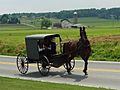
An Amish family in a traditional buggy
-

Amish children riding in the back of a buggy
-

An Amish farmer working with a team of draft horses
-

A traditional dairy farm in the county
-

Rolling dairy pastures in Lancaster County
-
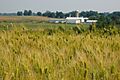
A bright summer grain field in Lancaster County
-

A hot air balloon flying over the landscape
-
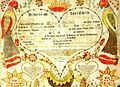
A colorful historic Fraktur baptismal certificate from 1788
-
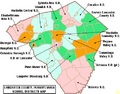
Map showing the sixteen public school districts
-
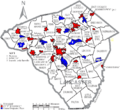
Map displaying the townships and boroughs
-

Map showing Pennsylvania German speaking areas
-
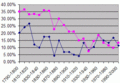
Chart showing historic population growth


See also
 In Spanish: Condado de Lancaster (Pensilvania) para niños
