
Arabic facts for kids
Quick facts for kids Arabic |
||||
|---|---|---|---|---|
| اَلْعَرَبِيَّةُ (al-ʿarabiyyah) | ||||

al-ʿarabiyyah in written Arabic (Naskh script)
|
||||
| Pronunciation | ||||
| Native to | Arab world and surrounding regions | |||
| Ethnicity | Arabs, and other ethnic groups of the Arab world | |||
| Native speakers | 411 million native speakers of all varieties (2020–2024) 70 million L2 users of all varieties (2020–2024) |
|||
| Language family | ||||
| Early forms: |
Proto-Afroasiatic
|
|||
| Standard forms | ||||
| Dialects |
Central Asian
Chadian
Levantine
Maghrebi
Mesopotamian
Peninsular
Saʽidi
Shirvani
Sudanese
|
|||
| Writing system | Arabic alphabet
Other official scripts
Latin script (Maltese alphabet) |
|||
| Official status | ||||
| Official language in |
24 states and territories
States and territories with limited recognition
International Organizations
|
|||
| Recognised minority language in | ||||
| Regulated by |
List
|
|||
| Linguasphere | 12-AAC | |||

Sole official language, Arabic-speaking majority
Co-official language, Arabic-speaking majority Co-official language, Arabic-speaking minority Not an official language, Arabic-speaking minority |
||||
|
||||
Arabic is a very important language spoken by millions of people around the world. It belongs to the Semitic language family, which also includes Hebrew. Most Arabic speakers live in the Arab world, a region stretching across North Africa and the Middle East.
Arabic is one of the most widely used languages globally. It is an official language of the United Nations and is the special language for the religion of Islam. Over 380 million people speak Arabic, making it one of the top five most spoken languages in the world. It is also very popular online.
Throughout history, Arabic has been a language of great learning. During the Middle Ages, many important discoveries in science, math, and philosophy were written in Arabic. This led to many Arabic words being borrowed into other languages, especially Spanish and Portuguese. The Maltese language, spoken on the island of Malta, even developed from an old Arabic dialect.
Arabic is written using the Arabic alphabet, which reads from right to left. There are different forms of Arabic: Classical Arabic, Modern Standard Arabic, and many spoken dialects. Classical Arabic is the language of the Quran, Islam's holy book. Modern Standard Arabic is used in schools, news, and official documents. The spoken dialects are what people use in their daily lives, and they can be quite different from each other.
Contents
The Arabic Language Family
Arabic is part of the Central Semitic language group. This group is a branch of the larger Afroasiatic language family. Other languages in the Semitic family include Hebrew and Aramaic.
Linguists study how these languages are related. They look at how grammar and words have changed over thousands of years. Arabic has kept many old features from its ancient ancestors.
A Look at Arabic History
Early Forms of Arabic
Long ago, many different Semitic languages were spoken in the Arabian Peninsula. The word "Arab" first described people living in areas like southern Syria and Mesopotamia. Over time, a group of related dialects, which scholars call "Old Arabic," began to appear.
The earliest writings that look like modern Arabic script date back to around 125 CE. A famous example is the Namara inscription from 328 CE. This inscription is an epitaph for a king. From the 4th to the 6th centuries, the old script slowly changed into the Arabic script we recognize today.
Classical Arabic and its Importance

Classical Arabic is the language found in the Quran, the holy book of Islam. It was used from before Islam up to the Abbasid Caliphate era. This form of Arabic has very specific grammar rules and a rich vocabulary.
In the late 500s AD, a special poetic language developed. This language was used by poets across different tribes. It helped unite people through shared stories and songs.
Making Arabic Standard
Around the 7th century, scholars began to set rules for Arabic grammar. A scholar named Abu al-Aswad al-Du'ali is known for starting this work. He helped create a system of dots and marks to make Arabic writing clearer. These marks helped people tell similar-looking letters apart and showed how to pronounce words.
Later, Al-Khalil ibn Ahmad al-Farahidi created the first Arabic dictionary. He also set rules for how Arabic poetry should sound. By the end of the 8th century, Arabic grammar and writing were largely standardized. This meant there was a clear, agreed-upon way to write and speak formal Arabic.
How Arabic Spread and Developed
Arabic spread widely with the growth of Islam. As new lands joined the Islamic world, Arabic became an important language for learning and government. It borrowed words from other languages like Middle Persian and Turkish. Many ideas from Ancient Greek also came into Arabic through translations.
By the 8th century, knowing Classical Arabic was key for people to succeed in many parts of the Islamic world. Even non-Muslim scholars, like the Jewish philosopher Maimonides, wrote their works in Arabic.
Over the centuries, scholars continued to study and improve Arabic. They created huge dictionaries and wrote many books about its grammar and sounds.
Modernizing Arabic: The Nahda
The Nahda was a cultural movement in the 1800s. During this time, writers wanted to update Arabic to fit the modern world. They aimed to make the language simpler and easier for more people to learn and read.
New printing presses helped spread Arabic books and newspapers. Scholars also worked to create new Arabic words for modern inventions and ideas. They formed special academies, like the Academy of the Arabic Language in Cairo, to help with this. These academies still work today to keep Arabic a living and growing language.
Different Kinds of Arabic
When people talk about "Arabic," they might mean a few different things.
- Classical Arabic is the oldest form. It is the language of the Quran and ancient poetry.
- Modern Standard Arabic (MSA) is based on Classical Arabic. It is used in schools, news, books, and official speeches today. Most educated Arabic speakers understand MSA.
- Spoken Arabic refers to the many everyday dialects. These are the versions of Arabic people use at home and with friends.
Classical vs. Modern Standard Arabic
Modern Standard Arabic (MSA) follows most of the grammar rules of Classical Arabic. It also uses much of the same vocabulary. However, MSA has changed to fit modern times. It uses new words for things like cars (sayyārah) and democracy (dīmuqrāṭiyyah).
One big difference is that MSA is simpler in some ways. For example, it uses a simpler number system. Also, in daily conversation, speakers often drop some of the complex endings that Classical Arabic uses.
Spoken Arabic Dialects

There are many different spoken Arabic dialects. These dialects can be very different from each other. For example, someone from Morocco might find it hard to understand someone from Iraq. This is similar to how Spanish and French are both Romance languages but sound very different.
These dialects are usually learned at home. They are used in informal settings, like TV shows and everyday chats. Some dialects, like Maltese, have even become their own separate languages. Maltese is unique because it uses the Latin script instead of the Arabic alphabet.
Arabic in the World
Two Ways of Speaking: Diglossia
Arabic has a special situation called diglossia. This means that people use two different forms of the language. They use their local spoken dialect for everyday life. They use Modern Standard Arabic for formal situations, like school or news.
Educated Arabs can usually switch between their dialect and Modern Standard Arabic. They might even mix them in the same conversation. While dialects can be very different, many Arabs feel they all speak one language.
Learning Arabic as a Foreign Language
Arabic is taught in schools and universities all over the world. Many Muslims learn Arabic because it is the language of the Quran. There are also many language schools in Arab and Muslim countries.
With technology, it's easier than ever to learn Arabic. There are apps, websites, and online classes. These resources help students learn Modern Standard Arabic and even some regional dialects.
Arabic Words and Their Journeys
How Arabic Got Words
Arabic has borrowed words from other languages throughout its history. For example, it took words from Aramaic and Persian. Some words for science and philosophy came from Ancient Greek.
- madīnah (مدينة, city) comes from Aramaic.
- lāzaward (لازورد, lapis lazuli) comes from Persian. This word also gave us "azure" in English.
Arabic Words in Other Languages

Arabic has greatly influenced many languages, especially in countries where Islam is important. You can find Arabic words in Persian, Turkish, Hindustani (Hindi and Urdu), and Swahili.
Even English has many words from Arabic! Some came directly, and others through languages like Spanish or French.
- admiral
- alcohol
- algebra
- coffee
- magazine
- sofa
- zenith
These words show how much Arabic culture and knowledge have traveled around the world.
How Arabic is Written
The Arabic Alphabet

Arabic is written using the Arabic alphabet. This alphabet developed from an older script called Nabataean. Unlike English, Arabic is written from right to left.
The Arabic alphabet has 28 letters. Many letters look similar but have different dots above or below them. Early Arabic writing didn't have these dots or short vowel marks. Scholars later added them to make reading clearer.
Beautiful Arabic Calligraphy

Arabic calligraphy is a very important art form. Calligraphers use the Arabic script to create beautiful designs. They often write verses from the Quran or famous sayings.
Because Arabic letters connect, they can be shaped into amazing patterns. Sometimes, the writing even forms the shape of an animal or object. Calligraphers are highly respected artists in the Arab world.
Writing Arabic with Latin Letters
Sometimes, people write Arabic using Latin letters (like the English alphabet). This is called romanization. It's often used for things like computer messages or text messages, where Arabic script might not be available.
To do this, people use numbers or other symbols for Arabic sounds that don't exist in English. For example, the number "3" might stand for the Arabic letter ⟨ع⟩. This informal way of writing is sometimes called the Arabic Chat Alphabet.
Arabic Numerals
You might be surprised to learn that the numbers we use every day (0, 1, 2, 3, etc.) are called Western Arabic numerals. They actually came from India and spread through the Arab world to Europe!
In some Arab countries, especially in the east, people use Eastern Arabic numerals (٠ – ١ – ٢ – ٣ – ٤ – ٥ – ٦ – ٧ – ٨ – ٩). When writing numbers, the smallest value is on the right, just like in English. However, when speaking numbers, Arabic often says the units before the tens, like "four and twenty" for 24.
Language and Identity
Throughout history, some groups have explored changing the Arabic script to Latin letters. This idea came up in places like Lebanon and Egypt. However, these efforts usually did not succeed. Many people felt that the Arabic alphabet was a strong part of their cultural identity and history. They wanted to keep their traditional script.
How Arabic Grammar Works
Arabic grammar has some unique features. It's different from English, but it's very logical once you learn its patterns.
Building Words from Roots

One of the most interesting things about Arabic is its "root-and-pattern" system. Most Arabic words come from a basic root, usually made of three consonants. You then fit these consonants into different patterns to create new words.
For example, the root k-t-b means "write."
- Add the pattern for "I did something," and you get katabtu (I wrote).
- Change the pattern, and you can get kitābun (book).
- Another pattern gives you kātibun (writer).
- And maktabun (desk or office).
This system allows many related words to be formed from just one root.
Nouns and Adjectives
Arabic nouns and adjectives change their endings based on their role in a sentence. They also change for singular, dual (for two of something), and plural. Nouns can be masculine or feminine.
For example, the plural of non-human nouns always uses a feminine singular adjective. So, you might say "the tall mountains" using a feminine singular form for "tall."
Verbs and Their Forms
Arabic verbs also change a lot. They show who is doing the action (I, you, he, she, we, they). They also show if the action happened in the past or is happening now.
There are also different "forms" of verbs. These forms can change the meaning of a verb. For example, from the root "write" (k-t-b):
- Form I: kataba (he wrote)
- Form II: kattaba (he made someone write)
- Form III: kātaba (he corresponded with someone)
These different forms help create a wide range of meanings from a single root.
Sample text
| Modern Standard Arabic, Arabic script | ALA-LC transliteration | English |
|---|---|---|
|
يولد جميع الناس أحراراً متساوين في الكرامة والحقوق، وقد وهبوا عقلاً وضميراً وعليهم أن يعامل بعضهم بعضاً بروح الإخاء. |
Yūlad jamīʻ al-nās aḥrār-an mutasāwīn fil-karāma-ti wal-huqūq-i, wa-qad wuhibū ʻaql-an wa-ḍamīr-an wa-ʻalayhim an yuʻāmil-u baʻduhum baʻd-an bi-rūh al-ikhāʼ-i. | All human beings are born free and equal in dignity and rights. They are endowed with reason and conscience and should act towards one another in a spirit of brotherhood. |
Images for kids
-
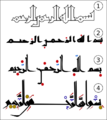
Evolution of early Arabic script (9th–11th century)

Images for kids
-
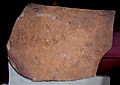
Safaitic inscription
-
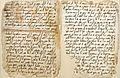
Arabic from the Quran in the old Hijazi dialect (Hijazi script, 7th century AD)
-
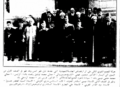
Coverage in Al-Ahram in 1934 of the inauguration of the Academy of the Arabic Language in Cairo, an organization of major importance to the modernization of Arabic.
-
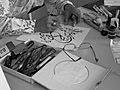
Arabic calligraphy written by a Malay Muslim in Malaysia. The calligrapher is making a rough draft.

_%D9%8A%D9%88%D9%85_%D8%AA%D8%AF%D8%B4%D9%8A%D9%86%D9%87.png)
See also
 In Spanish: Idioma árabe para niños
- Abjad numerals
- Arabic Ontology
- Arabic diglossia
- Arabic language influence on the Spanish language
- Arabic Language International Council
- Arabic literature
- Arabic–English Lexicon
- Arabist
- A Dictionary of Modern Written Arabic
- Glossary of Islam
- International Association of Arabic Dialectology
- List of Arab newspapers
- List of Arabic-language television channels
- List of Arabic given names
- List of countries where Arabic is an official language
- Arabic-based creole languages
- Varieties of Arabic
- List of French words of Arabic origin
- Replacement of loanwords in Turkish
