
Liberal Party of Australia facts for kids
Quick facts for kids
Liberal Party of Australia
|
|
|---|---|
 |
|
| Abbreviation |
|
| Leader | Angus Taylor |
| Deputy Leader | Jane Hume |
| Senate Leader | Michaelia Cash |
| Deputy Senate Leader | Anne Ruston |
| President | John Olsen |
| Founder | Robert Menzies |
| Founded | 13 October 1944 |
| Preceded by | United Australia |
| Headquarters | R. G. Menzies House, Barton, Australian Capital Territory |
| Think tank | Menzies Research Centre |
| Student wing | Liberal Students' Federation |
| Youth wing | Young Liberals |
| Women's wing | Federal Women's Committee |
| Overseas wing | Australian Liberals Abroad |
| Membership (2020) |  70,000–80,000 70,000–80,000 |
| Ideology |
|
| Political position | Centre-right to right-wing |
| National affiliation | Liberal–National Coalition |
| Regional affiliation | Asia Pacific Democracy Union |
| European affiliation | European Conservatives and Reformists Party (regional partner, until 2022) |
| International affiliation | International Democracy Union |
| Factions | Moderates Centre Right National Right |
| Colours | Blue |
| Governing body | Federal Council |
| Party branches |
|
| House of Representatives |
28 / 150
|
| Senate |
23 / 76
|
| State and territorial governments |
3 / 8
|
| State and territorial lower house members |
165 / 465
|
| State upper house members |
41 / 156
|
The Liberal Party of Australia (often called the LP or Liberals) is a major political party in Australia. It is known for its conservative and centre-right ideas. The Liberal Party is one of the two biggest parties in Australian politics, and its main competitor is the Australian Labor Party. The party was started in 1944 by Robert Menzies.
The Liberal Party works closely with the National Party in an alliance called the Liberal–National Coalition. This alliance usually focuses on issues important to country areas. When the Coalition is in charge of the government, the leader of the Liberal Party becomes the Prime Minister. The current leader of the Liberal Party is Angus Taylor. As the leader of the Liberal Party, he is also the Leader of the Opposition. Two former leaders, Robert Menzies and John Howard, were Australia's longest-serving Prime Ministers.
The Liberal Party has a structure that spreads across Australia. It has separate groups in all six states and the Australian Capital Territory (ACT). The Country Liberal Party (CLP) in the Northern Territory is also connected to them. In some states, like Queensland, the local Liberal and National parties have even joined together to form one party. Currently, the Liberal Party is part of the government in two states and one territory. They are the main opposition in New South Wales, Victoria, South Australia, and Western Australia, and in the ACT.
The party's ideas are often described as liberal and conservative. They usually support free markets and traditional values. Different groups within the party have slightly different views, from more central ideas to more right-wing ones.
Contents
- History
- How the Party Started
- The Menzies Era (1949–1966)
- The Holt Government (1966–1967)
- The Gorton Government (1968–1971)
- The McMahon Government and Snedden's Opposition Leadership (1971–1975)
- The Fraser Years (1975–1983)
- In Opposition (1983–1996)
- The Howard Government (1996–2007)
- In Opposition (2007–2013)
- The Abbott, Turnbull, and Morrison Governments (2013–2022)
- Federal Opposition (2022–present)
- Notable Firsts
- State and Territory Level
- Ideology
- Factions
- Organisation
- Images for kids
- See also
History
How the Party Started
Before the Liberal Party, there was a party called the United Australia Party (UAP). The ideas of the Liberal Party can be traced back to groups that opposed the Labor Party in the early days of Australia's parliament. In 1909, the Commonwealth Liberal Party was formed. Later, this party joined with others to become the Nationalist Party of Australia in 1917, and then the UAP in 1931.
The UAP was formed in 1931 and led by Joseph Lyons. This party won several elections during the Great Depression. They focused on reducing debt and balancing the budget to help Australia recover. After Lyons passed away in 1939, Robert Menzies became Prime Minister. However, the UAP faced difficulties and lost badly in the 1943 election.
From 1942, Menzies gave radio talks called "The Forgotten People." He spoke about the middle class as the "backbone of Australia" and felt they were often overlooked by politicians.
Menzies brought together different conservative groups in 1944. He shared his vision for a new political movement. He wanted a party that would work for fairness, national strength, and individual growth, but without relying on socialism.
The new party was officially announced in Sydney on 31 August 1945. It was named Liberal to honor the old Commonwealth Liberal Party. Many members of the old UAP joined the new Liberal Party. Important women's and youth groups also became part of the new party. By September 1945, the party had over 90,000 members.
The Menzies Era (1949–1966)
.jpg)

After losing the 1946 election, Menzies led the Liberals to a big win in the 1949 election. The party stayed in power for a record 23 years. Australia saw a lot of economic growth during this time. Menzies kept his promises to end rationing and helped families with children.
Menzies was against the Labor Party's plans to take over the banking system. He also strongly opposed Communism. He sent Australian troops to the Korean War and tried to limit the influence of the Communist Party in Australia. The Labor Party faced disagreements within its own ranks, which helped the Liberals win more elections.

During the Cold War, Menzies formed Australia's first military alliance outside of the British Commonwealth. This was the ANZUS Treaty with New Zealand and the United States in 1951. This treaty meant that an attack on one country would be seen as a threat to all. In 1954, the government signed another defense treaty called SEATO. That same year, a Soviet diplomat and his wife revealed spying activities in Australia, which Menzies investigated.
Menzies also supported universities by providing more funding. He continued a program to bring more immigrants to Australia and took steps to end the White Australia Policy. This policy had limited non-European immigration. In 1958, the government made it easier for people to enter Australia based on their skills. In 1962, a new law gave all Indigenous Australians the right to vote in federal elections. In 1949, the Liberals appointed Dame Enid Lyons as the first woman to serve in an Australian Cabinet. Menzies also helped Australia start trading with Japan, which led to a big increase in exports like coal and iron ore.
Menzies retired in 1966. He had been Prime Minister for 20 years, making him Australia's longest-serving leader.
The Holt Government (1966–1967)


Harold Holt took over from Robert Menzies in 1966. His government won a large victory in the 1966 election. Holt was Prime Minister until December 1967.
Holt continued many of Menzies' policies. He increased Australia's involvement in the Vietnam War, which caused some public protests. His government also changed Australia's money to decimal currency. Holt worked to strengthen Australia's ties with the United States and Asian countries. His government introduced the Migration Act 1966, which helped to end the White Australia Policy and allowed more non-European migrants, including refugees from the Vietnam War, to come to Australia.
.jpg)
Holt also called for the important 1967 Referendum. This vote gave the Federal Parliament more power over Aboriginal affairs. It also removed a unfair part of the Australian Constitution that excluded Indigenous Australians from the census. The referendum passed with huge support. After this, Holt created an Office of Aboriginal Affairs to help Indigenous Australians.
The Gorton Government (1968–1971)

The Liberals chose John Gorton to replace Holt. Gorton was a former pilot and had a strong Australian identity. Some people in his party found his personal style a bit challenging.
The Gorton government increased funding for the arts, creating the Australian Council for the Arts and supporting Australian films. His government passed laws for equal pay for men and women. They also increased pensions, allowances, and education scholarships. Free healthcare was provided to many poor Australians. Gorton's government kept Australia in the Vietnam War but stopped sending new troops by the end of 1970.

After the success of the 1967 Referendum, Gorton created the role of Minister for Indigenous Australians. He believed government policy should help Aboriginal people become self-supporting. His government started schemes like the Aboriginal Study Grants Scheme (ABSTUDY) to help Indigenous Australians get better education.
Gorton kept good relationships with the United States and Britain. He also worked to build closer ties with Asia. His government saw a drop in voter support in the 1969 election. Some Liberal leaders thought his policies were too focused on the central government. In 1971, he faced disagreements within his party and resigned as leader.
The McMahon Government and Snedden's Opposition Leadership (1971–1975)


.jpg)
William McMahon became Prime Minister after Gorton. The economy was starting to slow down. McMahon pulled Australia's remaining troops out of Vietnam. He also saw Neville Bonner join the Senate, becoming the first Indigenous Australian in the Australian Parliament. Bonner was a Liberal Senator for 12 years and worked on Indigenous and social welfare issues.
The McMahon government ended when Gough Whitlam led the Australian Labor Party to victory in the 1972 election, after 23 years of Liberal-Country Coalition rule. After this, John Gorton helped pass a motion in October 1973 that made laws fairer for all people across Australia.
Billy Snedden led the Liberal Party against Whitlam in the 1974 federal election, but Labor won again. When Malcolm Fraser became the Liberal Party leader in 1975, Gorton left the party.
The Fraser Years (1975–1983)
.jpg)

After some problems with government finances in 1974–75, the Malcolm Fraser-led Liberal-Country Party Coalition argued that the Whitlam government was not managing the country well. This led to a big political disagreement in 1975. The government was removed by the Governor-General, Sir John Kerr, and Fraser became caretaker Prime Minister. Fraser won a huge victory in the 1975 election.
Fraser kept some of the social changes from the Whitlam era. His government included Neville Bonner, the first Aboriginal federal parliamentarian. In 1976, a law called the Aboriginal Land Rights Act 1976 was passed. This law gave some traditional lands to Aboriginal people in the Northern Territory.
The Fraser government also started the multicultural broadcaster SBS. They welcomed Vietnamese refugees and opposed unfair white rule in South Africa and Rhodesia. However, some members left the party to form a new party called the Australian Democrats.
The Liberals under Fraser won elections in 1977 and 1980. However, they didn't make big changes to the economy. By 1983, Australia's economy was struggling, and there was a severe drought. Fraser's government faced disagreements about state and federal powers, like a dam project in Tasmania. The Liberal Party lost to the Bob Hawke-led Australian Labor Party in the 1983 election.
In Opposition (1983–1996)
.jpg)


After 1983, the Liberal Party went through a difficult time with disagreements between leaders like John Howard and Andrew Peacock. Australia's economy faced a recession in the early 1990s, and unemployment was high. Under Dr John Hewson, the opposition proposed big changes to the economy in a plan called "Fightback!" This plan included a new tax called the GST.
Labor Prime Minister Paul Keating strongly opposed the GST, saying it would hurt everyday people. Hewson faced a difficult interview where he struggled to explain how the GST would work, which many saw as a turning point. Keating won the 1993 election, and the Liberals remained in opposition.
The Howard Government (1996–2007)


Labor's Paul Keating lost the 1996 Election to the Liberals' John Howard. The Liberals had been in opposition for 13 years. John Howard became Prime Minister on 11 March 1996. With Howard as prime minister, Peter Costello as treasurer, and Alexander Downer as foreign minister, the Howard government stayed in power until 2007.
Howard's government was generally conservative on social issues and focused on reducing debt. However, Australia saw booming trade with Asia and increased immigration from many different countries. His government signed free trade agreements with the United States, China, Japan, and South Korea. After the September 11 attacks in the United States, the Howard government supported America's actions in Afghanistan and Iraq.
Howard supported traditional Australian institutions like the monarchy in Australia, ANZAC Day, and the Australian flag. His government sold some government-owned businesses and introduced the GST. Howard also held discussions and a vote in 1999 about whether Australia should become a republic (a country with a president instead of a monarch), but voters rejected the idea.
In the 2004 federal elections, the party won more seats and gained control of both houses of parliament. This allowed them to pass new laws, including those about workplaces and jobs called WorkChoices.
Howard often spoke about balancing Australia's history with its geography. He believed Australia should reflect its unique mix of past connections and its place in the world.
The 2007 federal election saw the Howard government defeated. The Liberal Party was then in opposition at both federal and state levels for a time.
In Opposition (2007–2013)

After the 2007 federal election, Dr Brendan Nelson became the leader of the Liberal Party. In 2008, Malcolm Turnbull became leader. Then, in 2009, Tony Abbott became leader. Abbott led the party in the 2010 federal election. This election resulted in a "hung parliament," meaning no single party won enough seats to form a government easily.
During this time, the party remained in opposition in Tasmania and South Australia. However, they won state government in Victoria in 2010. In March 2011, the Liberal-National Coalition in New South Wales, led by Barry O'Farrell, won a huge election victory. In Queensland, the Liberal and National parties had joined together in 2008. This new party, led by Campbell Newman, won government in 2012.
In March 2013, the Western Australian Liberal-National government won re-election. Later that year, Tony Abbott led the party to government in the 2013 Australian federal election.
The Abbott, Turnbull, and Morrison Governments (2013–2022)

The Abbott Government
The Abbott government focused on reducing the budget deficit. It signed free trade agreements with China, Japan, and South Korea. It removed previous taxes on mining and carbon. The government also investigated trade unions and created the Medical Research Future Fund.

Abbott worked to stop unauthorized boat arrivals to Australia. In foreign policy, Australia continued its military involvement in the Middle East. In 2015, the government agreed to resettle more refugees from that region. The government also started the New Colombo Plan to encourage student exchange with Asian countries.

Domestically, Abbott supported recognizing Indigenous Australians in the Australian Constitution. He also promised a public vote on same-sex marriage. The government prioritized investments in air and road infrastructure.
Treasurer Joe Hockey presented two budgets. The first faced a lot of opposition. The Liberal Party faced some challenges and changes in leadership. In September 2015, Malcolm Turnbull challenged Abbott for the leadership and won.
.jpg)
The Turnbull Government
Turnbull appointed Scott Morrison as Treasurer. The Turnbull government continued many of Abbott's plans. It held a public vote that approved legal recognition of same-sex marriage. It also continued campaigns against domestic violence, funded the National Disability Insurance Scheme, and reformed Senate voting.

In 2016, the government called an early election. They won, but with a very small majority. The Turnbull government then passed laws about registered organizations and building commissions. In 2017, they announced the construction of the Snowy 2.0 Pumped Storage Power Station.
Turnbull's removal of Abbott had caused disagreements within the Liberal Party. These tensions continued. In August 2018, Turnbull faced another leadership challenge. He won a vote against Peter Dutton, but decided to resign anyway. In a second vote, Scott Morrison became the new leader of the Liberal Party.

The Morrison Government
In the first Morrison Ministry, Josh Frydenberg became Treasurer and Marise Payne became Foreign Minister. After Turnbull left Parliament, the Coalition briefly lost its majority. However, Morrison restored the Coalition to majority government in the 2019 Election.
The Second Morrison Ministry included Ken Wyatt as Minister for Indigenous Australians, making him the first Aboriginal Australian in Federal Cabinet. It also had the largest number of women Cabinet members in Australian history.
.jpg)
.jpg)
In economic affairs, the government aimed for a budget surplus. However, the COVID-19 pandemic led to a big increase in government spending and a brief recession. The Morrison government focused on managing the pandemic. They put in place strict border controls, worked with state governments, and provided financial support for businesses and workers. Australia achieved low death rates and high vaccination rates during the pandemic. By March 2022, Australia's unemployment rate was very low.
In trade, the Morrison government signed free trade agreements with Indonesia, the United Kingdom, and India. In the Indo-Pacific region, Morrison launched the Pacific Step-Up to increase engagement with Pacific Island nations. He also revived the Quadrilateral Security Dialogue with Japan, India, and the United States. A new security agreement called AUKUS was signed with the United Kingdom and the United States. During this time, relations with China became difficult. Australia called for an inquiry into the origins of COVID-19, and China responded with trade sanctions. After the Russian invasion of Ukraine in 2022, Morrison committed Australian aid to support Ukraine.
The Morrison government was defeated in the 2022 election. After leaving office, Morrison faced criticism for secretly holding extra ministerial roles during the pandemic. Parliament formally expressed its disapproval.
Federal Opposition (2022–present)
_(cropped).jpg)
After the 2022 federal election, Peter Dutton was elected to lead the Liberal Party. In 2023, the Liberal/National government in New South Wales was defeated by the Labor Party.
In 2024, the party won government in Tasmania, Queensland, and the Northern Territory. At the start of 2025, polls suggested the Dutton-led Coalition might win the federal election. However, this lead disappeared due to campaigning issues and political events overseas.
.jpg)
The Liberal Party lost the 2025 election. Dutton lost his own seat in Brisbane. After this election, Dutton resigned as party leader and was replaced by Sussan Ley. Ley became the first woman to lead the Liberal Party and the first female Leader of the Opposition in Australian history.
In May 2025, the federal National Party briefly ended its agreement with the Liberal Party. This meant the two parties worked separately for a short time. However, the agreement was restored on 28 May 2025.
In her first speech as leader in June 2025, Sussan Ley spoke about the "Australian promise." She said that if people work hard, they should be able to build a better life for their families. She emphasized that the Liberal Party needs to respect, reflect, and represent modern Australia.
Notable Firsts
- 1949: First Liberal prime minister: Sir Robert Menzies wins 1949 election.
- 1949: First woman in an Australian Federal Cabinet: Dame Enid Lyons appointed.
- 1966: First female minister in an Australian Government: Dame Annabelle Rankin becomes minister for housing.
- 1971: First Aboriginal Parliamentarian: Neville Bonner becomes a senator for Queensland.
- 1995: First female opposition leader to win an election: Kate Carnell becomes Chief Minister of the Australian Capital Territory.
- 2010: First Aboriginal elected to House of Representatives: Ken Wyatt becomes Member for Hasluck.
- 2013: First Palestinian-Australian treasurer of Australia: Joe Hockey appointed treasurer.
- 2013: First female foreign minister: Julie Bishop appointed.
- 2013: First Aboriginal leader of a state or territory: Adam Giles becomes Chief Minister of the Northern Territory.
- 2015: First Aboriginal Assistant Minister in an Australian Government: Ken Wyatt becomes Assistant Minister for Health.
- 2015: First female minister for defence: Marise Payne appointed.
- 2017: First Aboriginal minister in an Australian Government: Ken Wyatt becomes minister for aged care and minister for Indigenous health.
- 2017: First Armenian-Australian premier of an Australian state: Gladys Berejiklian becomes Premier of New South Wales.
- 2018: First Jewish-Australian treasurer of Australia: Josh Frydenberg appointed treasurer.
- 2019: First Aboriginal Member for Federal Cabinet: Ken Wyatt appointed minister for Indigenous Australians.
- 2020: First Asian-Australian/Korean-Australian to lead a major Party: Elizabeth Lee becomes ACT Leader of the Opposition.
- 2025: First female Australian Federal Opposition Leader: Sussan Ley elected to lead Liberal Party.
State and Territory Level
Since the party started, the Liberals have been in power for long periods in most states. Queensland was an exception, where the National Party usually had more seats. However, in 2008, the Liberal and National Parties in Queensland merged to form the Liberal National Party of Queensland.
South Australia
The Liberal and Country League (LCL) was in power in South Australia for a long time, led by Premier Tom Playford. They changed their name to Liberal in 1974. Playford was premier from 1933 to 1965, partly due to a special system that helped them win elections.
Liberal David Tonkin became premier in 1979 for one term. The Liberals returned to power in 1993 and stayed for two terms with Premiers Dean Brown, John Olsen, and Rob Kerin. They were in opposition for 16 years until Steven Marshall led them to victory in 2018. Marshall's government was defeated in 2022.
Western Australia

Sir Ross McLarty was the first Liberal premier of Western Australia, winning elections in 1947 and 1950. Sir David Brand was a very successful Liberal premier, winning four elections from 1959 to 1968.
Sir Charles Court led the Liberals to three election wins in the 1970s. The Liberals returned to power in the 1990s under Richard Court. In 2008, Colin Barnett became premier after the Liberals won the election. He won a large majority in 2013.
Barnett's Liberals lost badly in the 2017 election. In 2025, the Liberals, led by Libby Mettam, won seven seats, allowing them to become the main Opposition Party again.
Victoria

The Liberals were in power in Victoria from 1955 to 1982. Jeff Kennett led the party back to government in 1992 and was premier until 1999. Ted Baillieu led the Liberal-National Coalition to government in Victoria in 2010. He was briefly followed by Denis Napthine, but their government was defeated in 2014.
New South Wales
In New South Wales, the Liberal Party has not been in office as much as Labor. Three leaders have led the party from opposition to government: Sir Robert Askin (1965–1975), Nick Greiner (1988–1992), and Barry O'Farrell (2011). The Coalition won another large victory in 2015, led by Premier Mike Baird, who planned many transport and infrastructure projects.
After Mike Baird resigned in 2017, Gladys Berejiklian became the first female Liberal premier. She led the Coalition to victory in 2019. Berejiklian and her successor Dominic Perrottet continued the party's infrastructure plans. The Coalition lost to Labor in the 2023 election.
Tasmania
Angus Bethune was the first Liberal premier of Tasmania in 1969. Robin Gray led the Liberals back to power in 1982 and 1986. Ray Groom won for the Liberals in 1992 and 1996. Will Hodgman won office for the Liberals in 2014, starting a long period of Liberal government. His successors Peter Gutwein and Jeremy Rockliff also won elections in 2021 and 2024.
Queensland
For many years, the Liberals were the smaller partner in the Coalition in Queensland. After the Liberal and National Parties merged in 2008, Campbell Newman led the new Liberal National Party of Queensland (LNP) to a huge victory in 2012. However, Labor returned to power in 2015 and stayed for almost a decade until David Crisafulli's victory in October 2024.
Northern Territory
The Country Liberal Party governed the Northern Territory from 1978 to 2001. After a period of Labor rule, the Country Liberal Party returned to office in 2012 under Terry Mills. Later, Adam Giles became leader, making him the first Aboriginal Australian to lead an Australian State or Territory. Giles lost the 2016 election. Lia Finocchiaro brought the Country Liberals back into office in the 2024 election.
Australian Capital Territory
The Liberals' Trevor Kaine became the first male Chief Minister of the ACT in 1989. In 1995, Liberal Kate Carnell became the first woman to lead any party from Opposition to Government in Australian history. She served as Chief Minister from 1995 to 1998. Gary Humphries kept the party in office until 2000.
The Liberals have been out of office in the Australian Capital Territory since 2000. Elizabeth Lee, a Korean-Australian, became the leader of the ACT Liberals in 2020, becoming the first Australian of Asian background to lead a major party. Lee led the party to defeat in the 2024 ACT election.
The Liberal Party does not officially run in most local government elections. However, many members do run as independent candidates.
Ideology
The Liberal Party has always had different ideas among its members. It mainly sees itself as a party that opposes Labor and socialism. It supports individual freedom and private businesses.
The party's founder, Robert Menzies, believed that Australia's middle class would be its main supporters.
In 1964, Menzies described the "Liberal Creed." He said that Liberals stand for freedom and believe in the individual. He said the party aims for fairness and security, national strength, and the full development of each person. He believed in setting individuals free and creating a society where rights and duties are respected.
In 1996, Prime Minister John Howard spoke about the "Liberal Tradition." He said that Australian Liberalism uses ideas from both classical liberal and conservative traditions. He called it the "broad church" of Australian Liberalism.
Historically, the Liberal Party was supported by the middle class. However, voting patterns have changed over time. The Liberal Party's main support base has been the upper-middle classes. In country areas, they either compete with or work with the Nationals.
Menzies strongly supported the monarchy in Australia and links to the Commonwealth of Nations. Today, the party has different views on whether Australia should become a republic. The Menzies government formed an alliance with the United States in 1951, and the party continues to strongly support this defense treaty.
At home, Menzies' governments managed an economy where many services were publicly owned. Commercial activities were also highly regulated. Liberal leaders generally kept high tariff levels (taxes on imported goods). Over time, especially in the 1980s, the party became more influenced by ideas that supported free markets, selling public services to private companies, and cutting taxes.
Socially, the party believes in liberty and free enterprise. Historically, Liberal governments have introduced important social reforms. These include opening Australia to multiethnic immigration under Menzies and Harold Holt. Holt's 1967 Referendum helped Aboriginal Rights. John Gorton supported cinema and the arts. Malcolm Fraser introduced the Aboriginal Land Rights Act 1976.
The Liberal Party is a member of the International Democracy Union and the Asia Pacific Democrat Union.
Factions
In the federal Liberal Party, there are two main groups, or "factions": the Moderates and the National Right. These groups can change, and sometimes people belong to more than one or none at all.
During the Morrison government, there were three main groups: a moderate wing, a centre-right wing, and a right wing. The centre-right was the largest group. After the 2022 Australian federal election, the National Right became the largest group. In 2025, Sussan Ley from the moderate faction was elected leader of the party.
Organisation
| Position | Leader | House or Senate | Electorate | Faction |
|---|---|---|---|---|
| Party office | ||||
| President | John Olsen | N/A | ||
| Treasurer | Charlie Taylor | N/A | ||
| Director | Andrew Hirst | N/A | ||
| Parliament | ||||
| Leader | Angus Taylor | House of Representatives | Hume, NSW | National Right |
| Deputy Leader | Jane Hume | Senate | Victoria | Moderate |
| Manager of Opposition Business in the House | Alex Hawke | House of Representatives | Mitchell, NSW | Centre Right |
| Manager of Opposition Business in the Senate | Jonathon Duniam | Senate | Tasmania | National Right |
| Senate Leader | Michaelia Cash | Senate | Western Australia | National Right |
| Deputy Senate Leader | Anne Ruston | Senate | South Australia | Moderate |
The Liberal Party's organization is mostly run by its six separate state divisions. This shows the party's original belief in a federal system of government. Party policies are mainly decided by the politicians in parliament, but party members also have some influence.
The smallest group in the Liberal Party is called a branch. This includes party members in a local area. For each election area, there is a conference that helps with campaigning and talks to the local politician or candidate. Each branch sends representatives to local, state, and federal conferences.
All the branches in a state are grouped into a Division. The main group for a Division is called a State Council. There is also one Federal Council that represents the entire Liberal Party in Australia.
Candidates for elections are chosen by a special group. This group includes representatives from the main office, branch leaders, and elected members from the branches.
Federal Parliamentary Leaders
State and Territory Divisions
| Division | Leader | Last election | Status | Federal representatives | |||||||||
|---|---|---|---|---|---|---|---|---|---|---|---|---|---|
| Lower House | Upper House | MPs | Senators | ||||||||||
| Year | Votes (%) | Seats | TPP (%) | Votes (%) | Seats | ||||||||
| Queensland | David Crisafulli | 2024 | 41.5 |
52 / 93
|
53.8 | N/A | Majority government |
21 / 30
|
5 / 12
|
||||
| Northern Territory | Lia Finocchiaro | 2024 | 49.0 |
17 / 25
|
57.1 | N/A | Majority government |
0 / 2
|
1 / 2
|
||||
| New South Wales | Kellie Sloane | 2023 | 26.78 |
25 / 93
|
45.73 | 29.78 |
10 / 42
|
Liberal–National Coalition opposition |
9 / 47
|
4 / 12
|
|||
| South Australia | Ashton Hurn | 2022 | 35.67 |
16 / 47
|
45.41 | 34.38 |
8 / 22
|
Opposition |
3 / 10
|
6 / 12
|
|||
| Tasmania | Jeremy Rockliff | 2024 | 36.67 |
14 / 35
|
N/A | N/A |
4 / 15
|
Minority government |
0 / 5
|
4 / 12
|
|||
| Canberra | Mark Parton | 2024 | 33.5 |
9 / 25
|
N/A | N/A | Opposition |
0 / 3
|
0 / 2
|
||||
| Victoria | Jess Wilson | 2022 | 29.76 |
19 / 88
|
45.00 | 29.44 |
14 / 40
|
Liberal–National Coalition opposition |
6 / 39
|
3 / 12
|
|||
| Western Australia | Basil Zempilas | 2025 | 28.0 |
7 / 59
|
42.9 | 27.27 |
10 / 36
|
Liberal–National opposition alliance |
5 / 15
|
5 / 12
|
|||
Federal Presidents
Networks and Party Wings
The Liberal Party has several groups for different members:
- The Australian Liberal Student's Federation (for students)
- The Federal Women's Committee (for women)
- The Young Liberals (for young people)
Other groups include Australian Liberals Abroad (for members living overseas) and a group for Norfolk Island.
Images for kids
-
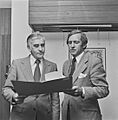
Billy Snedden and Andrew Peacock in 1973. They were the first two Liberal leaders who never served as Prime Minister.
-
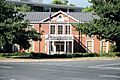
R.G. Menzies House, the Liberal Party's national headquarters, in Barton.
-
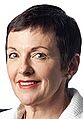
ACT Chief Minister Kate Carnell (1995–1998), was the first Liberal woman to lead a State or Territory.
-
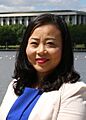
ACT Opposition Leader Elizabeth Lee (2020–2024), the first Asian-Australian to lead a major party.
-
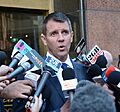
NSW premier Mike Baird (2014–2017) at the site of the Lindt Cafe terror attack.
-
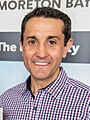
QLD premier David Crisafulli was elected in 2024.
-
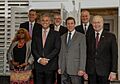
Country Liberal NT Chief Minister Adam Giles (standing second left), the first Aboriginal Australian to head a State or Territory, with his ministers in 2015.
-
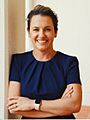
Country Liberal Lia Finocchiaro was elected Chief Minister of the Northern Territory in 2024.
.jpg)


.jpg)
Lindt_Cafe_Reopening_030.jpg)


See also
 In Spanish: Partido Liberal de Australia para niños
- Country Liberal Party (Northern Territory)
- Liberal National Party (Queensland)
- Liberal Party of Australia (New South Wales Division)
- Liberal Party of Australia (South Australian Division)
- Liberal Party of Australia (Tasmanian Division)
- Liberal Party of Australia (Victorian Division)
- List of political parties in Australia
- Turnbull Government (2015–2018)
- Abbott Government (2013–2015)
- Liberalism in Australia
- Moderates
- Young Liberal Movement of Australia
