
Mi'kmaq facts for kids
| L'nuk | |
|---|---|

Mi'kmaq flag
|
|

Mi'kma'ki, the Mi'kmaw country, and its districts, with the rest of the Wabanaki Confederacy labelled in light green.
|
|
| Total population | |
| 66,748 registered members (2023) 168,480 claimed Mi'kmaq ancestry (2016) |
|
| Regions with significant populations | |
| (Mi'kma'ki, Wapna'ki) Canada, United States |
|
| Newfoundland and Labrador | 28,282 |
| Nova Scotia | 18,814 |
| New Brunswick | 9,025 |
| Quebec | 7,655 |
| Maine | 1,489 |
| Prince Edward Island | 1,483 |
| Languages | |
| English, Mi'kmawi'simk, French American Sign Language, Quebec Sign Language, Maritime Sign Language |
|
| Religion | |
| Native American religion, Christianity, others | |
| Related ethnic groups | |
| Other Algonquian peoples Especially Abenaki, Maliseet, Passamaquoddy, Penobscot |
|
| ni'kmaq / l'nuk "my friends" / "people" |
|
|---|---|
| Person | Mi'kmaw (L'nu) |
| People | Mi'kmaq (Lnu'k) |
| Language | Mi'kmawi'simk |
| Country | Mi'kma'ki Wapna'ki |
The Mi'kmaq (pronounced MIG-mah, singular: Mi'kmaw) are an Indigenous group of people from the Northeastern Woodlands. Their traditional homeland, called Mi'kma'ki, covers areas in Canada's Atlantic Provinces, including Nova Scotia, New Brunswick, Prince Edward Island, and Newfoundland. It also includes the Gaspé Peninsula of Quebec and parts of Maine in the United States. Mi'kma'ki is one of the five connected countries of the Wabanaki Confederacy.
As of 2023, there are 66,748 Mi'kmaq people in this region. This number includes 25,182 members of the Qalipu First Nation in Newfoundland. According to the 2021 Canadian census, 9,245 people speak Mi'kmawi'simk, an Eastern Algonquian language. This language was once written using hieroglyphic writing but is now mostly written with letters from the Latin alphabet.
The Mi'kmaq, along with the Wolastoqiyik (Maliseet) and Pasamaquoddy nations, signed important agreements called the Peace and Friendship Treaties with the British Crown during the 1700s. The first treaty was signed in 1725, and the last in 1779. The Mi'kmaq believe they never gave up their land or other rights through these treaties. A major court decision in 1999 by the Supreme Court of Canada confirmed their right to hunt, fish, and trade, as promised in a 1752 treaty.
The Mi'kmaq Grand Council is an important group that works with the Canadian federal government and the Nova Scotia provincial government. This partnership was set up by a special agreement on August 30, 2010. This agreement, which includes all the First Nations in Nova Scotia, was the first of its kind in Canadian history. Historically, the Grand Council was the main government for the Mi'kmaq people. However, a law from 1876, called the Indian Act, changed how they were governed.
Contents
- Understanding the Name Mi'kmaq
- The Mi'kmaq Grand Council
- The Mi'kmaq Language
- Mi'kma'ki: The Mi'kmaq Homeland
- Current Relations with Mi'kmaq
- History
- Mi'kmaq Beliefs and Stories
- Mi'kmaq Communities Today
- Mi'kmaq Population Over Time
- Remembering the Mi'kmaq
- Important Mi'kmaq People
- See also
Understanding the Name Mi'kmaq
The name Mi'kmaq (singular: Mi'kmaw) comes from the word ni'kmaq, which means "my friends." You might see different spellings like Mi'gmaq or Míkmaq. The singular form, Mi'kmaw, is also used to describe things, like "Mi'kmaw Nation." The Mi'kmaq people also call themselves L'nu (plural: L'nuk), which means "the people."
The Mi'kmaq Grand Council
On August 30, 2010, the Mi'kmaq Nation and the Nova Scotia government made a historic agreement. This agreement recognized the Mi'kmaq Grand Council as the official group that works with the Canadian federal and Nova Scotia provincial governments. This agreement was a first for Canada, including all First Nations in Nova Scotia.
Historically, the Grand Council, also known as the Sante' Mawio'mi, was the main government for the Mi'kmaq people. It was made up of chiefs from different districts of Mi'kma'ki. The 1876 Indian Act changed this system, asking First Nations to create elected governments like the Canadian model. This law tried to limit the Grand Council's role to spiritual guidance.
The Grand Council included leaders called Keptinaq (meaning "captains"), elders, and putús (who were historians and helped with treaties). There was also a women's council and a grand chief. The grand chief was usually a leader from the Unamáki district, which is Cape Breton Island. This title was often passed down through families.
In 1610, Grand Chief Henri Membertou became Catholic and formed an alliance with the French. The Mi'kmaq, who were trading partners with the French, allowed some French settlements in their territory.

Gabriel Sylliboy (1874–1964) was a respected Mi'kmaq leader and Grand Chief of the Council, elected in 1918. He held this position for the rest of his life. In 1927, he faced legal challenges in Nova Scotia. He was the first to use the rights from the Treaty of 1752 in his defense, but he lost his case at that time. Later, in 1985, the Supreme Court of Canada finally recognized the 1752 treaty rights for Indigenous hunting and fishing. In 2017, Grand Chief Sylliboy received a special pardon from the Nova Scotia government, 50 years after his passing.
The Grand Council traditionally met on a small island called Mniku in the Bras d'Or Lake on Cape Breton. Today, this area is part of the Chapel Island reserve, also known as Potlotek. The Grand Council still meets at Mniku to discuss important issues for the Mi'kmaq Nation.
The Mi'kmaq Language
The Mi'kmaq language, called Mi'kmawi'simk, is spoken by many Mi'kmaq people. According to the 2021 census, 9,245 people identified as speakers of the language. For 4,910 of them, it was their first language, and 2,595 spoke it most often at home.
Ancient Writing: Hieroglyphs
The Mi'kmaq language was once written using Mi'kmaq hieroglyphic writing. This system was developed in 1677 by a French missionary named Chrestien Le Clerq. He noticed Mi'kmaq children using marks to remember prayers and created a hieroglyphic system to help teach Catholic prayers and hymns. Today, the language is mostly written using the Latin alphabet.
At Kejimkujik National Park and National Historic Site, you can find petroglyphs (ancient rock carvings) that show Mi'kmaq life. These carvings include hieroglyphics, human figures, houses, decorations, boats, and animals etched into slate rocks. These petroglyphs were made by the Mi'kmaq, who have lived in this area for thousands of years.
Jerry Lonecloud (1854–1930), a Mi'kmaq elder, was known for documenting Mi'kmaq culture. In 1912, he copied some of the Kejimkujik petroglyphs and shared his work with the Nova Scotia Museum. He also created the first Mi'kmaq memoir, based on his oral stories.
.jpg)
Christian Kauder, a missionary from Luxembourg, worked in Mi'kma'ki from 1856 to 1871. He included examples of Mi'kmaq hieroglyphic writing, like the Holy Mary Rosary prayer and the Lord's Prayer, in a German book he published in 1866. Researchers David L. Schmidt and Murdena Marshall later published some of these hieroglyphic prayers and stories in a 1995 book. They believe this is the oldest writing system for an Indigenous language in North America, north of Mexico.
Where the Name "Mi'kmaq" Comes From
By the 1980s, the spelling Mi'kmaq became widely used by scholars and the media. It replaced the older spelling Micmac, which some Mi'kmaq people feel is connected to colonialism. The "q" ending is used for the plural, and Mi'kmaw is used for one person or as an adjective.
The Mi'kmaq people prefer to use one of three current spellings for their language. These include Mi'kmaq (singular Mi'kmaw) in Prince Edward Island, Nova Scotia, and Newfoundland. Other spellings like Miigmaq and Mi'gmaq are used in different regions.
The Mi'kmaq call themselves Lnu (plural: Lnúk or Lnu'k), which means "human being" or "the people." Historically, they used níkmaq (my kin) as a friendly greeting.
Early French explorers called the Mi'kmaq "Souriquois" or "Gaspesiens." The British sometimes called them "Tarrantines." The word "Mi'kmaq" itself is thought to mean "the family" or "the brothers/allies." Some historians also suggest it might come from words related to "red earth," as the Mi'kmaq may have identified as "the Red Earth People."
Mi'kma'ki: The Mi'kmaq Homeland
.svg)
The Mi'kmaq homeland, Mi'kma'ki, is traditionally divided into seven districts. Before the Indian Act was put in place, each district had its own government and boundaries. These governments had a district chief and a council. The council members were band chiefs, elders, and other community leaders. They made laws, handled justice, managed hunting and fishing areas, and made decisions about war and peace.
Mi'kmaq Districts
The eight Mi'kmaq districts are Epekwitk aq Piktuk (Prince Edward Island and Pictou), Eskikewa'kik, Kespek (Gaspésie), Kespukwitk, Siknikt, Sipekni'katik, Ktaqmkuk (Newfoundland), and Unama'kik (Cape Breton).
Current Relations with Mi'kmaq
Working Together: The Tripartite Forum
In 1997, the Mi'kmaq–Nova Scotia–Canada Tripartite Forum was created. On August 31, 2010, the governments of Canada and Nova Scotia signed an important agreement with the Mi'kmaq Nation. This agreement means the federal government must talk with the Mi'kmaq Grand Council before starting any projects or activities that might affect the Mi'kmaq in Nova Scotia. This was the first agreement of its kind in Canada to include all First Nations in an entire province.
Fishing Rights: The Marshall Decision
On September 17, 1999, the Supreme Court of Canada made a landmark ruling in the case of Donald Marshall Jr.. This decision confirmed the treaty rights of Mi'kmaq people to hunt, fish, and gather resources to make a living. The court referred to a 1752 treaty that promised these rights. Before this ruling, these rights were not always respected. Donald Marshall Jr. had faced unfair legal challenges in 1993 for fishing eels. He famously said, "I don't need a licence. I have the 1752 Treaty."
After the 1999 decision, there were disagreements over fishing practices in Miramichi Bay, a major lobster fishing area. Mi'kmaq fishers began setting lobster traps outside the usual commercial season. This led to tensions between Mi'kmaq fishers and other commercial fishers. The Canadian Department of Fisheries and Oceans (DFO) later worked with the Mi'kmaq to find solutions. The DFO offered to buy commercial fishing licenses to help Mi'kmaq fishers expand their lobster fishery.
However, even today, some regulations prevent Mi'kmaq lobster fishers from selling their catch to non-Mi'kmaq buyers. Mi'kmaq fishers say this doesn't fully respect the Marshall decision. In 2019, the Listuguj First Nation in Quebec created its own lobster fishing plan. In 2020, a group of Mi'kmaq First Nations and a company called Premium Brands Holdings Corporation bought Clearwater Seafoods, a large seafood company. This was the biggest investment in the seafood industry by an Indigenous group in Canada.
Disagreements Over Lobster Fishing (2020–Present)
| Dispute over rights-based inshore lobster fishery | |||
|---|---|---|---|
| Date | September 2020 – ongoing | ||
| Location | |||
| Caused by | Mi'kmaq exercising their treaty rights to fish | ||
| Status | ongoing | ||
| Parties to the civil conflict | |||
|
|||
| Charged | 23 | ||
Since September 2020, there have been ongoing disagreements about lobster fishing between members of the Sipekne'katik First Nation and other lobster fishers in Nova Scotia.
Background to the Dispute
In October 2020, Mi'kmaq chiefs declared a state of emergency, and the federal government appointed a special representative to investigate. The Sipekne'katik First Nation created a fishing plan based on their right to fish for a moderate living. They issued lobster licenses to their members, allowing them to fish in St. Marys Bay, which is a very important lobster fishing area. This led to strong disagreements between Mi'kmaq fishers and other fishers in nearby coastal communities.
Legal Actions
In March 2021, 43 Mi'kmaq lobster fishers from the Sipekne'katik First Nation filed a lawsuit against the Canadian government, the RCMP, the DFO, and some non-Indigenous fishers. The lawsuit claims that the non-Indigenous fishers acted unfairly and that the DFO and RCMP did not do enough to prevent harm.
Discussions with the DFO
In October 2020, talks between the Mi'kmaq Rights Initiative and the DFO about defining "moderate livelihood" paused. Some Mi'kmaq chiefs, like Terry Paul of Membertou First Nation, decided to pursue treaty rights negotiations outside of the main Assembly of Nova Scotia Mi'kmaq Chiefs, seeking more transparency.
In March 2021, Fisheries Minister Bernadette Jordan sent a letter to Chief Mike Sack, outlining terms for a moderate livelihood fishery. These terms suggested that Mi'kmaq fisheries would operate within established seasons. Chief Sack rejected these terms, stating that the Mi'kmaq had their own management plan that was better for conservation.
Truth and Reconciliation: Residential Schools
In 2005, Mi'kmaw elder Nora Bernard from Nova Scotia led the largest class-action lawsuit in Canadian history. This lawsuit represented about 79,000 survivors of the Canadian Indian residential school system. The Government of Canada agreed to a settlement of over $5 billion.
In 2011, the Indian Residential Schools Truth and Reconciliation Commission visited communities in Atlantic Canada. Many Mi'kmaw children had difficult experiences at the Shubenacadie Indian Residential School between 1930 and 1967. The Commission worked to document these experiences and promote healing.
Mi'kmaq Kina' matnewey: Education Success
The first Mi'kmaq-operated school in Nova Scotia, called Mi'kmaq Kina' matnewey, was started in 1982. This was a partnership between the Mi'kmaq community and the Nova Scotia government. This school program is considered one of the most successful First Nation education programs in Canada.
By 1997, Mi'kmaq communities on reserves were given control over their own education. By 2014, there were 11 band-run schools in Nova Scotia. The province now has the highest rate of Indigenous students staying in school in Canada, and more than half of the teachers are Mi'kmaq. From 2011 to 2012, there was a 25% increase in Mi'kmaq students attending university.
History
Life Before European Contact

Archaeological findings in southwestern Nova Scotia show that the Mi'kmaq have used their traditional lands and resources for at least 4,000 years. In Kejimkujik National Park and National Historic Site, ancient canoe routes have been used by Indigenous people for thousands of years. Mi'kmaq traditions tell of a long war with the Kwēdĕchk, who were the original inhabitants of the land, before the Mi'kmaq became the main people in the area.
Before Europeans arrived, Mi'kmaq communities had a close relationship with nature. They fished, hunted, and gathered food, moving with the seasons. In winter, they lived in smaller camps inland, and in summer, they gathered in larger communities along the coast. They fished for smelt, herring, and cod, and gathered waterfowl eggs. They also hunted moose and caribou in the interior. Moose was especially important, providing meat for food, skin for clothing, and bones for tools.
Early European Contact (16th-18th Centuries)
The Mi'kmaq territory was one of the first parts of North America that Europeans visited for resources. Explorers like John Cabot and Jacques Cartier reported on the area, leading to visits from European fishermen and whalers starting in the 1500s.
These European fishing camps began trading with Mi'kmaq fishermen, and this trade quickly grew to include furs. By 1578, many European ships were operating around the Saint Lawrence area. Trading furs for European goods changed Mi'kmaq society. Men spent more time trapping in the interior, which made them more aware of their hunting territories. Larger groups of Mi'kmaq started gathering in fewer summer locations, leading to the formation of bigger bands led by skilled traders.
The Mi'kmaq used bear teeth and claws for decoration. Women created beautiful designs on clothing and moccasins using porcupine quills. Their main hunting weapon was the bow and arrow, made from maple wood. They ate many kinds of fish, shellfish, and eels, as well as seabirds and marine mammals like seals and whales.
Colonial Wars and Treaties
After conflicts with English colonists in New England, the Mi'kmaq joined the Wabanaki Confederacy. This alliance included other Algonquian-speaking nations like the Abenaki and Maliseet. The Wabanaki Confederacy was also allied with the Acadian people.
For 75 years, the Mi'kmaq and Acadians fought to prevent the British from taking over their region. France lost military control of Acadia in 1710 and its political claim (except for Cape Breton) in 1713 with the Treaty of Utrecht. However, the Mi'kmaq were not part of this treaty and never agreed to give up their land to the British. In 1715, they told the French that the French king couldn't give away land that wasn't his. European laws at the time claimed that land not owned by Christians could be taken by Christian rulers.
The Mi'kmaq, along with Acadians, resisted British settlements by raiding towns like Halifax and Dartmouth. During the French and Indian War, the Mi'kmaq helped the Acadians resist the British during the expulsion. British control grew after their victory at Louisbourg in 1758. In 1763, Great Britain officially claimed all of Mi'kma'ki in the Treaty of Paris.
Peace and Friendship Treaties

Between 1725 and 1779, the Mi'kmaq, Wolastoqey, and Peskotomuhkati nations signed many agreements called the Covenant Chain of Peace and Friendship Treaties. Through these treaties, they aimed to have a peaceful relationship with the British Crown. The Mi'kmaq maintain that they never gave up their land or other rights through these agreements.
The Halifax Treaties (1760–1761) marked the end of major warfare between the Mi'kmaq and the British. While these treaties included statements of Mi'kmaq submission, later statements show that the Mi'kmaq intended a friendly and equal relationship. Their goals were to make peace, establish fair trade, and build lasting friendship. In return, the Mi'kmaq offered friendship and allowed some British settlement, but without formally giving up their land. They expected that any new British settlements would be negotiated and accompanied by gifts.
The arrival of many new settlers, like the New England Planters and United Empire Loyalists, put pressure on Mi'kmaq lands and the treaties. This led to economic, environmental, and cultural challenges for the Mi'kmaq. During the American Revolution, many Mi'kmaq and Maliseet tribes supported the Americans against the British.
As their military strength lessened in the early 1800s, the Mi'kmaq asked the British to honor the treaties and provide "presents" for occupying Mi'kma'ki. The British responded by offering help, often called "relief." They also suggested that the Mi'kmaq should change their way of life, settle on farms, and send their children to British schools.

Gabriel Sylliboy was the first Mi'kmaq Grand Chief elected in 1919. He was also the first to fight for treaty recognition, specifically the Treaty of 1752, in the Supreme Court of Nova Scotia.
In 1986, the first Treaty Day was celebrated in Nova Scotia on October 1st. This day recognizes the treaties signed between the British Empire and the Mi'kmaq people. The treaties were officially recognized by the Supreme Court of Canada in 1982 when they became part of the Constitution Act.
The 19th Century: Changes and Innovations
Royal Acadian School and Support
Walter Bromley was a British officer who lived in Halifax from 1813 to 1825. He started the Royal Acadian School and supported the Mi'kmaq people. Bromley believed that Indigenous people were not naturally inferior and worked to help them improve their lives through settlement, farming, and education. He also studied their languages.
Mi'kmaq Missionary Society
Silas Tertius Rand helped create the Mi'kmaq Missionary Society in 1849. He lived in Hantsport, Nova Scotia, and traveled widely among Mi'kmaq communities. He shared the Christian faith, learned the Mi'kmaq language, and recorded many Mi'kmaq oral traditions. Rand translated parts of the Bible into Mi'kmaq and Maliseet, created a Mi'kmaq dictionary, and introduced the stories of Glooscap to a wider audience.
Mi'kmaq Hockey Sticks

The Mi'kmaq people have played ice hockey for a very long time, with records going back to the 1700s. Since the 1800s, the Mi'kmaq have been known for inventing the ice hockey stick. The oldest known hockey stick, made by Mi'kmaq people from Nova Scotia between 1852 and 1856, was carved from hornbeam wood. This stick was recently sold for a large sum of money.
In 1863, the Starr Manufacturing Company in Dartmouth, Nova Scotia, began selling "Mic-Mac" hockey sticks across Canada and internationally. Hockey became very popular in Canada in the 1890s, and the Mic-Mac hockey stick was the best-selling stick in Canada during the early 1900s. By 1903, making these hockey sticks was a main job for many Mi'kmaq on reserves in Nova Scotia. The Mi'kmaq continued to make hockey sticks until the 1930s, when the process became industrialized.
Gallery of 19th-century Images
-
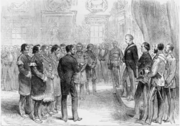
Grand Chief Jacques-Pierre Peminuit Paul (3rd from left with beard) meets Governor General of Canada, Marquess of Lorne, Red Chamber, Province House, Halifax, Nova Scotia, 1879.
-
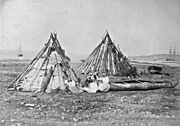
Mi'kmaq encampment, Sydney, Cape Breton Island
-
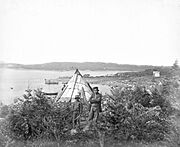
A Mi'kmaq father and child at Tufts Cove, Nova Scotia, around 1871
-
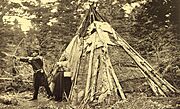
Mi'kmaq people (1873)
-
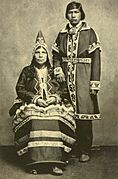
Mi'kmaq people (1865)


The 20th and 21st Centuries
Jerry Lonecloud worked with historian Harry Piers to document Mi'kmaq culture in the early 1900s. Lonecloud's memoir is considered the first Mi'kmaq memoir.
World Wars and Service
Over 150 Mi'kmaq men joined the armed forces during World War I. During World War II, more than 250 Mi'kmaq volunteered. In the 1950s, over 60 Mi'kmaq served in the Korean War.
Mi'kmaq of Newfoundland: Seeking Recognition
When Newfoundland and Labrador joined Canada in 1949, the political leader, Joey Smallwood, stated that there were "no Indians in Newfoundland." This meant that the Mi'kmaq people of Newfoundland did not receive the same official recognition as other Indigenous groups in Canada for many years.
In 1972, activists formed the Native Association of Newfoundland and Labrador to represent the Mi'kmaq, Innu, and Inuit peoples. Later, it became the Federation of Newfoundland Indians (FNI), representing six Mi'kmaq bands.
In 1987, the Miawpukek Mi'kmaq First Nation at Conne River was officially recognized under the Indian Act. However, recognition for the other Mi'kmaq in Newfoundland took much longer.
In 2011, the Canadian government officially recognized the Qalipu First Nation in Newfoundland and Labrador. This new band, which does not have its own reserve land, received many applications for membership. By 2021, nearly 24,000 people were recognized as founding members across 67 communities in Newfoundland and beyond. In November 2019, the Qalipu First Nation was accepted by the Mi'kmaq Grand Council as part of the Mi'kmaq Nation. There are still ongoing legal discussions about the membership process for the Qalipu First Nation.
Mi'kmaq Beliefs and Stories

Mi'kmaq Faith Today
Some Mi'kmaq people practice the Catholic faith, while others follow traditional Mi'kmaq beliefs. Many have adopted both, as they find the two systems can exist together.
Oral Traditions: Stories and Wisdom
The Mi'kmaq people traditionally passed down their history and knowledge through oral stories. They had very few physical records like petroglyphs, and it's believed they didn't have a written language before Europeans arrived. Storytelling was very important, with three main types: religious narratives, legends, and folklore. These stories explain how the world and society were created, and how people came to be. The most famous Mi'kmaq stories are about Glooscap, a powerful cultural hero. Good storytellers were highly valued because they shared important lessons and provided entertainment.
One story tells how the creator-sun-god wept tears that caused a great flood because of wickedness among people. Only an old man and woman survived in a bark canoe to repopulate the earth.
Special Places: Spiritual Sites
One important spiritual place for the Mi'kmaq Nation is Mniku, on Unama'ki. This is where the Mi'kmaq Grand Council, or Sante' Mawio'mi, gathers. It's also the site of the St. Anne Mission, a significant pilgrimage site for the Mi'kmaq. The island has been declared a historic site.
Traditional Plant Uses (Ethnobotany)
The Mi'kmaq traditionally use the Abies balsamea (balsam fir) tree for many purposes. They use its buds, cones, and inner bark for various health needs. The gum is used for burns and colds, and the bark for making a drink. The boughs are used to make beds, and the wood is used for starting fires and as fuel.
Mi'kmaq Communities Today
Mi'kmaq names in the following table are spelled using different writing systems. The Smith-Francis orthography is the most recent and is used in Nova Scotia and most Mi'kmaq communities.
Mi'kmaq Population Over Time
| Year | Population | Verification |
|---|---|---|
| 1500 | 4,500 | Estimation |
| 1600 | 3,000 | Estimation |
| 1700 | 2,000 | Estimation |
| 1750 | 3,000 | Estimation |
| 1800 | 3,100 | Estimation |
| 1900 | 4,000 | Census |
| 1940 | 5,000 | Census |
| 1960 | 6,000 | Census |
| 1972 | 10,000 | Census |
| 1998 | 15,000 | SIL |
| 2006 | 20,000 | Census |
| 2021 | 66,748 | Census |
Before Europeans arrived, the Mi'kmaq population is estimated to have been between 3,000 and 30,000 people. In the 1600s, European diseases, to which the Mi'kmaq had no immunity, caused a large decrease in their population. The population reached its lowest point in the mid-1600s. After that, the numbers slowly grew again and became stable in the 1800s. In the 1900s, the population began to rise significantly.
Remembering the Mi'kmaq
The Mi'kmaq people are remembered in many ways, including the ship HMCS Mi'kmaq (R10), and place names like Lake Mi'kmaq and the Mic Mac Mall.
Important Mi'kmaq People
Academics
- Pamela Palmater, professor at Toronto Metropolitan University
- Marie Battiste, professor at the University of Saskatchewan
Activists
- Anna Mae Aquash, activist (1946–1976)
- J. Kevin Barlow, health campaigner
- Nora Bernard, Canadian Indian residential school system activist
- Donald Marshall, Jr., faced unfair legal challenges; later, fought for Mi'kmaq fishing rights
- Daniel N. Paul, elder, author, historian, columnist, and human rights activist
- Gabriel Sylliboy, Grand Chief of the Mi'kmaq Nation, 1918 to 1964
Artists
- Rita Joe, poet
- Ursula Johnson, visual artist
- Nikki Gould, actress, Degrassi: Next Class
- Bretten Hannam, screenwriter and film director
- Candy Palmater, actress, comedienne, and broadcaster
- Amanda Peters, writer
- Morgan Toney, folk singer-songwriter and fiddler
- Jeff Barnaby, film director and screenwriter
- Cody Bowles, drummer, lead singer-Crown Lands
Athletes
- Patti Catalano, marathon runner
- Jahkeele Marshall-Rutty, soccer player
- Sandy McCarthy, played for the Calgary Flames ice hockey team
- Everett Sanipass, played for the Quebec Nordiques ice hockey team and the Chicago Blackhawks NHL team.
Military
- Étienne Bâtard (18th century)
- Chief Jean-Baptiste Cope
- Sam Gloade
- Paul Laurent
Other
- Peter Paul Toney Babey, a Mi'kmaq chief and medical practitioner in the 1850s
- Elsie Charles Basque, first Mi'kmaq to earn a teaching certificate and recipient of the Order of Canada
- Brian Francis, Senator of Canada
- Judge Timothy Gabriel, first Mi'kmaq judge in Nova Scotia
- Indian Joe, a scout around the time of the American Revolutionary War
- Noel Jeddore, Saqmaw forced into exile (1865–1944)
- Henri Membertou, grand chief and spiritual leader (c. 1525–1611)
- Lawrence Paul, a chief of Millbrook First Nation
See also
 In Spanish: Micmac para niños
