
Composition of Mars facts for kids
The composition of Mars is all about what the planet Mars is made of. Scientists study its rocks, soil, and atmosphere to understand its history and what it's like today. The planet's famous reddish-brown color comes from lots of iron compounds in its soil.

Contents
What Mars is Made Of: Elements

Like Earth, Mars has different layers inside. It has a dense central core made mostly of metallic iron and nickel. This core is surrounded by a less dense, rocky mantle and a thin outer crust. Mars's core seems to be molten, or at least its outer part is. However, Mars doesn't have much geological activity today.
The elements on Mars are different from Earth's in a few ways.
- Mars's mantle has about twice as much iron as Earth's. The planet's red color comes from iron oxides on its surface, like rust.
- Its core has more sulfur.
- The Martian mantle has more potassium and phosphorus.
- The Martian crust has more "volatile" elements like sulfur and chlorine. These are elements that easily turn into gas.
We learn about Mars's elements from orbiting spacecraft and landers. These machines carry special tools called spectrometers. They measure the surface from orbit or directly on the ground. We also study Martian meteorites that have fallen to Earth. These meteorites give us clues about Mars's crust and inside.

Scientists believe the most common elements in Mars's crust are silicon, oxygen, iron, magnesium, aluminium, calcium, and potassium. These are found in igneous rocks, which form from cooled magma. Other important elements, but less common, include titanium, chromium, manganese, sulfur, phosphorus, sodium, and chlorine. These are found in smaller amounts in rocks and in the dust and soil.
In September 2017, the Curiosity rover found boron on Mars. Boron is important for life on Earth. This discovery, along with past findings of water, suggests that Gale Crater on Mars might have once been a place where life could have existed.
Hydrogen is found in water (H2O) ice and in minerals that contain water. Carbon is in the atmosphere as carbon dioxide (CO2). It also forms dry ice at the poles. Some carbon is stored in carbonate rocks. Nitrogen makes up 2.7% of the atmosphere. Scientists have also found small amounts of methane in the atmosphere. In December 2014, Curiosity detected a temporary increase in methane. This could be a sign of geological activity or even life, but more research is needed.
In October 2023, scientists using data from the InSight lander reported that Mars has a radioactive magma ocean under its crust.
Rocks and Minerals on Mars

Mars is mainly an igneous planet. This means its rocks formed from cooling magma. We learn about Mars's minerals from spacecraft in orbit and landers on the surface. Orbiting spacecraft use special cameras and tools to see minerals. Rovers like the Mars exploration rovers have instruments to identify minerals directly on the ground.
In October 2012, the Curiosity rover did the first X-ray diffraction analysis of Martian soil. This test showed minerals like feldspar, pyroxenes, and olivine. It suggested that Martian soil is similar to weathered basaltic soils found near volcanoes in Hawaii.
Main Types of Rocks and Minerals
The dark areas on Mars have minerals like olivine, pyroxene, and plagioclase feldspar. These are common in basalt, a dark volcanic rock. Basalt also makes up Earth's ocean floor and the dark areas on the Moon.

The mineral olivine is found all over Mars. Large amounts are in areas like Nili Fossae. Olivine breaks down quickly when liquid water is present. So, finding lots of olivine means that liquid water has not been common in those areas since the rocks formed.

Pyroxene minerals are also common. Different types of pyroxene are found in older highland areas and younger volcanic plains. Scientists think that older magmas on Mars might have been hotter than newer ones.
From 1997 to 2006, the Thermal Emission Spectrometer (TES) on the Mars Global Surveyor spacecraft mapped Mars's minerals. It found two main types of volcanic rocks. One type is common in the older highlands. The other type is found in younger northern plains and has more silica. Some scientists think these silica-rich rocks formed from more evolved magmas. Others believe they are weathered basalts changed by water or ice.

Rocks similar to Earth's andesites and granitoids have been found in some places. This suggests that parts of Mars's crust might have a variety of igneous rocks, just like Earth.
The Spirit rover studied rocks in Gusev crater. These rocks are a type of primitive basalt. They are similar to ancient rocks on Earth called basaltic komatiites. They also resemble basaltic shergottites, which are meteorites from Mars.

In March 2013, NASA reported that Curiosity found evidence of mineral hydration. This means water was once present in rocks. It found hydrated calcium sulfate in rock samples and veins. The rover's DAN instrument showed that the subsurface soil contained up to 4% water down to 60 centimeters deep.

In September 2013, scientists described a rock called "Jake M" or "Jake Matijevic (rock)'." This rock was different from other known Martian rocks. It was similar to mugearites found on Earth, which form in specific volcanic areas. This suggests that alkaline magmas might be more common on Mars.

In December 2013, NASA announced many new discoveries from Curiosity. The rover found possible organic compounds. While these could be from dust or meteorites, they might also be from Mars itself. The carbon was released at low temperatures, suggesting it wasn't from carbonates. It could potentially be from past organisms, but this is not yet proven. These organic materials were found by drilling into a rock called "Sheepbed mudstone" at Yellowknife Bay. The samples were named John Klein and Cumberland.


Scientists also measured isotopes of helium, neon, and argon in the rocks. These isotopes are created by cosmic rays. By looking at them, scientists can tell how long a rock has been exposed near the surface. The 4-billion-year-old lakebed rock drilled by Curiosity was uncovered by winds between 30 million and 110 million years ago.
The amount of radiation on the Martian surface was measured. This is important for future human missions to Mars. It also helps scientists understand how long any past or present life, or signs of life, could survive. To protect astronauts from radiation, about 3 meters of Martian soil would be needed for shielding.
The rock samples studied were likely once mud. For millions of years, this wet environment could have supported living organisms. It had a neutral pH (not too acidic or basic) and low salt levels. It also had different forms of iron and sulfur that organisms could have used for energy. Key elements for life, like C, H, O, S, and N, were measured. P is also believed to have been present. The samples contained basaltic minerals, calcium-sulfates, iron oxides, iron-sulfides, and clay minerals. The presence of clay minerals suggests that neutral pH conditions lasted longer than previously thought in this location.
Martian Dust and Soil


Much of Mars's surface is covered by very fine dust, like talcum powder. This dust hides the rocks underneath. The dust looks red/orange because of iron(III) oxide (rust) and a mineral called goethite.
The Mars Exploration Rovers found that the dust is magnetic because it contains magnetite. This magnetite probably also has some titanium.
The dust and other wind-blown sediments make the soil composition very similar across Mars. Samples from the Viking landers in 1976 showed that the soil is made of tiny basaltic rock fragments. It also has a lot of sulfur and chlorine, likely from volcanic gases.
Minerals Formed by Water
Minerals that form when primary rocks are changed by water are also on Mars. These are called secondary minerals. They include hematite, phyllosilicates (clay minerals), goethite, jarosite, iron sulfate minerals, opaline silica, and gypsum. Many of these minerals need liquid water to form.
Opaline silica and iron sulfate minerals form in acidic water. Sulfates have been found in many places, often near landforms that show water once flowed there. The Spirit rover found sulfates and goethite in the Columbia Hills.
Some of these minerals could have formed in environments suitable for life. Clay minerals form in water that is not too acidic or basic. Clays and carbonates are good at preserving organic matter, so they might hold clues about past life. Sulfate deposits can preserve chemical and fossil evidence of microorganisms. Opaline silica suggests hot spring environments, which could also support life.
Layered Rocks and Sediments


Layered deposits are common on Mars. These layers are likely made of both sedimentary rock and loose sediments. Thick layers are found inside canyons like Valles Marineris and in large craters. The Opportunity rover landed in an area with layered sandstones. Evidence suggests that many craters in the southern highlands once held ancient lake sediments.
Scientists have been very interested in finding carbonates on Mars. Carbonates are minerals that form in the presence of water and carbon dioxide. In 2008, the Phoenix lander found calcite (a type of carbonate) in the soil. In 2010, the Spirit rover found rocks rich in magnesium-iron carbonate in the Columbia Hills. These carbonates likely formed from water in hot spring conditions.
Carbonates were also found in a crater on the rim of Huygens Crater. This discovery suggests that Mars once had a thicker carbon dioxide atmosphere and more moisture. These carbonates only form when there is a lot of water. They were found using the Compact Reconnaissance Imaging Spectrometer for Mars (CRISM) instrument. They were near clay minerals, which also form in wet places. Scientists believe that billions of years ago, Mars was much warmer and wetter. Carbonates would have formed then and later been buried. Earth has huge carbonate deposits, like limestone.
Spirit Rover's Discoveries
The Spirit rover explored Gusev crater. It found that the rocks on the plains were a type of basalt. These rocks contained minerals like olivine, pyroxene, plagioclase, and magnetite. They looked like volcanic rocks with small holes.
Much of the soil on the plains came from these local rocks breaking down. Some soils had high levels of nickel, probably from meteorites.
Analysis showed that the rocks had been slightly changed by tiny amounts of water. Coatings and cracks in the rocks suggested that water had deposited minerals, possibly bromine compounds. All the rocks had a fine layer of dust and harder crusts.
In the Columbia Hills (Mars), Spirit found a variety of rocks. Many of these rocks showed signs of being altered by water, though not by large amounts. They were rich in elements like phosphorus, sulfur, chlorine, and bromine, which can be carried by water. The rocks contained basaltic glass, olivine, and sulfates. Where there was more sulfate, there was less olivine. This makes sense because water breaks down olivine and helps create sulfates.
The rover found goethite in some rocks. Goethite only forms when water is present, which was direct proof of past water in the Columbia Hills. Also, many rocks that likely once had a lot of olivine now had less, because water destroys olivine. Sulfates, which also need water to form, were present.
Some rocks showed signs of clay minerals. Clays need water to form over a longer period. A type of soil called Paso Robles, found in the Columbia Hills, might be an evaporate deposit. This means it formed when water evaporated, leaving behind large amounts of sulfur, phosphorus, calcium, and iron. The iron in this soil was oxidized, which happens when water is present.
Later in its mission, Spirit found large amounts of pure silica in the soil. This silica could have formed from volcanic gases interacting with water, or from hot springs.
After Spirit stopped working, scientists re-examined old data. They confirmed the presence of many carbonate-rich rocks in an area called "Comanche." This means that parts of Mars may have once held water.
In summary, Spirit found slight weathering on the Gusev plains, but no evidence of a large lake. However, in the Columbia Hills, there was clear evidence of moderate water activity. This included sulfates, goethite, and carbonates, all of which need water to form. Scientists now believe Gusev crater might have had a lake long ago, but it was later covered by volcanic materials. All the dust on Mars contains magnetic magnetite with some titanium. The thin layer of dust covering Mars is the same all over the planet.
Opportunity Rover's Discoveries


The Opportunity rover landed in Meridiani Planum. It found soil similar to other landing sites. However, in many places, the soil was covered with round, hard, gray spheres called "blueberries." These blueberries were almost entirely made of the mineral hematite. Scientists realized that signals seen from orbit were coming from these spheres. After studying them, they concluded that the blueberries were concretions. This means they formed underground in the presence of water. Over time, the surrounding rock weathered away, leaving the blueberries concentrated on the surface.
The magnetic part of the dust on Opportunity was found to be titanomagnetite, a type of magnetite with titanium. A small amount of olivine in the dust suggested a long dry period on Mars. However, a small amount of hematite meant there might have been liquid water for a short time in Mars's early history.
The rover found that the bedrock was much softer than rocks at Gusev crater. This made it easy for the Rock Abrasion Tool (RAT) to grind into them.
Few rocks were visible where Opportunity landed. But bedrock exposed in craters was studied. These sedimentary rocks had a lot of sulfur in the form of calcium and magnesium sulfates. Some possible sulfates found include kieserite and gypsum. Other salts like halite might also be present.
These sulfate-rich rocks were light-colored. Their spectra (light patterns) matched those seen by the Thermal Emission Spectrometer on the Mars Global Surveyor. Since this spectrum was found over a large area, it suggests that water was once present across a wide region, not just where Opportunity landed.
The Alpha Particle X-ray Spectrometer (APXS) found high levels of phosphorus in the rocks. Similar levels were found by other rovers. This led to the idea that Mars's mantle might be rich in phosphorus. The minerals in these rocks could have formed from acidic water weathering basalt.
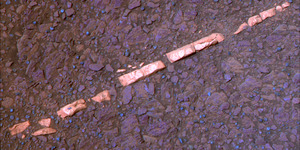
When Opportunity reached the rim of Endeavour crater, it found a white vein. This vein was identified as pure gypsum. It formed when water carrying gypsum dissolved in it deposited the mineral into a crack in the rock. This vein was named "Homestake" formation.
Evidence of Water


In 2004, studies of Meridiani rocks showed strong evidence of past water. The mineral jarosite was detected, which only forms in water. This proved that water once existed in Meridiani Planum. Some rocks also had small layers with shapes that only form from gently flowing water. These were called "cross-stratification" or "cross-bedding."
Box-shaped holes in some rocks were caused by sulfates forming large crystals. When these crystals later dissolved, they left behind holes called vugs. The amount of bromine in rocks varied greatly because it is very soluble. Water might have concentrated it in certain places before evaporating.
Rocks from Impacts and Meteorites
One rock, "Bounce Rock," was found on the sandy plains. It was different from the local bedrock. It was likely ejected from an impact crater. Its chemistry resembled a part of the shergottite meteorite EETA 79001, which is known to have come from Mars.
Opportunity also found meteorites just sitting on the plains. The first one analyzed was "Heatshield Rock." It was classified as an IAB meteorite, made of 93% iron and 7% nickel. Other rocks found were also thought to be meteorites.
Geological History
Observations suggest that the Meridiani Planum area was flooded with water many times. It then went through periods of evaporation and drying. During this process, sulfates were deposited. After the sulfates cemented the sediments, hematite concretions (the "blueberries") grew from groundwater. Some sulfates formed large crystals that later dissolved, leaving vugs. Several clues point to a dry climate for the past billion years or so. However, in the distant past, the climate supported water, at least for a time.
Curiosity Rover's Discoveries
The Curiosity rover has found many interesting rocks in Aeolis Palus near Aeolis Mons ("Mount Sharp") in Gale Crater. Some of the rocks studied in 2012 included ""Coronation" rock", "Jake Matijevic", and "Bathurst Inlet".
Evidence for Ancient Water


In September 2012, NASA announced that Curiosity found evidence of an ancient streambed. This suggested a "vigorous flow" of water on Mars long ago.
In December 2012, Curiosity did its first detailed soil analysis. It found water molecules, sulfur, and chlorine in the Martian soil. In December 2013, NASA reported that Gale Crater once held an ancient freshwater lake. This lake could have been a good environment for microbial life.
Evidence for Ancient Habitability
In March 2013, NASA reported that Curiosity found evidence that conditions in Gale Crater were once suitable for microbial life. This was after analyzing the first drilled sample of Martian rock, the "John Klein" rock. The rover detected water, carbon dioxide, oxygen, sulfur dioxide, and hydrogen sulfide. It also found chloromethane and dichloromethane. Other tests showed results consistent with the presence of smectite clay minerals.
(Drilled Sample of "John Klein" rock, Yellowknife Bay, February 27, 2013)


Detection of Organics
In December 2014, NASA reported that Curiosity detected a "tenfold spike" in methane in the Martian atmosphere. This increase was likely in a specific area. Measurements taken over 20 months showed increases in late 2013 and early 2014.

by the Curiosity rover (August 2012 to September 2014).

High levels of organic chemicals, especially chlorobenzene, were also found. These were in powder drilled from the "Cumberland" rock, analyzed by Curiosity.


Sulfur
In 2024, Curiosity discovered a rock that contained a lot of elemental sulfur.
Images for kids
-
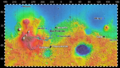
Map of actual (and proposed) Rover landing sites including Gale Crater.
-
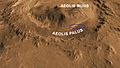
Gale Crater - Landing site is within Aeolis Palus near Aeolis Mons ("Mount Sharp") - North is down.
-
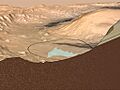
Gale Crater - Landing site is noted - also, alluvial fan (blue) and sediment layers in Aeolis Mons (cutaway).
-
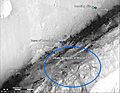
Curiosity rover landing site (green dot) - Blue dot marks Glenelg Intrigue - Blue spot marks "Base of Mount Sharp" - a planned area of study.
-

Curiosity rover landing site ("Bradbury Landing") viewed by HiRISE (MRO) (August 14, 2012).
-
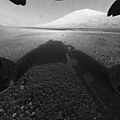
Aeolis Palus and "Mount Sharp" in Gale Crater as viewed by the Curiosity (August 6, 2012).
-
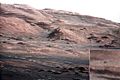
Layers at the base of Aeolis Mons - dark rock in inset is same size as the Curiosity rover (white balanced image).
-

Gale Crater rim about 18 km North of the Curiosity rover (August 9, 2012).
-
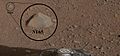
"Coronation" rock on Mars - first target of the ChemCam laser analyzer on the Curiosity rover (August 19, 2012).
-
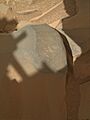
"Bathurst Inlet" rock on Mars - as viewed by the MAHLI camera on the Curiosity rover (September 30, 2012).
-
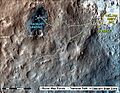
First-Year & First-Mile Traverse Map of the Curiosity rover on Mars (August 1, 2013) (3-D).
-
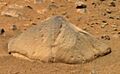
The rock "Adirondack" as seen by the Spirit rover.
-
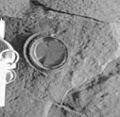
The rock "Adirondack" after being ground by the Spirit rover's Rock Abrasion Tool (RAT).


.jpg)

_-_HiRISE_-_20120814.jpg)


See also
- Carbonates on Mars
- Chloride-bearing deposits on Mars
- Columbia Hills (Mars)
- Geology of Mars
- Groundwater on Mars
- List of quadrangles on Mars
- List of rocks on Mars
- Margaritifer Sinus quadrangle
- Martian soil
- Mineralogy of Mars
- Ore resources on Mars
- Water on Mars
