
Democratic Party (United States) facts for kids
Quick facts for kids
Democratic Party
|
|
|---|---|
 |
|
| Abbreviation | Dem., D |
| Chairperson | Ken Martin |
| Governing body | Democratic National Committee |
| Senate Minority Leader | Chuck Schumer |
| House Minority Leader | Hakeem Jeffries |
| Founders | |
| Founded | January 8, 1828 |
| Preceded by | Democratic-Republican Party |
| Headquarters | 430 South Capitol St. SE, Washington, D.C., U.S. |
| Student wing |
|
| Youth wing | Young Democrats of America |
| Women's wing | National Federation of Democratic Women |
| LGBTQ wing |
|
| Overseas wing | Democrats Abroad |
| Ideology |
|
| Political position | Center to center-left |
| Caucuses |
|
| Colors | Blue |
| Senate |
45 / 100
|
| House of Representatives |
214 / 435
|
| State governors |
24 / 50
|
| State upper chambers |
841 / 1,973
|
| State lower chambers |
2,399 / 5,413
|
| Territorial governors |
2 / 5
|
| Territorial upper chambers |
21 / 97
|
| Territorial lower chambers |
9 / 91
|
| Election symbol | |

Formal 
Traditional |
|
The Democratic Party is one of the two major political groups in American politics. It shares the stage with its primary rival, the Republican Party. Started in 1828, it is celebrated as the oldest active political party on the planet. Its general ideas sit in the center and center-left of political beliefs. Many thinkers describe its main style as modern American liberalism.
Throughout its long existence, this party has influenced how laws are created across the nation. It supports strong public services and wants fairness for all citizens. Today, it stands for better access to schools and health programs. It also champions green initiatives like renewable energy to safeguard planet Earth. It has seen 16 members serve as president of the United States.
Contents
History of the Democratic Party

The beginnings of the organization reach back to the Democratic-Republican Party. That group was formed by early leaders such as Thomas Jefferson and James Madison during 1792. It opposed the Federalist Party and wanted a smaller federal government. After the War of 1812, the country entered the Era of Good Feelings, when only one party existed. Soon, leaders began disagreeing on key topics, leading to new factions.
In 1828, supporters of general Andrew Jackson and leader Martin Van Buren built a new national group. This moment created the modern Democratic Party. They championed the everyday citizen and supported farming communities across the country.
The Early 1800s and Jacksonian Democracy

In the 1830s, the party followed an idea known as Jacksonian democracy. These early leaders favored individual rights for common workers and small farmers. They were cautious of rich corporations and fought a political conflict called the Bank War. They wanted to stop monopolies that seemed unfair to ordinary people.
During this era, its top political competitor was the Whig Party, guided by figures such as Henry Clay. The two groups argued heavily over taxes and government spending. Democrats favored lower import taxes called tariffs to keep manufactured goods inexpensive. Presidents like James K. Polk expanded the nation across North America.
Slavery and the Civil War Era

By the 1850s, arguments about slavery tore the nation apart. Some anti-slavery members separated to build the Republican Party. Others created the Free Soil Party to prevent slavery from moving west.
In the fateful election of 1860, the Democrats broke into two teams. Stephen A. Douglas led the Northern group, while John C. Breckinridge ran for the Southern group. This deep divide allowed Republican leader Abraham Lincoln to win office. When the American Civil War broke out, Northern Democrats split between War Democrats, who backed the Union military, and Peace Democrats.
Reconstruction and the Gilded Age

After the war ended, the nation entered the Reconstruction period. In the late 19th century, conservative leaders called Bourbon Democrats guided party ideas. These leaders, including Samuel J. Tilden, fought against government waste and supported the gold standard for currency.
President Grover Cleveland won the White House in 1884 and again in 1892. He remains famous as the only president to serve two non-consecutive four-year terms. Cleveland stood up for lower tariffs and wanted honest government management.
The Progressive Era

At the end of the 19th century, farmers demanded economic help. In 1896, a gifted public speaker named William Jennings Bryan took over leadership. He wanted silver coins to assist poor rural families, but lost to William McKinley.
Later, in 1912, governor Woodrow Wilson was elected to the presidency. Wilson brought forward many progressive ideas to regulate big businesses. He set up the federal income tax system and created rules to protect consumers. Wilson also guided the country through the terrible years of World War I.
The New Deal and Franklin D. Roosevelt

The year 1929 brought an economic crisis called the Great Depression. Banks collapsed and millions of families lost their livelihoods under president Herbert Hoover. In 1932, the public elected Franklin D. Roosevelt to bring relief to the nation.
Roosevelt immediately launched an ambitious recovery plan named the New Deal. This program built dams, bridges, and parks to create jobs for out-of-work citizens. It also established Social Security to help older Americans retire with dignity. He formed the mighty New Deal coalition, bringing together labor unions, city workers, and diverse communities. When Roosevelt passed away in 1945, his vice president Harry S. Truman led the country during the end of World War II.
The Civil Rights Movement and the Great Society

During the 1960s, president John F. Kennedy inspired a whole generation of younger citizens. His platform, called the New Frontier, funded science research and supported the space program to send astronauts on an expedition to the moon. After his death, vice president Lyndon B. Johnson took the oath of office.
Johnson achieved major victories for human rights by passing the Civil Rights Act of 1964 and the Voting Rights Act of 1965. These landmark laws ended legal segregation and protected voting booths for African Americans. Johnson also created the Great Society, which introduced medical care programs called Medicare and Medicaid.
Troubles soon arrived with the unpopular Vietnam War. Protests broke out across university campuses, leading to unrest at the 1968 Democratic National Convention. Republican candidate Richard Nixon won the White House, beginning a period of political changes.
The Late 20th Century and Modern Reforms

In 1976, former Georgia governor Jimmy Carter won the presidency. Carter worked hard to make peace between conflicting nations and created new environmental rules. However, high prices and global troubles led to victory for Republican Ronald Reagan in 1980.
To win future elections, the group needed fresh thinking. In 1992, Arkansas governor Bill Clinton won the election by presenting himself as a centrist "New Democrat." Clinton supported a mixed economy, worked on balancing the federal budget, and helped pass the NAFTA trade deal.
The 21st Century

In 2008, history was made when Barack Obama became the nation's first African-American president. His term was marked by responses to a severe economic downturn through an economic stimulus law. He also signed the Affordable Care Act, which granted access to doctor visits and health care for millions of citizens.
Later, in 2020, former vice president Joe Biden was elected to lead the nation. His running mate, Kamala Harris, made history by becoming the first woman and person of South Asian descent to hold the vice presidency. During his term, Biden passed the huge Infrastructure Investment and Jobs Act to fix roads and bridges.
Famous Symbols and Party Colors

The Democratic Party has several famous symbols that appear on bumper stickers, posters, and signs. The best known mascot is the stubborn and hardworking donkey. This emblem started in 1828 when critics called Andrew Jackson names. Jackson decided to embrace the animal because it was determined and down-to-earth. Famous cartoonist Thomas Nast made the donkey famous in magazine drawings during the 1870s.
In some states, candidates previously used a rooster on local voting paper. Today, voters recognize the color blue as the visual mark of the party. Television networks introduced this design during the election of 2000, creating the terms blue states and red states. The group also uses an upbeat party song titled "Happy Days Are Here Again," which was first played for Franklin D. Roosevelt.
How the Democratic Party Operates

The everyday work of managing campaigns belongs to the Democratic National Committee. This central group sets up large gatherings like the Democratic National Convention, where members choose their presidential candidate. It works with local branches located across every single state and U.S. territory.
Young people take part through groups like the High School Democrats of America and the College Democrats of America. These clubs encourage students to volunteer, organize community projects, and learn how laws are written. Citizens living outside America can take part through an organization called Democrats Abroad.
Major Goals and Political Beliefs

Members share common ideas about using the government to assist families and protect fair treatment. They focus on economic security, healthy ecosystems, and broad voting access.
Economic Ideas and Fair Wages
Democrats believe that regular workers are the foundation of a healthy country. They support strong labor unions that bargain for safer workplaces and fair compensation. They also support raising the national minimum wage to help families afford groceries and rent.
They propose a progressive tax system where wealthy corporations pay a larger share to fund community needs. These taxes pay for public schools, clean drinking water, and safe roads. They also defend programs like Social Security so seniors can retire safely.
Schools and Learning for Everyone
Education is seen as the greatest tool for personal success. The party wants to expand free preschool through programs like Head Start. They also support giving extra classroom funds to neighborhoods that need help.
For older students, Democrats want to make universities more affordable. They propose boosting student funding through Pell Grants and lowering the cost of college student loans.
Protecting Nature and Fighting Climate Change

Caring for wild places and natural resources is another primary mission. Democrats view climate change as an urgent threat caused by pollution and greenhouse gases. Former vice president Al Gore won the famous Nobel Peace Prize for teaching people about saving the global environment.
The party promotes clean power like giant wind turbines and rooftop solar panels. In 2022, they passed the Inflation Reduction Act of 2022 to invest heavily in clean energy development. They believe shifting away from fossil fuels will keep the air fresh while generating new jobs.
Equal Rights for All Citizens
Democrats strongly believe that every person deserves fair treatment under the law. They work to protect voting rights by making it easier for citizens to cast ballots on election day. They support laws like the Americans with Disabilities Act to remove physical barriers in public buildings.
The party also celebrates civil rights leaders like congresswoman Shirley Chisholm. She inspired millions when she became the first African-American woman to seek a major presidential nomination.
World Relations and Global Cooperation
In world affairs, Democrats prefer talking with allies to solve international problems peacefully. They believe working through groups like the United Nations helps stop conflicts before they begin.
They strongly support democratic partners around the globe. When conflicts threaten peaceful regions, Democrats favor sending supplies and financial aid to defend freedom. They also back fair agreements between countries to exchange goods smoothly.
Wings and Groups Within the Party

The Democratic Party is made up of diverse viewpoints. Members often organize into smaller teams to debate and share suggestions.
- Liberals: This is the largest group within the party. They strongly favor clean energy rules, funding public health programs, and defending individual liberties.
- Moderates: Often called "New Democrats," this group looks for practical middle ground. They work with groups like the New Democrat Coalition and support balanced budgets alongside sensible market rules.
- Progressives: This left-leaning wing wants faster, bolder changes. Leaders like senator Bernie Sanders and representative Alexandria Ocasio-Cortez support single-payer healthcare and debt-free public colleges.
List of Democratic Presidents
Throughout American history, 16 different leaders from the party have served as the president of the United States.
| Number | President | Home State | Dates in Office |
|---|---|---|---|
| 7 | Andrew Jackson | Tennessee | 1829–1837 |
| 8 | Martin Van Buren | New York | 1837–1841 |
| 11 | James K. Polk | Tennessee | 1845–1849 |
| 14 | Franklin Pierce | New Hampshire | 1853–1857 |
| 15 | James Buchanan | Pennsylvania | 1857–1861 |
| 17 | Andrew Johnson | Tennessee | 1865–1869 |
| 22 & 24 | Grover Cleveland | New York | 1885–1889 and 1893–1897 |
| 28 | Woodrow Wilson | New Jersey | 1913–1921 |
| 32 | Franklin D. Roosevelt | New York | 1933–1945 |
| 33 | Harry S. Truman | Missouri | 1945–1953 |
| 35 | John F. Kennedy | Massachusetts | 1961–1963 |
| 36 | Lyndon B. Johnson | Texas | 1963–1969 |
| 39 | Jimmy Carter | Georgia | 1977–1981 |
| 42 | Bill Clinton | Arkansas | 1993–2001 |
| 44 | Barack Obama | Illinois | 2009–2017 |
| 46 | Joe Biden | Delaware | 2021–2025 |
Images for kids
-

James K. Polk, 11th president of the United States.
-

Franklin Pierce, 14th president of the United States.
-
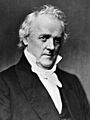
James Buchanan, 15th president of the United States.
-
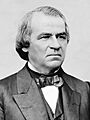
Andrew Johnson, 17th president of the United States.
-
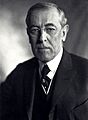
Woodrow Wilson, 28th president of the United States.
-

Harry S. Truman, 33rd president of the United States.
-

Lyndon B. Johnson, 36th president of the United States.
-
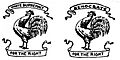
Old ballot logos previously used in Alabama.
-

Barack Obama speaking to college students in 2007.
-

President Obama signing the Affordable Care Act into law.
-
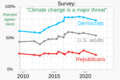
Survey chart on views about climate change.
-
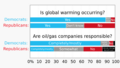
Poll data on climate change awareness.
-
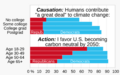
Opinion data on carbon reduction goals.
-
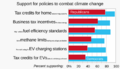
Public support for green initiatives.
-

Shirley Chisholm, pioneering African-American lawmaker.
-
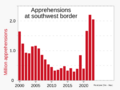
Border statistics chart.
-

President Obama meeting with foreign officials.
-
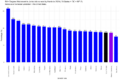
Educational levels in states won by the Democratic candidate in 2024.
-
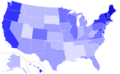
Map of self-identified liberals across the states.
-

Graph connecting educational attainment and liberal views.
-
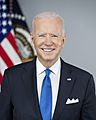
Joe Biden, 46th president of the United States.


Related Pages
- Democratic National Committee
- Democratic Party (United States) organizations
- List of presidents of the United States
- Political parties in the United States
- Republican Party (United States)
See also
 In Spanish: Partido Demócrata (Estados Unidos) para niños
