
Pre-Columbian era facts for kids


The pre-Columbian era is a fascinating time in the history of the Americas. It covers the period before Christopher Columbus arrived in 1492. This era includes the rich history of Native American cultures. These cultures thrived before Europeans had a big impact on their lives. For some, this influence came much later.
During this time, many amazing civilizations grew across the Americas. They built lasting towns and cities. People learned to farm and created impressive buildings. They also built large earth mounds. These societies had complex ways of organizing themselves. Some of these great civilizations had already faded before Europeans settled. We learn about them through archaeological digs and old stories. Other civilizations were still strong when Europeans arrived. We know about them from early European writings. For example, the Maya civilization kept detailed written records. Some of these records were unfortunately lost. But many have survived or were copied. They help us understand these ancient cultures today.
Contents
- How We Learn About the Past
- Understanding Ancient Migrations Through Genetics
- North America's Ancient Cultures
- Mesoamerica: Cradle of Civilizations
- South America: Diverse Empires and Cultures
- Agricultural Development in the Americas
- Images for kids
- See also
How We Learn About the Past
For a long time, what we knew about the pre-Columbian era came from European explorers. But in the 1800s, archaeologists started studying ancient sites. People like John Lloyd Stephens helped us understand these cultures better. Today, experts use science to learn about these amazing civilizations. They combine many different studies to get a full picture.
Understanding Ancient Migrations Through Genetics

Scientists study DNA to understand how people moved long ago. They found that many Native American groups share certain genetic markers. These markers show that people first came to the Americas in stages. They traveled from Asia, possibly across a land bridge. This journey happened thousands of years ago. These early groups then spread across North and South America.
The First Americans: A Journey Across Continents

Many scientists believe the first people in the Americas came from Asia. They crossed a land bridge called Beringia. This bridge once connected Asia and North America. Today, it is covered by the Bering Strait. These early travelers were Paleo-Indians, who were hunter-gatherers. They slowly moved south along the coast. They also used a path between huge ice sheets.
When exactly this happened is still a big discussion. Some evidence suggests people arrived about 13,000 years ago. This is linked to the Clovis culture. Other findings hint that people might have been here much earlier. Some studies suggest it could be 20,000 years ago or even more. The Inuit people, for example, likely arrived later. They crossed from Siberia into Alaska about 2,000 years ago.

North America's Ancient Cultures
Early Hunter-Gatherers and Farmers
After the last ice age, North America's climate became stable. This was about 10,000 years ago. Early Paleo-Indians were hunter-gatherers. They lived in small family groups. These groups moved to find food. They hunted large animals like mastodons. They also used tools like spear points and knives.
Over thousands of years, people learned to grow plants. They domesticated many crops we still eat today. These include corn, beans, and squash. Agriculture allowed populations to grow. People started living in one place.
Mound Builders of the Mississippi Valley
As early as 5500 BCE, people in the Lower Mississippi Valley built large earth mounds. These were likely for religious ceremonies. Sites like Watson Brake show complex construction. This happened even before people fully adopted farming. Later, the Poverty Point site, built around 1500 BCE, was another large mound complex. These Mound Builders continued to create many sites. They built different shapes of mounds.
Woodland Period: Trade and Innovation

The Woodland period lasted from about 1000 BCE to 1000 CE. During this time, cultures like the Adena culture and Hopewell tradition built impressive earthworks. They also created wide trade networks. People continuously improved their tools and crafts. They started using bows and arrows towards the end of this period.
Mississippian Culture: Great Cities and Trade
The Mississippian culture thrived across the Southeast and Midwest of the United States. They built large earthen mounds and plazas. They grew a lot of maize and other crops. They also had a complex society and a vast trade network. This culture appeared around 1000 CE.
Cahokia, near modern East St. Louis, Illinois, was their largest city. It may have had over 20,000 people. At its peak, it was the most populated city in North America. Monks Mound at Cahokia is the largest ancient earthen structure in the Americas. The Mississippian culture began to decline before Europeans arrived.
When Hernando de Soto explored in the 1540s, he met many Mississippian groups. European diseases had a devastating impact on these populations. By the time other Europeans returned, many Mississippian groups had disappeared.
Southwestern Cultures: Pueblos and Irrigation
Ancestral Puebloans

The Ancestral Puebloans lived in the Four Corners region of the U.S. They built kivas, multi-story houses, and apartment blocks. These were made from stone and adobe. Famous examples include the Cliff Palace in Mesa Verde National Park. They also built a road system. The term "Anasazi" is sometimes used, but it is not preferred by modern Pueblo peoples.
Hohokam
The Hohokam lived in the Sonoran Desert in Arizona and Mexico. They built many irrigation canals. These canals helped them farm successfully. They also had important trading centers like Snaketown. The Hohokam society likely declined due to drought after 1375 CE.
Mogollon
The Mogollon culture lived in parts of Arizona, New Mexico, Texas, and Mexico. They also built kivas and cliff dwellings. At Paquimé, they kept scarlet macaws. These birds were brought from Mesoamerica through trade.
Iroquois: A Powerful Confederacy
The Iroquois League of Nations, or Haudenosaunee Confederacy, was a very advanced society. It was a democratic system. Some historians believe it influenced the United States Constitution.
Other North American Peoples
When Europeans arrived, Native Americans had many different ways of life. Some were farmers, others were hunter-gatherers. Many formed new groups after European contact. These groups are often classified by their cultural regions:
- Arctic (e.g., Inuit)
- Subarctic
- Northeastern Woodlands
- Southeastern Woodlands
- Great Plains
- Great Basin
- Northwest Plateau
- Northwest Coast
- California
- Southwest
Many societies were settled, like the Tlingit and Chumash. Some built large towns, such as Cahokia.
Mesoamerica: Cradle of Civilizations

Mesoamerica is a region from central Mexico to Costa Rica. It was home to many advanced farming civilizations. These cultures shared similar beliefs, art, and technology. This period lasted about 3,000 years before Columbus.
Between 2000 and 300 BCE, complex cultures began to form. These grew into great civilizations. Examples include the Olmec, Teotihuacan, Mayas, Zapotecs, and Mexica (Aztecs).
These civilizations made many important inventions. They built pyramid temples. They developed mathematics, astronomy, and medicine. They also created writing systems and accurate calendars. They even invented the wheel, but mostly used it for toys. They worked with copper, silver, and gold.
Their number system was based on 20 and included zero. Many cities were built to align with astronomical events. Large cities like Teotihuacan and Tenochtitlan were among the biggest in the world. They were centers for trade, ideas, and religion.
Mesoamerica had five main civilizations that spread their influence: the Olmecs, Teotihuacan, the Toltecs, the Mexica, and the Mayas. They shaped trade, art, politics, and beliefs across the region.
Olmec Civilization: The First Great Culture
The Olmec were the earliest known civilization in Mesoamerica. They set the pattern for later cultures in Mexico. They started making pottery around 2300 BCE. Their main city was San Lorenzo Tenochtitlán. Olmec influence spread across Mexico and Central America. They introduced new ideas about government, pyramids, writing, and art. Their achievements helped pave the way for the Maya and other civilizations.
Teotihuacan: A Mighty Metropolis
After the Olmec declined, Teotihuacan rose to power. It was settled around 300 BCE. By 150 CE, it became the first true large city in North America. Teotihuacan created a new economic and political system. Its influence reached Maya cities like Tikal and Copan. The city had a diverse population. People from different regions lived and worked there. Teotihuacan's power declined around 650 CE. However, its cultural influence lasted for centuries.

Maya Civilization: Masters of Knowledge
The Maya civilization flourished alongside Teotihuacan. From 250 CE to 650 CE, they made incredible advancements. The many Maya city-states were not politically united. Yet, they had a huge impact on Mexico and Central America. The Maya built elaborate cities. They made breakthroughs in mathematics, astronomy, and calendars. They also developed a complex writing system. They wrote on stone, pottery, wood, and bark paper books.
Aztec/Mexica/Triple Alliance: A Powerful Empire
.jpg)
After the Toltec civilization declined, the Mexica people rose to power. They were originally from the desert. They formed the 'Triple Alliance' with two other cities. This alliance ruled much of central Mexico by 1400.
The Mexica-Aztecs saw themselves as heirs to earlier civilizations. They valued art, sculpture, and architecture. Their capital, Tenochtitlan, is where modern Mexico City stands. At its peak, it was one of the world's largest cities. It had a population of 200,000–300,000 people. Its market was huge and impressive to the first Europeans.
Tarascan/Purépecha Civilization: Metalworkers of Mesoamerica
Around 1300, the Purépecha Empire united several communities. Their capital was Tzintzuntzan. This empire was one of the largest in Central America. They often clashed with the Aztec Empire. The Tarascans were skilled in metallurgy. They used copper, silver, and gold for tools, decorations, and weapons. They had a unique culture and religion.
Tlaxcala Republic: Allies Against the Aztecs
Tlaxcala was a Nahua republic in central Mexico. They strongly resisted Aztec expansion. Later, they allied with the Spanish conquistadors. This helped them defeat the Aztecs. The Spanish rewarded the Tlaxcalans by preserving their culture.
South America: Diverse Empires and Cultures
.jpg)
By the first millennium, South America was home to millions of people. They lived in rainforests, mountains, plains, and coasts. Some groups formed permanent settlements. Important groups included the Muisca of Colombia and the Quechuas of Peru. Recent discoveries of geoglyphs in the Amazon rainforest show complex ancient civilizations there.
Norte Chico Civilization: The Oldest in the Americas

The Norte Chico civilization (also called Caral-Supe) emerged around 3200 BCE. It was on the north-central coast of Peru. This makes it the oldest known civilization in the Americas. They built large urban settlements. The Sacred City of Caral is one of the largest sites. They traded cotton and dried fish. This was a hierarchical society.
Valdivia Culture: Early Potters of Ecuador
The Valdivia culture lived on the coast of Ecuador. Their culture dates from 3500 to 1800 BCE. They lived in communities with houses in circles. They were settled people who farmed and fished. They grew maize, beans, and squash. Valdivian pottery became very detailed and artistic over time.
Chavín Civilization: A Mountain Trade Network

The Chavín culture in Peru developed a trade network. They also advanced agriculture by 900 BCE. Their artifacts were found at Chavín de Huántar. This site is high in the mountains of Peru. The Chavín civilization lasted from 900 to 300 BCE.
Muisca Confederation: Gold and Culture in the Andes
The Chibcha-speaking communities were very important in pre-Hispanic Colombia. By the 8th century, they had a strong civilization in the northern Andes. They developed farms and industries. The Chibcha had a notable culture among settled Indigenous peoples in South America.
Moche Civilization: Skilled Artisans
The Moche culture thrived on the north coast of Peru from 100 to 800 CE. We learn about them from their elaborate burials. Their ceramic pottery shows details of their daily lives. The Larco Museum in Lima has many Moche ceramics. These show they were technologically advanced and traded with distant peoples.
Inca Empire: Rulers of the Andes
Holding their capital at the great city of Cusco, Peru, the Inca civilization dominated the Andes region from 1438 to 1533. Their empire was called Tawantinsuyu. It meant "the land of the four regions." The Inca ruled over many communities and millions of people. They were connected by a 40,000-kilometer road system. Cities were built with precise stonework on mountain terrain. Terrace farming was a key agricultural method. The Inca were also skilled in metalwork and even performed successful brain surgery.

Taíno: First to Meet Columbus
The Taíno people lived across the Greater Antilles and other islands. They were the first pre-Columbian people to meet Christopher Columbus in 1492. The Taíno later faced slavery under Spanish colonists. Their population greatly declined by 1565.
Agricultural Development in the Americas
Early Americans developed many important crops. They transformed wild teosinte into modern corn. Potatoes, cassava, tomatoes, pumpkins, and chili peppers were also grown. Other plants included beans, pineapple, sweet potatoes, and cocoa beans. Over two-thirds of all food crops worldwide originated in the Americas.
Indigenous peoples also used fire to manage land. This helped clear forests and grow useful plants. This created the pre-Columbian savannas of North America.
While not as common as in other parts of the world, Americans did have livestock. Domesticated turkeys were raised in Mesoamerica and North America. They were valued for meat and feathers. Andean societies had llamas and alpacas for meat, wool, and carrying loads. Guinea pigs were also raised for meat in the Andes.
By the 15th century, maize farming had spread widely. Potatoes were a staple for the Inca. Chocolate was an important food for the Aztecs.
Images for kids
-
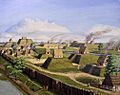
An artistic recreation of The Kincaid site from the prehistoric Mississippian culture as it may have looked at its peak 1050–1400 CE
-
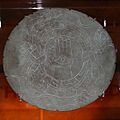
Engraved stone palette from Moundville, illustrating two horned rattlesnakes, perhaps referring to The Great Serpent of the Southeastern Ceremonial Complex
-
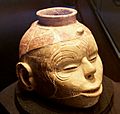
A human head effigy pot from the Nodena site
-
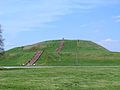
Monks Mound of Cahokia (UNESCO World Heritage Site) in summer. The concrete staircase follows the approximate course of the ancient wooden stairs.
-
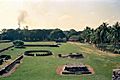
The Totonac city of Cempoala.
-
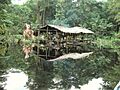
A palafito like the ones seen by Amerigo Vespucci
-
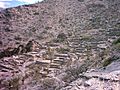
The Ruins of Quilmes in Tucumán Province, Argentina.
-
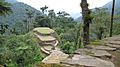
Ciudad Perdida ("The Lost City")
-
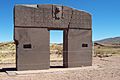
Gate of the Sun in Tiwanaku


See also
 In Spanish: América precolombina para niños
- 1491: New Revelations of the Americas Before Columbus by Charles C. Mann
- Before the Revolution, 2013 book by Daniel K. Richter
- List of pre-Columbian cultures
- Metallurgy in pre-Columbian America
- Periodization of pre-Columbian Peru
- Population history of indigenous peoples of the Americas
- Pre-Columbian trans-oceanic contact theories
- Pre-Columbian history of Brazil
