
Indigenous peoples of California facts for kids


Indigenous peoples of California, commonly called Native Californians or Indigenous Californians, are the original nations who have lived in the region for thousands of years. Long before modern borders existed, hundreds of distinct groups lived across the coast, mountains, deserts, and valleys. Today, there are over one hundred federally recognized tribes in the state. Many other groups continue to seek federal recognition. According to the 2020 US Census, California has the largest total population of Native Americans of any state.
Early Native Californians were skilled land managers who used forest gardening, permaculture, and controlled burn techniques. These methods helped native plants grow, kept forests healthy, and stopped huge, dangerous wildfires. Starting in the late 18th century, European settlers arrived. First came Spanish soldiers and Franciscan missionaries, followed later by Mexican ranchers and American settlers. These arrivals brought devastating diseases, mistreatment, and unfair laws that severely reduced the Native population.
Despite incredible hardships over the centuries, Native Californian nations kept their traditions alive. Today, tribes are leading an inspiring cultural revival. Communities are actively working on language revitalization, bringing back ancestral traditions, and caring for their traditional homelands through the Land Back movement.
Contents
- Who Are the Indigenous Peoples of California?
- Ancient History of Native California
- First Encounters with Outside Explorers
- The Spanish Mission Era
- The Mexican Rancho Era
- The Gold Rush and Statehood
- The Twentieth Century: Struggles and Survival
- Modern Revival in the Twenty-First Century
- Traditional Arts and Material Culture
- Traditional Foods and Land Stewardship
- Traditional Beliefs and Ceremonies
- California Indian Reservations Today
- Native Nations of California
- Indigenous Languages of California
- Images for kids
- Related Pages
- See also
Who Are the Indigenous Peoples of California?
Long before California became a state, diverse human societies thrived in its varied environments. Because California contains oceans, snowy peaks, dry deserts, and lush river valleys, Indigenous nations developed unique customs tailored to their surroundings.
Tribal Boundaries and Territories
The ancestral homelands of Native nations do not match modern state lines. For example, tribes near the eastern border with Nevada share cultural traditions with Great Basin tribes. In the far north, several groups near Oregon share traditions with Plateau tribes.
To the south, the Kumeyaay nation lived across lands that are now divided by the Mexico–United States border. Native peoples living just south in Baja California are often grouped as Indigenous peoples of Mexico.
Incredible Cultural and Group Diversity
California was one of the most culturally diverse places on Earth. Before Europeans arrived, the region contained over 500 distinct independent communities or tribelets. Each community typically had between 50 and 500 people.
Because the region had a mild climate and abundant natural foods, it supported the highest population density of Native peoples north of modern Mexico. About one-third of all Native people in what is now the United States lived within California.
Ancient History of Native California

Archaeologists have uncovered fascinating evidence proving that humans have lived in California for many thousands of years. Ancient tools, shell heaps, and ancient campsites tell a long story of discovery and adaptation.
Earliest Settlements and Archaeological Finds
Some archaeological discoveries suggest human activity in California dating back at least 19,000 years. Famous sites that date between 12,000 and 7,000 years ago include the Borax Lake Site, Cross Creek, and coastal locations like the Scotts Valley site, CA-SCR-177.
On the Santa Barbara Channel Islands, ancient human remains known as Arlington Springs Man were discovered, dating back about 10,000 years. Ancient campsites on the islands, such as Daisy Cave and Cardwell Bluffs, contain shell tools and animal bones from kelp forest ecosystems dating back up to 12,000 years.
Adapting to the Environment Over Millennia
Early Native Californians were skilled hunter-gatherers who relied on wild game, fish, seeds, and wild plants. By around 9,000 BCE, gathering nutritious wild seeds had become a primary way to find food.
Archaeologists have identified distinct regional cultures in southern California, such as the La Jolla complex and the Pauma Complex, which date from around 6050 to 1000 BCE. Between 3000 and 2000 BCE, different tribes developed specialized tools for their local regions, creating traditions that continued into modern history.
Caring for the Land with Fire and Gardening

Native Californians did not just gather wild foods; they actively shaped the landscape to make it more productive. Through careful forest gardening, tribes encouraged edible roots, berries, and seed grasses to grow in grasslands and wetlands.
One of their most important tools was controlled fire. By setting low-intensity fires at specific seasons, Native peoples cleared dry brush and prevented disastrous forest fires. This practice, sometimes called fire-stick farming, returned nutrients to the soil and encouraged tender green grass to sprout, which attracted deer and elk. This ancient system created a healthy, sustainable form of permaculture that protected nature for centuries.
First Encounters with Outside Explorers
Different California nations met explorers from distant countries at very different times. Some coastal tribes saw European sailing ships as early as the mid-16th century, while interior desert tribes did not meet outsiders until the 1800s.
Spanish Explorers and Coastal Contact
Spanish sailing expeditions began mapping parts of the Pacific coast in the 1500s. Later, in the 1760s and 1770s, overland Spanish expeditions met interior groups such as the Quechan and Yuman Indians along the Colorado River.
Encounters with Russian Traders
In northwestern California, coastal tribes such as the Miwok, Yurok, and Yokut met Russian explorers and maritime fur traders in the late 18th and early 19th centuries. Russian traders set up a trading settlement called Fort Ross to hunt sea otters for their valuable pelts.
The Spanish Mission Era

The arrival of Spanish settlers in 1769 brought enormous disruptions to Native communities along the southern and central coasts.
The Mission System
Spain established its first permanent California settlement in 1769 with the founding of Mission San Diego de Alcalá in San Diego. Over the next several decades, Spanish priests built twenty more missions stretching north along the coast toward San Francisco Bay.
Spanish authorities gathered Native peoples from surrounding villages into the missions. At the time the missions were founded, around 340,000 Native people lived in California, speaking at least 78 distinct languages. Inside the mission walls, Native life was strictly controlled, and traditional religious dances, songs, and customs were banned.
Population Loss and Environmental Changes
Life at the missions was harsh, and crowded living quarters led to outbreaks of European illnesses against which Native people had no natural immunity. Between 1769 and 1832, mission records recorded nearly 64,000 deaths. Native workers faced intense labor in farming and construction, leading to poor nutrition and severe population decline.
The missions also brought non-native invasive plant species and large herds of cattle. Uncontrolled cattle grazing destroyed the wild seed meadows, oak groves, and bulb plants that Native communities relied on for survival, changing the natural ecology of California forever.
The Mexican Rancho Era
After winning independence from Spain in 1821, Mexico took control of California. This brought major political changes for the missions and their lands.
Secularization of the Missions
In 1833, the Mexican government passed the secularization act, which closed down the missions as religious institutions. Leaders like José María Luis Mora believed mission lands should be broken up into private property.
Instead of returning these ancestral lands to the Native tribes who had tended them for generations, the government gave vast parcels of land, called ranchos, to Mexican settlers. This left thousands of Native people landless and without homes.
Labor on the Ranchos
Many Native Californians were forced to work as ranch hands, vaqueros (cowboys), and household workers for small wages on the new ranchos. Only a handful of Native individuals who fully adopted European customs, such as Victoria Reid from the village of Comicranga, were ever granted rancho land.
The Gold Rush and Statehood

The middle of the 19th century brought rapid, drastic upheaval to Native Californians when the region became part of the United States.
Broken Land Rights and New Leaders
Following the Mexican–American War, the United States took control of California through the Treaty of Guadalupe Hidalgo. In 1848, Peter Burnett was elected the first American governor of California. While American authorities recognized some private Mexican ranch grants, they ignored ancient aboriginal land titles held by Indigenous tribes.
Governor Burnett and other early leaders viewed Native people as obstacles to settlement. State authorities funded volunteer militia groups with public tax dollars to push tribes out of mining and farming regions. Local towns even offered bounties for capturing or harming Native people.
Gold Mining and Environmental Devastation

When gold was discovered at Sutter's Mill in 1848, hundreds of thousands of miners rushed into California's interior mountains and rivers, including the California deserts and Central Valley. This event, known as the California Gold Rush, caused catastrophic harm to Native communities.
Mining operations dumped toxic gravel and chemicals into pristine rivers, poisoning salmon runs and ruining fresh drinking water. Oak forests were cut down for mine timbers and firewood, wiping out crucial acorn supplies. During the first two years of the Gold Rush alone, an estimated 100,000 Native people lost their lives due to disease, starvation, and violence.
Unfair Labor Laws and Indenture
In 1850, California passed the Act for the Government and Protection of Indians. This law allowed white landowners to take custody of Native children and force them to work until adulthood without fair pay.
Under this system, Native children were separated from their families and indentured on ranches and farms. In cities like Los Angeles, city councils passed local ordinances that auctioned off Native prisoners for private labor, creating conditions that modern historians like Robert Heizer describe as a form of unfree labor.
The Eighteen Unratified Treaties
Between 1851 and 1852, United States government agents Oliver Wozencraft, George Barbour, and Redick McKee traveled across California to meet tribal leaders. Together, they signed eighteen formal treaties that promised California tribes 7.5 million acres of protected reservation lands.
However, white settlers protested against the treaties, arguing that too much valuable land was being set aside for Native people. The United States Senate secretly rejected the treaties and locked them away in government vaults without telling the tribal leaders who had signed them. The promised lands were never protected.
The Modoc War

In northern California, the Modoc people fought courageously to remain in their traditional homelands near Tule lake. Non-native wagon trails, such as the Applegate Trail, had ruined the Modoc hunting grounds, and conflicts grew steadily throughout the 1850s and 1860s.
When the government tried to force the Modocs onto a reservation in Oregon with other tribes, a leader named Kintpuash, also known as Captain Jack, led his people back to their homelands. In 1872 and 1873, Modoc fighters held off the United States Army for months in the rocky lava beds at Captain Jack's Stronghold. Despite their determined defense, the Modoc were eventually defeated and relocated far away from California.
The Twentieth Century: Struggles and Survival
By 1900, the Native population of California had dropped from hundreds of thousands to around 16,000 people. Although some outsiders wrongly claimed that California tribes were disappearing, Native families worked tirelessly to preserve their heritage.
The Cupeño Trail of Tears

Even into the early 20th century, Native Californians faced forced relocations. In May 1903, the Cupeño people of the village of Cupa were ordered off their ancestral lands at Warner Springs after losing a court dispute to private landowners.
Armed government agents forced the Cupeño families to leave their homes, gardens, and ancestral graves behind. They had to travel 75 miles across rough country to the Pala reservation, an event remembered today as the Cupeño Trail of Tears. Neighboring Luiseño and Kumeyaay villages were also impacted by these land seizures.
Indian Boarding Schools


Between the 1890s and 1930s, the federal government ran American Indian boarding schools designed to force Native children to abandon their heritage. In California, major off-reservation schools included the Sherman Institute in Riverside, California.
At these schools, children had their long hair cut short, were forced to wear military-style uniforms, were given English names, and were strictly punished if they spoke their native languages. Living conditions were often poor, with overcrowded dormitories and unhealthy food.
Tribal parents pushed back against this system and demanded the right to send their children to local public schools. In 1935, California lifted laws that prevented Native children from attending public public schools, and in 1978, federal laws finally protected Native parents from having their children taken away without consent.
Fighting for Treaty Rights and Compensation
During the 1920s, Native leaders began organizing to demand justice for the 18 unratified treaties of 1851. Tribal organizations brought legal claims against the federal government, winning settlements of $17.5 million in 1944 and $46 million in 1946. Although these funds provided financial payments, they did not restore the original millions of acres of stolen tribal lands.
Protecting Sacred Grounds and Nature

In 1978, Congress passed the American Indian Religious Freedom Act to protect Indigenous religious practices. However, this law did not fully protect sacred natural sites located on public lands.
In the 1988 court case Lyng v. Northwest Indian Cemetery Protective Ass'n, the U.S. Supreme Court allowed a logging road to be built through sacred forested mountain areas in northwestern California despite protests from local tribes. Additionally, government agencies like the United States Forest Service often banned Native plant harvesting or sprayed chemical weed killers, like granular hexazinone in the Stanislaus National Forest, which harmed wild plants used for traditional medicine and basket weaving.
Modern Revival in the Twenty-First Century

Today, Native Californian nations are experiencing a powerful cultural renaissance. Communities are revitalizing ancestral traditions, restoring native ecosystems, and protecting sacred heritage sites.
Language Reawakening Projects

For many decades, boarding schools and discrimination silenced many Indigenous languages. Today, tribes are leading an inspiring effort to bring their languages back to life through language revitalization.
Using historical audio recordings, written notes, and the knowledge of tribal elders, communities are teaching young children their ancestral tongues. Languages such as Yurok, Chumash, Kumeyaay, Hoopa, and Tolowa now have active classes, apps, and children's books. Tribal educators emphasize that these languages carry ancient ecological knowledge and wisdom that connect people to their ancestral land.
Protecting Ancient Burial Grounds and Artifacts

Tribes across California actively work to safeguard ancestral cemeteries and sacred shellmounds from commercial construction. Under the Native American Graves Protection and Repatriation Act and California state laws, museums and universities must return ancestral human remains and sacred artifacts to their home tribes.
In urban areas, tribal groups like the Tongva in Los Angeles, the Acjachemen in Orange County, and the Ohlone in the San Francisco Bay Area continue to advocate for ancient village sites. Native activists, including Corrina Gould, have worked to protect places like the West Berkeley Shellmound so future generations can honor their ancestors.
The Land Back Movement

The Land Back movement is an exciting effort where cities, organizations, and governments return ancestral lands to Native stewardship.
A historic milestone took place on Tuluwat Island in Humboldt Bay, the site of the 1860 Wiyot massacre. In 2019, the Eureka City Council officially returned the entire island to the Wiyot tribe, marking one of the first times a United States city returned land directly to a Native nation.
In the San Francisco Bay Area, the Sogorea Te' Land Trust created the voluntary Shuumi Land Tax, allowing non-native residents and businesses to support Indigenous land acquisition. In 2024, the state of California returned 2,820 acres of ancestral land along the Klamath River to the Shasta Indian Nation following the removal of aging dams like the Copco I dam.
Traditional Arts and Material Culture
Native Californian material culture is world-renowned for its artistic beauty, clever engineering, and sustainable use of natural resources.
The Incredible Art of Basket Weaving
Basket weaving is one of the most celebrated cultural traditions in California. Native weavers created baskets of every size and shape for daily chores, ceremonies, and clothing.
Watertight Cooking Baskets
Weavers used tough plant fibers, such as willow, sedge root, and fern stems, to weave baskets so tightly that they could hold water without leaking. To cook food, women heated smooth stones in a campfire until glowing hot, cleaned off the ash, and dropped them into water-filled baskets along with ground acorn meal. By stirring the mixture with wooden paddles, they could boil soups and porridges in minutes without burning the basket fibers.
Caps, Traps, and Storage Granaries
Tribes created open-weave baskets for carrying firewood, cone-shaped burden baskets for gathering seeds, and sturdy willow fish traps for catching river trout. Women and men wore tightly woven basket caps to protect their foreheads from the straps of heavy carrying bags. Girls learned basketry from a young age, developing a deep understanding of how to prune, gather, and dye native plants.
-
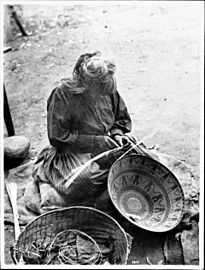
Yokuts woman basket maker, Tule River Reservation ca. 1900
-
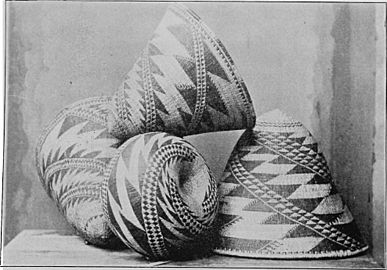
Pomo baskets, chuset weave
-

Basket materials and foundations
-
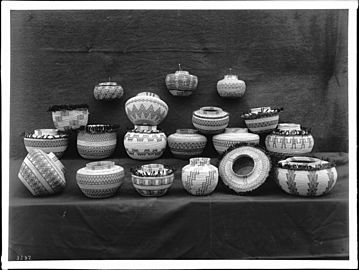
Indigenous baskets of California, photographed ca. 1900


Rock Art and Painted Caves
Native Californians were gifted painters and carvers. In the deserts of eastern California, ancient artists carved thousands of petroglyphs into dark volcanic rocks, depicting bighorn sheep, hunters, and geometric patterns.
In southern California, the Chumash created brilliant rock paintings or pictographs inside sandstone caves. Using natural mineral pigments of red ochre, white chalk, and black charcoal mixed with animal oils, they painted complex symbols representing spiritual ceremonies, constellations, and animals.
Ocean Canoes: The Chumash Tomol
Along the southern coast, the Chumash and their neighbors built remarkable ocean-going boats called a tomol. Instead of hollowing out a single tree trunk, builders split redwood or pine logs into smooth planks, bent them using steam, drilled holes along the edges, and stitched the wood together with milkweed cords.
They sealed the seams with a waterproof natural asphalt mixture called yop, made of pine pitch and natural oil seepage. A finished tomol could measure up to thirty feet long, carry thousands of pounds of goods, and travel across rough ocean waters to trade with villages on the Channel Islands.
Traditional Foods and Land Stewardship
Native Californians enjoyed a rich, diverse diet that varied depending on local ecology. Unlike farming societies that relied on one single crop, California nations harvested hundreds of wild foods, meaning a shortage of one plant never led to widespread famine.
Acorns: The Golden Food of California

The Acorn was the single most important plant food across most of California. Tribes harvested acorns from oak trees, including the California live oak (Quercus agrifolia), every autumn.
Acorns contain bitter tannic acid that makes them sour and hard to digest. Native women solved this by pounding shelled acorns into fine flour using stone mortars and pestles. They placed the flour into sandy shallow basins and poured clean warm water over it repeatedly. This leaching process washed away the bitter acid, leaving sweet, nutritious flour that was made into bread, porridge, or rich soup. Tribes stored tons of unshelled acorns in raised woven granaries to keep them safe from rodents and dampness through the winter.
Wild Berries, Nuts, and Seeds
Native peoples gathered a wide variety of other nourishing plant foods:
- Manzanita berries: Ripe berries were eaten raw, ground into sweet flour, or soaked in cool water to make a refreshing cider drink.
- California hazelnuts: These delicious seasonal nuts were harvested in shaded mountain valleys and coastal hills.
- Wild berries: Families gathered wild blackberries, strawberries, and the sweet purple berries of the California huckleberry.
- Medicinal herbs: Leaves from the California juniper were brewed into soothing teas for colds and pain relief.
- Root vegetables: People dug up wild bulbs and tubers, such as yampah (Perideridia gairdneri), using polished fire-hardened digging sticks.
Marine Animals and Coastal Fishing

For coastal communities, the Pacific Ocean provided rich sources of protein. Hunters pursued marine mammals such as California sea lions, harbor seals, northern elephant seals, and sea otters for nutritious food, thick leather, and waterproof warm furs. Along the tide pools, women and children collected clams, mussels, abalone, and crabs.
The Great Salmon Runs

In northern and central California, large rivers such as the Klamath and Sacramento were home to massive annual runs of anadromous fish. Anadromous fish hatch in freshwater rivers, swim out to the Pacific Ocean to grow into adulthood, and return years later to spawn.
Pacific salmon, particularly the giant Chinook salmon, was a vital staple for tribes like the Yurok and Karuk. Fishermen built wooden platforms over roaring river rapids and caught passing fish using long wooden dip nets and bone harpoons. Families cleaned, smoked, and sun-dried thousands of salmon on wooden racks, preserving barrels of fish to eat throughout the cold winter months.
Traditional Beliefs and Ceremonies
Spirituality played an essential part in daily Native life, connecting communities to animals, plants, waters, and the seasons.
The Kuksu Religion
Across Central California and Northern California, many nations—including the Maidu, Pomo, and Patwin—practiced the Kuksu religion.
Ceremonies took place inside large, circular, earth-covered roundhouses. Dancers wore elaborate headdresses made of hawk and flicker feathers and carved wooden masks to represent ancestral spirits. These dances were performed to heal sick community members, welcome the change of seasons, and give thanks for the annual harvest of seeds and salmon.
The Toloache Traditions
In Southern California, nations such as the Luiseño performed coming-of-age ceremonies that taught young people the sacred laws and moral teachings of the tribe. Sacred songs, sand paintings, and group dances helped youth learn about the stars, tribal history, and their responsibilities to the community.
California Indian Reservations Today


Today, California contains nearly one hundred federally recognized tribal reservations, ranches, and trust lands. Below are details on some of the most populated reservations in the state:
Native Nations of California
- Achomawi, Achumawi, Pit River tribe, northeastern California
- Atsugewi, northeastern California
- Cahuilla, southern California
- Chemehuevi, eastern California
- Chumash, coastal southern California
- "Barbareño", Coast Central Chumash
- "Cruzeño, Isleño", Island Chumash
- "Emigdiano", Tecuya, Interior Central Chumash
- "Interior", Cuyama, Interior Northwestern Chumash
- "Inezeño", "Ineseño", Samala, Inland Central Chumash
- "Obispeño", Yak-tityu-tityu-yak-tilhini, Northern Chumash
- "Purisimeño", Kagismuwas, Northern Chumash
- "Ventureño", Alliklik – Castac, Southern Chumash
- Chilula, northwestern California
- Chimariko, northwestern California
- Kuneste, "Eel River Athapaskan peoples"
- Lassik, northwestern California
- Mattole (Bear River), northwestern California
- Nongatl, northwestern California
- Sinkyone, northwestern California
- Wailaki, Wai-lakki, northwestern California
- Esselen, west-central California
- Hupa, northwestern California
- Karok, northwestern California
- Kato, Cahto, northwestern California
- Kawaiisu, southeast-central California
- Konkow, northern-central California
- Kumeyaay, Diegueño, Kumiai
- Ipai, southwestern California
- Jamul, southwestern California
- Tipai, southwestern California and northwestern Mexico
- Ipai, southwestern California
- La Jolla complex, southern California, ancient
- Maidu, northeastern California
- Konkow, northern California
- Yamani, Mechoopda, northern California
- Nisenan, Southern Maidu, northern California
- Miwok, Me-wuk, central California
- Bay Miwok, west-central California
- Coast Miwok, west-central California
- Lake Miwok, west-central California
- Valley and Sierra Miwok
- Monache, Western Mono, central California
- Mohave, southeastern California
- Nisenan, eastern-central California
- Nomlaki, northwestern California
- Ohlone, Costanoan, west-central California
- Patwin, central California
- Suisun, Southern Patwin, central California
- Pauma Complex, southern California, ancient
- Pomo, northwestern and central-western California
- Quechan, Yuman, southeastern California
- Te'po'ta'ahl, ("Salinan"), coastal central California
- "Antoniaño"
- "Migueleño"
- "Playano"
- Shasta northwestern California
- Konomihu, northwestern California
- Okwanuchu, northwestern California
- Tolowa, northwestern California
- Takic
- Acjachemem, ("Juaneño"), Takic, southwestern California
- Iívil̃uqaletem, Iviatim, ("Cahuilla"), Takic southern California
- Kitanemuk, ("Tejon") Takic, south-central California
- Kuupangaxwichem, ("Cupeño"), southern California
- Payómkawichum, ("Luiseño"), Takic, southwestern California
- Tataviam, Allilik Takic ("Fernandeño"), southern California
- Tongva, ("Gabrieleño"), ("Fernandeño"), ("Nicoleño"), "San Clemente tribe" Takic, coastal southern California
- Yuhaviatam Morongo, Vanyume Mohineyam ("Serrano"), southern California
- Tubatulabal, south-central California
- Bankalachi, Toloim, south-central California
- Pahkanapil, south-central California
- Palagewan, south-central California
- Wappo, north-central California
- Whilkut, northwestern California
- Wintu, northwestern California
- Wiyot, northwestern California
- Yana, northern-central California
- Yokuts, central and southern California
- Chukchansi, Foothill Yokuts, central California
- Northern Valley Yokuts, central California
- Tachi tribe, Southern Valley Yokuts, south-central California
- Timbisha, eastern California
- Yuki, Ukomno'm, northwestern California
- Huchnom, northwestern California
- Yurok, northwestern California
Indigenous Languages of California

California was home to an astonishing variety of languages. Before contact with Europeans, linguists estimate that over 300 dialects belonging to roughly 100 distinct languages were spoken across the region. California had far more linguistic variety than all of Europe combined.
Linguist Victor Golla noted that California languages belong to several distinct families, including Uto-Aztecan languages, Athapaskan languages, Hokan languages, and Penutian languages. Other groups, like Wiyot and Yurok, are part of the broader Algic group related to Algonquian tongues across North America.
Images for kids
-
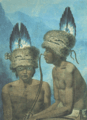
A painting representing Balthazar, Inhabitant of Northern California (1818), by Mikhail Tikhanov.
-
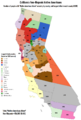
Map showing Native American populations by county in California.


Related Pages
- Aboriginal title in California
- California State Indian Museum
- Indigenous peoples of Mexico
- List of federally recognized tribes by state#California
- Martis people
- Mission Indians
- Population of Native California
- Survey of California and Other Indian Languages
- Traditional narratives of Indigenous Californians
- Bibliography of California history
- Rematriation
See also
 In Spanish: Pueblos indígenas de California para niños