
Washington, D.C. facts for kids
Quick facts for kids
Washington, D.C.
|
|||
|---|---|---|---|
| District of Columbia | |||
|
|||
| Nicknames:
D.C., The District
|
|||
| Motto(s):
Justitia Omnibus
(Justice for All) |
|||
| Anthem: "Washington" | |||

Neighborhoods of Washington, D.C.
|
|||

 Washington, D.C.
Location in the United States

Washington, D.C.
Location in North America
|
|||
| Country |  United States United States |
||
| Residence Act | July 16, 1790 | ||
| Named for | George Washington and Columbia | ||
| Area | |||
| • Total | 177.0 km2 (68.35 sq mi) | ||
| • Land | 158.32 km2 (61.126 sq mi) | ||
| • Water | 18.71 km2 (7.224 sq mi) | ||
| Highest elevation | 125 m (409 ft) | ||
| Lowest elevation | 0 m (0 ft) | ||


Washington, D.C. is the capital city of the United States. Its official name is the District of Columbia, but most people call it Washington or just D.C. It is special because it is not located inside any state. Instead, it is a federal district created specifically to serve as the permanent home of the U.S. federal government. The city rests along the northern shore of the Potomac River, with the state of Virginia across the water and the state of Maryland bordering it on all other sides.
The district was named in honor of two important figures. "Washington" honors George Washington, who served as the first U.S. president and helped plan where the city would sit. "Columbia" comes from an old, poetic symbol of the nation that represented liberty. Today, leaders from across the planet travel to Washington, D.C., to discuss important ideas, solve problems, and meet with American officials.
Millions of travelers visit each year to see world-famous landmarks like the White House, the Capitol Building, and tall stone monuments. Kids can explore large science, art, and space centers run by the famous Smithsonian Institution. The city is also filled with peaceful parks, calm waterways, wide tree-lined boulevards, and busy neighborhood markets.
Contents
- History of the Nation's Capital
- Geography and Natural Environment
- City Layout and Famous Architecture
- People and Neighborhoods
- Economy and Daily Work
- Culture, Food, and the Arts
- Smithsonian Museums and National Galleries
- Famous Monuments and Landmarks
- Sports and Recreation
- Local Government and Politics
- Education and Schools
- Transportation and How People Move
- Images for kids
- Related Pages
- See also
History of the Nation's Capital

Before any European explorers sailed along the Potomac River, Native American tribes made their homes along the gentle waterways. The Algonquian-speaking Piscataway people lived in the region for centuries. A group called the Nacotchtank built thriving farming villages near the junction of the Potomac and the Anacostia River. They fished for sturgeon, hunted deer in deep forests, and grew corn, beans, and squash along the rich soil of the riverbanks.
European settlers arrived in the early 1600s, bringing dramatic changes to the land. As more settlers established farms and trading posts, the Native American communities faced serious challenges and diseases. Many native families moved away, and some established a settlement near Point of Rocks, Maryland. Today, historians study the early tools and pottery left behind by these first inhabitants to understand how they cared for the land.
Founding the Federal City
During the American Revolutionary War, the Continental Congress met in several cities, including Philadelphia. When the war ended, American leaders needed a permanent location for the national government. In 1783, after soldiers protested outside the meeting hall during the Pennsylvania Mutiny of 1783, leaders realized the government needed its own secure home. James Madison wrote in Federalist No. 43 that a national capital must be independent so it would not rely on any single state for protection.
The new Constitution allowed Congress to create a special federal district up to ten miles square. However, lawmakers argued about where to place it. Northern states wanted help paying their war debts, while Southern states wanted the capital near them. In the famous Compromise of 1790, Alexander Hamilton agreed to put the capital in the south, while Thomas Jefferson and Madison agreed that the national government would pay state debts. Congress soon passed the Residence Act, signed by President George Washington, choosing land along the Potomac River.
To build the district, Maryland and Virginia donated land to form a diamond shape measuring ten miles on each side. The area included two older port towns: Georgetown, founded in 1751, and Alexandria, Virginia, founded in 1749. A surveyor named Andrew Ellicott led a team to map out the borders. He worked closely with Benjamin Banneker, a brilliant free African American astronomer and mathematician who calculated star positions to help set the border stones. Many of their stone markers still stand along the edges of the city today.
The government moved to the new capital in 1800. The 6th Congress met inside the unfinished United States Capitol, and President John Adams moved into the newly completed White House. The District of Columbia Organic Act of 1801 officially organized the district under the control of Congress. Because of this law, local citizens were no longer considered residents of Maryland or Virginia, meaning they lost their voting members in the national legislature.
War of 1812 and Reconstruction

During the War of 1812, enemy forces marched toward the capital after winning the Battle of Bladensburg. On August 24, 1814, British troops marched into the city and set fire to federal buildings. They burned the Library of Congress, the Treasury Building, the Capitol, and the White House during the tragic event called the burning of Washington. First Lady Dolley Madison helped save important treasures, including a famous portrait of George Washington, before leaving the house. A sudden violent rainstorm helped put out the flames the next day. Workers quickly began repairing the buildings, though the Capitol was not finished in its modern form until decades later.
In the 1830s, citizens living in Alexandria grew unhappy because Congress spent little money on their roads and harbors. In 1846, Virginia asked for its land back, and Congress agreed in an event called retrocession. This changed the district from a square diamond into its current shape, keeping only the land north of the Potomac River that came from Maryland.
During the American Civil War, Washington became an armed hub surrounded by defensive forts. President Abraham Lincoln signed the Compensated Emancipation Act in 1862, which ended slavery inside the district months before the nationwide Emancipation Proclamation. When the war ended, thousands of formerly enslaved people moved into the city looking for work, education, and safety. In 1868, Congress granted African American men the right to vote in local city elections.
Modern Growth and Civil Rights

By 1870, the city's population had climbed past 130,000 residents, but the capital lacked paved streets and modern water pipes. President Ulysses S. Grant appointed Alexander Robey Shepherd, who directed large building projects to pave roads, plant shade trees, and build sewer lines. The District of Columbia Organic Act of 1871 combined Georgetown, the city of Washington, and the rural county into one single local government.
In the early 1900s, planners created the McMillan Plan to beautify the city's center. They cleared away old railroad tracks from the National Mall and designed wide green lawns inspired by Neoclassical ideas. During the 1930s, the New Deal brought thousands of new workers to the city to run economic relief programs, leading to more government offices and museums.
Washington became a vital center for the American civil rights movement. On August 28, 1963, more than 200,000 people gathered for the historic March on Washington for Jobs and Freedom. Standing on the steps of the Lincoln Memorial, Martin Luther King Jr. delivered his famous speech about equality and freedom. In 1973, Congress passed the District of Columbia Home Rule Act, allowing residents to elect their own local leaders, including a city mayor and a 13-member council.
Geography and Natural Environment

Washington, D.C., sits on the Atlantic Seaboard fall line, where rocky hills meet flat coastal plains. The city covers an area of about 68.3 square miles, with roughly 61 square miles of land and 7.3 square miles of water. It is bordered by Montgomery County, Maryland, to the northwest, Prince George's County, Maryland, to the east, and Arlington County, Virginia, across the river.
The highest natural ground in the district is at Fort Reno Park in the northwest, which rises 409 feet above sea level. The lowest point is right at water level along the banks of the Potomac River. Long ago, a waterway named Tiber Creek flowed past the Capitol, but builders enclosed it inside underground tunnels during the 1870s. Further west, the historic Chesapeake and Ohio Canal begins in Georgetown, allowing boats in the 1800s to bypass the rocky rapids at Little Falls.
Public Parks and Green Spaces
.jpg)
Washington is famous for its lush greenery and open spaces. About one-fifth of the entire district is made up of public parkland, meaning nearly every resident lives within a short walk of a park. The National Park Service takes care of most of this federal land, ensuring that trees, nature trails, and historical monuments remain clean and protected for visitors.
The largest green space in the city is Rock Creek Park, established by Congress in 1890. This urban forest covers more than 1,750 acres and extends over nine miles through the center of the city. Animals such as white-tailed deer, red foxes, barred owls, and raccoons roam freely under the tall oaks and beech trees. Children can visit its planetarium, hike along rocky paths, or spot turtles resting on sunny logs in the stream.
Other wonderful parks include Meridian Hill Park, known for its multi-tiered waterfall and stone statues, and the United States National Arboretum in Northeast Washington. The Arboretum spans 446 acres and features colorful azalea collections, bonsai trees, and the historic National Capitol Columns. In the middle of the river, Theodore Roosevelt Island offers quiet walking trails and a large bronze statue honoring the conservation-minded president. Nearby Kingman Island sits along the Anacostia River, providing wetlands where migrating waterbirds find food and shelter.
Weather and Four Seasons

Washington experiences a temperate humid subtropical climate, giving the city four distinct seasons. Springs are mild and famous for blooming flowers, while autumn brings crisp air and bright orange and red leaves to the forests.
Summers are often hot and humid, with July temperatures averaging around 80 degrees Fahrenheit. Afternoon heat indexes can climb near 100 degrees, often creating sudden summer thunderstorms. Winters tend to be chilly and damp, with occasional snowstorms. Huge winter storms called nor'easters can sweep up the Atlantic coast, dropping heavy snow over the region. The largest recorded snowstorm, the Knickerbocker storm in 1922, brought 28 inches of snow to the city streets.
Every spring, thousands of visitors arrive to admire the cherry blossoms around the Tidal Basin. These flowering trees were given to the United States as a gift of friendship from Japan in 1912. When the blossoms open each year, the city hosts parades and cultural festivals to celebrate international friendship and the arrival of warm weather.
City Layout and Famous Architecture
.jpg)
Unlike many older American cities that grew naturally without a map, Washington was carefully planned before builders laid the first brick. In 1791, George Washington asked Pierre Charles L'Enfant, an engineer from France, to design the capital. L'Enfant imagined a grand city filled with wide avenues, public squares, and expansive lawns similar to royal gardens in Europe.
L'Enfant created a grid pattern crossed by wide diagonal avenues named after American states. He placed the Capitol on a high hill so lawmakers could look out over the city. Although L'Enfant later argued with city leaders and left the project, surveyor Andrew Ellicott finished the drawings, keeping most of L'Enfant's grand layout intact.
City Quadrants and Street Names
Washington is divided into four unequal sections called quadrants: Northwest, Northeast, Southwest, and Southeast. The dividing lines for these sections meet at the center of the Capitol building. Every street address includes a quadrant tag, like NW or SE, which helps mail carriers and visitors find the correct location:
- Numbered streets run north and south, starting with 1st Street near the Capitol.
- Lettered streets run east and west, starting with A Street and moving outward alphabetically.
- Diagonal avenues are named after U.S. states, such as Pennsylvania Avenue and Massachusetts Avenue.
- Circular intersections, known as traffic circles, sit where diagonal avenues cross the grid.
Because of the federal Height of Buildings Act of 1910, buildings in Washington cannot rise higher than the width of the street in front of them plus twenty feet. This prevents skyscrapers from blocking sunlight and keeps the city feeling open and bright. The tallest structure in the city remains the stone Washington Monument, which stands over 555 feet into the air.
Classical and Historic Buildings

The architecture of Washington features many different historic styles. Many government buildings and national monuments were built using classical Greek and Roman designs. Leaders felt that classical styles, with their strong stone columns, triangular pediments, and domes, reminded citizens of the democratic ideals of ancient Greece and Rome.
Examples of classical architecture include the United States Supreme Court Building, built with bright white marble, and the Jefferson Memorial, designed like a round Roman temple. The White House, begun in 1792, features simple Georgian and neoclassical details. On Capitol Hill, the Capitol features an enormous cast-iron dome painted white to match its stone walls.
Other parts of the city display different artistic styles:
- The Eisenhower Executive Office Building was built in the ornate French Second Empire style, featuring hundreds of small columns and mansard roofs.
- The Smithsonian Institution Building, known as the "Castle," was constructed from reddish-brown sandstone in the Norman medieval style.
- Neighborhoods like Dupont Circle and Capitol Hill feature rows of colorful Victorian townhouses with bay windows and iron railings.
- The National Museum of African American History and Culture features a modern, bronze-colored metal lattice inspired by traditional African metalwork.
- The Old Stone House in Georgetown, built in 1765, is the oldest surviving home in the district.
People and Neighborhoods
.jpg)
Washington, D.C., is home to nearly 700,000 year-round residents. However, on weekdays, hundreds of thousands of commuters travel into the city from Maryland and Virginia to work in government offices and private businesses. This brings the city's daytime population to well over one million people.
The city has a rich cultural heritage. For many decades, Washington was known as a center of African American culture, earning the nickname "Chocolate City" in the 1970s when more than two-thirds of its residents were Black. While many families have since moved into surrounding suburban communities, African Americans still make up over 40 percent of the population. The district also includes growing communities of Latino, Asian, and European families.
Vibrant Neighborhoods
Washington contains more than 130 unique neighborhoods, each with its own character:
- Georgetown: A historic riverfront neighborhood famous for cobblestone streets, colorful rowhouses, and Georgetown University.
- Adams Morgan: A lively neighborhood known for international restaurants, murals, and independent bookstores.
- Anacostia: A historic neighborhood east of the river that was home to famous writer and leader Frederick Douglass.
- Chinatown: A downtown neighborhood marked by the decorative Friendship Archway and home to Capital One Arena.
- Columbia Heights: A bustling community with popular retail plazas and the historic GALA Hispanic Theatre.
- Navy Yard: A newly rebuilt neighborhood along the Anacostia River where fans gather to watch baseball games at Nationals Park.
The city also attracts newcomers from all around the globe. Many people arrive to work at the 177 foreign embassies or international agencies located along Embassy Row. Immigrants from El Salvador, Ethiopia, China, and many other countries have built welcoming communities, opening bakeries, markets, and cultural festivals across the city.
Economy and Daily Work
_(cropped).jpg)
The economy of Washington, D.C., is unique because its biggest employer is the federal government. About one out of every four workers in the city works directly for an agency of the national government. These workers help run national parks, print currency, manage military branches, and pass laws in Congress.
Many other residents work for private companies that support the government's work. These include law firms, engineering groups, computer software companies, and think tank research centers that study public problems. The city is also home to major medical centers like the Children's National Medical Center and large colleges like George Washington University.
Tourism is the second-largest industry in the district. Millions of families, school groups, and international travelers visit every year to explore the monuments and museums. These visitors stay in local hotels, eat at restaurants, ride public trains, and buy souvenirs, bringing billions of dollars into the local economy each year.
The city also serves as the headquarters for major national and international organizations. The American Red Cross, which helps families during natural disasters, is based here. Nearby, international groups like the World Bank and the International Monetary Fund work to reduce global poverty and help economies grow around the world.
Culture, Food, and the Arts

Washington is an exciting hub for music, theater, and visual arts. The largest performing arts center in the city is the John F. Kennedy Center for the Performing Arts, located along the Potomac River. It hosts the National Symphony Orchestra, the Washington National Opera, and the Washington Ballet. Every year, the center presents the Kennedy Center Honors to celebrate artists who have made important contributions to American culture.
Historic theaters can be found throughout downtown. Ford's Theatre still hosts plays today, while also operating as a historic site teaching visitors about Abraham Lincoln's life. The National Theatre, which opened in 1835, is one of the oldest continuously operating playhouses in the nation. Near the river, Arena Stage produces modern plays by American writers.
Native Music and the Jazz Age
Washington played an important role in American musical history. During the 1920s and 1930s, the U Street neighborhood was known as the cultural center of the city. Music legend Duke Ellington, one of America's greatest jazz composers and pianists, grew up in Washington and began performing his songs in neighborhood theaters like the Howard Theatre and the Lincoln Theatre.
In the late 1970s, local musicians created a brand-new style of music called go-go. Popularized by musician Chuck Brown, go-go uses heavy drumming, cowbells, and conga drums to create rhythmic dance beats where the band keeps playing without stopping between songs.
During the 1980s, the city became an influential center for underground rock music. Bands recorded on the local label Dischord Records, started by musician Ian MacKaye. Venues like the 9:30 Club and The Black Cat helped popularize independent music, creating a style known as D.C. hardcore that inspired young musicians across the world.
Delicious Local Foods
.jpg)
Because people from all over the world move to Washington, the city offers an amazing variety of food. You can find restaurants serving meals from France, India, Mexico, China, and Vietnam. The city has one of the largest concentrations of Ethiopian restaurants in the world outside of Ethiopia, with many centered in the Shaw neighborhood.
The city also has its own famous local dishes:
- The half-smoke: A large smoked sausage made from beef and pork, grilled and served on a warm bun with mustard, chopped onions, and spicy chili sauce.
- Mumbo sauce: A sweet and tangy reddish sauce served over fried chicken wings, french fries, and egg rolls at neighborhood carryout spots.
- Jumbo slice: An oversized slice of cheese or pepperoni pizza that originated in the Adams Morgan neighborhood.
One of the city's most famous dining landmarks is Ben's Chili Bowl, opened on U Street in 1958 by Ben and Virginia Ali. It has served half-smokes and milkshakes to presidents, civil rights leaders, and musicians for over sixty years. Along the Southwest waterfront, the Maine Avenue Fish Market has been operating since 1805, selling fresh crabs, shrimp, and fish right from open barges.
Smithsonian Museums and National Galleries
.jpg)
Washington is famous for having some of the greatest museums in the world, and most of them are completely free to enter. The Smithsonian Institution was created by Congress in 1846 using money donated by British scientist James Smithson, who wanted to support the "increase and diffusion of knowledge." Today, it is the largest museum and research complex in the entire world.
Most Smithsonian museums sit along the wide grassy paths of the National Mall:
- National Museum of Natural History: Visitors can see giant dinosaur skeletons, preserved ocean animals, an ancient Egyptian mummy exhibit, and the sparkling 45-carat Hope Diamond.
- National Air and Space Museum: Displays real aircraft and spacecraft, including the original 1903 Wright Flyer airplane, the Spirit of St. Louis, and the command module from the Apollo 11 mission to the Moon.
- National Museum of American History: Preserves the giant Star-Spangled Banner flag that inspired the national anthem, historic steam locomotives, and presidential artifacts.
- National Museum of the American Indian: Highlights the arts, traditions, and languages of indigenous tribes from across North and South America.
- National Museum of African American History and Culture: Explores Black history, art, and achievement from early America to modern sports and music.
- National Zoo: Located in nearby Woodley Park, this 163-acre zoo cares for hundreds of animals, including giant pandas, Asian elephants, and western lowland gorillas.
Art lovers can visit the National Gallery of Art, which features famous paintings and sculptures from Europe and America, including the only painting by Leonardo da Vinci on public display in the Americas. Other exciting stops include the International Spy Museum, where kids can learn about secret codes, and the United States Holocaust Memorial Museum, which teaches lessons about courage, kindness, and human rights.
Famous Monuments and Landmarks

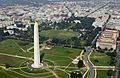
The heart of Washington is the National Mall, a wide, two-mile-long open park stretching between the Lincoln Memorial and the U.S. Capitol. This grand green space has hosted historic speeches, protest marches, Fourth of July firework celebrations, and presidential inaugurations.
At the center of the Mall stands the Washington Monument, built to honor George Washington. Made of white marble, granite, and bluestone, this towering obelisk is the world's tallest stone structure. An elevator takes visitors up to an observation deck at 500 feet, offering panoramic views of the entire city.
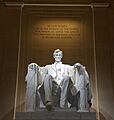
At the west end of the Mall sits the Lincoln Memorial. Designed like a Greek temple, it contains a large marble statue of Abraham Lincoln carved by the Piccirilli brothers. In front of the memorial lies the long Lincoln Memorial Reflecting Pool, where visitors can sit and watch the monument's reflection in the water. Nearby memorials honor those who served in the armed forces, including the National World War II Memorial, the Korean War Veterans Memorial, and the Vietnam Veterans Memorial designed by architect Maya Lin.
Tidal Basin and Capitol Hill Landmarks

South of the Mall, walking paths loop around the Tidal Basin, an inlet that connects to the Potomac River:
- Jefferson Memorial: A domed rotunda honoring Thomas Jefferson, the third U.S. president.
- Martin Luther King Jr. Memorial: A large granite carving called the "Stone of Hope" that honors the famous civil rights leader.
- Franklin Delano Roosevelt Memorial: An outdoor stone memorial featuring waterfalls, bronze statues, and quiet garden rooms highlighting Roosevelt's presidency.
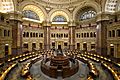
Across town on Capitol Hill, the Library of Congress houses over 170 million books, maps, recordings, and manuscripts, making it the largest library in the world. Visitors can tour the Thomas Jefferson Building to admire its golden ceilings, classical wall paintings, and a historic printed Gutenberg Bible. Right next door sits the United States Supreme Court Building, where nine justices make important legal decisions under the carved stone motto "Equal Justice Under Law."
Just north of the Mall, the National Archives Building protects the original parchment pages of the United States Declaration of Independence, the U.S. Constitution, and the United States Bill of Rights. Visitors can view these founding documents protected inside special glass cases.
Sports and Recreation
Washington is an active sports city with professional teams playing in every major American league. Sports fans wear team jerseys and wave red, white, and blue banners at matches all through the year.
The city's major professional teams include:
- Washington Nationals: A baseball team in Major League Baseball that plays its home games along the river at Nationals Park. The team won its first World Series championship in 2019.
- Washington Commanders: A football team in the National Football League that plays at Northwest Stadium. The team has won three Super Bowl titles.
- Washington Wizards: A basketball team in the National Basketball Association playing downtown at Capital One Arena.
- Washington Capitals: An ice hockey team in the National Hockey League that also plays at Capital One Arena. They won the Stanley Cup championship in 2018.
- Washington Mystics: A women's basketball team in the Women's National Basketball Association that plays at CareFirst Arena and won the WNBA championship in 2019.
- D.C. United: A soccer team in Major League Soccer that plays at Audi Field and has won four league cups.
- Washington Spirit: A professional soccer team in the National Women's Soccer League that also plays at Audi Field.
College sports are also popular in the district. The Georgetown Hoyas men's basketball team draws large crowds to its games, while teams from George Washington University, American University, and Howard University compete in NCAA Division I tournaments.
For everyday athletes, the city offers miles of running and biking trails. Every autumn, thousands of runners participate in the Marine Corps Marathon, known as "The People's Marathon" because anyone can register to run without winning prize money. Tennis fans travel to Rock Creek Park each summer to watch international stars play matches at the Washington Open.
Local Government and Politics

Because Washington is a federal district, its government works differently from any state or city in America. Under Article One of the United States Constitution, the national United States Congress has final authority over the entire city. For almost a century, local residents could not elect their own city leaders; instead, the U.S. president appointed commissioners to run the government.
In 1973, Congress passed the District of Columbia Home Rule Act. This law gave citizens the right to elect their own mayor and a 13-member Council of the District of Columbia. The mayor manages city services like police officers, firefighters, trash collection, and public parks, while the council passes local ordinances and sets the budget. The mayor and council work inside the historic John A. Wilson Building on Pennsylvania Avenue. However, Congress still holds the legal power to review and cancel any local law passed by the city council.
Voting Representation and Statehood

Residents of Washington pay all normal federal taxes, but they do not have full representation in Congress. The city elects one delegate to the United States House of Representatives, currently Eleanor Holmes Norton. The delegate can introduce legislation, speak in debates, and vote inside committees, but cannot vote on final bills on the House floor. The district has no members at all in the United States Senate.
To protest this situation, city vehicle license plates display the famous motto "End Taxation Without Representation", echoing the words of the American colonists who founded the country. Many residents actively support the District of Columbia statehood movement, which aims to make Washington the nation's 51st state, tentatively named Washington, Douglass Commonwealth, in honor of Frederick Douglass.
Until 1961, citizens in the capital could not even vote for the U.S. president. The Twenty-third Amendment to the United States Constitution fixed this by giving the district three votes in the Electoral College. This means that Washington residents have an equal say with smaller states when choosing the American president.
Education and Schools
_(cropped).jpg)
Children in Washington attend a wide variety of public, charter, and private schools. The city's traditional public school system is called District of Columbia Public Schools (DCPS). It manages more than 120 elementary, middle, and high schools across every quadrant of the city. Among these is the famous Duke Ellington School of the Arts, a specialized high school where students study drama, dance, and music alongside academic classes.
Washington also has many public charter schools monitored by the District of Columbia Public Charter School Board. These schools are free to attend and receive public funding, but they operate independently from the main DCPS school board. Roughly half of all public school students in the district attend charter schools.
Colleges and Universities

The city is home to several top colleges and universities that attract students from all over the world:
- Georgetown University: Founded in 1789, it is the oldest university in the district and sits on hills overlooking the Potomac River.
- George Washington University: Located in the Foggy Bottom neighborhood just blocks from the White House and the State Department.
- Howard University: A famous historically Black university founded in 1867 that has educated many national leaders, scientists, and writers.
- American University: Located in upper Northwest Washington, known for its programs in government, international service, and communications.
- Gallaudet University: The world's first university designed specifically for deaf and hard-of-hearing students, where instruction is taught using American Sign Language.
- Catholic University of America: A private university located in Northeast Washington, situated near the large Basilica of the National Shrine of the Immaculate Conception.
- University of the District of Columbia: The city's public university, offering degrees in engineering, agriculture, and business.
Neighborhoods throughout the capital are also served by the District of Columbia Public Library system. Its central library, the Martin Luther King Jr. Memorial Library downtown, features reading spaces, digital media labs, and rooftop garden terraces where students can study and learn.
Transportation and How People Move

Washington is one of the easiest cities in the United States to explore without a car. It features an extensive public transit system operated by the Washington Metropolitan Area Transit Authority (WMATA), which runs trains and buses across the district and into nearby Maryland and Virginia suburbs.
The city's rail system, called the Washington Metro, opened in 1976. Today, it includes six color-coded lines: Red, Blue, Orange, Silver, Green, and Yellow. Metro trains run along 129 miles of track through 98 stations. The underground stations are easily recognized by their vaulted concrete ceilings. Metro stations feature some of the longest escalators in the world, including a 230-foot escalator at the Wheaton station in suburban Maryland.
Above ground, the city operates hundreds of Metrobus routes that stop at neighborhood schools, shopping centers, and office parks. In Northeast Washington, riders can also hop on the modern DC Streetcar, which carries passengers down H Street and Benning Road to local shops and restaurants.
Walking and Biking

Washington is consistently ranked among the most walkable cities in North America. Flat sidewalks, shaded avenues, and pedestrian plazas make it easy for residents to walk to work or school. Neighborhoods like Dupont Circle, Mount Vernon Square, and U Street are especially popular for walking.
Bicycling is also very popular. The city contains over 100 miles of dedicated bike lanes, including protected lanes separated from car traffic by concrete barriers. Residents and visitors can rent bikes through Capital Bikeshare, which operates thousands of bikes at hundreds of solar-powered stations across the metropolitan region. Paved recreation trails, such as the Capital Crescent Trail and the Mount Vernon Trail along the river, allow cyclists to travel through scenic parks away from cars.
Railroads and Major Airports

For long-distance travel, train passengers arrive at Washington Union Station. Opened in 1907, this historic train station serves millions of passengers each year. It is one of the busiest Amtrak hubs in the country, connecting travelers along the busy Northeast Corridor to cities like Baltimore, Philadelphia, and New York City. Commuter trains from Maryland and Virginia also bring suburban workers right into Union Station every morning.
Three major airports serve the capital region, located outside the city borders:
- Ronald Reagan Washington National Airport: Located across the Potomac River in Arlington County, Virginia, just minutes from downtown. It handles domestic flights across the United States.
- Washington Dulles International Airport: Located 24 miles west in Virginia, serving large airplanes and flights to Europe, Asia, Africa, and South America.
- Baltimore/Washington International Airport: Located northeast in Maryland, offering domestic flights and regional connections.
When the President of the United States travels by air, special procedures are followed. The president boards the green Marine One helicopter on the South Lawn of the White House and flies to Joint Base Andrews in Maryland. From there, the president flies aboard the presidential jet, Air Force One, to destinations around the globe.
Images for kids
-
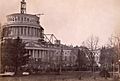
The Capitol dome under construction during Abraham Lincoln's inauguration in 1861.
-
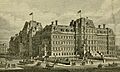
The Eisenhower Executive Office Building shortly after completion in the late 1880s.
-
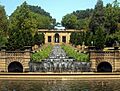
The cascading stone waterfall inside Meridian Hill Park.
-
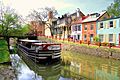
The historic Chesapeake and Ohio Canal flowing through Georgetown.
-
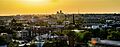
An aerial view of Northwest Washington showing tree-lined avenues and low buildings.
-
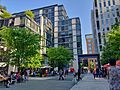
Modern glass buildings and pedestrian walkways at CityCenterDC downtown.
-
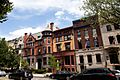
Historic brick townhouses in the Dupont Circle neighborhood.
-
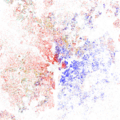
Map showing the distribution of residents across the metropolitan region.
-
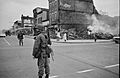
Historic scene along city streets in 1968.
-
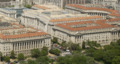
Aerial view of the Federal Triangle office buildings from the Washington Monument.
-
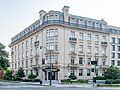
Headquarters of the American Enterprise Institute, one of the city's policy research centers.
-
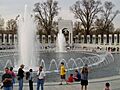
The fountains and stone pillars of the National World War II Memorial.
-
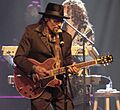
Musician Chuck Brown performing go-go music for local fans.
-
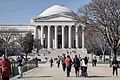
The grand marble entrance of the National Gallery of Art on the Mall.
-
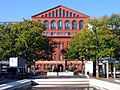
The National Building Museum, featuring enormous interior Corinthian columns.
-
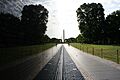
The polished black granite wall of the Vietnam Veterans Memorial.
-
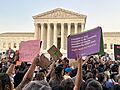
Citizens gathering outside the Supreme Court Building to voice their opinions.
-

A hockey game featuring the Washington Capitals at Capital One Arena.
-
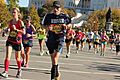
Runners participating in the annual Marine Corps Marathon past the U.S. Botanic Garden.
-
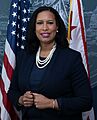
Muriel Bowser, who has served as the mayor of Washington since 2015.
-
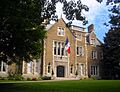
The historic residence of the French ambassador on Embassy Row.
-
View looking toward the White House from the base of the Washington Monument.
-
The large seated statue of Abraham Lincoln inside the Lincoln Memorial.
-
The Main Reading Room inside the Thomas Jefferson Building of the Library of Congress.
-
Modern office buildings surrounding Franklin Park downtown.
-
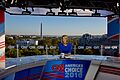
Television journalists broadcasting news from a temporary studio in Washington.
-
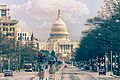
Pennsylvania Avenue looking toward the Capitol dome on a quiet winter day.
-
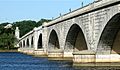
Arlington Memorial Bridge crossing the Potomac River at sunrise.
-
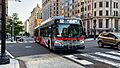
A public Metrobus carrying riders through city streets.
-
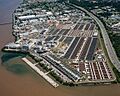
The Blue Plains Advanced Wastewater Treatment Plant along the Potomac River.

.jpg)
.jpg)

.jpg)


.png)

_(53821618777).jpg)

.jpg)


.jpg)
.jpg)

.jpg)


.jpg)


Related Pages
- George Washington
- Library of Congress
- National Mall
- Potomac River
- Smithsonian Institution
- United States Capitol
- White House
See also
 In Spanish: Washington D. C. para niños
