
Connecticut facts for kids
Quick facts for kids
Connecticut
|
|||
|---|---|---|---|
|
|||
Nickname(s):
|
|||
Motto(s):
|
|||
| Anthem: "Yankee Doodle" |
|||

Location of Connecticut within the United States
|
|||
| Country | United States | ||
| Before statehood | Connecticut Colony | ||
| Admitted to the Union | January 9, 1788 (5th) | ||
| Capital | Hartford | ||
| Largest city | Bridgeport | ||
| Largest county or equivalent | Capitol (Hartford County) | ||
| Largest metro and urban areas | New York (combined) Greater Hartford (metro and urban) |
||
| Legislature | General Assembly | ||
| • Upper house | Senate | ||
| • Lower house | House of Representatives | ||
| Judiciary | Connecticut Supreme Court | ||
| U.S. senators | Richard Blumenthal (D) Chris Murphy (D) |
||
| U.S. House delegation | 5 Democrats (list) | ||
| Area | |||
| • Total | 5,543 sq mi (14,356 km2) | ||
| • Land | 4,849 sq mi (12,559 km2) | ||
| • Water | 698 sq mi (1,809 km2) 12.6% | ||
| Area rank | 48th | ||
| Dimensions | |||
| • Length | 70 mi (113 km) | ||
| • Width | 110 mi (177 km) | ||
| Elevation | 500 ft (150 m) | ||
| Highest elevation
(Massachusetts border on south slope of Mount Frissell)
|
2,379 ft (725 m) | ||
| Lowest elevation | 0 ft (0 m) | ||
| Population
(2025)
|
|||
| • Total |  3,688,496 |
||
| • Rank | 29th | ||
| • Density | 745/sq mi (288/km2) | ||
| • Density rank | 4th | ||
| • Median household income | $91,700 (2,023) | ||
| • Income rank | 10th | ||
| Demonym(s) |
|
||
| Language | |||
| • Official language | None | ||
| Time zone | UTC−05:00 | ||
| • Summer (DST) | UTC−04:00 | ||
| USPS abbreviation |
CT
|
||
| ISO 3166 code | US-CT | ||
| Traditional abbreviation | Conn. | ||
| Latitude | 40°58′ N to 42°03′ N | ||
| Longitude | 71°47′ W to 73°44′ W | ||


Connecticut is an exciting state found in the beautiful region called New England in the Northeastern United States. It touches Rhode Island on the east, Massachusetts to the north, and New York on the west side. To the south, its rocky shorelines touch the sparkling waters of Long Island Sound. The busy capital city of the state is Hartford, while the largest city by population is Bridgeport. Connecticut sits right inside the lively Northeast Corridor, halfway between New York City and Boston. It is the third-smallest state by area, but it is home to over 3.6 million people. This makes it the fourth among the most densely populated U.S. states.
The state gets its interesting name from the winding Connecticut River, which is the longest river across all of New England. This river splits the state into two halves before flowing into the sea between Old Saybrook and Old Lyme. The word comes from an old Mohegan-Pequot Native American word that means "upon the long tidal river". Long before any European travelers arrived, many Algonquian groups made their homes across the hills and valleys. Later, European settlers arrived from places like the Massachusetts Bay Colony to set up towns.
Connecticut is known proudly as the "Constitution State" because its leaders wrote early government rules called the Fundamental Orders of Connecticut in 1639. When the Thirteen Colonies wanted freedom during the American Revolution, Connecticut stepped forward to help build the new nation. Today, the state is famous for top colleges like Yale University in New Haven, huge sailing ships, and great inventions like the modern helicopter. It has rolling green hills, lively sandy seashores, and deep forests full of wonder.
Contents
- Exciting History of the Constitution State
- Where is Connecticut? Geography and Landscapes
- People and Communities
- How the State Works: Government and Laws
- Busy Economy and Work
- Getting Around: Transportation
- Schools and Universities
- Sports and Fun Activities
- State Symbols and Fun Nicknames
- Images for kids
- Notable People
- See also
Exciting History of the Constitution State

The story of Connecticut began thousands of years ago with early Native American nations. People used rocks to shape sharp tools for hunting deer, catching fish, and building wooden canoes. These groups moved from one spot to another as seasons changed to collect nuts, berries, and freshwater fish. They belonged to the Algonquian language group. These diverse Native American groups included the Nipmuc, the Tunxis, the Schaghticoke, the Podunk, the Wangunk, the Hammonasset, and the Quinnipiac. Along the coast lived the Pequot and the Mohegans. Many tribal members, including the Paugusetts, still proudly live in the state today.
Native families planted corn, beans, and squash together in mounds so the plants could help each other grow tall. They gathered shiny purple and white shells to make beautiful beads called wampum, which served as money and kept records of important treaties.
Early European Explorers and Settlements

In the year 1614, a Dutch sailor named Adriaen Block explored the coastline and rivers of Connecticut. Soon, traders from the Dutch trading posts sailed up the river and built a trading post named the House of Hope in Hartford.
English settlers arrived shortly after from Massachusetts. A leader named Thomas Hooker guided a big group of Puritan settlers across the wilderness in 1636 to build the Connecticut Colony in Hartford. In 1639, they wrote down the Fundamental Orders of Connecticut, setting up rules for electing leaders. Many historians consider this the very first written constitution that created a government! Another separate group created the New Haven Colony under leader John Davenport and merchant Theophilus Eaton. Another town started at Saybrook near the ocean, organized by John Winthrop the Younger.
Over time, more towns grew rapidly, such as Windsor, Wethersfield, Fairfield, Guilford, Milford, Stratford, Farmington, Stamford, and New London. In 1662, King Charles II gave Connecticut an official royal charter that allowed these different communities to join together.
The Revolutionary War and Gaining Freedom

When the American colonies fought for independence, Connecticut played an enormous role. Four leaders from Connecticut signed the famous Declaration of Independence: Samuel Huntington, Roger Sherman, William Williams, and Oliver Wolcott. Brave Connecticut soldiers marched quickly to fight in the Battle of Bunker Hill in 1775.
In that same year, an inventor named David Bushnell built an amazing wooden submarine named the Turtle. It was designed to steer secretly underwater and attach powder charges to enemy ships in New York Harbor!
Because Connecticut produced massive amounts of grain, cattle, boots, and cannonballs for General George Washington, it became known as "The Provisions State." When British troops invaded to burn storage depots, brave officers like General David Wooster and Benedict Arnold fought back during the fierce Battle of Ridgefield. Later, General Israel Putnam established a winter camp for the Continental Army at Redding to protect supply lines. Connecticut ratified the Constitution of the United States on January 9, 1788, happily becoming the fifth state to join the new country.
Inventions and Big Factories

During the 1800s, Connecticut turned into an incredible center for building things. Talented inventors like Eli Whitney designed new manufacturing methods that allowed factories to make parts that were completely interchangeable. This transformed the entire world of industry.
Small mill towns popped up quickly along rushing waterways. In Jewett City, textile entrepreneur Samuel Slater built busy spinning mills powered by the rushing water of the Pachaug River and Quinebaug River. Fast rivers spun giant waterwheels and metal turbines to drive machinery. Cities like Danbury became the hat-making capital of the nation, while Waterbury was celebrated worldwide for making shiny brass buttons and clocks.
During this era, fast sailing clipper ships and fishing fleets made ports like New London famous around the globe. Noah Webster worked diligently in New Haven to complete the first great American dictionary. When the American Civil War began, Connecticut sent 55,000 soldiers to support the Union. Its busy factories made firearms, uniforms, and equipment, while Connecticut native Gideon Welles directed naval operations as Secretary of the Navy.
Modern Growth in the Twentieth Century

In the 1900s, Connecticut companies built equipment that changed transportation forever. During World War I, major gunmakers like Remington Arms, Winchester, and Colt manufactured vast supplies of gear. Shipyards along the coast built submarines at Electric Boat in Groton, creating the world's premier submarine base.
In 1925, an engineer named Frederick Rentschler helped start Pratt & Whitney to design powerful airplane engines. On May 13, 1940, inventor Igor Sikorsky successfully flew the first practical single-rotor helicopter in the air! His company, Sikorsky Aircraft, went on to build giant rescue helicopters for pilots across the globe.
Disasters tested the spirit of the state as well. On September 21, 1938, a massive storm nicknamed the "Long Island Express" slammed into the shoreline with huge waves and destructive winds. Rivers flooded cities like Hartford, but neighbors worked together to rebuild bridges, roads, and homes.
In 1974, Connecticut made history by electing Ella T. Grasso as governor. She was the first woman in American history elected as governor in her own right, without being married to a previous governor!
Where is Connecticut? Geography and Landscapes

Connecticut is a small state packed with an incredible variety of nature. It covers 5,543 square miles of land and water. The state is shaped somewhat like a rectangle, but has a curious bump on the northern border called the Southwick Jog. This little boundary notch happened after long colonial arguments with Massachusetts were resolved in 1804. Another corner in the southwest forms a special shape called the Connecticut Panhandle, reaching toward New York.
The highest mountain top entirely within Connecticut is Bear Mountain in the town of Salisbury, standing 2,316 feet high. An even higher spot sits right on the southern slope of Mount Frissell, reaching 2,379 feet near the Massachusetts border! In contrast, coastal towns along the ocean sit right at sea level.
Rolling Hills and Winding Rivers

The state has several natural regions. In the northwest, the scenic Litchfield Hills feature tall ridges, dairy barns, and forest trails. Part of the famous Appalachian National Scenic Trail cuts through these high ridges for hikers to explore.
Through the center of the state runs the broad Connecticut River Valley. The great river flows through farmland and bustling cities before emptying into Long Island Sound. Because the coast is protected by Long Island across the sound, the beaches do not have giant ocean waves, making the water calm and pleasant for small boats and marine animals.
Four Beautiful Seasons
Connecticut experiences four distinct seasons each year, having a mix of humid continental climate in the hills and humid subtropical climate along the warmer coast. Summers are pleasantly warm and sunny, with average temperatures in July around 85 degrees Fahrenheit. Occasionally, heat waves reach higher, with an all-time record of 106 degrees set in Danbury back in 1995.
Autumn brings crisp air and brilliant red, gold, and orange leaves to the hillsides. Winters bring snowy days, especially in the northern mountains, which can receive 60 inches of snow every year. Powerful winter storms known as a nor'easter sometimes sweep along the coast, covering towns in thick blankets of white snow. Spring brings singing birds, blooming flowers, and melting mountain streams.
Plants and Wild Animals
Connecticut's rich landscape is covered with green woodlands. The southern coast has Northeastern coastal forests with mighty oak trees, while northern hills feature cool New England-Acadian forests filled with sugar maples, birch, and pine trees.
- Mountain Laurel (Kalmia latifolia) is the official state flower. It produces delicate white and pink blossoms along forest paths.
- Rosebay rhododendron (Rhododendron maximum) grows wild in places like Pachaug State Forest.
- Atlantic white cedar (Chamaecyparis thyoides) grows in cool freshwater swamps.
- Connecticut even has a native cactus called the eastern prickly pear (Opuntia humifusa) that grows on dry, sandy coastal hills!
Many wild animals thrive in these habitats. White-tailed deer, black bears, red foxes, and wild turkeys roam the woods. The state bird, the cheerful American robin, hunts for earthworms on school lawns. Along the shores, you can find the Eastern oyster and the American shad swimming in the tidal bays.
People and Communities


Over 3.6 million people call Connecticut home! Most residents live in cities and suburban neighborhoods close to Long Island Sound or along the central river valley. Many towns feature a traditional central park called a Village green, surrounded by a historic white church, an old colonial meeting house, and wooden colonial homes with historic stone walls.
The people of Connecticut come from a rich blend of backgrounds and cultures. Many families trace their ancestral roots back to Italy, Ireland, England, Germany, and Poland. The state also has a large, vibrant Hispanic community, especially families of Puerto Rican heritage. People have moved to Connecticut from all across the world, including India, Jamaica, the Dominican Republic, Poland, and Ecuador.
Different religious traditions exist side by side across the state. Many residents are Christian, including Roman Catholic and various Protestant groups like the United Church of Christ. Many citizens are Jewish, and there are growing communities of Muslim, Hindu, and Buddhist families.
Big Cities and Bustling Towns
Connecticut does not have giant individual cities like New York or Chicago, but it has many lively, close-knit communities:
- Bridgeport: The state's most populous city, known for its deep harbor, parks, and historic zoo.
- Stamford: A thriving city close to New York with towering office buildings and shopping centers.
- New Haven: Famous as the home of Yale University and tasty New Haven-style pizza!
- Hartford: The capital city, filled with government buildings, museums, and historic insurance companies.
- Waterbury: Known historically as the "Brass City" because of its former metal factories.
- Greenwich: A beautiful coastal community filled with sandy beaches and historic estates.
How the State Works: Government and Laws

The state government of Connecticut works like the United States government, divided into three balanced branches. The rules for the state are written in the state constitution, which was updated in 1965.
The Three Branches of Government
- The Executive Branch: This branch is led by the Governor, who makes sure state laws are carried out properly. The Governor works in the State Capitol building in Hartford. Other leaders include the Lieutenant Governor, the Secretary of the State, and the Attorney General.
- The Legislative Branch: Called the Connecticut General Assembly, this group makes new laws. It is divided into two parts: the Connecticut State Senate with 36 senators, and the Connecticut House of Representatives with 151 representatives. Citizens vote for their local representatives every two years.
- The Judicial Branch: This branch includes judges who make sure laws are fair and match the constitution. The highest court in the entire state is the Connecticut Supreme Court.
Unlike almost every other state in the country, Connecticut does not have active county governments! The state eliminated old county administrations in 1960. Instead, local decisions are made directly by leaders in 169 independent towns and cities, or through regional councils of government.
Busy Economy and Work

Connecticut has a strong, modern economy where people work in technology, medical care, finance, and engineering. The state produces hundreds of billions of dollars in goods and services every year.
Modern Inventions and Manufacturing
Building machines remains a huge part of Connecticut's identity. Workers at General Dynamics Electric Boat in Groton construct high-tech nuclear submarines for the United States Navy. Engineers at Sikorsky Aircraft in Stratford assemble famous helicopters like the Black Hawk. At Pratt & Whitney in East Hartford, skilled mechanics make mighty jet engines that power commercial airliners and military planes.
The state is also globally famous for financial companies. The city of Hartford is known far and wide as the "Insurance Capital of the World" because many large insurance companies have their headquarters there, including Travelers and The Hartford.
Farming and Fishing
Even though Connecticut has lots of factories and towns, farming remains very important. Local farmers grow crisp apples, sweet corn, squash, and nursery plants. Dairy farms produce fresh milk and cheese. Along the coastline, oystermen harvest delicious oysters and clams from beds in Long Island Sound. In the river valleys, farmers grow a special type of leaf called Connecticut shade tobacco, used around the world for wrapping fine cigars.
Getting Around: Transportation

Connecticut has a massive network of roads, railways, and waterways that keep people and goods moving every day.
Highways and Bridges
Several major Interstate highways run through the state:
- Interstate 95: Runs along the busy coastline, connecting New York City to Rhode Island.
- Interstate 84: Travels northeast from Danbury through Hartford toward Massachusetts.
- Interstate 91: Runs right up the center of the state, connecting New Haven to Vermont.
A famous scenic route called the Merritt Parkway (part of Connecticut Route 15) features dozens of uniquely designed concrete bridges built in the 1930s. In New Haven, the stunning Pearl Harbor Memorial Bridge, known locally as the "Q Bridge," carries ten lanes of traffic over the Quinnipiac River.
Trains, Ferries, and Planes

Riding the train is very popular in Connecticut. The Metro-North Railroad carries thousands of people between southwestern Connecticut towns and Grand Central Terminal in New York City every single day. Passengers can also board speedy Amtrak trains on the Northeast Corridor to travel to Boston or Washington, D.C. The Hartford Line gives riders an easy way to travel by rail between New Haven, Hartford, and Springfield.
Water travel has a long history here too! The historic Rocky Hill–Glastonbury ferry began taking travelers across the Connecticut River way back in 1655, making it the oldest continuously operated ferry in the entire country. Large ferries also carry cars and people across Long Island Sound to Port Jefferson, New York and Orient, New York.
For flights to other states and countries, travelers use Bradley International Airport located in Windsor Locks, just north of Hartford.
Schools and Universities

Education has always been a top priority in Connecticut. The very first law school in the United States was the Litchfield Law School, established in 1773. In Hartford, Hartford Public High School was founded way back in 1638, making it the third-oldest high school in the country!
Today, the state is home to world-renowned colleges and universities:
- Yale University: Founded in 1701 in New Haven, Yale is one of the world's most prestigious Ivy League schools. It has magnificent stone libraries and world-class museums.
- University of Connecticut (UConn): The state's flagship public university, located in Storrs, with top programs in agriculture, science, and the arts.
- Other wonderful colleges include Wesleyan University, Trinity College, and the United States Coast Guard Academy, where future officers train aboard the tall sailing ship Eagle.
Sports and Fun Activities

Connecticut sports fans have many exciting teams to cheer for year-round!
The most celebrated athletes in the state are the Connecticut Huskies from UConn. Both the men's basketball team and the women's basketball team have won multiple national championships! In fact, UConn is the only school in history to win both the men's and women's Division I basketball tournaments in the very same year, doing so twice, in 2004 and 2014. The women's team once won an unbelievable 111 games in a row!
Baseball fans can catch the Hartford Yard Goats hitting home runs at Dunkin' Park in Hartford. Hockey fans support the Hartford Wolf Pack, a fast-skating minor league team affiliated with the New York Rangers. Soccer fans pack the stands to watch Hartford Athletic play at Trinity Health Stadium.
For racing fans, Lime Rock Park in Salisbury is a famous sports car racing course nestled in the green hills. Golf enthusiasts visit each summer to watch top professional golfers compete in the PGA Tour's Travelers Championship near Hartford.
State Symbols and Fun Nicknames

Connecticut has gathered many fun nicknames and proud symbols over its long history:
- The Constitution State: The official state nickname, honoring the early democratic rules of 1639.
- The Nutmeg State: A classic nickname whose origins are a mystery. One story says early traders sold clever wooden nutmegs, while another says sailors brought back real, aromatic nutmeg spices from sea voyages.
- The Charter Oak: The state tree is the white oak, inspired by the legendary Charter Oak of Hartford. Legend says colonists hid their royal charter inside the hollow trunk of this giant tree so an English governor could not take away their freedoms!
- State Animal: The giant Sperm whale was chosen to honor Connecticut's history of whaling and sailing ships.
- State Ship: The USS Nautilus (SSN-571), built in Groton, was the world's very first nuclear-powered submarine.
- State Song: The energetic tune "Yankee Doodle", which has been sung since colonial times.
Images for kids
-
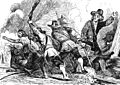
Drawing representing the early Pequot War
-
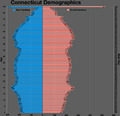
Population chart showing age groups in Connecticut
-
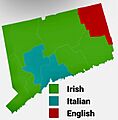
Map showing the largest ethnic ancestries across Connecticut counties
-

Bradley International Airport, the busiest airport in the state
-

The official logo used by the state government of Connecticut
-
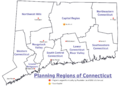
Map of the regional planning districts that serve as county equivalents
-

Chart showing political party registrations over several decades
-
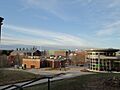
The main campus of the University of Connecticut in Storrs
-

Sports cars racing around the bend at Lime Rock Park
-
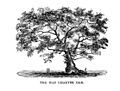
Painting showing the famous historic Charter Oak tree in Hartford


Notable People
Connecticut has been the birthplace and home of many remarkable individuals who changed history:
- Nathan Hale: A brave young schoolteacher and patriot soldier during the American Revolution.
- Noah Webster: The dedicated author who created America's first comprehensive English dictionary.
- Charles Edward Ives: A brilliant American composer who wrote unique modern music inspired by town bands.
- Prudence Crandall: A pioneering schoolteacher recognized as the state heroine for her courage in education.
- Eli Whitney: The creative inventor who developed interchangeable parts for machines.
- Igor Sikorsky: The talented engineer who pioneered the first practical helicopter.
See also
 In Spanish: Connecticut para niños
