
Maritime history of England facts for kids
The maritime history of England is all about England's connection to the sea. This includes ships and ports, how people navigated, and the lives of sailors. It also covers sea exploration, trade, and how the sea has inspired art.
For a long time, before planes and the Channel Tunnel, the only way to reach the rest of Europe from England was by sea. This is why sea trade and naval power have always been super important for England. Before England and Scotland officially joined to form Great Britain in 1707, England's sea story was the main one for the British Isles.
Contents
Timeline of England's Sea History
Ancient Times: Early Boats and Trade
People might have first reached Great Britain by sea thousands of years ago. The island separated from Ireland around 9000 BC and from Europe around 6500 BC.
England's sea history really begins with ancient trade routes. Around 600 BC, Phoenician traders used a guide called the "Massaliote Periplus" to find their way to England. They were likely trading for tin and other raw materials. Later, a Greek explorer named Pytheas wrote about his journey to Britain around 325 BC. It's clear that in the Iron Age, trade between Gaul (modern France) and Britain was common. Fishermen even traveled as far as Orkney, Shetland, and Norway.
The first boats in Britain were probably rafts and dugout canoes. A small, round boat called a coracle was used even during the Roman invasion. Coracles are light, made from a wooden frame covered with animal hide, and waterproofed with tar. They can float in very shallow water and are easy to carry. Early people used them for fishing and travel.
Ancient Britons also used hollowed-out tree trunks as canoes. Some of these have been found, like a six-meter-long oak canoe discovered in Shapwick, Somerset, in 1906. It was probably used to move people, animals, and goods across the Somerset Levels.
A very special discovery was made in 1992 in Dover, England. It was a Bronze Age boat about 9.5 meters long and 2.3 meters wide. This boat, dating back to about 1600 BC, is the oldest known ocean-going boat! It was made from oak logs stitched together with yew branches. A modern reconstruction showed that 4 to 16 paddlers could move it at about 4 knots (around 7.4 km/h) even in strong winds. This boat could carry a lot of cargo and travel up to 30 nautical miles (about 55 km) in a day.
Parts of a Bronze Age trading ship were also found off Salcombe, Devon. These finds included axe heads, a cauldron handle, and a gold bracelet. Some items came from northern France, showing early international trade.
Roman Period: Invasion and Sea Control
Julius Caesar made short sea trips to Britain in 55 and 54 BC, but many of his boats were wrecked. The big Roman invasion fleet under Emperor Claudius in AD 43 was much more successful. It carried 40,000 soldiers and landed at Richborough, Kent.
Later, a part of the Roman fleet, called the Classis Britannica, was based in Britain. Its job was to control the English Channel and North Sea. During this time, Britain faced raids from Scoti (from Ireland) and Saxons, as well as attacks from Picts (from northern Scotland). The Romans even had an officer in charge of the "Saxon Shore" and built a series of forts or trading posts along the south and east coasts. There's also evidence of a Roman fleet in the Bristol Channel.
Roman trade with Britain involved importing grain and olive oil from North Africa. Britain exported slaves and lead. Soldiers and administrators also arrived by sea. Later, Britain even exported grain to the continent for the army. There was also trade with Ireland.
Early Middle Ages: Saxons, Vikings, and Trade
After the Romans left Britain in the early 5th century, "Saxon" soldiers were hired by British kings. The first Saxons arrived in "three keels" (boats) and more followed. After a disagreement, the Saxons rebelled and took control of areas in eastern and southern England. This involved Angles and Jutes too. This led to a lot of trade across the North Sea from Britain's east coast.
When important people died, their bodies were sometimes placed in a ship burial. A famous example is at Sutton Hoo, where traces of a 27-meter-long boat from about 625 AD were found.
In western Britain, trade with the Mediterranean world continued. Many pots and goods from Byzantium have been found at places like Tintagel. People also moved from southern England to Brittany and northern Spain.
By the 730s, ships using the port of London had to pay a toll. King Alfred re-established London after taking it back from the Vikings in 886 AD. Wine, timber, and food were imported, while salt, cloth, hide, lead, and slaves were exported.
From the 9th century, Vikings raided Britain, but they were also traders. King Alfred built a navy to fight them, and the first sea battle against Vikings is thought to have happened in 875 AD. Viking longships were built with overlapping wooden planks and curved ends. They used both oars and sails. The knarr was a larger cargo ship that relied only on its square sail.
Later Middle Ages: Normans, Cinque Ports, and Cogs
In 1066, King Harald of Norway and Tostig Godwinson attacked northern Britain with 300-500 ships. The Norman conquest of England happened later that year. William the Conqueror's sea invasion at Hastings was unopposed because the English fleet had returned to base.
After this, the Kings of England also ruled parts of France, leading to much trade across the English Channel. Many wars were fought against the French, requiring ships to transport armies and supplies. In 1120, the "White Ship" sank, and the sons of Henry I drowned. In 1147, a fleet of 167 ships sailed from Dartmouth on a crusade to capture Lisbon from the Moors. Henry II invaded Ireland in 1171.
The Cinque Ports were a group of five (originally) harbors that received special rights. In return, they had to provide ships to the kings of England when needed.

The cog was a ship design that likely developed from the longship and was widely used by the 12th century. It also used overlapping planks. Ships began to be built with straight ends, and the rudder was fixed to the back, making steering easier. To make ships faster, more masts and sails were added.
The Hanseatic League was a powerful group of trading guilds that controlled trade in the Baltic Sea and parts of the North Sea from the 13th century. They had warehouses in eight English ports. By the 16th century, the league declined, and Dutch and English merchants became more important.
In the 14th and 15th centuries, groups for seamen were formed in cities like Bristol, King's Lynn, and Newcastle.
Age of Exploration: New Worlds and Trade Routes
From the early 15th century into the 17th century, English ships sailed around the world. They were looking for new trading partners and routes. This led to meeting new peoples and mapping lands previously unknown to the English. Bristol ships were already sailing into the Atlantic Ocean by 1480.
Before Christopher Columbus reached mainland America, John Cabot was hired by the English government to find new lands. He sailed from Bristol in the "Matthew" in 1497. It's thought he reached Nova Scotia or Newfoundland. They were looking for a passage to China but didn't find it. A second voyage in 1498 saw 4 of 5 ships vanish.
An attempt to find a north-east passage to China in 1553 failed but led to the creation of the Muscovy Company. The Baltic Sea was explored in the 1570s, leading to English bases in Hanseatic ports.

In 1578, Sir Francis Drake, while sailing around the world, discovered Cape Horn at the tip of South America. The sea between this and Antarctica is now called Drake Passage.
Richard Hakluyt was an English writer who encouraged English settlement in North America. His books, like Divers Voyages Touching the Discoverie of America (1582), described many voyages.
Sir Humphrey Gilbert started a colony in Newfoundland in 1583. The first (unsuccessful) British colony in America was set up by Sir Walter Raleigh at Roanoke, in what is now North Carolina, in 1585. When a supply ship arrived later, the colonists had disappeared.
Because of this exploration, joint stock companies were formed. These included the Muscovy (Russia) Company, the Honourable East India Company (1599), and the Hudson's Bay Company. These companies set up trading posts in places like India. Other countries like the Dutch and Portuguese also had similar companies, which led to rivalries.
The first idea for a modern underwater boat was made by Englishman William Bourne in 1578. His ideas never became a real boat.
Seventeenth Century: Colonies and Ship Changes

The first successful British colony in America was founded in 1607 at Jamestown. It grew when new colonists arrived later in the 17th century and started farming tobacco. The famous Mayflower sailed from Plymouth in 1620, carrying Pilgrims to America. The strong connection between the American colonies and Britain, with shipping at its heart, grew for almost 200 years.
The Navy played a big role in some major political events. In 1660, the English Royal Navy brought Charles II back from exile in Holland. Later, in 1688, when James II left the country, the British fleet did not stop William of Orange from landing, which led to a change in monarchy.
Ships changed a lot in the 17th century. Early English ships were strong and well-armed but needed many sailors. This made them less competitive for merchant shipping, which needed ships that could carry more cargo with fewer crew members. The Dutch had ships called fluits that were better for trade. They had a longer keel for more cargo space and fewer sails, meaning fewer sailors were needed. When England fought wars with the Dutch, they captured many Dutch merchant ships. English shipbuilders then started to use some of the Dutch techniques to build ships that were better for trade.
Sea trade grew a lot in the 17th century. Trade with the Mediterranean, East Indies, and North American Colonies increased. The fishing industry also saw growth. To control Dutch trade, Parliament passed the Navigation Ordinance of 1651. After the monarchy was restored, foreign trade continued to expand significantly.
The first real submersible boat was built by Cornelius Drebbel, a Dutchman working for James I of England, in 1620. Improved versions were tested in the River Thames.
England's first known navy was started by Alfred the Great. It won an important victory against the Vikings in the Wantsum Channel, Kent. This navy later fell out of use but was revived by Athelstan and had 400 ships by 937.
When the Norman invasion was about to happen in 1066, King Harold expected his navy to stop William the Conqueror's fleet from crossing the Channel. However, a storm damaged the English fleet, forcing it into harbor, and the Normans were able to cross without being stopped.
The Norman kings created a naval force in 1155, or used one that already existed, with ships provided by the Cinque Ports. The English Navy grew during the 12th and 13th centuries. King John had a fleet of 500 ships. In the mid-14th century, Edward III's navy had 712 ships. After this, there was a period when the navy declined.

Before Henry VII, English kings would take over and arm merchant ships when they needed a navy. Henry VII started building special warships. By the end of his reign, there were five royal ships, including two large, four-masted ships called carracks.
By the time Henry VIII died in 1547, the navy had grown to about 40 ships. The invention of the gunport meant that heavy guns could be placed lower in a ship, allowing for more and bigger cannons. Warships also carried archers to attack enemy crews. Henry VIII started new shipbuilding yards at Deptford and Woolwich Dockyard. His two most famous ships were the Henri Grâce à Dieu and the Mary Rose, which later sank.
Neither James I nor Charles I spent much money on the navy, making it too weak to defend the coast from Barbary pirates.
During the Commonwealth of England, Oliver Cromwell made the navy much stronger. Admiral Robert Blake led the English fleet to victory in the First Anglo–Dutch War (1652–1653). After the monarchy was restored, Charles II continued to improve the navy. His brother, who later became James II, was the Lord High Admiral for many years. Samuel Pepys became a key official and reformed the Navy's supply system. He also started examinations for commanders, surgeons, and other officers.
In the late 13th century, admirals commanded the Northern and Western Fleets. The position of "Lord Admiral of England" was created in 1408. The Admiralty itself was set up in March 1545 as the King's Council of the Marine. It was in charge of Navy operations and ship officers. The First Lord of the Admiralty is a civilian and a member of the government.
The first official fighting instructions for the Navy were issued in 1653, and sailing instructions in 1673.
Notable Wars: Famous Sea Battles
Hundred Years' War: Sea Power Shifts
During the Hundred Years' War (1337–1453), the French fleet was initially stronger than the English. However, the French fleet was almost completely destroyed at the Battle of Sluys in 1340. Many other sea battles were fought during this long period.
The Armada: Defeating Spain

The Spanish Armada was a huge Spanish fleet that sailed against England in 1588. It was sent by King Philip II of Spain to pick up an army from the Spanish Netherlands and land them in southeast England. The Armada had about 130 warships and converted merchant ships.
After fighting its way up the English Channel, being attacked by the English fleet of about 200 vessels, it anchored off Gravelines. A fire ship attack forced the Spanish ships from their safe spot. The Armada was then blown north up the east coast of England and tried to return to Spain by sailing around Scotland. Many ships were wrecked off Ireland. The Spanish sent a smaller fleet the next year, but it ran into stormy weather off Cornwall and was blown back to Spain.
The English sent a fleet to Spain in 1589 led by Sir Francis Drake. This further weakened the Spanish fleet. Another raid was made in 1596. The war between England and Spain ended with the Treaty of London in 1604. This peace allowed the British to strengthen their hold on Ireland and focus on setting up colonies in North America.
The First Anglo–Dutch War was fought between 1652 and 1653. Battles took place at Dungeness, Portland, and Scheveningen. In the last battle, the Dutch commander Maarten Tromp was killed.
The Second Anglo-Dutch War (1665-1667) was a victory for the Dutch. After this war, the Dutch Navy became the strongest in the world for a time, continuing to dominate world trade.
Shipbuilding: How Ships Evolved
Shipbuilding in England started in the many small rivers and creeks along the coast. An Anglo-Saxon cargo boat (about 900 AD), 14 meters long, was found at Graveney, Kent. A 13th-century ship was found at Magor Pill on the River Severn.
Early ships were open, but they started to have decks around the 12th century. Rudders were fixed to the back of the ship by 1200, making steering easier. In 1416, the king's ship "Anne" had two masts, and the "Edward" was built in 1466 with three. Topsails were added by 1460, then a spritsail under the bowsprit. By 1510, a large warship might have 12 sails, but usually there were four.
By 1500, there were about 60 types of vessels, mostly cogs with deep hulls. However, from about 1450, "carvels" began to be built, based on the Portuguese caravel. These ships had planks that fit together smoothly without overlapping. Gunports became common in the mid-16th century. The main type of English galleon had a low front, a sleek body, and many heavy guns. It was both fast and easy to steer.
In the 16th century, the Thames area became the main shipbuilding center. Royal Dockyards were built there, and the Honourable East India Company also had shipbuilding facilities. The East India Company built large, well-defended ships known as "East Indiamen".
Famous Ships: The Mary Rose
Mary Rose
The Mary Rose was built in Portsmouth for Henry VIII between 1509 and 1511. She was the flagship of his navy and one of the first ships with gunports. She was rebuilt in 1536.
The Mary Rose sank on July 19, 1545, off Portsmouth, as she was leaving to fight a French fleet. Her remains were found in the 19th century, but it wasn't until 1982 that she was raised from the seabed. Many items were recovered, and these are now on display in Portsmouth at the Royal Dockyard, along with the ship's remains.
Privateers and Pirates: Robbery at Sea
Privateers were like legal pirates. They had a special permission called a "letter of marque" from their government, allowing them to capture enemy ships during wartime. Pirates, on the other hand, robbed ships (or sometimes attacked from the sea onto shore) without any legal permission.
In 937, Irish pirates joined with Scots, Vikings, and Welsh in an invasion of England, but they were pushed back by Athelstan.
An Englishman named William Maurice was found guilty of piracy in 1241. In the Medieval period, piracy was common, and most pirate attacks came from France, which led to the organization of the Cinque Ports to defend the coast.
Until 1536, piracy was a civil law problem and hard to prove. Then it became a common law offense. In the 1550s, English gentlemen who opposed Phillip and Mary took refuge in France. They became active in the English Channel as privateers, with permission from Henry II of France. Some of these men later held important positions under Queen Elizabeth.
Queen Elizabeth allowed attacks on the Spanish but tried to avoid full-scale war. Gentlemen, merchants, and sea captains worked together to equip ships. Perhaps the most famous English privateer was Sir Francis Drake, who often attacked the Spanish treasure fleet. Thomas Cavendish was another privateer who sailed around the world and gained valuable maps of the East.
Barbary pirates came from North Africa to attack shipping. In 1621, an expedition was sent against them. In 1655, Blake defeated them and started a campaign against them in the Caribbean.
Sir Henry Morgan, Captain William Kidd, and Edward Teach (Blackbeard) were just three of the many English pirate leaders who operated in the Atlantic and Caribbean in the 17th century. In 1700, a law was passed to try pirates in special courts.
Images for kids
-
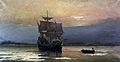
The Mayflower in the New World.

