
Computer facts for kids
.jpg)


.jpg)
- Early vacuum-tube computer (ENIAC)
- Mainframe computer (IBM System/360)
- Smartphone (LYF Water 2)
- Desktop computer (IBM ThinkCentre S50 with monitor)
- Supercomputer (IBM Summit)
A computer is an amazing machine that can follow instructions to solve problems and handle information. Modern digital electronic computers can run lists of tasks called programs. Because they follow programs, computers can perform many different jobs quickly and accurately. A full setup is called a computer system. It includes parts you can touch, called hardware, and tasks that run inside, called software. It also features an operating system and connected peripheral gadgets like screens and mice. Multiple machines can connect in a computer network or work together as a computer cluster.
Long ago in the 1930s, only a handful of computers existed on Earth. Today, computers appear everywhere around us. They help run machines in modern factories and power everyday consumer electronics. Computers act as a tiny control system in many household items. An embedded single-purpose device can live inside a car key fob, a kitchen microwave oven, or a TV remote control. Large versions include giant supercomputers that help predict weather patterns and control an industrial robot. Everyday general tools include the personal computer, a handy tablet computer, and a pocket smartphone. Computers also power the global Internet, connecting billions of people across our world.
Early computers were built simply to do fast arithmetic and logical operations. Ancient people used tools like the abacus to count items. Later, during the Industrial Revolution, inventors created mechanical devices like automated pattern guides for a weaving loom. In the early 20th century, scientists made specialized analog devices. Soon, inventors built calculating machines out of electromechanical parts and glowing vacuum tubes. Next came tiny semiconductor transistors, advanced MOSFET designs, and compact integrated circuits. These breakthroughs sparked the microcomputer revolution and created the microprocessor. As Moore's law predicted, computers grew smaller, faster, and cheaper, starting the Digital Revolution.
Every modern digital computer contains an electronic brain with a processing element, usually a central processing unit (CPU). It also needs computer memory made from semiconductor memory chips. The CPU follows instructions and controls data flow. Outside devices help us give information to the machine or view its work. These include input and output devices. An input device like a keyboard, mouse, or joystick sends information in. An output device like a monitor or printer shows or prints results. A modern touchscreen acts as both an input and output device at once.
Contents
What Does the Word Computer Mean?

The word computer originally meant a human being rather than an electronic machine. According to the Oxford English Dictionary, the word first appeared in 1613 in a book written by Richard Brathwait. In that book, he used the term to describe a talented person who was great at doing math. For hundreds of years, a human computer was a person hired to do long, tricky calculations for astronomy and navigation.
During the late 19th and early 20th centuries, many companies and government agencies hired women as human computers. By the middle of World War II, most human computers working on science projects were women. The Online Etymology Dictionary explains that people started using the word for mechanical machines around 1897. In 1937, mathematician Alan Turing imagined an ideal thinking machine called a Turing machine. By 1945, people began using the word computer specifically for electronic machines that could run stored programs.
History of Computing Tools

Humans have always looked for clever ways to count and measure things. Thousands of years ago, people used finger counting and simple one-to-one correspondence to count sheep and crops. Early hunters carved notches into animal bones, creating a tally stick. The famous Ishango bone from Africa is an ancient bone tool covered in carved markings that may show counting.
In the ancient Middle East around the Fertile Crescent, merchants made small clay tokens shaped like cones and spheres. They sealed these tokens inside hollow clay balls to prove what goods were shipped, much like a modern bill of lading. Later, people pressed symbols into the wet clay instead of hiding tokens inside. These marks evolved into written numbers and tablets. People in ancient China also counted quickly using wooden counting rods.
Early Counting Tools and Mechanical Inventions

The abacus was one of the earliest tools invented to help people add and subtract large numbers. People in Babylonia used counting boards around 2400 BCE, which led to the portable Roman abacus. In ancient China, scholars solved arithmetic using a bead frame called a suanpan. During the Middle Ages in Europe, people ran a counting house using a checkered cloth on a table. They moved wooden counters across squares to calculate taxes and payments.
.webp)
Around 100 BCE, people in ancient Greece built an incredible machine called the Antikythera mechanism. Discovered by divers in the Antikythera wreck near Kythera and Crete, it used bronze gears to calculate planetary movements. Historian Derek J. de Solla Price showed that this gear system was actually an ancient analog computer.
Inventors across the Islamic world created clever astronomical instruments. The scholar Al-Biruni designed an early star chart called a planisphere during the 11th century. He also built a geared mechanical lunisolar calendar astrolabe with a complex gear train and wires. An earlier version of the astrolabe was developed during the Hellenistic civilization, often credited to the astronomer Hipparchus. An astrolabe helped sailors and astronomers solve problems in spherical astronomy using gear parts. In 1235, an inventor named Abi Bakr built a geared calendar astrolabe in Isfahan, Persia.
In the late 16th century, scientists created the sector, a compass-like tool used in trigonometry, surveying, and navigation. In the 19th century, surveyors measured map areas using a mechanical linkage called a planimeter.

In the 1620s, an English clergyman named William Oughtred invented the slide rule. The slide rule worked using the mathematical rules of the logarithm. By sliding marked rulers past each other, users could quickly multiply, divide, and calculate a square root or cube root. Later slide rules handled advanced math like hyperbolic functions, trigonometry, and transcendental functions. Pilots still learn to use a circular slide rule called the E6-B flight computer to check speed and fuel during flights.
In the 1770s, a Swiss watchmaker named Pierre Jaquet-Droz built amazing mechanical dolls called automata. One doll could write messages with an ink quill pen. Inside the doll, interchangeable cams worked like a mechanical program. In the 1830s, Giovanni Plana designed a perpetual calendar machine in Italy that calculated dates for thousands of years. In 1872, Sir William Thomson built a mechanical tide-predicting machine to help ships navigate shallow waters.
The First Programmable Machine Designs

The British inventor and polymath Charles Babbage is celebrated as the grandfather of computing. In 1822, he proposed a machine called the difference engine to the Royal Astronomical Society to calculate math tables without human errors.
In 1833, Babbage realized he could build an even more powerful machine called the analytical engine. This machine was designed to use paper punched cards inspired by the Jacquard loom, a weaving device that created cloth patterns automatically. His engine featured an arithmetic logic unit (which he called the mill), stored memory (called the store), and a printer. It could perform control flow tasks like conditional branching and loops, making it truly Turing-complete.
Building thousands of precision brass parts by hand proved too difficult and expensive. The British Government eventually stopped funding the project. Years later, his son Henry Babbage built a working section of the calculating unit and demonstrated it in 1906.
In 1914, Spanish engineer Leonardo Torres Quevedo published designs for an electromechanical calculating machine. He showed how to use floating-point arithmetic, internal programs, and read-only memory. In 1920, he built the Electromechanical Arithmometer, which let users enter math problems on a keyboard and printed out answers.
Analog Calculating Machines

During the early 20th century, scientists built complex analog computers to solve difficult equations. These machines did not use digital bits. Instead, they used physical movements like spinning shafts, electrical voltages, or fluid levels to simulate mathematical problems.
In 1876, James Thomson designed a machine that used a ball-and-disk integrator to solve math equations. Later, engineers added a device called a torque amplifier to give the spinning wheels enough physical power to move graphing pens. In 1931, engineer Vannevar Bush built a famous mechanical differential analyzer at the MIT.
Building the First Digital Computers

In 1937, a student named Claude Shannon wrote a famous master's thesis called A Symbolic Analysis of Relay and Switching Circuits. He showed that electrical switches could solve problems in Boolean logic. By setting an open switch to "0" and a closed switch to "1", electric circuits could do math.
In 1938, the United States Navy built the Torpedo Data Computer inside a submarine to calculate firing angles. German inventor Konrad Zuse built early relay-based machines in Berlin, including the Z2. In 1941, he finished the Z3, the world's first working electromechanical programmable computer. The Z3 used 2,000 telephone relays, worked with binary numbers, and read instructions from punched celluloid film strips. Zuse later built the Z4 with his company Zuse KG. It was delivered to ETH Zurich in 1950 and inspired another early European machine named the ERMETH.
In the 1930s, British engineer Tommy Flowers tested electronics for telephone switching at the Post Office Research Station. In the United States, John Vincent Atanasoff and Clifford Berry designed the Atanasoff–Berry Computer in 1942 at Iowa State University. It used 300 vacuum tubes to solve linear equations.

During World War II, British experts at Bletchley Park worked hard to decode secret communications. Early messages scrambled by the Enigma machine were solved using electro-mechanical machines called bombes. To crack a more advanced cipher machine called the Lorenz SZ 40/42, mathematician Max Newman asked Tommy Flowers to design a machine. Flowers created the famous Colossus computer.
Colossus was the world's first electronic digital programmable machine. It used thousands of glowing vacuum tubes to read paper tapes at high speeds. Ten Colossus machines helped decode vital information and saved countless lives.

In the United States, engineers John Mauchly and J. Presper Eckert designed a giant machine called ENIAC. Built at the University of Pennsylvania, ENIAC was unveiled in 1945. It weighed 30 tons, took up an entire room, and used more than 18,000 vacuum tubes. ENIAC could add numbers 5,000 times per second. Six brilliant women programmed ENIAC by manually changing cables, wires, and switches.
The Stored-Program Revolution

Early machines had a big drawback: changing their job meant workers had to reconnect physical cables by hand. In 1936, Alan Turing showed that a single machine could run any task if instructions were stored directly in memory. In 1945, mathematician John von Neumann shared these ideas in a paper titled First Draft of a Report on the EDVAC.
On 21 June 1948, researchers at the University of Manchester ran the first stored-program computer, nicknamed the Manchester Baby. Built by Frederic Calland Williams, Tom Kilburn, and Geoff Tootill, it used a special CRT screen called a Williams tube for memory. This project soon became the Manchester Mark 1.
A British company named Ferranti turned this work into the Ferranti Mark 1, delivering units to places like Royal Dutch Shell labs in Amsterdam. Meanwhile, a catering business called J. Lyons and Co. built the LEO computer to track bakery orders, creating the first business computing system. In 1950, a team led by Sergey Lebedev built the MESM in Kyiv, making it the first operational electronic stored-program computer in continental Europe.
The Transistor and Silicon Chips

Glowing vacuum tubes were big, fragile, and hot. In 1947, scientists John Bardeen, Walter Brattain, and William Shockley invented the point-contact transistor at Bell Labs. Soon after, they made the bipolar junction transistor. Transistors acted like tiny switches, but were smaller, faster, cooler, and longer-lasting than vacuum tubes.
In 1953, the University of Manchester built an experimental transistor computer. In 1955, British researchers built the all-transistor Harwell CADET at Harwell, Oxfordshire. Engineers soon invented the MOSFET (metal-oxide-silicon transistor) at Bell Labs. MOSFETs were tiny and consumed very little electricity. They allowed computer scientists to pack millions of switches into compact semiconductor memory chips.

Engineers next discovered how to place many electronic circuits onto a single flat piece of silicon, creating an integrated circuit (IC). Radar engineer Geoffrey Dummer first proposed this idea in 1952. In 1958, Jack Kilby built a working hybrid integrated circuit at Texas Instruments. In 1959, Robert Noyce invented the modern silicon chip at Fairchild Semiconductor using the planar process developed by Jean Hoerni.
By 1971, engineers Federico Faggin, Marcian Hoff, Masatoshi Shima, and Stanley Mazor combined an entire CPU onto one single chip called the Intel 4004. This single-chip engine became known as a microprocessor. Soon, chips like the MOS Technology 6502 powered early home computers and video game systems. Today, modern phones use a system on a chip (SoC) that puts a computer, graphics processor, and memory onto a single coin-sized microchip.
Computer Hardware: Parts You Can Touch

Computer hardware includes every physical part of a computer system. Hardware includes metal cases, electronic cables, spinning drives, chips, and expansion boards.
The CPU: The Central Processing Unit
The central processing unit (CPU) is often called the brain of the computer. It fetches instructions, figures out what they mean, and carries them out. A modern CPU includes several key parts:
- The control unit: This part acts like a director. It reads an instruction from memory, figures out what needs to happen, and tells other components what to do.
- The program counter: This special storage slot keeps track of where the computer is in its list of instructions.
- The registers: These are tiny, ultra-fast memory pockets inside the CPU that hold numbers while the computer does math.
- The arithmetic logic unit (ALU): This is the calculator inside the CPU. It handles addition, subtraction, and comparisons.
Memory: How Computers Store Information

A computer needs memory to hold instructions and data. Decades ago, machines used tiny magnetized rings called magnetic-core memory. Today, computers use fast silicon chips.
- Random-access memory (RAM): RAM is the computer's temporary workspace. The CPU can read and write data in RAM very quickly. However, RAM is temporary; when you turn off the power, everything in RAM vanishes.
- Read-only memory (ROM): ROM holds permanent startup instructions called firmware. When you start a computer, software in ROM called the BIOS tells the computer how to load its main operating system.
- CPU cache: A small, super-fast memory area placed directly on the CPU chip to hold frequently used numbers.
Storage Devices

Because RAM forgets everything when turned off, computers need long-term storage:
- Hard disk drive (HDD): A device that stores data magnetically on spinning platters.
- Solid-state drive (SSD): A fast, modern drive that stores files using silent flash memory chips.
- Optical discs: Discs like CDs, DVDs, and Blu-rays that use laser beams to read data.
Input and Output Gadgets
Input devices let you send information into the computer, while output devices show or share the results:
- Common input tools: A computer keyboard, a computer mouse, a joystick, a microphone, an image scanner, or a webcam.
- Common output tools: A computer monitor, a desktop printer, and computer speakers.
Computer Software: The Instructions That Run

Hardware cannot do anything on its own without software. Software is the collection of programs, rules, and data that tell the hardware what to do.
Operating Systems
An operating system (OS) is the main master software that manages the computer's memory, files, and connected devices. Popular operating systems include:
- Microsoft Windows: A widely used system on home and office personal computers.
- macOS: The operating system used on Apple desktop and laptop computers.
- Linux: A free, flexible operating system that runs many web servers, supercomputers, and gadgets.
- Android and iOS: Operating systems created for touchscreens on smartphones and tablets.
Applications and Programs
Applications are programs made to help people do specific jobs or have fun. Examples include:
- Word processors for typing school essays.
- Web browsers for visiting internet websites.
- Spreadsheets for organizing numbers and budgets.
- Video games for entertainment and storytelling.
- Digital audio editors and paint programs for making art and music.
Programming Languages and Bugs

Computers only understand electrical codes of ones and zeros called machine code. Because writing endless strings of ones and zeros is difficult for humans, software developers write in a programming language. A program called a compiler turns human-readable code into machine language. Popular languages include:
- Python: An easy-to-learn language used for teaching, science, and AI.
- Scratch: A block-based visual language designed for kids learning to code.
- JavaScript: A language that makes web pages interactive.
- C++ and Java: Fast, powerful languages used for video games and large apps.
When a mistake appears in a computer program, programmers call it a software bug. If an error is serious, it can make the computer freeze up or crash. In 1947, computer pioneer Grace Hopper and her team found a real moth trapped inside a switch on the Harvard Mark II computer. They taped the moth into their logbook, popularizing the phrase "debugging" a computer!
Different Types of Computers

Computers come in all shapes and sizes depending on the job they need to do:
- Supercomputers: The fastest, most powerful machines on Earth. Scientists use them to model climate patterns, simulate space flights, and study medicine.
- Mainframes: Large computers used by banks and governments to process millions of transactions safely.
- Servers: Computers that store web pages, videos, and multiplayer games so users across the world can access them.
- Desktops and Laptops: Everyday personal computers used at school, home, and work.
- Smartphones and Tablets: Small, battery-powered portable touch devices you can carry in a backpack or pocket.
- Embedded systems: Tiny computers built right inside appliances like microwave ovens, washing machines, cars, and toys.
Connecting the World: Networks and Artificial Intelligence

Computers become even more useful when they talk to one another. During the late 1960s, scientists funded by DARPA connected university computers together, creating the ARPANET. This network grew over time and evolved into the modern Internet. Today, fiber-optic lines, radio towers, and satellites link computers across continents.
Modern computers also explore artificial intelligence (AI). In earlier decades, programmers had to write strict step-by-step instructions for every decision. Today, systems use machine learning and neural networks to study data and learn patterns on their own. Powered by powerful chips called graphics processing units (GPUs), AI models can translate languages, help medical researchers, steer robots, and recommend fun books to read.
Related Topics
 In Spanish: Computadora para niños
Images for kids
-
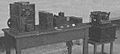
Electro-mechanical calculator built by Leonardo Torres Quevedo
-
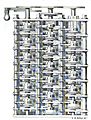
Diagram of Charles Babbage's Difference Engine
-
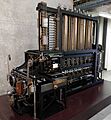
Working model of Babbage's Difference Engine Number 2
-
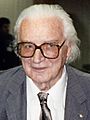
Konrad Zuse, pioneer of digital computing
-
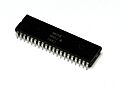
A MOS 6502 processor in a protective chip package
-
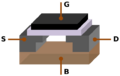
Diagram of a MOSFET transistor
-
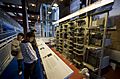
Full replica of the Manchester Baby computer


.jpg)


