
Crown jewels facts for kids

Crown jewels are shimmering treasures made of fine metalwork and sparkling jewellery. They belong to the regalia of a reigning or past monarchy. A monarch, such as a king or queen, wears these royal treasures during an official coronation. Monarchs also bring them out for big national celebrations. Official royal portraits often show kings and queens wearing these grand items. They serve as symbols of royal leadership, history, and national unity. Some royal families add new gems over time. Most collections have stayed intact since the Middle Ages to honor deep historical traditions.
European royal sets often include golden crowns, tall sceptres, spherical orbs, ceremonial swords, large maces, and precious rings. Goldsmiths usually forge these items from pure gold or silver-gilt. They decorate them with brilliant gemstones like diamonds, rubies, sapphires, and emeralds. Many royal collections stay safely locked in secure vaults or castle strongrooms when not in use. The public can view these treasures in famous museums. In former royal nations like Hungary, the Holy Crown of Hungary remains a proud cultural icon. It is even shown on the official coat of arms of Hungary. Across the world, royal regalia blend local customs with historic craft traditions.
Contents
- Royal Treasures Across the African Continent
- Treasures of Asian Dynasties
- The Golden Regalia of Brunei
- Cambodian Regalia and Ancient Discoveries
- Imperial Seals of China
- The Koh-i-Noor and Indian Royal Treasures
- Island Regalia of Indonesia
- The National Jewels of Iran
- Golden Crowns of Ancient Korea
- The Three Sacred Treasures of Japan
- Treasures of Laos and Myanmar
- Royal Headgear and Daggers of Malaysia
- The Crown of Sri Lanka
- Royal Regalia of Thailand
- Imperial Treasures of Turkey
- Imperial Seals of Vietnam
- Crown Jewels Across European Monarchies
- The Warrior Helmet of Albania
- The Imperial Collections of Austria
- The Crown of Saint Wenceslas in Bohemia
- Regalia of Bulgaria and Croatia
- The Golden Crowns of Denmark
- The Crown Designed for Finland
- Treasures of the French Monarchy
- The Lost Royal Crowns of Georgia
- Royal Regalia Across German Lands
- Relics of Ancient and Byzantine Greece
- The Holy Crown of Hungary
- The Insignia of Ireland
- Treasures of Italian Kingdoms
- The State Sword of the Isle of Man
- The Coronation Sword of Poland
- Crowns of Portugal and Romania
- The Imperial Treasures of Russia
- Serbian Regalia of the Karađorđević Dynasty
- Royal Insignia of Spain and Sweden
- The Crown Jewels of the United Kingdom
- The Papal Regalia of the Vatican
- Treasures of the Americas and Oceania
- See also
- Images for kids
Royal Treasures Across the African Continent
Axum and Ancient Ethiopian Kingdoms
The historic kingdom of Axum created magnificent royal traditions. Its treasures later became part of the imperial treasures of the Ethiopian Empire. Craftsmen used pure gold and sacred symbols to design these early royal relics.
The Holy Drums of Burundi

In the nation of Burundi, the highest emblem of the Mwami was not a golden hat. The king used a sacred wooden instrument called the Karyenda drum. People considered these drums sacred objects of unity and peace. Caretakers protected the royal drums in special sanctuaries across the countryside. Keepers brought the drums out only during major state celebrations. One famous home for these treasures was in the royal city of Gitega.
Central African Treasures
During the time of the Central African Empire, Emperor Bokassa gathered an enormous set of jeweled regalia. Many of these golden items came from European jewelers. When the monarchy ended, the restored republic protected the treasures inside national collections for the public.
Ancient Egypt and Royal Dynasties
- Ancient Pharaohs: The ancient rulers of Egypt left behind world-famous treasures. Visitors can view the glittering gold items of each pharaoh inside the Egyptian Museum in Cairo.
- Modern Dynasties: The kings of the Muhammad Ali dynasty collected dazzling jewels, crowns, and medals. Curators display many of these royal treasures inside the historic museum at Abdeen Palace in Cairo.
Imperial Crowns of Ethiopia


Crowns worn by Ethiopian monarchs have a unique shape. Craftsmen created them to fit over a fabric turban. Most crowns form a tall cylinder of gold, though some older styles resemble a cube. A curved golden dome sits on top, supporting a decorative cross. Skilled goldsmiths decorated the cylinders with delicate wire called filigree. They also hammered saint portraits into sheets of gold using the technique of repoussé.
Many Ethiopian crowns feature dangling golden cones called pendilia. These small cones hang on short golden chains around the edges. Round gold medallions dangle on chains to cover the ears of the ruler. These ear ornaments look like decorations once worn by emperors in ancient times. Certain crowns worn by Emperor Menelik II have small gold statuettes. One statuette depicts St. George battling a dragon.
The full imperial collection contains many amazing pieces:
- A jeweled gold ceremonial sword.
- A sceptre made of polished gold and ivory.
- A large golden orb with cross.
- A royal ring set with glittering diamonds.
- Two gold spears called lances made with traditional openwork wire.
- Long scarlet robes embroidered with thick threads of gold.
During a coronation, priests anointed the emperor seven times with fragrant oils. The priests presented the royal items in a strict order. The crowning took place at the very end of the ceremony. Empress Menen Asfaw received her own crown and ring during the coronation of Emperor Haile Selassie.
Kings were traditionally crowned at the Church of Our Lady Mary of Zion in Axum. Legend connects the royal family to Menelik I, the son of King Solomon and the Queen of Sheba. According to tradition, Menelik brought the sacred Ark of the Covenant to Axum. Today, Haile Selassie's coronation jewels rest in a museum at the National Palace in Addis Ababa.
The Golden Stool of the Ashanti Confederacy
The rulers of the Ashanti in Ghana treasure a sacred throne known as the Golden Stool, or Sika 'dwa. Rulers of the Ashanti Confederacy teach that the stool holds the soul of the entire nation. No person is ever permitted to sit upon it. Attendants place the sacred stool on its own velvet chair next to the ruler. Royal guards keep it secure inside the royal palace in the city of Kumasi.
The Royal Crown of Madagascar

Queen Ranavalona I ordered a massive golden crown from French jewelers around 1890. Craftsmen forged this heavy crown out of real gold mined directly on the island of Madagascar. The crown features four curved arches that meet at the top under a golden falcon. The falcon is an ancient Malagasy symbol of royal leadership. Between the golden arches rise ornaments shaped like warrior spearheads or giant feathers.
A soft cap of crimson velvet lines the inside of the golden frame. In Malagasy tradition, red is the sacred color of kings and queens. King Radama II and Queen Ranavalona III wore this crown during state events. When fire damaged the Rova of Antananarivo in 1995, brave caretakers rescued the crown. The treasure now sits safely inside the Andafiavaratra Palace museum. Queen Ranavalona III took a smaller crown into exile to Réunion and Algiers. A decorative canopy piece from her collection rests in the Musée de l'Armée in Paris.
Regalia Across Nigerian Kingdoms
The historic kingdoms of Nigeria keep unique collections of royal regalia. These collections include beaded robes, flowing capes, ceremonial staffs, and sculpted headwear. Rulers of the Yoruba people are known as an Oba. An Oba wears an elaborate crown made by sewing thousands of tiny glass beads onto a stiff frame.
Historic kingdoms that maintain royal regalia include:
- Abeokuta and the Akure kingdom
- Benin, famous for ancient bronze casting
- Borno and the Adamawa emirate
- Edo lands and Fika
- Ibadan, Ijebu, and the sacred city of Ile Ife
- Ilorin, Jos, and Issele-Uku
- The northern trading emirates of Kano and Katsina
- Lagos, Onitsha, and Oshogbo
- The historic Oyo empire and the Sokoto caliphate
- The lands of the Tiv, Warri, Zaria, and Zamfara
Southern and Eastern African Kingdoms
In South Africa, the Zulu Kingdom keeps royal symbols that represent brave leaders and cultural heritage. The island of Zanzibar in Tanzania also maintains regalia from its historic sultans.
In Uganda, several ancient kingdoms preserve historic drums and regalia. During the 20th century, these monarchies stopped operating for a time after independence. In the 1990s, the people restored their cultural kings to celebrate local customs and unity. Kings in kingdoms like Buganda, Bunyoro, Busoga, Ankole, and Toro safeguard their royal drums in palace treasuries.
Treasures of Asian Dynasties
The Golden Regalia of Brunei

The Sultan of Brunei owns an astonishing collection of golden regalia. Keepers display these treasures inside the Royal Regalia Museum in the capital of Bandar Seri Begawan. The museum houses a full-sized golden royal chariot, ceremonial armor, and dazzling crowns studded with gems.
Cambodian Regalia and Ancient Discoveries
Cambodian kings wore tall, pointed crowns resembling the crown of the King of Thailand. King Norodom Sihanouk wore this historic crown during his coronation in 1941. Political changes during the Cambodian coup d'état of 1970 led by Lon Nol caused that crown to disappear.
Archaeologists found a far older set of Cambodian gold jewels that had been lost for years. A British art dealer named Douglas Latchford had hidden these treasures away. Following his death, investigators found boxes of crowns, belts, earrings, and necklaces in England. In 2023, officials completed the repatriation of these ancient treasures back to Cambodia. Curators now protect them inside the National Museum of Cambodia.
Imperial Seals of China
In imperial China, the most important royal object was not a crown. Emperors needed the carved Imperial Seal of China to prove their right to rule under the mandate of heaven. For centuries, each new emperor commissioned fresh robes, golden caps, and jade ornaments for personal use. Many ancient robes and seals are preserved in the Forbidden City in Beijing and the National Palace Museum in Taipei.
The Koh-i-Noor and Indian Royal Treasures

Rulers across India crafted some of the most famous jewels in world history. One famous gem is the Koh-i-Noor diamond, which miners discovered in ancient Indian riverbeds. The stone was later set into the Crown of Queen Elizabeth The Queen Mother in Britain. Rulers of India's historic Princely States collected enormous diamonds, rubies, and golden swords. Many surviving relics are displayed in Indian museums today.
Island Regalia of Indonesia
Many royal courts flourished across the islands of Indonesia. Distinct crown jewels belonged to the Sultanate of Banten, Sultanate of Siak, Sultanate of Ternate, and Sultanate of Gowa. Splendid crowns also belonged to the Sultanate of Jailolo, Sultanate of Bacan, and the Sultanate of Kutai Kertanegara. In addition, the Sumedang Larang Kingdom, Sunda Kingdom, and various kingdoms on Bali made exquisite gold ornaments. The National Museum of Indonesia in Jakarta guards most of these treasures. One rare Balinese crown is preserved at the Museum of Fine Arts, Houston.
The National Jewels of Iran
The Iranian National Jewels form one of the most glittering collections in the world. The collection features several large crowns, 30 tiaras, and feathered cap brooches called aigrettes. It also includes golden shields encrusted with gems and dinner sets made of solid silver and gold.
One fascinating item is a giant jewel-encrusted globe ordered by Naser al-Din Shah Qajar. The oceans on the globe sparkle with green emeralds, while the landmasses shine with red rubies. Diamonds mark the equator line and countries like Iran and Britain. Ruler Reza Shah transferred these treasures to state ownership to back the national currency. His son, Mohammad Reza Pahlavi, opened the Treasury of National Jewels in Tehran so the public could view the collection.
Golden Crowns of Ancient Korea

Korean kings and queens used magnificent gold and jade regalia for centuries. Dynasties like the Gojoseon and Joseon dynasty ruled the peninsula. Many ancient royal sets survived from the Silla, Gaya, and Baekje kingdoms.
The crowns of Silla are famous for delicate gold branches and jade ornaments shaped like commas. Goldsmithing skills traveled to Korea from ancient Egypt and Mesopotamia along the Silk Road. Silla royals were buried with their personal treasures in great earth mounds. Archaeologists have dug up golden crowns, belts, necklaces, daggers, shoes, and rings. Baekje kings also used gold ornaments decorated with colorful stones. During the Korean Empire, Emperor Gojong introduced Western-style diadems and tiaras for royal ceremonies.
The Three Sacred Treasures of Japan
The imperial regalia of Japan are known as the Three Sacred Treasures (Sanshu no Jingi). They represent ancient values of courage, wisdom, and benevolence:
- The sacred sword Kusanagi, kept at a Shinto shrine in Nagoya.
- The sacred jewel Yasakani no Magatama, kept at the Tokyo Imperial Palace.
- The sacred mirror Yata no kagami, kept at the Ise Grand Shrine.
During an enthronement ceremony, priests present the jewel and sword to the new emperor. The ancient imperial throne rests inside the Kyoto Imperial Palace in Kyoto.
Treasures of Laos and Myanmar
In Laos, royal treasures are safely kept inside the Royal Palace Museum in the city of Luang Prabang.
In Burma (now Myanmar), the rulers of the Konbaung dynasty sat upon the carved wooden Sihasana Pallanka. British soldiers took several royal items to London after defeating King Thibaw and Queen Supayalat. Many pieces were later returned to the National Museum of Myanmar in Yangon, while some items remain in the Victoria and Albert Museum.
Royal Headgear and Daggers of Malaysia

The king of Malaysia, titled the Yang di-Pertuan Agong, wears unique regalia kept at the Istana Negara palace in Kuala Lumpur. The monarch wears a folded black silk headdress called the Tengkolok Diraja, embroidered with gold thread and set with a diamond crescent. The queen, or Raja Permaisuri Agong, wears a matching platinum and diamond tiara.
Malaysian regalia include traditional wavy daggers known as the royal Keris. Royal attendants carry long ceremonial maces, royal swords, yellow-fringed umbrellas, and lances. Nine states in Malaysia are led by traditional rulers who keep their own regalia:
- Johor and Kedah
- Kelantan and Negeri Sembilan
- Pahang and Perak
- Perlis, Selangor, and Terengganu
The Crown of Sri Lanka
The kingdom of Sri Lanka preserved magnificent royal regalia for centuries. The crown, sceptre, sword, and throne of King Sri Vikrama Rajasinha of the Kingdom of Kandy are on display at the National Museum in Colombo.
Royal Regalia of Thailand

The royal symbols of the Kingdom of Thailand are presented during the coronation of the Thai monarch. The collection features five primary items:
- The tall, pointed Great Crown of Victory (Phra Maha Phichai Mongkut), made of gold and studded with diamonds.
- The Sword of Victory (Phra Saeng Khan Chai Si), representing royal protection.
- The Royal Staff (Than Phra Kon), carved from wood to represent justice.
- The Royal Fan and Flywhisk (Walawichani), made from palm leaves and white yak hair.
- The Royal Slippers (Chalong Phra Bat Choeng Ngon), with curved golden tips.
The Thai collection also contains the Golden Jubilee Diamond. Weighing 545.65 carats, it is the largest faceted diamond in the world. People presented this brown gem to King Bhumibol Adulyadej in 1997. The regalia are preserved inside the Grand Palace in Bangkok.
Imperial Treasures of Turkey
The sultans of the Ottoman Empire gathered priceless treasures inside Topkapı Palace in Istanbul:
- The Sword of Osman, strapped to each new sultan during his enthronement ceremony.
- The Spoonmaker's Diamond, an 86-carat teardrop diamond surrounded by a double row of smaller diamonds.
- Süleyman the Magnificent's Venetian Helmet, a four-tiered gold crown adorned with giant pearls, crafted for Suleiman the Magnificent.
- The Topkapi Dagger, forged with three massive green emeralds and a pommel containing a hidden working clock.
- Gold cradles lined with jewels and embroidered quilts for young princes and princesses.
Imperial Seals of Vietnam
The rulers of the Nguyễn dynasty used heavy golden seals and swords as emblems of imperial command. When Bảo Đại, the last emperor of Vietnam, stepped down in Huế in 1945, he handed over the Great Imperial Seal and the sword to the new government. During conflicts in the city, many historical buildings suffered damage. Some surviving artifacts were taken to Hanoi for preservation.
Crown Jewels Across European Monarchies
The Warrior Helmet of Albania

The national hero of Albania, Gjergj Kastrioti Skanderbeg, wore a famous steel helmet that served as his crown. On top sits a bronze figure of a horned goat coated in gold leaf. A copper strip around the base is engraved with Latin initials honoring Skanderbeg as a protector of his people. The historic helmet is preserved in the Imperial Treasury in Vienna, Austria.
The Imperial Collections of Austria

The Austrian Crown Jewels rest in the Hofburg Palace treasury in Vienna. The collection features regalia from the Austrian Empire and the earlier Holy Roman Empire:
- The Imperial Crown of Austria, made in 1602 for Emperor Rudolf II, decorated with pearls and red spinels.
- The Imperial Crown of the Holy Roman Empire, an octagonal crown forged from gold plates in the 10th century.
- The Holy Lance and the Imperial Cross, containing ancient relics.
- The archducal hat of Lower Austria, kept at Klosterneuburg Abbey.
- The ducal hat of Styria, preserved in Graz.
The Crown of Saint Wenceslas in Bohemia

The Bohemian crown jewels belong to the Czech Republic. The famous Crown of Saint Wenceslas was forged in 1346 for King Charles IV, Holy Roman Emperor. Made of 22-carat gold, it weighs nearly 2.5 kilograms. The crown is decorated with four upright golden fleurs-de-lis and set with sapphires, rubies, and pearls. Keepers lock the crown inside a hidden chamber in St. Vitus Cathedral at Prague Castle. The chamber requires seven separate keys, held by seven government and church leaders, to unlock the door for public display.
Regalia of Bulgaria and Croatia
Ancient crowns belonging to the First Bulgarian Empire and Second Bulgarian Empire were lost in medieval wars. In Croatia, King Zvonimir received the Crown of Zvonimir from the Pope in the 11th century. Although the physical crown disappeared during regional conflicts, its distinct shape appears on several Croatian flags and emblems.
The Golden Crowns of Denmark

Danish kings and queens preserve their historic regalia inside Rosenborg Castle in Copenhagen. The collection features the brilliant crown of King Christian V of Denmark, glittering with table-cut gemstones and blue enamel.
The Crown Designed for Finland
In 1918, Finnish leaders prepared to establish a kingdom and designed a royal crown. Before the ceremony could take place, Finland adopted a republican government. In the 1990s, a master goldsmith named Teuvo Ypyä built a real model based on the 1918 sketches. The crown features enamel shields of the provinces and a golden lion rampant from the coat of arms of Finland. It is displayed in a museum in Kemi.
Treasures of the French Monarchy

Before the French Revolution, France owned one of the most lavish collections of jewels in Europe. While many items were broken apart during the revolution, several historic crowns survived. Visitors can view the glittering Crown of Louis XV in the Galerie d'Apollon at the Louvre in Paris. Other pieces rest in the National Library of France and the Basilica of Saint Denis.
In Brittany, early dukes wore their own royal crowns until the region became part of France. The original Breton crown was likely melted down during the Reign of Terror. In Burgundy, dukes wore a jeweled velvet hat. Duke Charles the Bold lost this hat during the Battle of Grandson in 1476. Swiss soldiers captured the hat, and it was later sold to Emperor Maximilian I before disappearing from records.
The Lost Royal Crowns of Georgia
The kingdom of Kartli-Kakheti used a closed golden crown commissioned by King George XII of Georgia in 1798. Decorated with diamonds, rubies, emeralds, and amethysts, the crown was sent to Moscow after his death. Officials returned it to the National Museum of Georgia in Tbilisi in 1923, but it was moved again in 1930 and lost. The medieval crown of Imereti, kept at Gelati Monastery, also vanished during political changes in 1917.
Royal Regalia Across German Lands
Before modern Germany formed, several independent kingdoms and duchies created their own crown jewels:
- Baden: Grand Duke Karl II ordered a unique crown made of stiff gold fabric rather than cast metal plates, decorated with pinned jewel brooches.
- Bavaria: King Maximilian I Joseph of Bavaria ordered a royal set in 1806. It originally included the blue Wittelsbach Diamond. The crown is kept in the Residenz Palace treasury in Munich.
- Hessen: Historic jewels kept at Schlosshotel Kronberg were stolen and broken apart following World War II.
- Saxony: Rulers preserved priceless green diamonds and gold jewelry inside the Green Vault museum in Dresden.
- Prussia: Royal crowns and sceptres belonging to the House of Hohenzollern are preserved at Hohenzollern Castle and Schloss Charlottenburg in Berlin.
- Württemberg: Royal diadems and sceptres are kept inside the Landesmuseum Württemberg in Stuttgart.
Relics of Ancient and Byzantine Greece
Modern Greece used a regalia set made for King Otto of Greece, which was preserved and returned to Athens. In ancient times, Greek rulers were buried with golden wreaths made of hammered gold leaves.
In the medieval Byzantine Empire, rulers wore crowns decorated with hanging chains of pearls and enamel plates. Empress Anna of Savoy once pawned the imperial jewels to the Republic of Venice in 1343 to pay for state expenses. Enamel plates from the ancient Monomachus Crown survive in Budapest.
The Holy Crown of Hungary

The Holy Crown of Hungary, also called the Crown of Saint Stephen, is the most sacred object in Hungarian history. Kings were not considered truly legitimate unless crowned with this exact crown. More than fifty Hungarian kings wore it during their coronations.
The crown is made of dark gold and decorated with enamel pictures of saints, pearls, and precious gems. At the top sits a small golden cross that was accidentally bent sideways centuries ago. Royal guards keep the crown, along with a crystal sceptre and gold orb, inside the central hall of the Hungarian Parliament Building.
The Insignia of Ireland
The Irish Crown Jewels were jewel-studded stars and badges belonging to the Order of St. Patrick. Keepers stored the insignia inside a safe at Dublin Castle. In 1907, an intruder stole the entire collection, and the jewels were never found. Older relics, such as the ancient bronze Comerford Crown discovered in 1692, have also vanished.
Treasures of Italian Kingdoms

Italy was once home to several distinct kingdoms:
- Lombardy: The famous Iron Crown of Lombardy is kept in the Cathedral of Monza. It contains a narrow band of iron that legend claims was hammered from a nail of the True Cross. Napoleon Bonaparte used it during his coronation as King of Italy.
- Kingdom of Italy: The Savoy royal jewels are stored inside the vaults of the Banca d'Italia in Rome.
- Tuscany: Grand Duke Cosimo I de' Medici wore an open crown decorated with a red Florentine lily.
- Ancient Rome: Archaeologists discovered an imperial bronze sceptre and glass spheres buried on the Palatine Hill in Rome, thought to belong to Emperor Maxentius.
The State Sword of the Isle of Man
The royal regalia of the Kingdom of Man consists of the ceremonial Manx Sword of State. A sword bearer carries this steel weapon before the lieutenant governor at each annual meeting of Tynwald day. The sword features steel crossguards decorated with the famous triskelion symbol showing three running legs.
The Coronation Sword of Poland

Most Polish crown jewels were lost when soldiers captured Kraków in 1794. The only original piece to survive is the famous coronation sword called Szczerbiec. The sword has a small notch in the blade and rests in the Wawel Castle museum in Kraków. Replacement crowns were built for King Augustus II and his son Augustus III of Poland.
Crowns of Portugal and Romania
Portuguese monarchs used royal sets made from Brazilian gold and diamonds during the reigns of King João VI of Portugal and King Luís I of Portugal. The pieces rest in the Royal Treasure Museum at Ajuda National Palace in Lisbon.
In Romania, the royal collection contains the Steel Crown of Romania. Craftsmen built this crown using steel from an enemy cannon captured during the War of Independence in 1877. The nation also keeps the gold crowns of Queen Elisabeta and Queen Marie of Romania in Bucharest.
The Imperial Treasures of Russia

Russian tsars gathered a massive collection of jewels inside the Kremlin Armoury and the Diamond Fund in Moscow:
- Monomakh's Cap: A medieval gold-filigree cap trimmed with soft sable fur and topped with a jeweled cross.
- The Imperial Crown of Russia: Crafted in 1762 for Catherine the Great, this large silver crown is shaped like two domes and covered with 4,936 diamonds.
- The Imperial Sceptre: Set with the giant Orlov Diamond, which resembles half a pigeon's egg.
- The Shah Diamond: An ancient, clear yellow gemstone engraved with the names of three Persian rulers.
Serbian Regalia of the Karađorđević Dynasty
Medieval Serbian rulers wore Byzantine-style crowns, as shown in wall frescoes of Emperor Stefan Dušan. For the coronation of King Peter I in 1904, jewelers made a new crown set. Workers melted down bronze from a historic cannon used by his ancestor Karađorđe during the First Serbian Uprising.
Royal Insignia of Spain and Sweden
Spanish monarchs do not have an actual crowning during coronation events. Instead, the king is proclaimed before parliament. The silver-gilt crown and golden sceptre ordered by King Charles III of Spain sit on a red cushion during the ceremony. The personal crown of Queen Isabella I of Castile is kept in the Royal Chapel of the Cathedral of Granada.
In Sweden, the royal regalia sit inside deep vaults underneath the Royal Palace in Stockholm. The collection features the ceremonial sword of King Gustav Vasa and the jeweled Crown of Eric XIV.
The Crown Jewels of the United Kingdom

The British Crown Jewels are displayed inside the Jewel House at the Tower of London:
- St Edward's Crown: The solid gold crown used during the crowning moment of a coronation.
- The Imperial State Crown: A lighter crown worn for the annual State Openings of Parliament. It holds the Black Prince's Ruby and the Cullinan II diamond.
- The Sovereign's Sceptre with Cross: Holds the 530-carat Cullinan I diamond, the largest clear-cut diamond in the world.
- Anointing Spoon: A delicate silver-gilt spoon dating from the 12th century, used to pour holy oil.
In Scotland, the Honours of Scotland are displayed inside Edinburgh Castle. They include the Crown of Scotland, a golden sceptre given by Pope Alexander VI, and the ancient Stone of Scone.
The Papal Regalia of the Vatican
The popes of the Catholic Church historically used unique regalia in the Vatican City:
- The triple tiara: A tall, beehive-shaped silver hat encircled by three golden crowns, worn during solemn processions.
- The Ring of the Fisherman: A gold ring showing Saint Peter casting a fishing net from a boat.
- The papal ferula: A long staff topped with a crucifix.
Treasures of the Americas and Oceania
The Imperial Regalia of Brazil
The Imperial Crown of Brazil was forged in 1841 for Emperor Pedro II. Craftsmen made the crown from solid Brazilian gold and decorated it with 639 diamonds and 77 large pearls. The crown rests inside the Imperial Museum of Brazil in Petrópolis.
The Feathered Regalia of Mexico
Before Spanish forces reached Mexico, rulers of the Aztec Empire wore colorful regalia made of rare bird feathers. The emperor Montezuma II wore a tall feathered headdress known as the quetzalāpanecayōtl. Woven with hundreds of shimmering green quetzal feathers and gold discs, Montezuma's headdress is preserved in the Museum of Ethnology, Vienna. Mexico also preserves regalia from the later First Mexican Empire and Second Mexican Empire.
Feather Cloaks and Crowns of Hawaii

Before joining the United States, the Kingdom of Hawaii possessed magnificent royal regalia. Kings and queens wore capes made from the yellow feathers of the mamo bird. King Kamehameha I wore a full-length cloak made of thousands of golden feathers. Queen Nāhiʻenaʻena wore a famous 180-feather skirt called Nāhiʻenaʻena's Pāʻū. King Kalakaua ordered two European-style gold crowns in 1883. These crowns and thrones are displayed in the throne room at Iolani Palace in Honolulu.
Regalia of New Zealand, Tahiti, and Tonga
In New Zealand, the Māori people honor their traditional monarch in the Kīngitanga movement. Rulers wear a sacred feather cloak known as a korowai. During the ceremony, attendants hold a bible over the monarch's head.
In Tahiti, the London Missionary Society presented a crown to King Pōmare III in 1824, now kept in the Musée de Tahiti et des Îles. In Tonga, King George Tupou I had the Crown of Tonga made out of solid gold in 1873. It remains one of the largest and heaviest crowns in the world.
See also
- Crown Jewel Defense
Images for kids
-
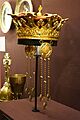
The ornate crown of Queen Marie of Romania.
-
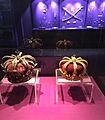
Historic royal crowns of the Kingdom of Romania.
-

The lost gold crown of King George XII of Georgia.
-
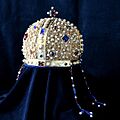
Historical crown style of Emperor Stefan Dušan.
-
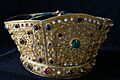
The crown of Prince Stefan Lazarević.
-
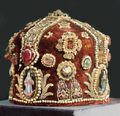
Medieval crown design of the Petrović-Njegoš dynasty.
-
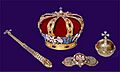
The Karađorđević bronze crown jewels of Serbia.
-

Royal insignia and crowns of the Kingdom of Prussia.
-
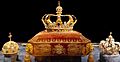
The Bavarian royal crown in Munich.
-

The fabric crown of the Grand Dukes of Baden.
-

Enamel plates from the ancient Byzantine Monomachus Crown.
-
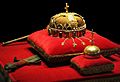
The Holy Crown of Hungary with the royal orb and sword.
-

Portrait of Cosimo I de' Medici with the Florentine crown and sceptre.
-

Drawing of the ancient Irish Comerford Crown discovered in 1692.
-
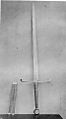
The ceremonial Manx Sword of State from the Isle of Man.
-

Modern model of the crown designed for the King of Finland.
-
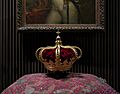
The Portuguese royal crown of King João VI.
-

Replica of the Great Imperial Crown of Catherine the Great.
-

The proclamation crown of the Spanish monarchs.
-
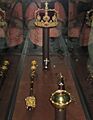
The Swedish royal regalia in Stockholm.
-

A papal tiara adorned with sapphires and rubies in Rome.
-
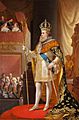
Emperor Pedro II of Brazil with the Imperial Regalia.
-
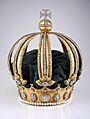
The diamond-studded Imperial Crown of Brazil.
-

The feathered headdress of Montezuma II in Vienna.
-
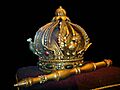
Replica of the Imperial Crown of Mexico.
-
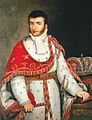
Emperor Agustín de Iturbide of Mexico.
-
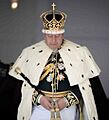
King Tupou VI of Tonga wearing the gold Crown of Tonga.
-

King Thibaw and Queen Supayalat of Burma on the Lion Throne.
-
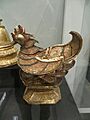
Gold and jeweled royal container from the Burmese Konbaung dynasty.


