
North Texas facts for kids
Quick facts for kids
North Texas
|
|
|---|---|
|
|
|

North Texas counties in red
|
|
| Country |  United States United States |
| State |  Texas Texas |
| Largest city |  Dallas Dallas |
| Population
(2020)
|
|
| • Total | 8,584,519 |


North Texas is a large, exciting, and fast-growing cultural and geographic region in the state of Texas. People who live in the area often call it the Dallas–Fort Worth metroplex, or simply the "Metroplex." Geographically, the area lies south of Oklahoma, east of Abilene, west of Paris, and north of Waco. It does not include the Texas Panhandle, which is the box-shaped region at the very top of the state.
North Texas is home to more than eight million people, making it one of the largest populated areas in the entire Southern United States. It features bustling urban centers, quiet farming towns, huge sports arenas, historic pioneer trails, and major university campuses. It serves as a vital transportation and economic hub for the whole nation.
Contents
- Understanding the Geography and Landscape of North Texas
- Weather Patterns and Climate in North Texas
- History of North Texas and Its Communities
- Counties and Organization in North Texas
- Major Cities and Metropolitan Centers
- Economy, Industries, and Major Employers
- Higher Education: Colleges and Universities
- Sports Culture and Professional Teams
- How People Travel: Transportation Networks
- Images for kids
- See also
Understanding the Geography and Landscape of North Texas
Where is North Texas Located?
North Texas sits near the northern boundary of Texas, right below the state of Oklahoma. The northern edge of the region follows the winding path of the Red River of the South. The region spans rolling plains, gentle hills, and open prairies.
Geographers usually divide North Texas into several natural zones. The eastern section contains parts of the Blackland Prairie, which has rich, dark soil that early settlers prized for farming cotton and grain. The central and western parts transition into the Cross Timbers region and the Grand Prairie, where hardwood forests of oak trees mix with open grazing land for cattle.
Rivers, Lakes, and Waterways
While North Texas does not sit next to an ocean, it has many vital rivers and lakes that supply drinking water and recreation:
- The Trinity River is the most famous river in the area, flowing straight through both Fort Worth and Dallas before traveling hundreds of miles south to the Gulf of Mexico.
- The Brazos River passes through the western edge of the region, carving rocky canyons and wide valleys.
- The Red River of the South marks the northern border with Oklahoma and creates important wetlands for wildlife.
- Major human-made reservoirs, including Lake Lewisville, Grapevine Lake, Lake Ray Hubbard, and Lake Texoma, offer boating, fishing, swimming, and flood control for nearby cities.
Plants and Wildlife of the Prairies
North Texas is home to diverse animals and plants adapted to warm weather and wide-open spaces:
- Mammals: White-tailed deer, coyotes, armadillos, bobcats, red foxes, and black-tailed jackrabbits roam the parks, ranches, and greenbelts.
- Birds: The region sits along the Central Flyway, a massive migration path for millions of birds traveling between North and South America every spring and autumn. Famous birds include the northern mockingbird (the state bird of Texas), scissortail flycatchers, and red-tailed hawks.
- Wildflowers: Every spring, millions of colorful wildflowers bloom along North Texas roadsides, most notably the famous Texas bluebonnet and bright red Indian paintbrush.
Weather Patterns and Climate in North Texas
Subtropical Climate Characteristics
North Texas has a humid subtropical climate, which means it experiences long, hot summers and relatively short, mild winters. Because the region is located inland away from cooling ocean breezes, it also shows characteristics of a continental climate, featuring wide swings in daily and seasonal temperatures.
Summer days regularly climb above 100 °F (38 °C), creating very hot weather from late June through early September. Sunny skies, high heat, and humidity mean residents rely heavily on air conditioning and shaded parks. Winters are generally mild, with daytime temperatures often resting comfortably in the 50s and 60s Fahrenheit. However, sudden cold windstorms, known locally as "blue northers," can sweep down from the Great Plains and drop the temperature by 30 degrees in just a few hours.
Storms, Tornadoes, and Precipitation
Rainfall in North Texas averages between 28 and 48 inches (700 to 1,200 mm) per year, with eastern areas receiving more rain than western counties:
- Thunderstorms: Most precipitation arrives during strong spring and early summer thunderstorms, which can produce spectacular lightning displays, heavy downpours, and gusty winds.
- Tornado Alley: North Texas sits along the southern edge of "tornado alley," where cool, dry air from Canada collides with warm, moist air from the Gulf of Mexico. These collisions can generate severe rotating supercell storms and occasional tornadoes during the spring months.
- Hail and Winter Weather: Strong storms occasionally drop large hailstones. Snowfall is uncommon, but when winter storms bring freezing rain or sleet, roads can become slick and schools often close for safety.
History of North Texas and Its Communities
Native American Heritage
Long before European explorers arrived, diverse Indigenous tribes lived throughout North Texas:
- The Caddo lived in established farming villages along the river valleys of the east, building large earthen mounds and crafting fine pottery.
- The Wichita and Tawakoni built thatched-grass homes and grew corn, beans, and squash along the waterways.
- The Comanche and Kiowa were expert horse riders and hunters who followed massive herds of bison across the rolling plains.
These native nations developed trade routes and deep connections to the land. During the 19th century, European settlement, westward expansion, and forced government relocations moved many tribes away to reservations in neighboring Indian Territory (now Oklahoma).
Settlement, Cattle Drives, and Railroads
In the 1840s, settlers began building small farming outposts in North Texas. John Neely Bryan built a small trading cabin near the Trinity River in 1841, founding the city of Dallas. In 1849, the United States Army established a military outpost named Fort Worth to protect the western frontier.
Following the American Civil War, Fort Worth became a crucial stop along the famous Chisholm Trail, where millions of Texas Longhorn cattle were herded north to railroad towns in Kansas. Fort Worth earned the nickname "Cowtown" and became a lively center for cowboys, cattle traders, and meatpacking plants. When transcontinental railroads connected Dallas and Fort Worth in the 1870s, the entire region transformed into a bustling commercial gateway.
20th Century Growth, Oil, and Technology
During the 20th century, North Texas experienced massive industrial expansion:
- The Oil Boom: Discoveries of oil across North and East Texas in the early 1900s brought immense wealth, funding banks, office towers, museums, and research centers.
- Aviation and Defense: During World War II, the region built massive aircraft manufacturing factories and military training bases, laying the groundwork for a major aerospace industry.
- The Telecom Corridor: In the late 20th century, cities like Richardson and Plano attracted global technology and telecommunications giants, helping North Texas become known as the "Silicon Prairie."
Counties and Organization in North Texas
North Central Texas Council of Governments
While North Texas is an informal region rather than an official political state, government demographers organize the region through regional planning councils. The largest is the North Central Texas Council of Governments (NCTCOG), which includes 16 central counties:
- Collin County
- Dallas County
- Denton County
- Ellis County
- Erath County
- Hood County
- Hunt County
- Johnson County
- Kaufman County
- Navarro County
- Palo Pinto County
- Parker County
- Rockwall County
- Somervell County
- Tarrant County
- Wise County
Regional Partner Counties
Other neighboring county councils are frequently included in broader definitions of North Texas:
- Nortex Regional Planning Commission: Includes rural and agricultural counties along the western Red River plains, such as Archer, Baylor, Clay, Cottle, Foard, Hardeman, Jack, Montague, Wichita, Wilbarger, and Young counties.
- Texoma Council of Governments: Includes northern border counties near Lake Texoma, such as Cooke, Fannin, and Grayson counties.
Major Cities and Metropolitan Centers
| City | Population (2023) | State rank | U.S. rank |
|---|---|---|---|
 Dallas |
1,259,404 | 3 | 9 |
 Fort Worth |
1,029,221 | 4 | 11 |
 Arlington |
405,995 | 7 | 49 |
 Plano |
291,450 | 9 | 69 |
 Garland |
235,293 | 12 | 91 |
 Irving |
248,931 | 13 | 93 |
 Grand Prairie |
199,395 | 15 | 127 |
 McKinney |
214,302 | 17 | 155 |
 Frisco |
227,528 | 18 | 162 |
 Mesquite |
143,792 | 20 | 181 |
 Carrollton |
132,935 | 23 | 197 |
 Denton |
160,564 | 26 | 202 |
 Richardson |
113,613 | 32 | 255 |
 Wichita Falls |
103,687 | 35 | 285 |
 Lewisville |
114,170 | 36 | 288 |
 Allen |
109,411 | 40 | 300 |
 Flower Mound |
79,102 | 50 | 450 |
Dallas: The Commercial and Arts Capital
Dallas is the ninth-largest city in the United States and the commercial heart of North Texas. It features a dazzling skyline dominated by iconic skyscrapers like Reunion Tower and the Bank of America Plaza. Dallas is internationally recognized for its finance, technology, telecommunications, and fashion industries.
The city also boasts the Dallas Arts District, the largest contiguous urban arts district in the United States. It houses world-class venues like the Dallas Museum of Art, the Perot Museum of Nature and Science, and the Morton H. Meyerson Symphony Center.
Fort Worth: Where the West Begins
Located just 30 miles west of Dallas, Fort Worth embraces its proud frontier heritage while maintaining a modern economy. The historic Fort Worth Stockyards feature daily cattle drives, wooden boardwalks, and rodeo arenas.
Fort Worth is also home to a world-renowned Cultural District, which includes the Kimbell Art Museum, the Modern Art Museum of Fort Worth, and the Fort Worth Museum of Science and History. The city serves as a major hub for aviation, logistics, defense manufacturing, and railway transportation.
Arlington: The Sports and Entertainment Hub
Positioned directly between Dallas and Fort Worth, Arlington is famous across the nation as an entertainment destination. Millions of visitors travel to Arlington each year to visit:
- AT&T Stadium, the massive home of the Dallas Cowboys football team.
- Globe Life Field, the high-tech, retractable-roof baseball stadium of the Texas Rangers.
- Six Flags Over Texas, the original Six Flags theme park filled with world-class roller coasters.
Booming Suburban Communities
The suburbs surrounding Dallas and Fort Worth are among the fastest-growing cities in the United States:
- Plano and Frisco host numerous corporate headquarters, modern parks, and sports complexes.
- Irving features the master-planned community of Las Colinas, famous for the Mustangs at Las Colinas bronze sculpture.
- McKinney and Denton offer historic downtown squares, vibrant indie music scenes, and annual cultural festivals.
- Wichita Falls, situated further northwest, serves as an important hub for commerce, healthcare, and military aviation training.
Economy, Industries, and Major Employers
Leading Business Sectors
The North Texas economy is one of the strongest and most diverse in the world. Key economic drivers include:
- Aviation and Aerospace: North Texas builds advanced aircraft, hosts corporate flight headquarters, and operates giant global shipping hubs.
- Technology and Innovation: Many global computer, microchip, and software firms have major facilities located in the region.
- Healthcare and Biomedical: Top-rated hospital networks, medical research universities, and biotechnology labs provide care and discover treatments.
- Finance and Logistics: Because of its central geographic location in North America, North Texas serves as a premier distribution center for cargo planes, trains, and trucking fleets.
Major Regional Employers
Thousands of people work for large companies, hospital systems, and public institutions across North Texas:
Dallas–Fort Worth Metroplex Leading Employers
| Company | Employees locally | Industry sector |
|---|---|---|
| Wal-Mart Stores, Inc. | 34,000 | Retail and Logistics |
| American Airlines | 27,000 | Commercial Aviation |
| Texas Health Resources | 22,296 | Healthcare |
| Dallas Independent School District | 19,740 | Public Education |
| Baylor Health Care System | 16,500 | Healthcare |
Wichita Falls Metropolitan Area Leading Employers
| Employer | Employees locally | Industry sector |
|---|---|---|
| Sheppard Air Force Base | 12,272 | Military and Defense |
| Wichita Falls Independent School District | 2,059 | Public Education |
| North Texas State Hospital | 1,974 | Healthcare |
| United Regional Health Care System | 1,778 | Healthcare |
| City of Wichita Falls | 1,477 | Local Government |
Higher Education: Colleges and Universities
North Texas is a major center for higher education, hosting dozens of top-tier public and private universities that educate hundreds of thousands of undergraduate and graduate students.
Public Universities
Public universities in North Texas provide state-funded education and conduct groundbreaking scientific research:
| School | Enrollment | Location | Mascot | Athletic Conference | University System |
|---|---|---|---|---|---|
 East Texas A&M University |
10,966 | Commerce | Lions | NCAA Division I (Southland) | Texas A&M University System |
.jpg) The University of North Texas |
46,940 | Denton | Mean Green | NCAA Division I (American) | University of North Texas System |
 University of Texas at Arlington |
40,990 | Arlington | Mavericks | NCAA Division I (WAC) | University of Texas System |
 University of Texas at Dallas |
30,885 | Richardson | Comets | NCAA Division III (American Southwest) | University of Texas System |
 Texas Woman's University |
15,472 | Denton | Pioneers | NCAA Division II (Lone Star) | Independent |
 Tarleton State University |
14,092 | Stephenville | Texans | NCAA Division I (WAC) | Texas A&M University System |
.jpg) Midwestern State University |
6,102 | Wichita Falls | Mustangs | NCAA Division II (Lone Star) | Texas Tech University System |
 University of North Texas at Dallas |
3,513 | Dallas | Trailblazers | NAIA | University of North Texas System |
Private Universities
North Texas also features prestigious private colleges and research institutes:
| School | Enrollment | Location | Mascot | Athletic Division |
|---|---|---|---|---|
 Southern Methodist University |
11,643 | University Park | Mustangs | NCAA Division I (ACC) |
| Texas Christian University | 10,323 | Fort Worth | Horned Frogs | NCAA Division I (Big 12) |
 Dallas Baptist University |
5,445 | Dallas | Patriots | NCAA Division II / NCAA Div I (Baseball) |
.jpg) Texas Wesleyan University |
3,378 | Fort Worth | Rams | NAIA |
 University of Dallas |
2,576 | Irving | Crusaders | NCAA Division III |
 Southwestern Assemblies of God University |
2,012 | Waxahachie | Lions | NAIA |
 Austin College |
1,224 | Sherman | Roos | NCAA Division III |
 Paul Quinn College |
600 | Dallas | Tigers | NAIA |
Sports Culture and Professional Teams
Sports play a massive role in North Texas culture. The region is one of the few metropolitan areas in North America with championship teams in every major professional sports league.
Major League Sports Teams
| Club | Sport | League | Home Stadium / Arena |
|---|---|---|---|
 Dallas Cowboys |
Football | NFL | AT&T Stadium (Arlington) |
 Texas Rangers |
Baseball | MLB | Globe Life Field (Arlington) |
 Dallas Mavericks |
Basketball | NBA | American Airlines Center (Dallas) |
 Dallas Stars |
Ice Hockey | NHL | American Airlines Center (Dallas) |
 FC Dallas |
Soccer | MLS | Toyota Stadium (Frisco) |
 Dallas Wings |
Basketball | WNBA | College Park Center (Arlington) |
College Athletics and Minor Leagues
North Texas fans also enthusiastically support collegiate athletics:
- The TCU Horned Frogs and SMU Mustangs play top-level Division I college football and basketball.
- The Cotton Bowl Classic is a legendary annual college football bowl game held in the region since 1937.
- Minor league baseball teams like the Frisco RoughRiders and minor league hockey teams like the Allen Americans offer fun, family-friendly sporting events throughout the season.
How People Travel: Transportation Networks
International Airports and Aviation

North Texas has one of the world's most advanced aviation hubs:
- Dallas/Fort Worth International Airport (DFW): Covering over 27 square miles, DFW Airport is larger than the island of Manhattan. It connects North Texas with hundreds of nonstop destinations worldwide.
- Dallas Love Field (DAL): Located close to downtown Dallas, Love Field is a bustling commercial airport famous as the birthplace of Southwest Airlines.
- Wichita Falls Municipal Airport: Serves passenger flights for northern communities near the Red River.
Public Transit and Commuter Rail

Public transit systems help commuters travel across the busy urban centers:
- Dallas Area Rapid Transit (DART): Operates buses and the longest light rail system in the United States, spanning more than 90 miles of track.
- Trinity Metro: Operates buses and commuter trains in Fort Worth, including the TEXRail service connecting downtown Fort Worth directly to DFW Airport.
- Trinity Railway Express (TRE): A popular commuter train running directly between downtown Dallas and downtown Fort Worth.
- Denton County Transportation Authority (DCTA): Operates the A-train passenger rail linking Denton to the DART light rail network.
Highway System and Roadways

.jpg)


North Texas relies on a massive grid of highways, interstate freeways, and modern toll roads that handle millions of vehicles every single day:
- Interstate Highways: Major national freeways pass through North Texas, including Interstate 20, Interstate 30, Interstate 35 (which splits into I-35E through Dallas and I-35W through Fort Worth), Interstate 45, and Interstate 44.
- U.S. Routes: Important historic routes include US 75 (Central Expressway), US 287, US 82, US 67, and US 380.
- Tollways: High-speed toll roads such as the Dallas North Tollway, President George Bush Turnpike, Sam Rayburn Tollway, and Chisholm Trail Parkway provide smooth travel across booming outer suburbs.
Images for kids
-
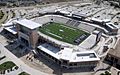
Eagle Stadium in Allen, Texas
-
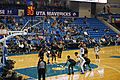
College basketball game between UNT and UT Arlington
-
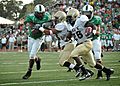
UNT Mean Green football team in action
-
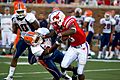
SMU Mustangs football player on the field
-
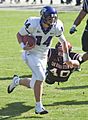
TCU Horned Frogs quarterback playing in a game
-

East Texas A&M Lions football competition
-
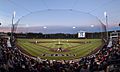
Horner Ballpark at Dallas Baptist University
.jpg)
_football_game,_Navy_Midshipmen_running_back,_Shun_White,_attempts_a_to_run_against_UNT%27s_defense.jpg)


.jpg)

See also
- List of geographical regions in Texas
- Dallas–Fort Worth metroplex
- Texas
