
Maize facts for kids
Quick facts for kids Maize |
|
|---|---|
 |
|
| Includes male and female flowers | |
| Conservation status | |
Scientific classification  |
|
| Kingdom: | Plantae |
| Clade: | Tracheophytes |
| Clade: | Angiosperms |
| Clade: | Monocots |
| Clade: | Commelinids |
| Order: | Poales |
| Family: | Poaceae |
| Genus: | Zea |
| Species: |
Z. mays
|
| Binomial name | |
| Zea mays |
|
| Script error: The function "autoWithCaption" does not exist. | |

Script error: No such module "Check for conflicting parameters".
Maize (Zea mays), often called corn, is a tall, strong grass that gives us delicious cereal grain. It has a thick stalk with shiny, long leaves. At the top of the stalk, you can see male flower clusters called tassels. Lower down on the stem, female flower clusters grow into ears of corn. These ears produce sweet seeds that many people enjoy eating. Most kinds of corn sold in grocery stores are yellow or white. However, corn can also grow in red, blue, pink, and purple!
Long ago, Native farmers in ancient Mexico created corn from a wild grass called teosinte. This amazing step in agriculture took place about 9,000 years ago. Native Americans later planted corn together with beans and squash. This clever farming team is called the Three Sisters. The tall corn gives climbing beans a strong pole to grow on. The leafy squash covers the soil and keeps it moist.
Maize cannot survive in the wild without human help. Today, farmers around the world grow more corn by weight than wheat or rice. People eat delicious sweet corn right off the cob. They also turn corn into flakes, flour, and syrup. Farm animals like cows, pigs, and chickens eat field corn every single day. Factories even turn corn starch into clean fuel and eco-friendly plastics.
Contents
Discovering the Parts of the Maize Plant

Maize is an annual plant, which means it completes its life cycle in one year. It grows from a single seed into a giant plant during the warm summer. Most corn stalks reach heights between 4 and 13 feet tall. The long, blade-shaped leaves sprout from joints called nodes along the stalk. Each leaf alternates sides as it travels up the strong stem. This plant design allows every leaf to catch plenty of bright sunlight.
Maize is a monoecious plant, meaning it has male and female flowers on one plant. The male flower sits right at the very top of the stalk. It looks like a feather duster and is called the tassel. Inside the tassel, tiny parts called anthers produce yellow pollen powder. Maize relies on anemophily, which means the wind carries the pollen across the field. A single tassel can shed millions of pollen grains into the breezy air.
The female flowers grow lower down along the middle of the leafy green stalk. They form what we call an ear of corn. Each female flower has a long, sticky thread called silk. The silk catches flying pollen grains floating by in the wind. When pollen lands on a silk, it fertilizes the flower to form a seed. Botanically speaking, each kernel is a tiny single-seeded fruit called a caryopsis.
A thick jacket of green leaves called husks protects the baby kernels from danger. The leaf closest to the ear is known as the ear leaf. This important leaf acts like a solar food factory for the growing ear. It uses photosynthesis to make over three quarters of the carbohydrates inside the kernels. Underneath the green husks, the kernels grow in neat, straight rows around a hard cob.
Colors and Kernels of Corn
A regular ear of corn usually has between 8 and 32 rows of seeds. A big, healthy ear can hold as many as 1,200 tasty kernels! Most modern corn varieties are bright yellow, creamy white, or a mix of both. Native growers also saved seeds that produce orange, deep red, brown, and deep blue kernels. Some varieties produce purple or shiny black grains that look like sparkling glass beads.
These fun colors come from natural plant pigments that protect the growing seeds. Yellow corn gets its sunny glow from healthy plant chemicals called carotenoids. Deep red and purple corn grains contain rich amounts of anthocyanins and phlobaphenes. These natural colors act like plant sunblock and fight off tiny harmful molecules. Orange and green ears contain clever mixtures of several pigments working together inside the seed coat.
How Corn Grows and Flowers
Maize has short-day photoperiodism, which means it watches the length of night and day. It begins to make flowers when the summer nights reach a certain length. Corn also needs plenty of warm days with temperatures well above 50 degrees Fahrenheit. If the weather stays chilly, the seeds will wait patiently before they start to grow. Special light-sensing proteins called phytochromes tell the plant when it is time to bloom.
Tropical corn plants need extra care if farmers plant them far up north. The long summer daylight hours trick the plants into growing tall like jungle trees! Sometimes they grow too tall and forget to make ears before winter arrives. However, scientists love these giant plants because they make wonderful green biomass for clean energy. Plant breeders continue to select seeds that bloom at the perfect time for every climate.
Young corn shoots make a natural plant medicine with a big name: DIMBOA. This natural chemical defends baby seedlings from hungry bugs and harmful fungus. Because corn has shallow roots, strong summer windstorms can sometimes knock whole stalks down. Maize roots spread out near the surface of the soil rather than digging deep. Because of this, farmers give corn plenty of water and rich, dark soil to thrive.
Corn pollen can cause sneezing in people who have seasonal allergies. Luckily, corn pollen grains are quite heavy compared to light tree pollen grains. Most corn pollen drops straight down within a few feet of the tall tassel. Farm workers wear protective masks when walking through pollen-filled fields in the middle of summer. For most kids, visiting a corn maze in the autumn is completely safe and fun!
-
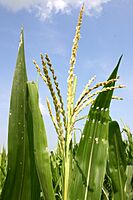
Many small male flowers make up the tassel.
-
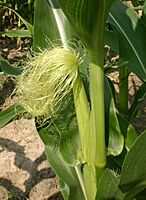
Female inflorescence, with young silk
-
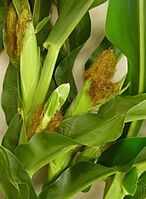
Stalks, ears and silk
-
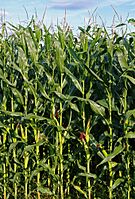
Full-grown maize plants
-
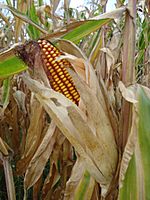
Mature maize ear on a stalk
-

Male flowers
-
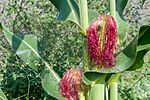
Mature silk


.JPG)


The Amazing Genetics of Corn

Maize is a diploid plant, meaning it has two sets of matching chromosomes. Inside every tiny corn cell, you can find 20 chromosomes holding its DNA code. More than 80 percent of corn's genetic traits come directly from its wild teosinte ancestors. Because different corn plants easily trade pollen, corn has huge amounts of genetic diversity. This great diversity helps scientists breed tough new plants that resist heat and hungry pests.
A famous American scientist named Barbara McClintock made history studying colorful corn kernels. She noticed that spotted and streaked kernels had pieces of DNA that moved around! She called these jumping units transposons, or jumping genes. Many people doubted her ideas at first, but she proved her discovery was real. In 1983, she won the Nobel Prize in Physiology or Medicine for her brilliant research with corn.
Today, corn is an important model organism used in science labs all over the globe. Scientists study corn flowers to see how plant genes work during early growth stages. Special gene patterns called the MADS-box control how tassels and silks develop on the stalk. By understanding these plant patterns, botanists can help other food crops produce bigger harvests. Corn continues to teach us exciting secrets about plant biology and modern medicine.
Governments and universities work together to keep large digital libraries of corn genes. The United States Department of Agriculture helps run the Maize Genetics and Genomics Database for global researchers. In Mexico, the International Maize and Wheat Improvement Center preserves thousands of rare seed samples. Scientists completely read and mapped the full maize genome in the year 2008. They discovered that maize has around 32,540 genes hidden inside its cells!
Family Tree and Plant Relatives
How Corn Fits into the Grass Family
Maize belongs to the giant grass family, which botanists call Poaceae. Inside this green plant family, maize sits inside a special group called the PACMAD clade. Its closest cousin among farm crops is sorghum, a sweet and hardy grain plant. Maize is also closely related to a wild American prairie grass named Tripsacum. Other favorite grains like rice, wheat, and barley belong to a different grass branch named the BOP clade.
| (Part of Poaceae) |
|
||||||||||||||||||||||||||||||||||||||||||||||||
From Wild Teosinte to Giant Ears

Modern maize looks completely different from its wild ancestor, a bushy grass called teosinte. Teosinte grows lots of branching stems and tiny spikes of hard, rock-like seeds. Ancient hunter-gatherers gathered teosinte seeds because the tough grass survived hot droughts and sudden floods. In 1931, the Russian botanist Nikolai Ivanovich Vavilov suggested corn came from wild teosinte. An American scientist named George Beadle proved this great theory using genetic clues in 1932.
It turns out that just two main genes caused this huge transformation in corn's shape! One gene, called grassy tillers-1, tells the plant whether to grow bushy or straight. The second gene, named teosinte branched-1, controls how side branches turn into cob-bearing ears. By saving seeds from the straightest plants, ancient farmers changed the plant completely. Modern genetic tests show that wild teosinte is indeed the true mother of all farm corn.
In 2004, scientist John Doebley showed that Balsas teosinte is the closest wild cousin to corn. This wild grass grows naturally along the warm Balsas River valley in southwestern Mexico. Archaeologists exploring deep caves near Iguala, Guerrero found stone grinding tools coated in ancient corn dust. These fascinating tools were used by ancient people about 8,700 years ago! Genetic tests confirm that maize was domesticated only once before spreading across the globe.
Ancient pollen grains found at San Andres prove people grew corn 7,300 years ago. Early farmers shared corn seeds along trading trails into Central America and South America. Archaeologists working at Guila Naquitz Cave in the Oaxaca Valley found tiny ancient cobs. These mini cobs are more than 6,200 years old! Over thousands of years, Native farmers transformed a tiny wild spike into large, sweet ears.
How Maize Traveled North
Around 4,500 years ago, ancient travelers brought corn northward into what is now the American Southwest. Farmers in New Mexico and Arizona planted corn seeds in sunny desert soils 4,100 years ago. Over hundreds of years, northern tribes selected seeds that grew well in cooler climates. Around the year 900, tribes living along eastern American rivers grew huge fields of corn. These big farming harvests supported large towns and rich native cultures.
Native farmers cleared grassy river valleys to plant expanding gardens of corn, beans, and squash. Interestingly, ancient riverbeds show that freshwater mussels declined when large-scale farming grew rapidly. Clearing trees changed the flow of muddy soil into clean streams where mussels lived. Even so, maize gave Native nations a stable food supply that lasted through cold winters. Dried corn kernels could be stored safely in clay jars for years.
What Is in a Name?
The word maize comes from the word mahis, used by the ancient Taíno people. Christopher Columbus heard this word in the Caribbean and shared it with Spanish explorers as maíz. In 1753, Swedish scientist Carl Linnaeus chose the scientific name Zea mays for the plant. Scientists prefer the name maize because it always means this exact special grass. In international trade and scientific laboratories, people everywhere use the name maize.
In the United States and Canada, most people simply call this plant "corn." Hundreds of years ago, the English word "corn" meant any common grain crop. In England, people called wheat "corn," while in Scotland, "corn" meant tasty oats. When European settlers arrived in North America, they called maize "Indian corn." Over time, Americans dropped the first word and called the sweet golden crop corn. In many other countries, both words are understood and used happily.
How Farmers Grow Corn
Ancient Farming in the Americas

Maize cannot plant itself without human help because its kernels are locked tightly onto the cob. Wild teosinte drops its seeds naturally when they ripen so they can sprout next spring. In contrast, maize kernels stay glued to the cob inside dry, papery husks. If an entire ear falls on the ground, dozens of baby seedlings choke each other. Corn completely depends on human hands to shell its seeds and plant them in rows.
From its birthplace in Mexico, corn spread across mountains, rainforests, and open plains. Native farmers carried corn seeds up into the high peaks of the Andes mountains. Maize reached the green valleys of Colombia and Ecuador thousands of years ago. By 3,000 years ago, the great Olmec civilization relied on corn for its daily food. The ancient Maya believed that the first humans were lovingly formed from white and yellow cornmeal.
Far to the south, the Mapuche people of Chile planted corn alongside nutritious quinoa and potatoes. Ancient traders carried corn through mountain passes into the flat plains of Argentina. Long before the powerful Inca Empire arose, farmers across South America celebrated rich corn harvests. They developed special ways to freeze-dry corn and brew refreshing drinks from crushed kernels. Corn formed the very foundation of great cities, temples, and trade networks.
The Columbian Exchange Spreads Corn
In 1492, European explorers arrived in the Americas and tasted delicious sweet corn for the first time. During the Columbian exchange, Spanish sailing ships carried golden corn ears back home across the Atlantic. At first, European bakers were confused because corn flour did not rise like wheat flour. Traditional churches insisted on using wheat bread rather than cornmeal for their sacred communion services. However, everyday gardeners quickly noticed that corn produced huge harvests with very little work.
Maize spread across the globe faster than almost any other plant in human history. Farmers in Italy, Spain, and West Africa planted corn in their sunny garden plots. Traders carried seeds along the ocean routes to the Philippines, India, and southern China. By the 1600s, corn was a popular daily food for hardworking families in Southern Europe. People in northern Italy loved cooking warm, creamy cornmeal porridge, which they called polenta.
However, a mysterious illness named pellagra began spreading in places where people ate only corn. People who got pellagra suffered from tired bodies, itchy skin sores, and upset stomachs. Native Americans had solved this problem thousands of years earlier with a clever trick called nixtamalization. They soaked hard kernels in alkaline water made with wood ashes or dissolved limestone. This ancient cooking step unlocks vitamin B3, also known as niacin, so our bodies can use it!
When European farmers copied the plant, they forgot to copy the clever ash-soaking recipe. Because they ate plain corn without niacin, their bodies suffered from painful vitamin deficiencies. Once modern scientists discovered the magic of nixtamalization, pellagra disappeared from wealthy nations. Eating a colorful diet with beans, eggs, and vegetables also keeps our bodies strong and healthy. Today, corn factories enrich cornmeal with extra vitamins so everyone stays safe.
Modern Plant Breeding
Native farmers spent thousands of years turning a skinny wild grass into big, juicy corn ears. In the 1800s, curious farmers in North America began selecting seeds to create special varieties. An American farmer named James L. Reid developed a famous variety called Reid's Yellow Dent. He chose seeds from the biggest, healthiest plants in his fields every autumn. This famous yellow corn became the great-grandparent of most field corn grown in America today!
In the early 1900s, plant scientists discovered how to make amazing hybrid corn. They took two different parent plants and carefully crossed their pollen together. The baby hybrid plants grew faster, stood taller, and made much more corn than either parent. This exciting biological boost is known by scientists as hybrid vigor. Today, university researchers and seed companies continue to breed super-strong hybrids for farmers worldwide.
Some fascinating corn varieties have been bred for unusual tasks and scientific experiments. Farmers grow miniature varieties to pick tender baby corn for tasty stir-fry dishes. Scientists created a speedy variety called "mini-maize" that flowers very quickly inside research greenhouses. In Mexico, a rare native variety named olotón works with friendly bacteria in its roots. These helpful bacteria pull plant food right out of the air, reducing the need for chemical fertilizers!
Researchers also collect rare tropical corn varieties to find hidden plant superpowers. In hot climates, corn must defend itself against fungus, droughts, and hungry grasshoppers. Scientists at the International Maize and Wheat Improvement Center search for tough genes in wild plants. When they find a helpful gene, they breed it into farm corn using natural pollination. These tough new varieties help small family farms in Africa harvest plenty of food during dry years.
Understanding Genetic Engineering
Scientists have also used modern genetic engineering to protect corn crops from dangerous pests. One famous type is called Bt maize, which carries a natural soil protein. This protein comes from a friendly soil bacterium called Bacillus thuringiensis. When hungry caterpillars bite into the leaf, the protein stops them from eating the plant. This built-in plant shield allows farmers to spray far fewer chemical bug sprays over their fields.
Farmers also grow corn varieties that tolerate weed-control sprays without getting hurt. In North America, most field corn grown today uses these modern genetic improvements. These tough crops help farmers grow more food on less land while saving precious tractor fuel. Seed safety agencies test these plants carefully before farmers can plant them in open fields. Genetically modified corn is now grown by farmers in more than twenty different countries.
Planting and Caring for the Crop
Corn loves warm sunshine and cannot survive freezing winter frosts. In places with cold winters, farmers wait until sunny springtime to sow their seeds. Because corn roots stay near the surface, the soil must hold plenty of moisture. Maize is very smart about water because it uses a special superpower called C4 carbon fixation. This internal plant engine helps corn turn sunlight into sugar while using water very efficiently.
Maize needs the most water right when its delicate silks appear in the summer breeze. If a dry drought hits during silk week, the ears cannot form full rows of kernels. In the American Midwest, farmers used to say corn should be "knee-high by the Fourth of July." Today, modern hybrid plants grow so fast they are often shoulder-high by that holiday! Farmers test their soil regularly to make sure their growing plants have plenty of rich nutrients.
Native American tribes created an ingenious farming method known as the Three Sisters. They shaped loose soil into neat, rounded mounds and planted corn, beans, and squash together. The sturdy corn stalks acted as living bean poles for climbing bean vines. In return, the bean roots made natural nitrogen food to share with the hungry corn. Meanwhile, giant spiky squash leaves shaded the ground, blocking weeds and keeping the soil moist!
-
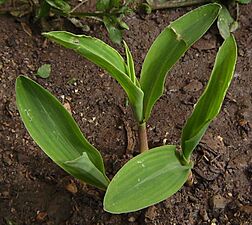
Seedlings three weeks after sowing
-
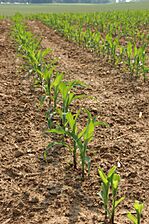
Young stalks
-
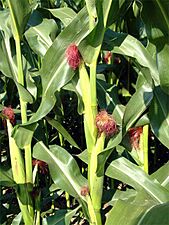
Mature plants showing ears
-
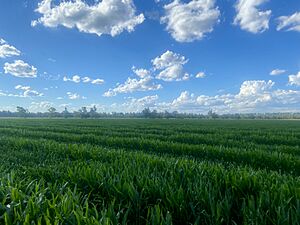
Established broadacre maize seed crop


The Excitement of Harvest Time
Sweet corn and field corn are harvested at completely different times of the year. Sweet corn is picked during late summer when the kernels are soft, juicy, and sweet. Farmers call this the "milk stage" because popping a kernel squirts out sweet, milky liquid. If you wait too long, the plant turns those delicious sugars into hard, chalky starch. Sweet corn must be rushed to local grocery stores or frozen quickly to keep its sugary taste.
Field corn, on the other hand, is left standing in the field until late autumn. The warm sun and crisp autumn breezes dry the stalks until they turn golden brown. The kernels turn rock-hard on the cob so they will not rot during winter storage. Farmers can leave dry field corn standing for weeks without hurting the grain. Sometimes, farmers in northern states even harvest dry corn when snow is on the ground!
Long ago, harvesting corn was hard, slow work done entirely by human hands. Families and neighbors gathered for fun community parties called husking bees. Working together, people pulled husks off ears and sang songs late into the night. In the late 1800s, inventors designed early mechanical pickers pulled by strong farm horses. These clever iron machines helped farmers harvest their fields much faster than before.
Today, giant harvesting machines called combine harvesters do all the work in one pass. The combine rolls through the field, gently snapping ears off the tall green stalks. Inside the machine, spinning drums rub the ears to strip the kernels off the cob. The machine shoots clean kernels into a bin while spitting chopped stalks back onto the soil. The leftover plant pieces, called corn stover, protect the dirt from rain erosion.
-
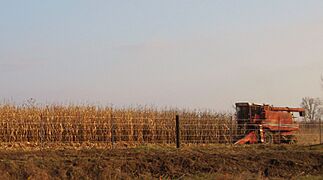
Harvesting maize, Iowa
-

Harvesting maize, Finland
-
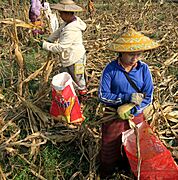
Hand-picking maize, Myanmar
-
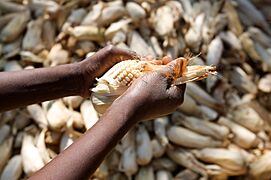
Dehusking maize by hand, Malawi


.jpg)
Safe Grain Storage in Silos
Harvested grain must be dried carefully before it gets tucked away into storage bins. If corn kernels stay wet, dangerous mold fungi can grow on the pile. Some molds, such as Aspergillus and Fusarium, make harmful toxins called mycotoxins. To stop mold from growing, farmers blow warm, dry air through giant steel grain dryers. Giant fans push warm air through the seeds until the extra water evaporates away.
Once the corn is dry and cool, farmers store it inside tall, shiny steel silos. Electric fans keep fresh air circulating through the grain pile all winter long. Farmers monitor digital thermometers to make sure the grain stays cool and dry. Keeping corn dry protects the world's food supply from sneaky bugs, moisture, and spoilage. Stored correctly, golden corn kernels can remain fresh and nutritious for many years.
World Production and Global Harvests
Maize is truly a champion plant, producing more grain each year than any other crop on Earth! In the year 2020, world farmers harvested an amazing 1.16 billion metric tonnes of corn. The United States is the world's top corn producer, growing about 31 percent of the total. China is the second largest grower, producing more than 22 percent of global corn. Other top corn-growing countries include Brazil, Argentina, Ukraine, India, and Mexico.
Corn is also a big topic in global business and world news. In August 2026, corn market prices climbed to their highest levels since July 2023. Busy food factories and international animal feed markets created high demand for grain. At that time, the United States Department of Agriculture estimated a strong national harvest of 180.7 bushels per acre. From small family gardens to massive prairie fields, corn feeds billions of people every day.
| Top maize producers | |
|---|---|
| in 2020 | |
| Numbers in million metric tonnes | |
 United States United States |
360.3 |
 China China |
260.7 |
 Brazil Brazil |
104.0 |
 Argentina Argentina |
58.4 |
 Ukraine Ukraine |
30.3 |
 India India |
30.2 |
 Mexico Mexico |
27.4 |
 Indonesia Indonesia |
22.5 |
 South Africa South Africa |
15.3 |
 Russia Russia |
13.9 |
|
|
|
| World total | 1162.4 |
| Source: FAOSTAT | |
Script error: No such module "owidslider".
Script error: No such module "owidslider".
Script error: No such module "owidslider".
-

Production of maize (2023)
-
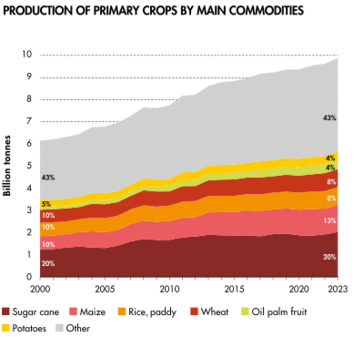
Maize is the second most widely produced primary crop, after sugarcane, and the first among grain crops.
.svg)

Troublesome Pests and Plant Diseases

Like any garden plant, corn faces many tiny enemies in the wild, including fungus and bugs. Fungal diseases can attack the leaves, stems, and ears during humid, rainy weather. Northern corn leaf blight causes long, grayish spots to appear across green leaves. Another fungal sickness called corn smut turns kernels into puffy, blue-gray mushrooms. In Mexico, people pick this unusual smut fungus and cook it as a delicious taco filling called huitlacoche!
Bacterial and viral infections can also make corn plants sick in farm fields. A fungus called tar spot creates tiny black specks that look like drops of black paint. In 2022, tar spot damaged over 116 million bushels of corn across the United States. Plant doctors help farmers choose disease-resistant seeds and rotate their crops to stay ahead of plant germs. Keeping fields clean and well-drained helps corn stay healthy all summer.
Hungry insects love dining on sweet, crunchy corn plants just as much as we do! Two of the biggest insect enemies in North America are the European corn borer and corn rootworms. European corn borer caterpillars chew tunnels through stalks, causing plants to break in the wind. Corn rootworm beetles lay eggs in the dirt, and their larvae chew on baby roots. Together, these two pesky bugs cause over two billion dollars in crop damage every year!
Other insect pests include the fall armyworm and the tiny maize weevil. Armyworm caterpillars travel in giant groups, eating leaves off entire fields in just a few days. Tiny soil worms called nematodes attack roots under the soil, making it hard for plants to drink water. Farmers use helpful insects like ladybugs, rotate crops every year, and plant smart seeds to stop these hungry visitors. Working with nature helps farmers keep their fields green and productive.
-
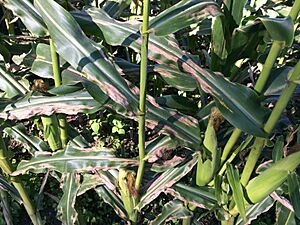
Northern corn leaf blight
-
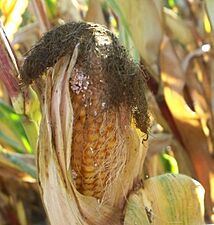
Corncob damage by European corn borer
-
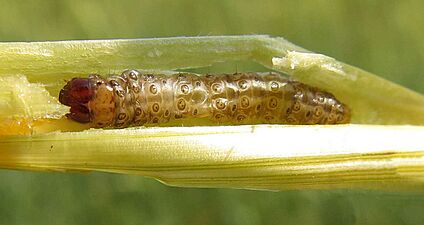
Caterpillar of European corn borer in maize

.JPG)
.jpg)
Delicious Uses for Maize and Corn
Yummy Culinary Traditions
Corn is a versatile ingredient found in thousands of delicious foods across the world. Sweet corn on the cob is a summertime favorite at backyard family barbecues. When dried field corn is ground into yellow powder, it becomes versatile cornmeal. Bakers use cornmeal to bake crumbly cornbread, crispy muffins, and crunchy pizza crusts. Corn is also processed into corn starch, a powdery white starch used to thicken warm soups and gravies.
Thousands of years ago, Native American cooks in Mexico ground soaked kernels on stone slabs called metates. They shaped the wet dough, called masa, into thin, flat circles to bake tortillas. Today, masa dough is used to make warm tamales, crispy chips, and warm drinks like atole. In Mexico and Central America, hot corn tortillas are served at almost every single meal. Fresh corn tortillas smell wonderful and wrap up beans, cheese, and vegetables.
Around the world, different cultures turn coarse cornmeal into warm, comforting bowls of porridge. Families in Italy love eating creamy yellow polenta topped with tomato sauce and melted cheese. In Romania, people cook a similar golden corn porridge named mămăligă. People living in the American South enjoy warm breakfast bowls of creamy hominy grits. Across Africa, corn porridge is a beloved staple called mieliepap, sadza, or ugali.
Food scientists also turn corn starch into natural sweeteners like high fructose corn syrup. This sweet liquid is added to fruit juices, jams, sodas, and breakfast cereals. Heart-healthy corn oil is pressed from the tiny germ found inside each hard kernel. Cooks use corn oil to fry crispy foods because it handles high cooking heat very well. From crunchy breakfast cornflakes to warm popcorn at the movies, corn makes eating fun!
-
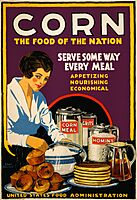
Poster of corn-based foods,
U.S. Food Administration, 1918 -
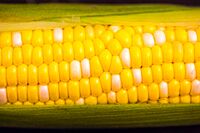
Semi-peeled corn on the cob
-

Mexican tamales
-
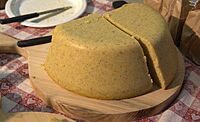
One way of serving Italian polenta

.jpg)


Nutrition Facts and Healthy Energy
| Nutritional value per 100 g (3.5 oz) | |
|---|---|
| Energy | 360 kJ (86 kcal) |
|
18.7 g
|
|
| Starch | 5.7 g |
| Sugars | 6.26 g |
| Dietary fiber | 2 g |
|
1.35 g
|
|
|
Protein
|
3.27 g
|
| Tryptophan | 0.023 g |
| Threonine | 0.129 g |
| Isoleucine | 0.129 g |
| Leucine | 0.348 g |
| Lysine | 0.137 g |
| Methionine | 0.067 g |
| Cystine | 0.026 g |
| Phenylalanine | 0.150 g |
| Tyrosine | 0.123 g |
| Valine | 0.185 g |
| Arginine | 0.131 g |
| Histidine | 0.089 g |
| Alanine | 0.295 g |
| Aspartic acid | 0.244 g |
| Glutamic acid | 0.636 g |
| Glycine | 0.127 g |
| Proline | 0.292 g |
| Serine | 0.153 g |
| Vitamins | Quantity
%DV†
|
| Vitamin A equiv.
lutein zeaxanthin
|
1%
9 μg
644 μg
|
| Thiamine (B1) |
13%
0.155 mg |
| Riboflavin (B2) |
5%
0.055 mg |
| Niacin (B3) |
11%
1.77 mg |
| Pantothenic acid (B5) |
14%
0.717 mg |
| Vitamin B6 |
7%
0.093 mg |
| Folate (B9) |
11%
42 μg |
| Vitamin C |
8%
6.8 mg |
| Minerals | Quantity
%DV†
|
| Iron |
4%
0.52 mg |
| Magnesium |
10%
37 mg |
| Manganese |
8%
0.163 mg |
| Phosphorus |
13%
89 mg |
| Potassium |
9%
270 mg |
| Zinc |
5%
0.46 mg |
| Other constituents | Quantity |
| Water | 75.96 g |
|
Link to USDA Database entry
One ear of medium size maize has 90 grams of seeds. |
|
| †Percentages estimated using US recommendations for adults. | |
Sweet corn is a tasty and healthy vegetable packed with natural energy for active kids! Raw sweet corn kernels are made of about 76 percent water and 19 percent carbohydrates. One medium ear provides around 86 calories along with two grams of healthy dietary fiber. Dietary fiber helps your stomach digest food smoothly and keeps your heart working happily. Sweet corn also provides valuable minerals like potassium, phosphorus, and muscle-building magnesium.
Corn is a wonderful source of important B vitamins, which help your body turn food into playground energy! It contains thiamin, folate, and pantothenic acid to help your growing brain stay sharp. Yellow corn also contains lutein, a sunny antioxidant that protects your eyesight from bright light. Because corn lacks high amounts of two amino acids called lysine and tryptophan, pairing corn with beans creates a complete protein team!
Feeding Farm Animals
Most of the field corn grown in North America is used to feed hungry farm animals. In fact, about 40 percent of all American corn feeds beef cattle, dairy cows, pigs, and chickens. Dried kernels are packed with energy-rich starch, making them an ideal winter animal feed. Farmers store dried kernels in tall metal bins or feed whole ears to cattle. Crushed corn helps farm animals grow strong and produce rich milk and fresh eggs.
Farmers do not waste any part of the corn plant when feeding their animals. Instead of harvesting just the kernels, huge machines can chop the entire green plant into small pieces. Workers pack these chopped green stalks tightly into airtight silos to make fermented silage. Silage smells slightly sweet and sour, like farm pickles, and cows love munching on it! In dry seasons, farmers roll dry stalks into giant bales for cozy animal bedding.
-
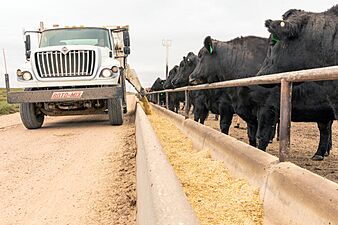
Cattle wait alongside a fence as a truck distributes a grain feed composed of maize by-products into troughs.
-
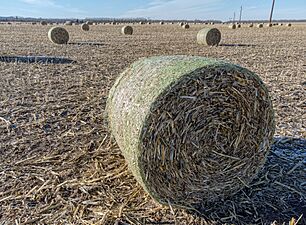
Baled cornstalks


Green Chemistry and Useful Materials
Corn is not just for breakfast; it is also a superhero in green chemistry laboratories! Scientists can transform corn starch into biodegradable bioplastics that break down naturally in compost piles. Many eco-friendly drinking cups, picnic spoons, and food wrappers are made entirely from corn starch! Using corn plastic helps reduce trash in landfills and saves petroleum oil. Corn starch is also used to make paper, glues, and shiny clothing fabrics.
During corn processing, factories collect a thick, nutrient-rich liquid called corn steep liquor. Scientists use this liquid in biology labs to feed friendly microorganisms like yeast and bacteria. These helpful bacteria produce important medicines, including life-saving penicillin antibiotics! Corn components are also mixed into shiny car wax, laundry detergents, and soothing skin lotions. Corn touches hundreds of everyday items you use around your home.
Clean Biofuel and Renewable Energy

Did you know that cars and trucks can run on fuel made from golden corn? Factories ferment corn starch with tiny yeast cells to brew clean-burning ethanol fuel. In many countries, gas stations blend ethanol directly into gasoline to reduce air pollution from cars. Using renewable corn fuel helps reduce the amount of fossil fuels pumped from underground. Scientists continue working to make ethanol production cleaner and more energy-efficient every year.
Leftover dry cobs and stalks can also be burned to generate clean electrical energy. Some homes stay cozy during freezing winters using special corn stoves that burn dry kernels! In Europe, farms collect whole green corn plants and place them into giant biogas digesters. Inside these warm tanks, friendly microbes turn plant matter into clean natural gas. That gas powers electric generators, lighting up neighborhood homes and schools!
Corn in Human Art and Culture
Corn has been celebrated in songs, artwork, and festivals for thousands of years. For ancient Mesoamerican civilizations, maize was a sacred gift from the gods. The ancient Maya worshipped a handsome young Maya maize god who represented rebirth and spring growth. Sculptors carved statues showing the maize god wearing an ear of corn as a headdress. Aztec artisans crafted stone statues of young women holding golden corn ears to celebrate bountiful autumn harvests.
In the United States, corn is celebrated as a proud symbol of agriculture and hard work. Beautiful ears of corn are carved into stone pillars inside the famous U.S. Capitol building! In Mitchell, South Dakota, you can visit the world-famous Corn Palace. Every year, local artists cover the outside of this giant building with murals made of colored corn ears! In Dublin, Ohio, visitors enjoy walking through a giant public park sculpture called the Field of Corn.
Coins around the world have also featured beautiful images of this important golden plant. The European country of Croatia featured a tall corn stalk on its one-lipa coin for many years. Because chickens love eating corn, people in some cultures playfully teased timid folks by scattering corn kernels. In modern times, corn mazes carved through tall autumn fields bring laughter and fun to families every October. Corn remains one of the greatest treasures nature and human hands have ever created!
-
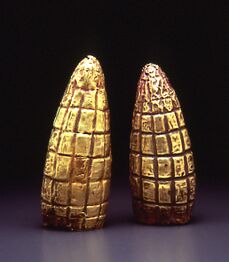
Maize sculpture, Moche culture, 300 AD, Larco Museum, Lima, Peru
-
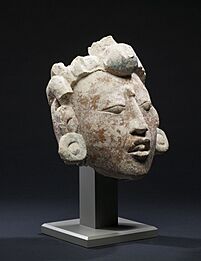
Stucco head of the Maya maize god from Campeche, Mexico, 550–850 AD
-

Jaina Island ceramic statuette of the young Maya maize god emerging from an ear of corn, 600–900 AD
-
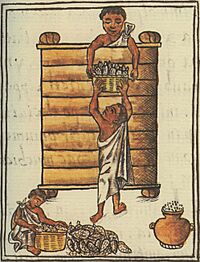
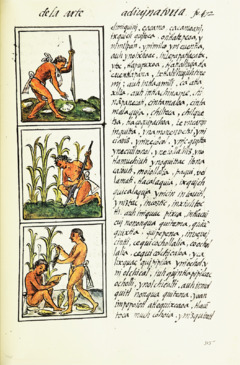
Aztecs storing maize,
Florentine Codex, 1540/1585 -
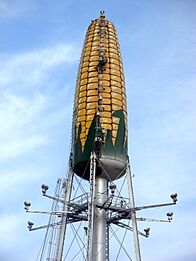
Water tower in Rochester, Minnesota being painted as an ear of maize, 2008


See also
 In Spanish: Maíz para niños
- Blue corn
- Dent corn
- Detasseling
- Flint corn
- Glass gem corn
- Post-harvest losses (grains)
- Purple corn
- Push–pull technology – Pest control strategy for maize and sorghum
- Zein
