
Group 4 element facts for kids
Group 4 is a special family of elements in the periodic table. Think of the periodic table as a big chart that organizes all the known chemical elements. Group 4 includes four elements: titanium, zirconium, hafnium, and rutherfordium. These elements are known for being strong and useful in many ways.
Contents
What are Group 4 Elements?
These elements are found in the "d-block" of the periodic table. This just means they have a certain way their electrons are arranged, which gives them similar properties. They are all metals, except for rutherfordium, which is a synthetic (man-made) and radioactive element.
Titanium: The Strong and Light Metal

Titanium is the most well-known element in Group 4. It is a very strong metal, but also very light. This makes it perfect for building things like airplanes, spacecraft, and even sports equipment. You might find titanium in bicycle frames or golf clubs! It is also used in medical implants, like artificial joints, because it is safe for the human body. Titanium is also found in white paints and sunscreens.
Zirconium: Tough and Heat-Resistant
Zirconium is another important element in Group 4. It is very tough and can handle high temperatures without melting or breaking down. Because of this, zirconium is often used in nuclear power plants. It helps to hold the nuclear fuel safely. Zirconium is also used to make some types of ceramics and even in jewelry, where it can look like diamonds when cut and polished.
Hafnium: A Close Relative
Hafnium is very similar to zirconium. They are often found together in nature and have many similar properties. Hafnium is also used in nuclear power plants, but for a different reason. It is very good at absorbing neutrons, which helps to control the nuclear reactions. Hafnium is also used in some computer chips and light bulbs.
Rutherfordium: The Man-Made Element
Rutherfordium is different from the other three elements in Group 4 because it does not exist naturally on Earth. It is a synthetic element, meaning scientists have to create it in laboratories. It is also radioactive, which means it gives off energy as it breaks down. Rutherfordium is very unstable and only lasts for a very short time. Because of this, it has no practical uses outside of scientific research. It helps scientists understand more about how elements are made and how they behave.
Where are Group 4 Elements Found?
Titanium and zirconium are quite common in the Earth's crust. They are usually found in minerals, which are natural solid substances. Hafnium is almost always found alongside zirconium. Rutherfordium, as mentioned, is only made in labs.
Uses of Group 4 Elements
- Aerospace: Titanium's strength and lightness make it ideal for aircraft and spacecraft.
- Medical: Titanium is used for artificial joints and dental implants because it is biocompatible (safe for living tissue).
- Nuclear Energy: Zirconium and hafnium are crucial in nuclear reactors due to their heat resistance and neutron absorption properties.
- Everyday Products: Titanium dioxide, a compound of titanium, is used as a white pigment in paints, plastics, and even food. Zirconium is used in some ceramics and gemstones.
| Group | 1 | 2 | 3 | 4 | 5 | 6 | 7 | 8 | 9 | 10 | 11 | 12 | 13 | 14 | 15 | 16 | 17 | 18 | |
|---|---|---|---|---|---|---|---|---|---|---|---|---|---|---|---|---|---|---|---|
| Hydrogen & alkali metals |
Alkaline earth metals | Triels | Tetrels | Pnictogens | Chalcogens | Halogens | Noble gases |
||||||||||||
| Period |
|||||||||||||||||||
| 2 | |||||||||||||||||||
| 3 | |||||||||||||||||||
| 4 | |||||||||||||||||||
| 5 | |||||||||||||||||||
| 6 |  |
||||||||||||||||||
| 7 |  |
||||||||||||||||||
|
|||||||||||||||||||
|
|||||||||||||||||||
Primordial From decay Synthetic Border shows natural occurrence of the element
- Ca: 40.078 — Abridged value (uncertainty omitted here)
- Po: [209] — mass number of the most stable isotope
Images for kids
-
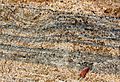
Heavy minerals (dark) in a quartz beach sand (Chennai, India).
-
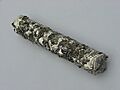
A bar of pure titanium metal.

See also
 In Spanish: Elementos del grupo 4 para niños
